
Notifications
Clear all

Topic starter
06/01/2026 10:18 am
This is our first winter with our Aira 12kW heat pump. It was commissioned the end of September 2025. The energy consumption and associated costs are terrifying us.
Our 1.5 storey home was previously heated by oil and our combined monthly energy costs, oil and electric, was circa £140 / month. In December 2025 we ran up a bill of over £300. January I reckon it’s going to be closer to £500.
We have the thermostat set to 19C. The other day the upstairs of our home, which we rarely use, was 21C whereas a downstairs room which we use in the evening was 15C! We had to use blankets to keep warm! Aira don’t have a zone system and treat the entire house as one room.
We are on a Good Energy Time Of Use tariff. I am becoming to realise that such a tariff is of little benefit to us unless we have a battery. The only benefit I see from such a tariff is for our own domestic devices, washing machine and dishwasher. It contributes very little to the running of our heat pump.
In fairness to Aira they are working with us on this. However we were told by both Aira and Home Energy Scotland (who carried out a very detailed survey) that we would save money. We don’t see it. I read people stating that the savings will kick in over spring and summer but I fail to see that. Our energy consumption will be exactly as it was when we had oil, so where are the great savings?
I am posting to this forum in the hope that more experienced ASHP users can offer us advice and/or recommendations on how we can better manage the ASHP and possibly reduce our energy bill.
Thank you for reading this very lengthy posting!
This topic was modified 2 months ago by Mars
1

06/01/2026 11:38 am
Firstly you need to recognise that December through February are very cold and so you will inevitably have MUCH higher bills in these months, probably about 3* a typical bill. With oil, and to an extent gas, you dont look at daily/monthly figures so you don't notice how expensive these are during the cold months. With an ASHP you are more likely to look at daily/monthly figures AND the effect is greater - its cold so your house needs more energy (roughly twice as much as the typical amount for the season) and its cold so the heat pump COP is lower. Together these mean that you can expect roughly three times the consumption on very cold days as that you will see on a typical day/the average for the season.
The key with heat pumps is to get the flow temperature as low as possible, by operating them 24x7 without thermostats switching them on and off (which can be achieved easily by turning the thermostat and any TRVs up to maximum), adjusting the weather compensation curve so the house is just warm enough, and if necessary balancing the radiators. This is generally both the cheapest and the most comfortable but takes a bit of setting up and a bit of a leap of faith as its the polar opposite of what we have been told (in part incorrectly) to do with boilers. If you want some 'instructions' for doing that then tell us a bit more about your house and system.
TOU tarifs can be beneficial with heat pumps if either
(a) you can arrange a 'set forward' (ie boost) during the cheap period. Only some heat pumps support this without resorting to thermostatic control, which is likely to
(b) your heat pump is well oversized and your house has a large thermal mass, particularly if it has UFH in a concrete slab. In this case you can treat the house like a storage heater, warming the slab when electricity is cheap.
In the absence of these its a balancing act and depends on the price ratio and # hours for the cheap rate- basically does the average work out less than a non ToU tarrif. Often it does, but not with all tarrifs.
If you would like to try optimising your set up (but bearing in mind that you may not want to conflict with Aira) please provide a bit more info about the heat pump (model/capacity) and house (estimated loss, construction and area) and any controls you have other than the heat pump control itself. Also what was your annual oil consumption/cost (which gives a sense check on the loss).
4kW peak of solar PV since 2011; EV and a 1930s house which has been partially renovated to improve its efficiency. 7kW Vaillant heat pump.
1
Topic starter
06/01/2026 12:14 pm
JamesPa,
Thank you for your very detailed and considered response.
To answer your questions:
It is an Aira 12Kw heat pump. I don’t know the model. The house is a timber frame built in 2000 with cavity wall insulation. The area is 180 m2 and the estimated heat loss is 8.86kW. The original specification called for a 8kW pump but that was later upped to 12kW. No UFH. The pump is controlled by the app and thermostat. Those are the only controls. Annual oil consumption/cost circa 1300 litres/£900.
Aira has the functionality to have a cool-down period overnight. This is what I had and boosting the temperature during the cheap tariff period in early morning. However I was advised by Aira to disable the cool-down and keep a constant temperature 24 hours a day. Hence my scepticism about TOU tariffs.
Regarding optimising the set-up, I would check with Aira first.
Thanks again for any advice.
06/01/2026 12:26 pm
Assuming your house was heated previously your oil consumption indicates a loss of more like 4-7kW, so an 8kW unit would probably have been perfect assuming that an '8kW' unit actually does 8kW at your design temp. Given your house construction I would say 4-7kW is more likely anyway. I guess that the surveyed figure of 8.9kW (two dp is nonsense, even one is doubtful) probably was just over the capacity of the 8kW unit once the DHW load was taken into account. Unfortunately there are design cusps like this where the uncertainty in loss can affect the choice.
What are the weather compensation settings? Key to lowest cost operation is to get these as low as possible consistent with heating your house. Do you have TRVs, are they fully open or set well above the target temperature, or set to the target temperature. If they are set to your target temperature then they are probably fighting your heat pump which can result (paradoxically) in cold rooms. Unfortunately there is a tendency in the UK to design heating systems with too many bosses (as in control elements in charge). The correct number of bosses is exactly 1. Fortunately tweaks to the settings can deal with this.
If you can answer the questions in the paragraph above I can make some suggestions which you can line up against what Aira say.
4kW peak of solar PV since 2011; EV and a 1930s house which has been partially renovated to improve its efficiency. 7kW Vaillant heat pump.
1

06/01/2026 1:11 pm
We are on a Good Energy Time Of Use tariff. I am becoming to realise that such a tariff is of little benefit to us unless we have a battery. The only benefit I see from such a tariff is for our own domestic devices, washing machine and dishwasher. It contributes very little to the running of our heat pump.
Just on the tariff point, we find that Agile works for us. We have 19kWh batteries but they only run the house + Ecodan 14kW for around 5 hours on cold winter days so a cheap overnight tariff is not helpful. Agile is in the range 10 - 15 overnight, 15 - 20p during the day and 40 - 60p in the peak from 1600 - 1900.
We stayed on Agile throughout 2025, despite some very high rates in January /February when the rate hit 100p/kWh in the peak on a few days. However, looking at the year overall we have this monthly usage and costs:
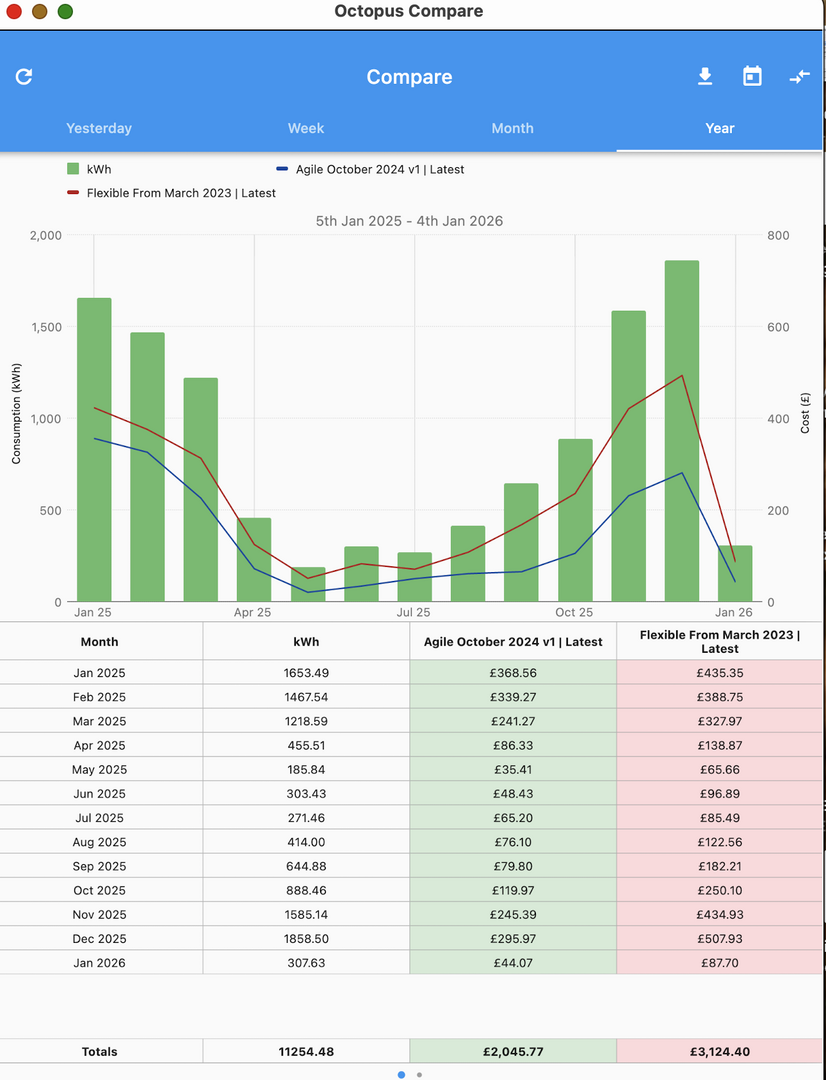
and you will see that the blue line (Agile) was always cheaper than the red line (Flexible tariff) - read these off the right axis.
This table summarises the average cost and savings:
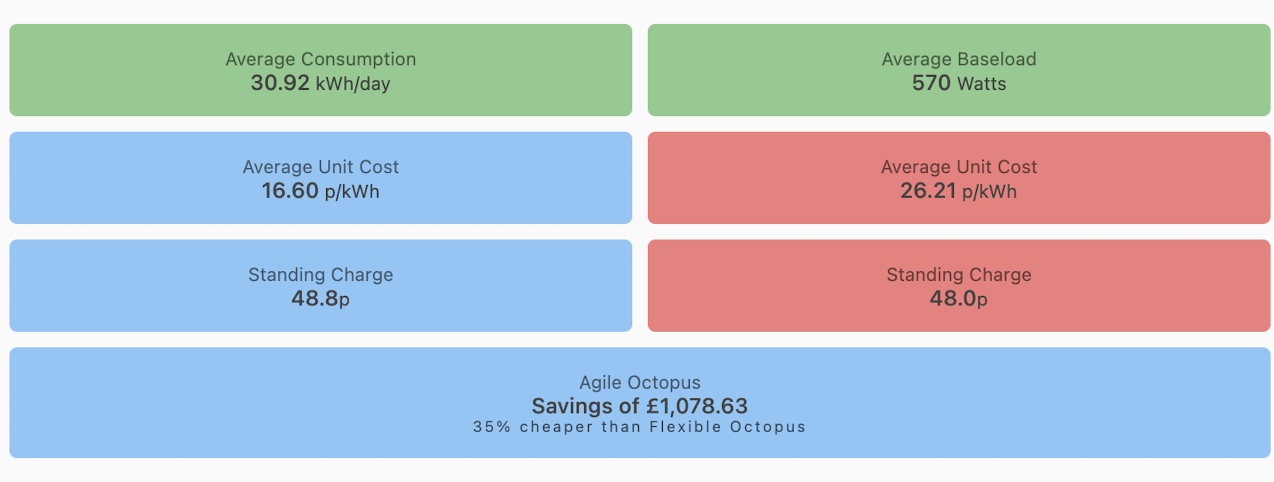
We have an EV so the usage includes about 5000 miles @ 3 miles/kWh = 1650kWh approx. (We do more mileage than that but also have solar so some car charging is effectively zero cost.
Agile works for us but without a battery you would need to be ready to turn off during the peak hours if the rates get too high. But this is usually only for 3 hours so if your property has a reasonable thermal mass or good insulation it may work for you.
Lots of historical Agile tariff data on this excellent web site:
https://energy-stats.uk/octopus-agile-tariff-pricing/
Mitsubishi Zubadan 14kW with Mixergy 210l DHW in 220m2 barn property. 24 solar panels = 9kWp with GivEnergy 5.0kW Hybrid inverter and 19kWh GivE batteries. Jaga Strada fan-assisted rads throughout. Landvac vacuum glazing/triple glazed windows.
Topic starter
06/01/2026 1:22 pm
As far as I am aware I don’t think Aira has explicit weather compensation settings. Certainly no settings that are user accessible. Instead Aira heat pump ‘learns’ from usage, comfort and efficiency and weather patterns. In saying that I am aware the Aira engineer has the ability to amend the heat curve.
On Aira’s advice I have set the comfort setting at Comfort plus which keeps the system locked into our set temperature (19) all the time. 24 hours a day.
All the TRV’s are set are their highest settings with the exception of our bedroom which is set mid-way at 3.
Topic starter
06/01/2026 1:29 pm
@downfield Thank you for your response and suggestions. The more I read on TOU tariffs I see the real benefits for those with batteries and/or EV’s. The Good Energy tariff is: 05:00 to 09:00 and 13:00 to 16:00 - 13.00 pence. The rest of the day it is 28.98 pence.
06/01/2026 1:37 pm
All the TRV’s are set are their highest settings with the exception of our bedroom which is set mid-way at 3.
Thats sensible then
As far as I am aware I don’t think Aira has explicit weather compensation settings. Certainly no settings that are user accessible. Instead Aira heat pump ‘learns’ from usage, comfort and efficiency and weather patterns. In saying that I am aware the Aira engineer has the ability to amend the heat curve.
Most heat pumps seem to limit adjustment of the WC settings to installer mode, although some do expose something to ordinary users. Until all heat pumps can self-optimise I personally think thats a mistake because, like it or not, few installers are going to spend the 2 weeks (elapsed) or so it takes properly to balance radiators and properly to set up the WC curve.
My house is about 7kW, possibly similar to yours. My December consumption was 650kWh and Jan to date 247kWh. Jan 2025 was 1022kWh. My total 2025 consumption was 4700kWh, so Jan 2025 represented over one fifth of the total! Im in the South so its warmer. You gave cost but not consumption and of course I dont know what tarrif you are on, you might want to compare the consumption figures .
4kW peak of solar PV since 2011; EV and a 1930s house which has been partially renovated to improve its efficiency. 7kW Vaillant heat pump.
Topic starter
06/01/2026 1:44 pm
@jamespa My December 2025 consumption was 1241kWh. So far for January, 337kWh.
06/01/2026 1:51 pm
@jamespa My December 2025 consumption was 1241kWh. So far for January, 337kWh.
That seems high. Do you know what your WC settings are (even if you cant change them and even roughly?)
4kW peak of solar PV since 2011; EV and a 1930s house which has been partially renovated to improve its efficiency. 7kW Vaillant heat pump.
Topic starter
06/01/2026 1:53 pm
@jamespa Regrettably I have no idea. However I am due a call from Aira and will pose that question. As a matter of interest, what would you expect the figure to be?


06/01/2026 1:57 pm
As far as I am aware I don’t think Aira has explicit weather compensation settings.
I was supposed to write/comment about this last year, because I was in touch with all major manufacturers towards the end of last year regarding weather compensation controls and how to tweak settings. Aira got back to me and said, "Aira heat pumps don’t have a controller, it’s all app controlled and optimised by ML and AI." I followed up, but never heard back from them, on whether weather compensation tweaks existed at all because it didn't sound like it did, which is a bit crazy to me, leaving everything to AI and ML.
Any other Aira users here that can confirm this?
Get a copy of The Ultimate Guide to Heat Pumps
Subscribe and follow our YouTube channel!
Page 1 / 3
Next

Latest Posts
-

RE: Daikin Altherma 3 LT compressor longevity question
This mess is intriguing: I wonder if this represent...
By bobflux , 20 minutes ago
-
RE: Say hello and introduce yourself
Hi. I'm Mike. Thank you for letting me join. My partn...
By Fretless6 , 2 hours ago
-
RE: Connecting Growatt SPH5000 over wired ethernet rather than wireless
The simplest wired option is usually the Growatt Ethern...
By Jonatan , 5 hours ago
-
RE: Peak Energy Products V therm 16kW unit heat pump not reaching flow temperature
ASHPs do have a minimum compressor speed. The minimum h...
By bobflux , 11 hours ago
-

RE: Electricity price predictions
@jamespa And it seems some of the nasty public cloud...
By Batpred , 12 hours ago
-
RE: Tell us about your Solar (PV) setup
Location: near Lyon, France 12kWp on the roof, 2x Sol...
By bobflux , 12 hours ago
-

RE: Jokes and fun posts about heat pumps and renewables
Technology is rapidly advancing. BBC News reported th...
By Transparent , 15 hours ago
-
What matters for flow and pressure drop is internal dia...
By bobflux , 16 hours ago
-

RE: Do Fridges and Freezers have COP ratings?
@editor Thank you all for your replies and submitted in...
By Toodles , 18 hours ago
-
I know and yes. The secondary deltaT wont necessaril...
By JamesPa , 22 hours ago
-
RE: Designing heating system with air to water heat pump in France, near Lyon
Just love the way you put it! 🤣
By Batpred , 2 days ago
-
RE: Safety update; RCBOs supplying inverters or storage batteries
Thank you for sharing. So it seems that your Schneid...
By Batpred , 2 days ago
-

RE: Forum updates, announcements & issues
@upnorthandpersonal thanks for the thoughtful, consider...
By Mars , 2 days ago
-
RE: Solar Power Output – Let’s Compare Generation Figures
@mk4 All 21 panels have their own Enphase IQ7a microinv...
By Toodles , 2 days ago
-
RE: Setback savings - fact or fiction?
Great, so you have proven that MELCloud is consistently...
By RobS , 3 days ago
-
RE: Mitsu PUHZ120Y 'Outdoor Temp 'error?
Thanks David & James It almos...
By DavidAlgarve , 3 days ago
-
RE: Surge protection devices SPDs
@trebor12345 - your original Topic about the right type...
By Transparent , 3 days ago
-
RE: Help needed with Samsung AE120RXYDEG
@tomf I’ve been sent this from a service engineer at Sa...
By Mars , 3 days ago
-
RE: Buying large amp bidirectional RCD and RCBO
Yes... I went through this particular headache and ende...
By bobflux , 4 days ago
-
O-oh! Let's take this as an opportunity to 'pass the ...
By Transparent , 4 days ago
-
RE: Homely setup on daikin heat pump
@craigh I refer to our somewhat elevated temperature of...
By Toodles , 4 days ago
-
RE: Air source heat pump roll call – what heat pump brand and model do you have?
My turn, this describes the future installation, only t...
By bobflux , 4 days ago