

Notifications
Clear all
Joining the Renewable Heating Hub forums is completely free and only takes a minute. By registering you’ll be able to ask questions, join discussions, follow topics you’re interested in, bookmark useful threads and receive notifications when someone replies. Non-registered members also do not have access to our AI features. When choosing your username, please note that it cannot be changed later, so we recommend avoiding brand or product names. Before registering, please take a moment to read the Forum Rules & Terms of Use so we can keep the community helpful, respectful and informative for everyone. Thanks for joining!

Topic starter
20/10/2025 8:32 pm
I ended up with a Solis S6-EH1P8K-L-PLUS (8 kW) hybrid inverter, and so thought it might be useful to share why.
A hybrid inverter is basically the brain that sits between your solar panels, batteries, and the grid, deciding—many times per second—where power should flow.
If you picture a normal solar inverter, it just takes DC power from your panels and turns it into AC for the house or export. A hybrid inverter does that and manages batteries: charging them when there’s surplus solar or cheap grid energy, and discharging when prices rise or the sun’s gone.
Here’s what it quietly juggles in the background:
- ☀️ From solar → house / battery / grid
- 🔋 From battery → house / grid
- ⚡ From grid → house / battery (if allowed)
So it’s not just converting; it’s scheduling and balancing. That’s why you see models like the Solis S6-EH1P8K-L-PLUS called “hybrid” or “energy storage inverters.”
Needs and goals
For a typical 4–5 bed house with an EV in SW England, my goal was flexibility—avoiding double work later when the house grows and needs an extra EV point, a heat pump, or more storage (has anyone ever had an installer actually praise what was already there? Exactly.)
Disclosure: My engineering and general science background, IET membership etc means this was an option for us. Essentially tinkering within reason.
What mattered to me
- ⚡ Fast battery charge/discharge rates and strong export capability.
- 🧰 Manufacturer support we can actually reach—too many stories of pop-up installers disappearing.
- 🔌 Compatibility with a wide range of batteries and accessories for future expansion.
- 🔋 The cherry on the cake was being able to handle power cuts gracefully—some of these units can keep a home running for days if paired with enough storage.
So far, the Solis has been a solid, expandable bit of kit. We only had it installed after we had the consumer unit swapped with one with the latest safety features and plenty of capacity to grow.
One quirk worth flagging:
It quietly “cleans up” some of the electrical imperfections we get from the grid. In my patch, the DNO’s neutral feed isn’t what you’d call rock-steady. That means a conventional 30 mA RCD may not behave as you expect. This is usually needed if you’re planning to bury cables in the wall—many electricians prefer to use plastic ducting for this reason and speed of installation. Speak to your electrician for advice.
In practice, the inverter smooths out stray currents between neutral and earth.
Some folks in the forum call these “leaky” inverters—a non-technical nickname that sounds worse than it is. It doesn’t waste measurable energy or affect your bill; your meter is on the live conductor. The “leak” current is tiny, and the inverter is tidying up the messy bits of the supply than the idea of spilling juice.
All in all, it was a capable, forward-looking choice if you’re also after a system that can grow with your needs.
Notes
You can find more background and our journey so far here.
Please do not interpret it as a recommendation, there are plenty of other inverters that can do this. Just not many options that handle 8kw (a standard EV charger) and retail for around £1300.
This topic was modified 10 months ago by Mars
8kW Solis S6-EH1P8K-L-PLUS hybrid inverter; G99: 8kW export; 16kWh Seplos Fogstar battery; Ohme Home Pro EV charger; Vaillant Arotherm Pro 7kW; 100Amp head, HA lab on mini PC
Topic starter
23/10/2025 2:06 pm
Via the cloud and via the online, similar data is shown. So far, just doing its job.
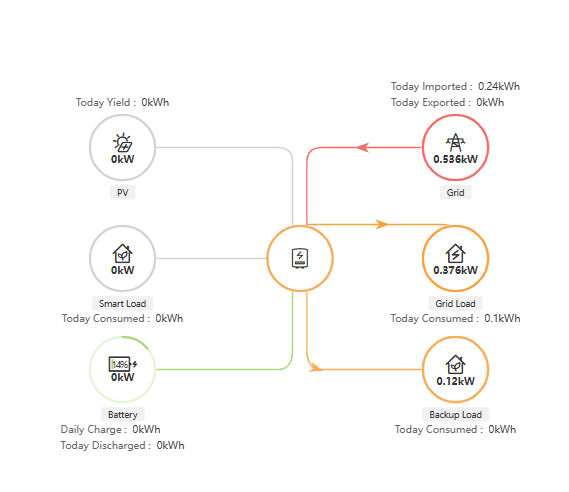
And if you can live with plastic surface ducting, your electrician will thank you for it.
8kW Solis S6-EH1P8K-L-PLUS hybrid inverter; G99: 8kW export; 16kWh Seplos Fogstar battery; Ohme Home Pro EV charger; Vaillant Arotherm Pro 7kW; 100Amp head, HA lab on mini PC
Topic starter
12/11/2025 8:08 pm
Some of the circuits in my home are not protected by RCD (which is fairly common, the earth wire was often not even run for ceiling/lighting circuits).
I am exploring this topic and whether it contributed to the fact a conventional 30 mA RCD was not behaving as we expected.
8kW Solis S6-EH1P8K-L-PLUS hybrid inverter; G99: 8kW export; 16kWh Seplos Fogstar battery; Ohme Home Pro EV charger; Vaillant Arotherm Pro 7kW; 100Amp head, HA lab on mini PC
Topic starter
17/11/2025 5:21 pm
@swwils suggested me to stick to givEnergy.
@dcsh, @downfield and @DREI seem to have givEnergy inverters, so they may be able to assist.
I was curious to see how it compares to the Solis..
So the GivEnergy 1PH Hybrid Inverter 8.0kW HV 3rd Generation is retailing for around £1300 (+VAT?) and features:
-
Rated AC Power: 8,000 W
-
Max AC Power (5 Minutes): 8,000 W
-
Surge AC Power (1 Second): 12,000 W
- Nominal AC Output Power: 10,000W
-
Max DC Input Power: 12,000 W
-
Max Input Voltage: 600 V
-
MPPT Voltage Range: 90 – 550 V
-
Max DC Current: 2*25 A
-
DC Inputs: 4
-
MPPT Trackers: 2
-
Euro Efficiency: 97%
-
Integrated DC Switch: No
- Battery Max. Charge / Discharge Power 8000W / 85000W
- BACKUP TERMINAL PARAMETER (AC)
- Nominal Voltage 230VAC
- Nominal AC Output Power 8000W
- Max. Output Current 37A
Based on this, I can see my 8.0kW hybrid Solis also includes:
- wifi, bluetooth and GPRS connectivity (GivEnergy mentions wifi and LAN)
- a port for UPS "backup loads" rated 36.4Amps with 4ms changeover (givEnergy is 10ms, enough to cause some devices to power cycle)
- a smart port, able to take AC loads from other inverters or a generator
- works with low voltage battery up to 190Amps (similar power)
- only AC power rated 8,000W
- only max 32 DC current
- EU efficiency 96.1%
- it has an integrated DC switch
- Solis AI to drive the battery usage based on agile import and export tariff rates (that we are currently evaluating)
The main differences seem to be that the Solis inverter can:
- use the cheaper "48V" batteries
- has true UPS functionality
- has an additional port for AC solar input or a generator
- potentially useful AI functionality that allows it to optimise import and export using agile tariffs
@transparent , does this seem a fair comparison? Or did I miss much?
8kW Solis S6-EH1P8K-L-PLUS hybrid inverter; G99: 8kW export; 16kWh Seplos Fogstar battery; Ohme Home Pro EV charger; Vaillant Arotherm Pro 7kW; 100Amp head, HA lab on mini PC


17/11/2025 6:12 pm
I have a gen 1 5kw Givenergy hybrid inverter and two gen 1 5.2kWh batteries with the emergency output to a the distribution board for the lights and a few sockets via a manual switch.
The Givenergy portfolio has come on a lot in the 5 years I’ve had my kit, so my experience won’t be up to date in terms of spec and performance. What hasn’t changed is that Givenergy is a locked environment, where only qualified installers can configure the kit including adding additional batteries, which seems to be a constant bug bearer on the Givenergy forum.
However home assistant can be used with Givenergy via a local API, giving flexibility for automation beyond that included in the portal or app.
Topic starter
18/11/2025 2:08 pm
What hasn’t changed is that Givenergy is a locked environment, where only qualified installers can configure the kit including adding additional batteries, which seems to be a constant bug bearer on the Givenergy forum.
Locked environments are difficult to manage, it also means features may not vbe made accessible since it depends on the installer being familiar with it.
I can access many menus on the Solis including the professional ones. I can do everything except things like firmware updates. For those, I raise a ticket and Solis Engineers run it.
However home assistant can be used with Givenergy via a local API, giving flexibility for automation beyond that included in the portal or app.
On my HA, I configured the Solax integration via modbus (so I assume this is local) and also two Solis ones, the first for extensive monitoring and the second to control the inverter. But I have not had time to get them working.
At the moment, I am giving Solis AI EMS a chance. The challenges to find the right configuration for the Fogstar Seplos battery slowed me down...
Anyway, the AI charges the battery during cheap agile periods and then powers the house in an off-grid mode. It is still learning despite all the config changes.
8kW Solis S6-EH1P8K-L-PLUS hybrid inverter; G99: 8kW export; 16kWh Seplos Fogstar battery; Ohme Home Pro EV charger; Vaillant Arotherm Pro 7kW; 100Amp head, HA lab on mini PC
Topic starter
23/11/2025 7:22 pm
Quick update, Solis AI looks like work in progress. Had a few issues with it that HQ are looking into. The promise is worth the pain I think..
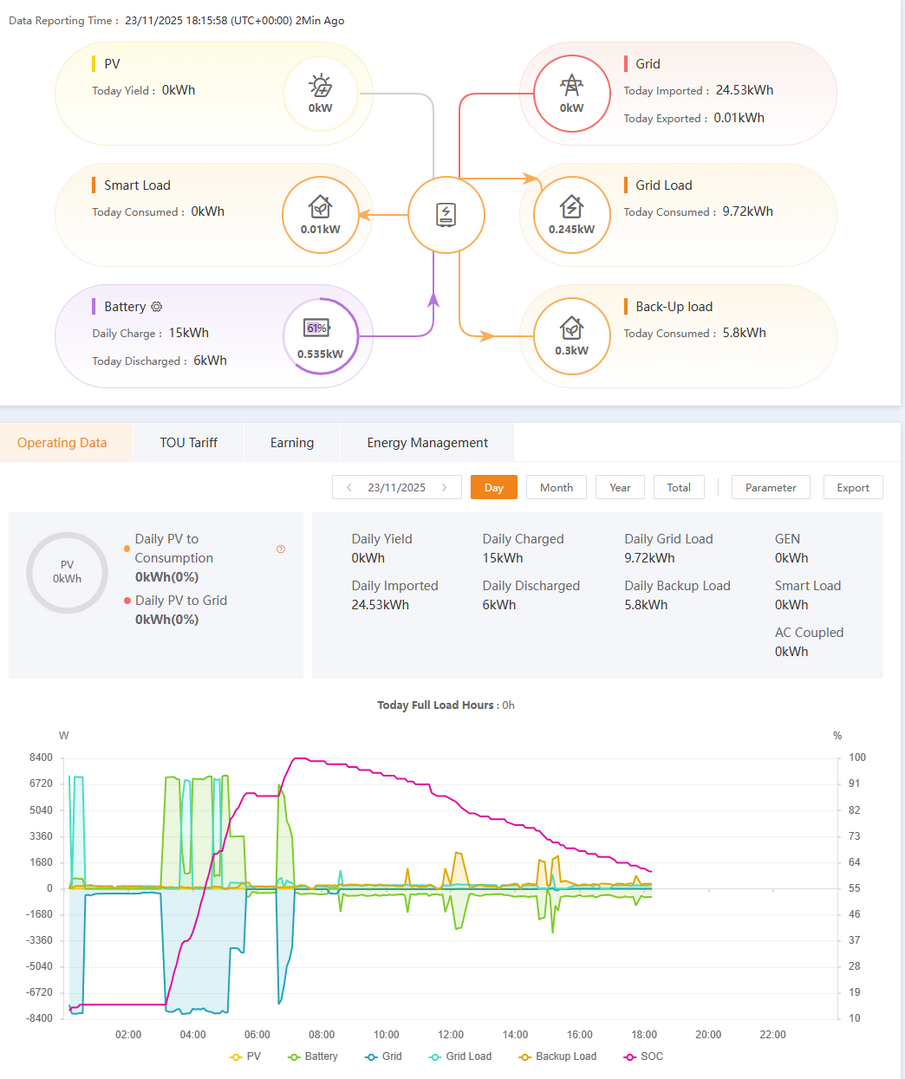
It also seems the smart port that is commonly used for AC solar input or a generator is also doubling as a second "lower priority backup" port. I do not want to assume it doubles the UPS capacity, but it does look like that.
Below is a chart showing the inverter charging the battery and then slowing down when the EV charger kicks in. With 100A there would be no reason to have to choose between the two as below 64A, it seems the Solis Engineers limited it like usual for Spain or Portugal...
8kW Solis S6-EH1P8K-L-PLUS hybrid inverter; G99: 8kW export; 16kWh Seplos Fogstar battery; Ohme Home Pro EV charger; Vaillant Arotherm Pro 7kW; 100Amp head, HA lab on mini PC

24/11/2025 6:15 pm
I'd be interested to know if you have found a way of real time data as Solis Cloud only updates every 5 minutes.
Topic starter
25/11/2025 12:50 am
I'd be interested to know if you have found a way of real time data as Solis Cloud only updates every 5 minutes.
If you mean with Home Assistant, I have got a Solis modbus integration working. I did not check the frequency, what data are you after?
8kW Solis S6-EH1P8K-L-PLUS hybrid inverter; G99: 8kW export; 16kWh Seplos Fogstar battery; Ohme Home Pro EV charger; Vaillant Arotherm Pro 7kW; 100Amp head, HA lab on mini PC
Topic starter
26/11/2025 8:53 am
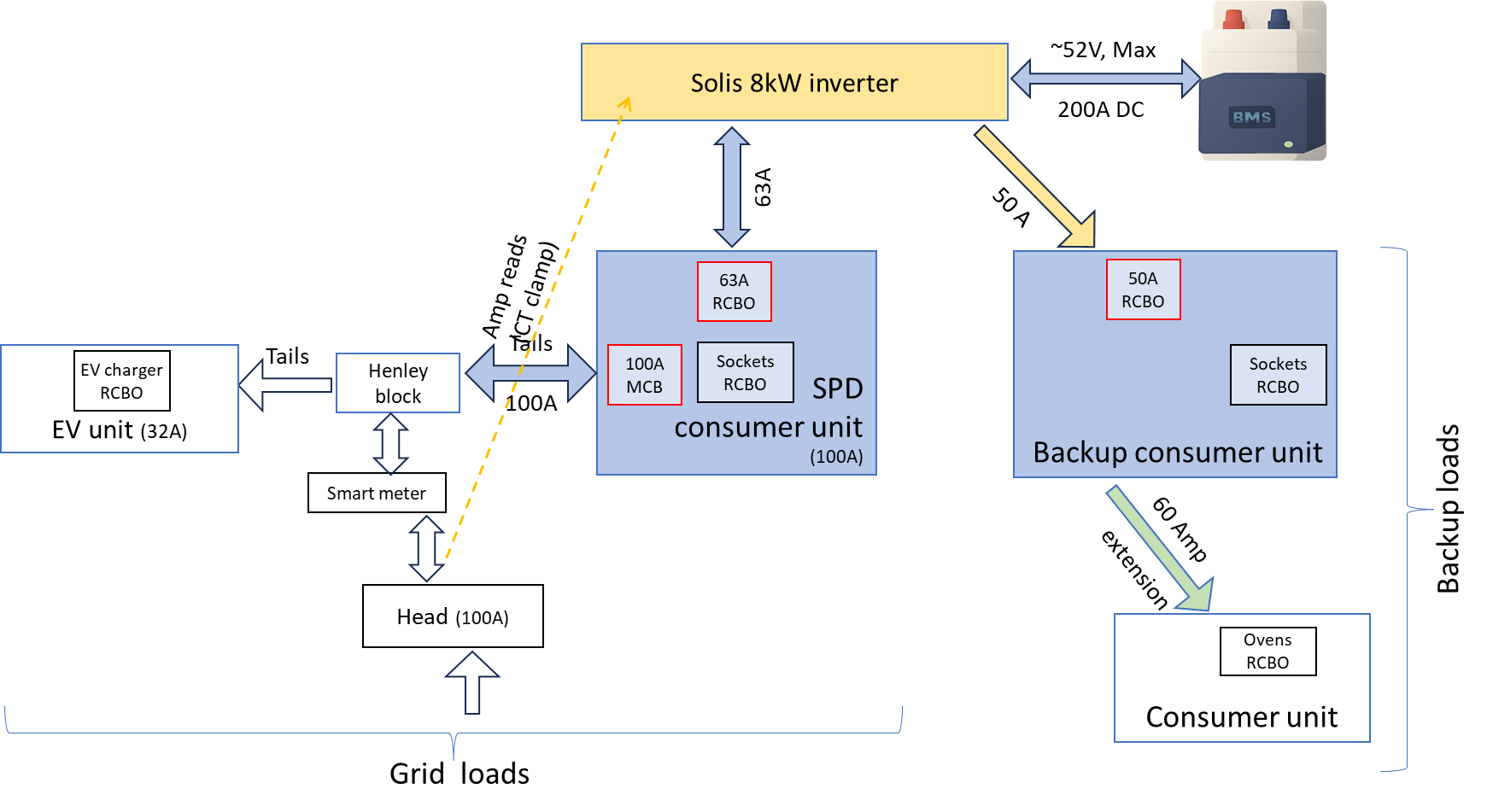
This is a simplified view of how we currently use the Solis inverter:
8kW Solis S6-EH1P8K-L-PLUS hybrid inverter; G99: 8kW export; 16kWh Seplos Fogstar battery; Ohme Home Pro EV charger; Vaillant Arotherm Pro 7kW; 100Amp head, HA lab on mini PC
26/11/2025 2:32 pm
Topic starter
26/11/2025 2:43 pm
Ah, what do you need it fo
8kW Solis S6-EH1P8K-L-PLUS hybrid inverter; G99: 8kW export; 16kWh Seplos Fogstar battery; Ohme Home Pro EV charger; Vaillant Arotherm Pro 7kW; 100Amp head, HA lab on mini PC

Page 1 / 13
Next

SPONSORS

Degrees of Separation
Latest Posts
-

RE: The Changing Jet Stream Could Challenge UK Air Source Heat Pumps
@susannasaunders I'll set this up and start monito...
By Rob of York , 18 minutes ago
-
Tradespeople on Their Phones: What’s Acceptable When They’re Working in Your Home?
I’m interested in where other homeowners draw the line ...
By Mars , 28 minutes ago
-
RE: Electrical works for air to air heat pump
An electrician who signs off work is responsible for it...
By EtchedPixels , 6 hours ago
-
RE: Are there any comparisons of DHW heat stores around?
@sarahemmm I have done things the opposite way round I ...
By Toodles , 6 hours ago
-
RE: 15kw pump for 225m2 1990's house - over kill?
@seaviews I have read you latest response re buffer ...
By JamesPa , 1 day ago
-
RE: How will removing the standing charge on gas bills benefit heat pumps?
The BUS grant funding for 2026/27 will run out at the c...
By Rob of York , 1 day ago
-
-
@editor Ouch, sorry to re start the tick. I had assume...
By DavidB , 3 days ago
-
RE: Say hello and introduce yourself
@e-a-west as the good Major said, welcome to the forums...
By Mars , 3 days ago
-
RE: How much of your renewable and home setup would still work if the internet went down?
Yes I actually have a copy of a tool that whenever a ce...
By EtchedPixels , 4 days ago
-
RE: Indevolt Batteries UK Support & Info Thread
@editor Hi, To resolve this, please tap on the A...
By Indevolt Tech , 4 days ago
-
RE: Double or Triple Glazed Windows?
Posted by: @singlespeed With 9 years repairing windo...
By Rob of York , 4 days ago
-
@transparent we’re still running a secure version of PH...
By Mars , 5 days ago
-
RE: How quickly would you want/expect heat recovery to take from setback?
Much longer than that here. The heating isn't even on. ...
By bobflux , 5 days ago







SPONSORS
