

Notifications
Clear all
Joining the Renewable Heating Hub forums is completely free and only takes a minute. By registering you’ll be able to ask questions, join discussions, follow topics you’re interested in, bookmark useful threads and receive notifications when someone replies. Non-registered members also do not have access to our AI features. When choosing your username, please note that it cannot be changed later, so we recommend avoiding brand or product names. Before registering, please take a moment to read the Forum Rules & Terms of Use so we can keep the community helpful, respectful and informative for everyone. Thanks for joining!

08/12/2025 1:12 pm
I have just received a link to this Report on Health and Safety aspects of Commercial BESS (1MW and above).
I've read only the first 10% thus far, but it contains information which would be useful for this discussion.
The report is by Frazer Nash Consultants on behalf of DESNZ, and has a direct email to one of the authors at the start.
That's a refreshing change to the usual unattributed government reports!
Note that many aspects of Health and Safety are not 'material issues' for planning purposes.
For example a threat to people and wildlife from contamination outside of a BESS site would be considered 'material' due to environmental legislation.
However, a potential risk to staff who are tasked with maintenance of BESS equipment is not a planning issue.
Yes, I know it should be... and I would still raise it in a submission opposing a planning application.
But the legal advisor to the Planning Committee would intervene to point out that it can't be a reason for which consent should be withheld.
Planning legislation for energy-based sites is not competent, and needs Parliament to seek amendments.
Save energy... recycle electrons!

08/12/2025 2:17 pm
I have just received a link to this Report on Health and Safety aspects of Commercial BESS (1MW and above).
This is a pearl! The list of bibliographic references may be very useful as well.
8kW Solis S6-EH1P8K-L-PLUS hybrid inverter; G99: 8kW export; 16kWh Seplos Fogstar battery; Ohme Home Pro EV charger; Vaillant Arotherm Pro 7kW; 100Amp head, HA lab on mini PC

08/12/2025 3:37 pm
Note that many aspects of Health and Safety are not 'material issues' for planning purposes.
For example a threat to people and wildlife from contamination outside of a BESS site would be considered 'material' due to environmental legislation.
However, a potential risk to staff who are tasked with maintenance of BESS equipment is not a planning issue.Yes, I know it should be... and I would still raise it in a submission opposing a planning application.
Sorry but I disagree completely.
Planning law is about the effect of a development on the population in general, the environment, or neighbours. It is not about workplace safety or any other matter essentially private to the applicant, and nor should it be.
Laws are compartmentalised for good reason. In the case of planning law there are already many, many complaints that 'nothing happens in this country'. If you conflate it with workplace health and safety and other things, that gives even more ways people can try to stop anything happening for reasons which, lets face it, have nothing to do with the reason they state.
So IMHO its entirely correct that a threat to people and wildlife from contamination outside of a BESS site is 'material' due to environmental legislation but a potential risk to staff who are tasked with maintenance is not.
This post was modified 10 months ago by JamesPa
4kW peak of solar PV since 2011; EV and a 1930s house which has been partially renovated to improve its efficiency. 7kW Vaillant heat pump.
1

08/12/2025 3:49 pm
@jamespa Indeed! As an ex-H&S co-ordinator, I would agree that the staff tasked with the duties of keeping any such equipment and the site ‘safe’ whilst ensuring that said staff and any ‘outsiders’ were not endangered whilst carrying out such duties or being present in the area is indeed a H&S matter entirely. (Steps down from his soap and in doing, so slips and trips over his own tongue.) 😉 Toodles.
Toodles, heats his home with cold draughts and cooks food with magnets.

08/12/2025 3:52 pm
There are some strange attitudes and requirements in H&S; whereas I was responsible for ensuring the safety of all staff working in or at the various premises over which I had jurisdiction, the students were not so ‘covered’ - I just owed them a ‘duty of care’. Toodles.
Toodles, heats his home with cold draughts and cooks food with magnets.
08/12/2025 4:35 pm
There are some strange attitudes and requirements in H&S; whereas I was responsible for ensuring the safety of all staff working in or at the various premises over which I had jurisdiction, the students were not so ‘covered’ - I just owed them a ‘duty of care’. Toodles.
Interesting indeed!
4kW peak of solar PV since 2011; EV and a 1930s house which has been partially renovated to improve its efficiency. 7kW Vaillant heat pump.
13/12/2025 7:44 am
It does make one wonder why there is so much hand wringing and bed wetting in the regulatory, emergency service and insurance sectors about all lithium batteries. They need to sharpen up their act and focus on the real risks from particular types of lithium batteries, rather than on imaginary risks across the board.
All players would normally be expected to be transparent about why they are generally considering lithium batteries risky.
But clearly these batteries came into the market without much safety related research being carried out. Alternatives using raw materials that are not as tightly concentrated (in terms of supply chain in a single country) are rightly exploiting this lack of peer reviewed research to carve space in what is still a fast growing market.
From what I saw, sodium batteries are more stable, easier to recycle, etc. They seem to operate in a wider voltage range, so the inverters would need some adjustment. And I think this would make it difficult to mix use of lithium and sodium batteries and allow them to be managed by a single inverter? Anyway, this would be something to discuss in a thread about sodium batteries.
8kW Solis S6-EH1P8K-L-PLUS hybrid inverter; G99: 8kW export; 16kWh Seplos Fogstar battery; Ohme Home Pro EV charger; Vaillant Arotherm Pro 7kW; 100Amp head, HA lab on mini PC

Topic starter
13/12/2025 12:59 pm
@batpred — your latest post here has more than a bit of a whiff of AI about it, be that as it may, we might hope that regulators might be transparent, even if they often aren't, but the insurance industry? They are gaming us for a profit! Plus the principle of autonomy means that a business is free to do as it pleases within the law, and is not obliged to give a single word of explanation.
But clearly these batteries came into the market without much safety related research being carried out.
This simply isn't true. Lithium ion batteries in general and LiFePO4 batteries in particular have be subject to very severe stress testing, and for the latter, no one, so far as I know, has ever got one to spontaneously ignite or explode. They have even been seen to survive, albeit badly scorched, at the epicentre of a fire/explosion.
Edited to correct some typos
This post was modified 10 months ago 2 times by cathodeRay
Midea 14kW (for now...) ASHP heating both building and DHW

13/12/2025 2:36 pm
From what I saw, sodium batteries are more stable, easier to recycle, etc. They seem to operate in a wider voltage range, so the inverters would need some adjustment.
That's somewhat of an understatement. 🤨
The following table compares a 16-cell battery which must deliver 5kW to a load using the two cell chemistries you've chosen:

The much wider voltage range of the Na-ion chemistry means that it must handle greater current at the lower-end of its capacity.
The additional copper required for the inter-cell busbars and the cable to connect to a load or inverter quickly wipes out any possible cost savings.
I think this would make it difficult to mix use of lithium and sodium batteries and allow them to be managed by a single inverter?
You wouldn't even attempt to mix different Li-ion cell chemistries on the same inverter.
Inverters and BMS units can only operate correctly and safely if they are handling one type of cell.
Have you yet looked into the specifications for a notional 5kW inverter which is designed for Sodium-ion cells?
If so, please post the URL here.
This post was modified 10 months ago 2 times by Transparent
Save energy... recycle electrons!
14/12/2025 12:44 am
@batpred — your latest post here has more than a bit of a whiff of AI about it, be that as it may, we might hope that regulators might be transparent, even if they often aren't, but the insurance industry?
It is not AI, it was my own thinking! I was just describing a possible explanation.
The fact that there is recent research about safety of lfp batteries (when, as far as I know, there have not been significant changes in them) made me think this was a gap.
But clearly these batteries came into the market without much safety related research being carried out.
This simply isn't true. Lithium ion batteries in general and LiFePO4 batteries in particular have be subject to very severe stress testing, and for the latter, no one, so far as I know, has ever got one to spontaneously ignite or explode.
Ok, I should have said "without sufficient safety related research being published" ...
I assume that the research published before missed key safety tests including the ones covered in the recent paper?
Additionally, very shorty after I wrote my post, I saw what seemed better safety related research on sodium batteries...
The hypothesis is them that china's dominance in lithium processing and batteries would naturally lead to statements creating conditions for sodium alternatives to be pursued...
8kW Solis S6-EH1P8K-L-PLUS hybrid inverter; G99: 8kW export; 16kWh Seplos Fogstar battery; Ohme Home Pro EV charger; Vaillant Arotherm Pro 7kW; 100Amp head, HA lab on mini PC
14/12/2025 1:25 am
From what I saw, sodium batteries are more stable, easier to recycle, etc. They seem to operate in a wider voltage range, so the inverters would need some adjustment.
That's somewhat of an understatement. 🤨
..
Have you yet looked into the specifications for a notional 5kW inverter which is designed for Sodium-ion cells?
If so, please post the URL here.
Yes, more than an adjustment...
This is the only combined inverter+ battery that I found (from Eleven) , but the specs look very high level:
https://drive.google.com/file/d/1pG90wpIrX0OzYN4iSgJrZViJMG958heh/view?usp=drivesdk
8kW Solis S6-EH1P8K-L-PLUS hybrid inverter; G99: 8kW export; 16kWh Seplos Fogstar battery; Ohme Home Pro EV charger; Vaillant Arotherm Pro 7kW; 100Amp head, HA lab on mini PC
14/12/2025 2:53 pm
I too had spotted the Na-ion battery and matching inverters from Eleven in Cambridge.
it's good to see a British company designing something for the obvious gap in the market.
Note that their inverters can only be used with their own Na-ion battery.
It's not a generic approach. They need to be transferring data between their own BMS and the inverter across the CAN-bus to make the system work.
You must use their own supplied cables for the battery connection,
And the Emergency Power Supply socket is intended to switched manually to feed the home during an outage:
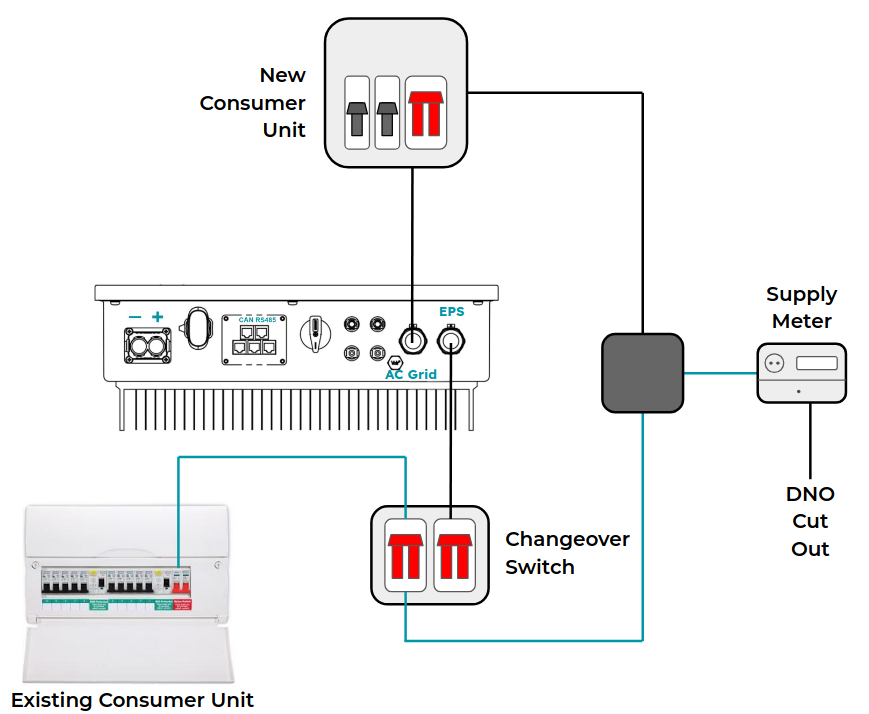
Their North Sea range is fairly new, and I expect they'll add more features in later models.
Save energy... recycle electrons!

SPONSORS
Degrees of Separation

Latest Posts
-

RE: Heat pump branding. Clever, contemporary… or a bit too much?
I think Heat Geek have done an amazing job on their bra...
By Tomtheheatingengineer , 7 hours ago
-
RE: HeatGeek vs Octopus surveys: puzzling disparity - any ideas why?
I have just had 3 heat loss surveys, one by heat geek o...
By David , 7 hours ago
-
RE: Heat Geek Zero Disrupt: Are We Sleepwalking Into Another Race to the Bottom?
I think that's the key question. After all inverter uni...
By Prunus , 9 hours ago
-
RE: battery storage without solar
As of October 1st they need specific qualifications to ...
By EtchedPixels , 10 hours ago
-
RE: How should the Boiler Upgrade Scheme be reformed?
A unit which uses water to transfer the heat/chill from...
By Temperature_Gradient , 10 hours ago
-
RE: Renewables & Heat Pumps in the News
With regards to the BUS grant raid, I gave it more thou...
By ASHP-BOBBA , 10 hours ago
-
RE: Why are ASHP installs so expensive?
The whole system seems to work on the basis of...
By ian33a , 11 hours ago
-
RE: Missing flow temperature in Heat Geek proposal
Good plan. If you can get half hourly meter readings a...
By JamesPa , 16 hours ago
-
RE: Heat Pumps Without Grants: Would You Have Installed One & Will You Now?
@editor Most certainly. The heat pump was an ideal s...
By Abernyte , 16 hours ago
-
Although regulations may well vary from country to coun...
By Majordennisbloodnok , 17 hours ago
-
RE: Does anyone have experience of a smart water meter?
Yep I caught our slow leak from a £100 bill rise 8)
By EtchedPixels , 17 hours ago
-
RE: Do You Need a Buffer Tank or Low Loss Header for Underfloor Heating in a Large Property?
@jamespa in some cases, failing the Turing test might b...
By GrahamF , 20 hours ago
-
RE: Passiv Smart Thermostat - Help & Forum Support
@energystoragetech The heat capacity of some...
By JamesPa , 22 hours ago
-
RE: tepeo ZEB UK Support & Info Thread
Sorry you are correct, I was remembering figures from t...
By JamesPa , 1 day ago




SPONSORS