

Notifications
Clear all
Joining the Renewable Heating Hub forums is completely free and only takes a minute. By registering you’ll be able to ask questions, join discussions, follow topics you’re interested in, bookmark useful threads and receive notifications when someone replies. Non-registered members also do not have access to our AI features. When choosing your username, please note that it cannot be changed later, so we recommend avoiding brand or product names. Before registering, please take a moment to read the Forum Rules & Terms of Use so we can keep the community helpful, respectful and informative for everyone. Thanks for joining!

27/05/2026 8:03 am
One view of price breakdown but not today's announcement in case it hasn't been posted before
Interesting historical timeline of changes to electricity price cap to show what has driven the cap costs. Again not sure if this has been posted before. Some interesting narrative to go with the historical figures.
https://www.electricitybills.uk/
A shame NESTA haven't updated their figures for some time as a comparison.
This post was modified 5 months ago 3 times by Jeff

27/05/2026 8:39 am
I remember it was only a couple of months ago that someone on the forum was adamant that the latest genius Milliband energy policy was going to drive down unit cost. That taxing energy suppliers more would somehow bring the supply price down. That lasted all of one quarter then, shouldn’t be gloating for stating the bleeding obvious, as everyone suffers.
Talking of being adamant, I recently rediscovered some early Ants, I’d completely forgotten just how good their pre 80s work was, before it soured.


27/05/2026 8:48 am
As expected, energy prices are going up.
https://renewableheatinghub.co.uk/energy-bills-to-rise-again-as-ofgem-confirms-price-cap-increase/
🔥 Britain’s Heat Pump Shitshow
How Installing a Heating System Became a National Nervous Breakdown
Free UK shipping.
📗 Heat Pumps Explained
A Jargon-Free Guide for Homeowners
Rewritten and updated for 2027
📘 From Zero to Heat Pump Hero
🛠️ Bodge Buster
New to heat pumps?
Take the Heat Pump Fundamentals course and use INTRO50 at checkout for 50% off.

27/05/2026 9:15 am
As a reminder you can see the wholesale gas price here to get a heads up on the next cap along with the likes of Cornwall Insight estimates.
https://tradingeconomics.com/commodity/uk-natural-gas
If the gas price falls in the next months, expect the ratio between gas and electricity unit rates to widen at the next cap, obviously unless the government make more changes.
This post was modified 5 months ago by Mars
1

27/05/2026 9:58 am
I remember it was only a couple of months ago that someone on the forum was adamant that the latest genius Milliband energy policy was going to drive down unit cost.
Source references are important on this Forum.
This links to a UK Government video announcement by the Secretary of State for ESNZ in May'26. At 59secs he explains that HMG policy is to expand the installation of renewable generation. That will de-link household energy bills from the high-priced and volatile international markets for oil and gas.
Readers here may agree with those comments or not. And I'm confident that you're about to tell us!
However, let's ensure that our observations are based on the message the Minister intends for the public to hear, rather than when he gets backed into a corner by a high-pressure interviewer.
3rd-party commentators and highly-edited news clips aren't sufficiently authoritative for the more detailed discussions we hope to be hosting here.
Save energy... recycle electrons!
3
27/05/2026 12:01 pm
I remember it was only a couple of months ago that someone on the forum was adamant that the latest genius Milliband energy policy was going to drive down unit cost.
Source references are important on this Forum.
This links to a UK Government video announcement by the Secretary of State for ESNZ in May'26. At 59secs he explains that HMG policy is to expand the installation of renewable generation. That will de-link household energy bills from the high-priced and volatile international markets for oil and gas.
Readers here may agree with those comments or not. And I'm confident that you're about to tell us!
However, let's ensure that our observations are based on the message the Minister intends for the public to hear, rather than when he gets backed into a corner by a high-pressure interviewer.
3rd-party commentators and highly-edited news clips aren't sufficiently authoritative for the more detailed discussions we hope to be hosting here.
I do definitely think delinking electricity from gas will reduce the volatility on electricity bills due to wholesale gas price spikes. Also moving from gas boilers to heat pumps will reduce overall energy bill volatily.
What is less sure is the net impact on the average punters electric bill over time as lots of components of our electricity bill have baked in increases for network upgrades, nuclear, CfD, capacity market etc. I am not talking about the minority with home solar, batteries etc. I am not the only one saying this, retail energy suppliers have also mentioned this.
I feel the government are at risk of over promising through carefully worded statements. When you look at the breakdown of electricity bills there are lots of potential things that could increase even more than currently projected. We may yet see social tarrif introduced for the very poorest which would increase bills for others. Ditto for mechanisms to cancel historical energy bill debt.
https://www.electricitybills.uk/
It will be interesting to see how it all nets out in the coming years.
2
27/05/2026 12:56 pm
I do definitely think delinking electricity from gas will reduce the volatility on electricity bills due to wholesale gas price spikes. Also moving from gas boilers to heat pumps will reduce overall energy bill volatily.
What is less sure is the net impact on the average punters electric bill over time as lots of components of our electricity bill have baked in increases for network upgrades, nuclear, CfD, capacity market etc.
To de-link electricity bills from the cost of gas requires significant regulatory changes. The price per MWh is still being set by the final trade on the wholesale market, which occurs ten minutes before the next half-hour consumption period commences.
Simply adding more generation from renewable sources doesn't solve the problem.
I'm not yet hearing DESNZ putting effort into changing the wholesale market. And yes, I do realise that Elexon is a Europe-wide market.
NESO are strategically-placed to help the Secretary of State address this issue. It's they who actually manage the supply (generation) which is required to meet Britain's national demand. They also handle the 'settlement' which needs to be made after each HH Period ends.
But they too appear to putting most effort into reaching Net Zero, which is being interpreted as "more renewable generation".
To achieve Net Zero the present focus is on building a grid which has more than double the capacity of the present one. But that would require funding by adding significantly to consumer bills. It's the energy-sector's equivalent of PFI to build schools and hospitals.
I believe that's biased far too much in favour of the DNOs and the three Transmission operators. There are other solutions available to better utilise the grid capacity already available.
I'll be attending the first in-person NESO Workshop for the SW England Region at Taunton on 23rd June.
That Workshop will either be "presentation based" with invited speakers showing slides of how the grid 'needs to be changed and upgraded', or it could be a more open format which allows for innovation and an open sharing of ideas from all attendees. Which style gets used will tell us a lot about the part NESO wants to play in the future cost of electricity.
There are similar in-person workshops for the other RESP regions, but I'm having difficulty finding the links. For some reason they aren't listed as entries on the whole-NESO calendar of meetings and events.
Save energy... recycle electrons!
2

27/05/2026 2:04 pm
I revel in my oversimplification however, the policy changes were promised to deliver quarter on quarter reductions in domestic and industrial power cost to users
What has been the actual outcome: a large increase this quarter and a predicted similar large increase next quarter. The polar opposite.
If that was one of my key performance indicators for my role I’d think it fully justifiable to be looking for a new career. Perhaps Miliband can use the time constructively, improving his fake bacon sandwich appreciation technique.
2

27/05/2026 2:40 pm
I revel in my oversimplification however, the policy changes were promised to deliver quarter on quarter reductions in domestic and industrial power cost to users...
Firstly I apologise if your comments above were not meant to be taken seriously. If that is the case then please ignore what I am about to say.
Firstly I don't think quarter on quarter reductions were promised, it was a one off but permanent reduction (ie the same reduction carries on but does not grow).
Secondly, in case you have been living in a cave, an orange man launched a war that has stopped the flow of oil through a vital trade route and as a result global energy prices have shot up. The fact that the orange man would do something stupid was entirely predictable, that it would be so stupid and affect oil and gas prices to the extent it has, was not. You can't blame our government, whatever the colour, for world events that are outside it's control and which could not possibly have been predicted.
Had the March adjustment not been made our prices would be higher still, by the amount equal to the effect of the policy change.
This post was modified 5 months ago 7 times by JamesPa
4kW peak of solar PV since 2011; EV and a 1930s house which has been partially renovated to improve its efficiency. 7kW Vaillant heat pump.
2
27/05/2026 2:57 pm
Let me emphasise another change which Ofgem is using in its Price Cap calculations for the first time.
The Typical Domestic Consumption Value is being reduced.
That's happened before, and is due to statistical analysis showing that households are using less electricity and gas due to energy saving measures.
We've installed better insulation, and we buy appliances which consume less power.
It's interesting to note that average household demand continues to fall in spite of increasing installations of EV-chargers and Heat Pumps. And yet National Grid Transmission and NG-ESO were telling us for more than a decade that grid capacity must increase sharply to allow the uptake of precisely these technologies.
Ofgem themselves have been using this very argument as recently as last month (May26) in order to justify its use in assessing the DNO's financial forecasts for the RIIO-ED3 period 2028-33.
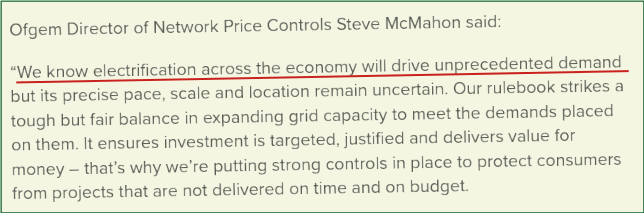
The main drivers to underpin arguments for such a significant increase in grid capacity are:
- a sudden rise in the number of planning applications for Data Centres (main in SE England)
- a mismatch between the availability of grid capacity and the times at which off-peak tariffs are available
- DNOs and Transmission companies are privately owned, and would like to gain income from recruiting thousands of engineers to perform re-cabling
Ofgem stands little chance of striking the right balance whilst its own managers are conflicted on what grid capacity is going to be needed.
This post was modified 5 months ago 2 times by Transparent
Save energy... recycle electrons!

27/05/2026 4:59 pm
The spark gap seems to have narrowed this time from 4.3 to 3.6. While electricity prices are going up by nearly 5%, gas prices are going up by 27%. I thought they were still exploring various options to decouple electricity from gas prices. What changes have they made to make such a big impact. Surely, I am missing something. Not that I am complaining, as heat pumps are now more attractive from a running cost perspective.
If the gas price falls in the next months, expect the ratio between gas and electricity unit rates to widen at the next cap, obviously unless the government make more changes
16 * 435 watts PV
13 kWh Growatt battery
1 EV - Mercedes EQB
6 kW Aira Heat Pump
Bosch Induction Hob
Pod Point Solo 3 charger

SPONSORS
Degrees of Separation

Latest Posts
-

RE: Heat pump branding. Clever, contemporary… or a bit too much?
I think Heat Geek have done an amazing job on their bra...
By Tomtheheatingengineer , 6 hours ago
-
RE: HeatGeek vs Octopus surveys: puzzling disparity - any ideas why?
I have just had 3 heat loss surveys, one by heat geek o...
By David , 6 hours ago
-
RE: Heat Geek Zero Disrupt: Are We Sleepwalking Into Another Race to the Bottom?
I think that's the key question. After all inverter uni...
By Prunus , 8 hours ago
-
RE: battery storage without solar
As of October 1st they need specific qualifications to ...
By EtchedPixels , 8 hours ago
-
RE: How should the Boiler Upgrade Scheme be reformed?
A unit which uses water to transfer the heat/chill from...
By Temperature_Gradient , 9 hours ago
-
RE: Renewables & Heat Pumps in the News
With regards to the BUS grant raid, I gave it more thou...
By ASHP-BOBBA , 9 hours ago
-
RE: Why are ASHP installs so expensive?
The whole system seems to work on the basis of...
By ian33a , 9 hours ago
-
RE: Missing flow temperature in Heat Geek proposal
Good plan. If you can get half hourly meter readings a...
By JamesPa , 15 hours ago
-
RE: Heat Pumps Without Grants: Would You Have Installed One & Will You Now?
@editor Most certainly. The heat pump was an ideal s...
By Abernyte , 15 hours ago
-
Although regulations may well vary from country to coun...
By Majordennisbloodnok , 15 hours ago
-
RE: Does anyone have experience of a smart water meter?
Yep I caught our slow leak from a £100 bill rise 8)
By EtchedPixels , 15 hours ago
-
RE: Do You Need a Buffer Tank or Low Loss Header for Underfloor Heating in a Large Property?
@jamespa in some cases, failing the Turing test might b...
By GrahamF , 19 hours ago
-
RE: Passiv Smart Thermostat - Help & Forum Support
@energystoragetech The heat capacity of some...
By JamesPa , 20 hours ago
-
RE: tepeo ZEB UK Support & Info Thread
Sorry you are correct, I was remembering figures from t...
By JamesPa , 1 day ago




SPONSORS