
Notifications
Clear all

02/03/2026 11:20 am
I can see your point but being an area I am fairly familiar with, it seemed worth adding to the discussion..
My concern is it may be oversimplified and so does not justify why more data centres are planned and why this requires so much more power.
I will explain here why so many data centres are planned, and the consequential increase in the Demand Forecast.
1: The NESO Connections Reform process, which commenced in May'25, addressed connections applications for both generation/storage and for Demand. It has been the generation applications which have dominated the discussions here, and elsewhere in the public media.
2: During Connections Reform, NESO were required to use a strategy/model called TM04+ which had already been part of a consultation and a Decision Notice from Ofgem. Ofgem based TM04+ on an aspiration to speed up grid connections, in an attempt for economic growth and to accelerate decarbonisation strategies/policies. But TM04+ was flawed, and had failed to foresee the possibility of a large surge in future demand outside of the historic categories (Commercial, Domestic, Transport etc).
3: Between Nov'24 and June'25 (when NESO closed the Connections Reform re-application process), the Demand Queue rose from 41GW to 125GW, of which 97GW was for direct connection to the 400kV Transmission Grid.
4: The TM04+ regulations (created by Ofgem just a year earlier) stated that Generation & Storage Project Applications had to meet criteria for being both 'ready' and 'needed', in keeping with the Clean Power 2030 Action Plan. However, Demand Applications only have to satisfy a requirement for being 'ready'. In most cases that is interpreted as meaning Planning Consent must have been granted, and the Applicant must have received a Final Investment Decision (FID).
5: NESO's Call-for-Input to their Connections Reform process identified that there were 140 data centre applications, requiring a total 50GW power. Almost all of these will be given a Gate-2 Offer by NESO and will proceed. 71 of those 140 data centres have FID in place.
6: Since TM04+ has no mechanism to disallow Demand Applications based on 'need' or 'viability', there will be a number which will fail. Many may be speculative or an attempt to obtain an 'Offer to Connect' which can be sold on at a profit. But neither NESO nor Ofgem have a regulatory mechanism to assess those, remove them from the queue or prioritise other applications.
In short, this is a fiasco created by Ofgem, for which they are now looking for a way out.
That's the back-story to the Demand Connections Reform 'consultation' which closes on 13th March. You can read the 'full' version of the above explanation within the accompanying documentation.
If no legally-enforceable remedy can be found, then consumer bills will need to rise significantly in order to fund a massive Transmission Grid infrastructure programme.
This post was modified 2 days ago 4 times by Transparent
Save energy... recycle electrons!

02/03/2026 2:22 pm
I will explain here why so many data centres are planned, and the consequential increase in the Demand Forecast.
the explanation that then follows is entirely based on the actions of OFGEM
In short, this is a fiasco created by Ofgem
I would challenge the causal link you seem to imply (essentially that OFGEM is responsible for the high number of data centres). So far as I am aware people don't build data centres just for fun nor because it means they can have an electricity connection, they build them because they have a market for processing data, which is nothing at all to do with a decision made by OFGEM
If we accept this, which surely we must, then we have two options only
- a) Inhibit the processing of data by making it impossible to source the electricity needed
- b) Allow connections and source the electricity needed
(a) is pretty much a non starter I would have thought (since when was it reasonable for an energy regulator to dictate that industry cant build the facilities it needs), so (b) is more or less inevitable if there is in fact a market for data processing.
Thus the only real decision Ofgem has to make is how to provide the electricity, whether there are any reasonable restrictions it can put on location and price structure.
Now it may have missed a pricing opportunity, or an opportunity for reasonable restrictions, but thats a very different allegation to blaming OFGEM for the high number of data centres!
This post was modified 2 days ago 5 times by JamesPa
4kW peak of solar PV since 2011; EV and a 1930s house which has been partially renovated to improve its efficiency. 7kW Vaillant heat pump.
1
02/03/2026 2:36 pm
The causal link is that Ofgem developed the TM04+ process, not that they are responsible for the number of data centres.
It's NESO, not Ofgem, who are required to ensure that the electricity demand is met.
Money is no object. Ofgem can allow whatever bill increases are requested by NGET, SSEN and SP Transmission.
Nor can NESO currently reject demand applications which may seem to lack integrity or viability.
They must work within Ofgem's rules, including TM04+
Save energy... recycle electrons!
1
02/03/2026 6:03 pm
The causal link is that Ofgem developed the TM04+ process, not that they are responsible for the number of data centres.
It's NESO, not Ofgem, who are required to ensure that the electricity demand is met.
Money is no object. Ofgem can allow whatever bill increases are requested by NGET, SSEN and SP Transmission.
Nor can NESO currently reject demand applications which may seem to lack integrity or viability.
They must work within Ofgem's rules, including TM04+
OK, thanks for confirming, thats not what you appeared to say, but makes more sense.
Do I correctly interpret your latest comment as meaning that NESO is required to meet demand, but that this requirement is a result of a process designed by OFGEM. If so, is OFGEM at liberty to design a process where demand is not met and under what circumstances would it reasonably be expected to do so.
Im sorry to be persistent, but Im starting from a position that the demand is there, independently of anything that OFGEM or NESO do. You appear to have confirmed that. I am thus struggling to understand how the consequences are, in any reasonable sense, a 'fiasco' caused by OFGEM, yet you claim that is the case. What, in your opinion (and please in simple terms) should OFGEM do in response to a demand from industry for an electricity supply?
This post was modified 2 days ago by JamesPa
4kW peak of solar PV since 2011; EV and a 1930s house which has been partially renovated to improve its efficiency. 7kW Vaillant heat pump.

02/03/2026 6:52 pm
Cold standby nodes are only appropriate for web sites presenting static data
A single case is needed to disprove broad statements. Thank you
8kW Solis S6-EH1P8K-L-PLUS hybrid inverter; G99: 8kw export; 16kWh Seplos Fogstar battery; Ohme Home Pro EV charger; 100Amp head, HA lab on mini PC

02/03/2026 7:38 pm
Cold standby nodes are only appropriate for web sites presenting static data
A single case is needed to disprove broad statements. Thank you
Agreed, but you unilaterally broadened it in the first place. As for @technogeek’s statement, I’ve only confirmed it.
105 m2 bungalow in South East England
Mitsubishi Ecodan 8.5 kW air source heat pump
18 x 360W solar panels
1 x 6 kW GroWatt battery and SPH5000 inverter
1 x Myenergi Zappi
1 x VW ID3
Raised beds for home-grown veg and chickens for eggs
"Semper in excretia; sumus solum profundum variat"
02/03/2026 8:27 pm
Yes, NESO is required to meet demand, and it may only do so within the regulations which Ofgem set. It has no authority to do otherwise.
Yes, Ofgem is looking for a way out of the mess, and preferably without facing legal action from potential Demand Customers.
This increasing Demand is not immediate, but it is imminent. Consider how long it takes to build a Data Centre, and you'll have an idea of the time-scales. It's very likely that all Data Centres who are given access through Gate-2, plus many other high-demand Applicants, would expect to be fully operational before the 2030 target for GB to have attained decarbonisation of the electricity supply.
It takes much less time to build 140 Data Centres than it does to build and install 140 Floating Offshore Wind Turbines (FLOW) in the North Sea for example.
Ofgem states that a proportion of these Demand Applications are non-viable. But there's no straightforward way to identify them and prevent then passing through Gate-2 in the Connections Reform process being undertaken by NESO.
If a particular Applicant has fulfilled all the requirements set out by NESO, and their Application satisfies the criteria within TM04+, then who has the legal right to deny them the grid connection they've applied for? The Application may not be denied simply because Ofgem or NESO believes that Britain doesn't need or want the project. TM04+ was intended to make the process easier and quicker by removing such arbitrary criteria !
Ofgem might hope that a non-viable project would naturally fall away due to lack of investment money. But there's no certainty that it will. Nor does Ofgem have the right to investigate the confidential contracts and financial agreements of an Applicant who they suspect might not be 'viable'.
Ofgem's consultation refers to possible solutions, including some which have been implemented in other countries.
1: Demand Flexibility measures. Typically this involve paying money to customers who reduce their demand for a certain period of time.
It's expensive, and unlikely to be an attractive option for a Data Centre.
There is a Demand Flexibility strategy waiting in the wings, which will shortly be announced by DESNZ. Consumer Led Flexibility (CLF) involves paying domestic consumers for a 3rd-party Agent to turn off their heat-pump remotely during times of high demand.
But CLF comes with huge political risks attached. It would mean removing the source of heating in British households for 2 or 3 hours, so that Data Centres could be kept operational 24/7.
It puts British consumers at a lower level of priority, despite the fact that we are the ones who have to pay £40bn+ for the Transmission Grid upgrades.
2: a Refundable Deposit to be paid by the Applicant, returned to them when certain criteria/milestones have been achieved by their Project.
3: a Progression Commitment Fee (PCF) similar to that already used for the electricity generation sector. That might be aimed at discouraging unviable projects, causing them to unblock themselves from the connections queue. But Applicants for Data Centres often have deep pockets and may think little of putting up £½m just to keep their place in a queue.
4: Allowing self-build works at the 400kV Transmission Grid level. But that could result in sections of the Transmission Grid under private ownership. What happens a decade later when we need to add another customer to that part of the Grid, such as a new town or a wind-farm?
The more I learn about them, both NESO and Ofgem seem to spend considerably more effort on creating and managing Regulatory Mechanisms, and less on facilitating an effective and affordable energy supply system.
If Government got itself into this situation, then the Chancellor would intervene and say that there's no money available for the Project or Proposals. But there's no such constraint on Ofgem, and no political backlash either.
What, in your opinion (and please in simple terms) should OFGEM do in response to a demand from industry for an electricity supply?
Doubling the capacity of the Transmission Grid by 2030 would seem to be technically impossible.
That's especially the case when you realise that most of those Data Centre Projects are to be in SE England, which has a high density of Boundary Constraints. Here's just four of them to give you an idea of what NESO grapples with every half-hour of every day.
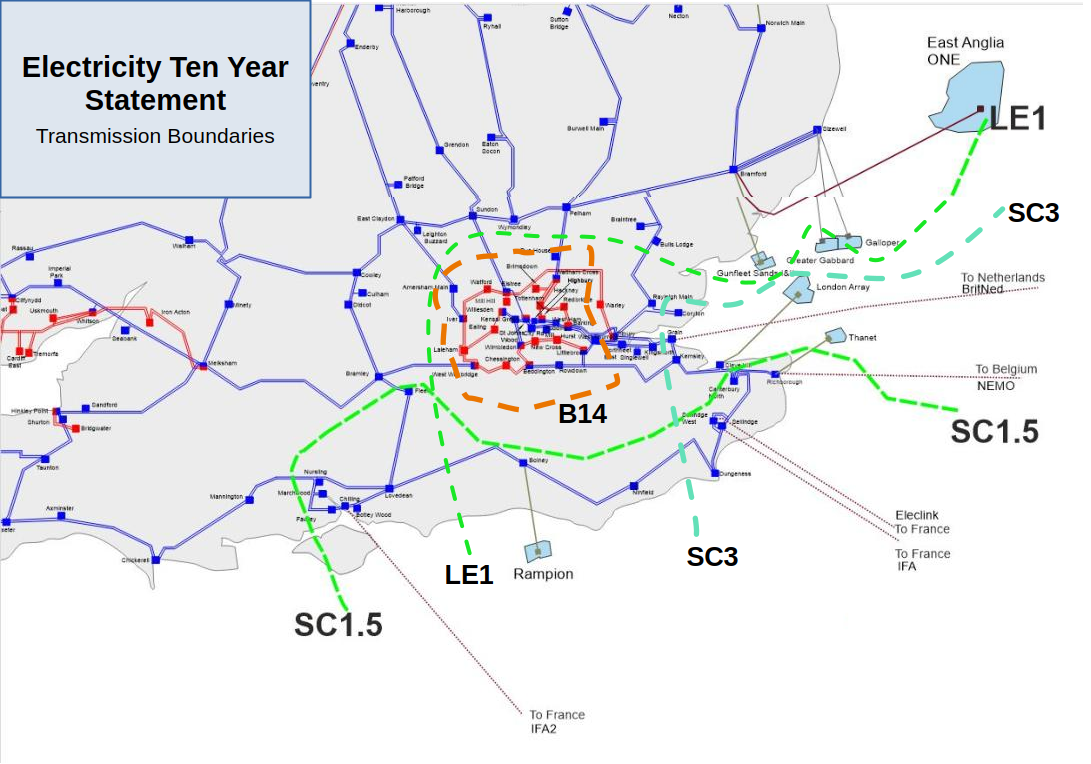
B14 crosses eight 400kV double-circuits and one 275kV double circuit. Its capability is limited to 11.6GW due to a thermal constraint on the Grain - Kingsnorth & Grain - Tilbury circuits.
SC1.5 crosses three 400kV double circuits. The boundary capability is limited to 5.4 GW due to a voltage constraint for a fault on the Cleve Hill – Canterbury North – Kemsley 400kV circuits.
SC3 crosses three 400kV double circuits. The boundary capability is limited to 6.7GW due to a thermal constraint on the Grain – Tilbury 400kV circuit.
LE1 crosses six 400kV double circuits. The boundary capability is limited to 10.2 GW due to a voltage constraint for a fault on the Pelham-Bramford-Braintree 400kV circuits.
Try adding another 20GW or so into that corner of Britain and doing so without interrupting any of the existing supplies.
Does that provide a better idea of how much this is likely to cost?
We're looking at another HS2, but to be done in less than half the time.
What would I do?
1: Set a new (political) policy that the priority for GB electricity supplies is to be the existing customer base.
2: Set a cap on the amount by which Ofgem can allow bills to rise for network infrastructure upgrades. The guidance is to include an ethical constraint clause.
3: Set a levy to be paid by Demand Applicants depending on the geographical location of their Project; define this by:
- the Transmission Boundaries across which their electricity will be required to pass
- the generation-surplus forecast for the area in which their data-centre will be built
4: reverse the decision to exclude regional nodal tariffs. Set up a technical workgroup of grid engineers and network-planners to devise a mechanism which minimises the need for upgrades on the Distribution Grid.
5: Add a section into the RIIO-ED3 Agreements between Ofgem and DNOs which requires them to work in partnership with consumers to reduce by half the losses due to phase-imbalance at local substations. That will save us at least 2GW of capacity, and give us some algorithms to create a genuine Smart grid for the future.
This was written in haste.
I reserve the right to adjust my thinking by tomorrow morning. 😉
This post was modified 2 days ago 2 times by Transparent
Save energy... recycle electrons!
02/03/2026 8:59 pm
OK, so I think we can conclude that
a) Neither Ofgem nor NESO is the cause of the increase in (future) demand caused by data centres
b) there is a level of uncertainty associated with that demand resulting from uncertainties in the business viability of planned facilities
c) the consequence of this raises is that some challenging political and technical issues need to be resolved
Put simply, its a difficult problem. Blaming anyone (or any organisation) for the existence of a difficult problem, unless they caused it and had the reasonable choice not to cause it, is not 'fair' and in my opinion not helpful.
As to the solution, I appreciate you have reserved the right to adjust your thinking, which is fair enough I also reserve the right to adjust my thinking but here are my initial thoughts
What would I do?
1: Set a new (political) policy that the priority for GB electricity supplies is to be the existing customer base.
2: Set a cap on the amount by which Ofgem can allow bills to rise for network infrastructure upgrades. The guidance is to include an ethical constraint clause.
3: Set a levy to be paid by Demand Applicants depending on the geographical location of their Project; define this by:
- the Transmission Boundaries across which their electricity will be required to pass
- the generation-surplus forecast for the area in which their data-centre will be built
4: reverse the decision to exclude regional nodal tariffs. Set up a technical workgroup of grid engineers and network-planners to devise a mechanism which minimises the need for upgrades on the Distribution Grid.
5: Add a section into the RIIO-ED3 Agreements between Ofgem and DNOs which requires them to work in partnership with consumers to reduce by half the losses due to phase-imbalance at local substations. That will save us at least 2GW of capacity, and give us some algorithms to create a genuine Smart grid for the future
(1) So you would exclude newly built houses or newly built industries from connection? This proposal clearly needs considerable refinement. My immediate view is that this is impractical
(2) I can see (and to an extent support) the intent, but how would a cap work given the other constraints? Im minded to think this is not practical but other constraints should apply.
(3) This prima facie makes some sense, basically if you build in an area where there is a deficit of supply you have to pay. It needs an analysis for possible conflicts with social objectives such as rebalancing the spatial distribution of economic activity to help with poverty 'black spots', but I can see it has potential merit. Its quite political, so will need political input.
(4) for reasons I have already set out this is a political hot potato. I personally think it is unlikely that 'postcode pricing' will be supported by any political party.
A more nuanced approach (perhaps applicable to industry only) may be a possibility but that needs analysis and may be prevented by practical difficulties or matters related to (3).
Unless a more nuanced approach is practical I think this can be discarded, at least until we have a government that is opposed both to green measures and UK energy independence, and thus doesn't care if 'postcode pricing' is portrayed as a direct consequence of 'net stupid zero'.
(5) Put another way, somehow incentivise domestic solutions to the problem of local grid demand.
This I can support, because it seems to me a bit of a no-brainer. That said I am conscious that ToU tarrifs, in whatever form are not particularly popular and we have a population that has grown used to having whatever they want. Thus doing this will likely create a backlash which will inevitably be exploited by some as a consequence of 'net stupid zero'. Nevertheless, properly presented, its clearly an opportunity.
I think this addresses a different problem to matters (1) - (4), namely the 11kV grid. (1) - (4) I think principally target the higher level connections.
Just my first thoughts!
4kW peak of solar PV since 2011; EV and a 1930s house which has been partially renovated to improve its efficiency. 7kW Vaillant heat pump.


02/03/2026 10:23 pm
Quick change of direction in conversation, but with the energy price cap dropping from 1 April, most of us were looking forward to a bit of breathing room on electricity costs.
But with the fresh escalation in the Iran conflict pushing oil and gas prices sharply higher are those savings likely to get eaten up pretty quickly by rising wholesale costs filtering through to suppliers?
How long would this need to drag on (say, weeks of real disruption to shipping and exports versus a short-lived flare-up) before we start seeing real upward pressure on the next Ofgem cap review. Keen to hear what others think… could this geopolitical stuff reverse the recent downward trend, or might it stay temporary and not fully hit our bills?
Get a copy of The Ultimate Guide to Heat Pumps
Subscribe and follow our YouTube channel!
02/03/2026 10:49 pm
Quick change of direction in conversation, but with the energy price cap dropping from 1 April, most of us were looking forward to a bit of breathing room on electricity costs.
But with the fresh escalation in the Iran conflict pushing oil and gas prices sharply higher are those savings likely to get eaten up pretty quickly by rising wholesale costs filtering through to suppliers?
How long would this need to drag on (say, weeks of real disruption to shipping and exports versus a short-lived flare-up) before we start seeing real upward pressure on the next Ofgem cap review. Keen to hear what others think… could this geopolitical stuff reverse the recent downward trend, or might it stay temporary and not fully hit our bills?
That’s an incredibly hard question to answer whilst still avoiding the political tangents the rules discourage. However, my opinion is that the actions in Iran, no matter anyone’s feelings about rights or wrongs, have not been thought through first, and that will make it difficult to conclude tidily or quickly. I cannot see any way this conflict can avoid dragging on and so fully expect higher oil prices to continue for long enough to translate into higher energy prices for consumers. Even worse, I fully expect much more bloodshed.
This post was modified 1 day ago by Majordennisbloodnok
105 m2 bungalow in South East England
Mitsubishi Ecodan 8.5 kW air source heat pump
18 x 360W solar panels
1 x 6 kW GroWatt battery and SPH5000 inverter
1 x Myenergi Zappi
1 x VW ID3
Raised beds for home-grown veg and chickens for eggs
"Semper in excretia; sumus solum profundum variat"
3
02/03/2026 10:54 pm
@editor BBC news was saying today that consumers will feel gas price hikes around the summer (if they stay where they spiked to). I guess wholesale indexed tariffs will be impacted earlier than others.
8kW Solis S6-EH1P8K-L-PLUS hybrid inverter; G99: 8kw export; 16kWh Seplos Fogstar battery; Ohme Home Pro EV charger; 100Amp head, HA lab on mini PC
02/03/2026 11:03 pm
A single case is needed to disprove broad statements. Thank you
Agreed, but you unilaterally broadened it in the first place. As for @technogeek’s statement, I’ve only confirmed it.
I deepened it. But not very helpful, as no doubt @technogeek did not mean it literally.
I understand his argument but the growth in expected power use by data centres, particularly in the UK, is mainly due to different factors
8kW Solis S6-EH1P8K-L-PLUS hybrid inverter; G99: 8kw export; 16kWh Seplos Fogstar battery; Ohme Home Pro EV charger; 100Amp head, HA lab on mini PC

Latest Posts
-

RE: Heat Pump vs New Gas Boiler for Inherited House - Worth the Extra Cost?
*** I now see @jamespa has already posted but will stil...
By cathodeRay , 20 minutes ago
-

RE: Tell us about your Solar (PV) setup
@mk4 Charge to 100%, discharge down to 10%.
By bobflux , 28 minutes ago
-
RE: Daikin Altherma 3 LT compressor longevity question
This mess is intriguing: I wonder if this represent...
By bobflux , 2 hours ago
-
RE: Connecting Growatt SPH5000 over wired ethernet rather than wireless
The simplest wired option is usually the Growatt Ethern...
By Jonatan , 6 hours ago
-
RE: Peak Energy Products V therm 16kW unit heat pump not reaching flow temperature
ASHPs do have a minimum compressor speed. The minimum h...
By bobflux , 13 hours ago
-
RE: Electricity price predictions
@jamespa And it seems some of the nasty public cloud...
By Batpred , 13 hours ago
-
RE: Jokes and fun posts about heat pumps and renewables
Technology is rapidly advancing. BBC News reported th...
By Transparent , 16 hours ago
-
What matters for flow and pressure drop is internal dia...
By bobflux , 17 hours ago
-

RE: Do Fridges and Freezers have COP ratings?
@editor Thank you all for your replies and submitted in...
By Toodles , 19 hours ago
-
I know and yes. The secondary deltaT wont necessaril...
By JamesPa , 23 hours ago
-
RE: Designing heating system with air to water heat pump in France, near Lyon
Just love the way you put it! 🤣
By Batpred , 2 days ago
-
RE: Safety update; RCBOs supplying inverters or storage batteries
Thank you for sharing. So it seems that your Schneid...
By Batpred , 2 days ago
-

RE: Forum updates, announcements & issues
@upnorthandpersonal thanks for the thoughtful, consider...
By Mars , 2 days ago
-
RE: Solar Power Output – Let’s Compare Generation Figures
@mk4 All 21 panels have their own Enphase IQ7a microinv...
By Toodles , 2 days ago
-
RE: Setback savings - fact or fiction?
Great, so you have proven that MELCloud is consistently...
By RobS , 3 days ago
-
RE: Mitsu PUHZ120Y 'Outdoor Temp 'error?
Thanks David & James It almos...
By DavidAlgarve , 3 days ago
-
RE: Surge protection devices SPDs
@trebor12345 - your original Topic about the right type...
By Transparent , 3 days ago
-
RE: Help needed with Samsung AE120RXYDEG
@tomf I’ve been sent this from a service engineer at Sa...
By Mars , 3 days ago
-
RE: Buying large amp bidirectional RCD and RCBO
Yes... I went through this particular headache and ende...
By bobflux , 4 days ago
-
O-oh! Let's take this as an opportunity to 'pass the ...
By Transparent , 4 days ago
-
RE: Homely setup on daikin heat pump
@craigh I refer to our somewhat elevated temperature of...
By Toodles , 4 days ago
-
RE: Air source heat pump roll call – what heat pump brand and model do you have?
My turn, this describes the future installation, only t...
By bobflux , 4 days ago