
Notifications
Clear all

26/02/2026 12:36 am
I wonder if things are really so doomy and gloomy.
I do not see any reason to be gloomy. In just 5 years, the live connections to the grids will massively change. Masses of new contracts as well.
This is really exciting. Huge capacity of new wind, solar farms, grid batteries, interconnectors all coming online.
And nobody is even preparing for any outages, so failures are not an option.
It will be a great story to tell other countries: that it can be done, they can also transform their grids.
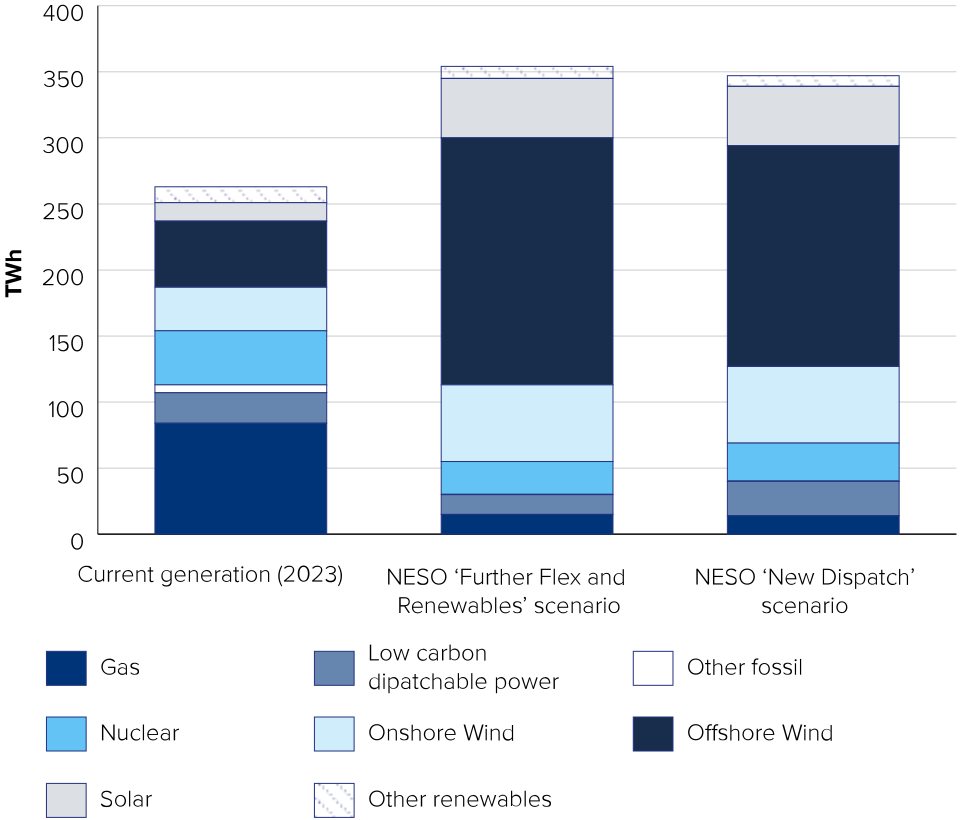
Figure 7: Generation in 2030 in the NESO ‘Further Flex and Renewables’ and ‘New Dispatch’ scenarios, compared to current generation (TWh)
Generation capacity is also clearly expected to double by 2030, in the same policy paper..
Figure 6: Installed capacity in 2030 in the NESO ‘Further Flex and Renewables’ and ‘New Dispatch’ scenarios, compared to current installed capacity (GW)
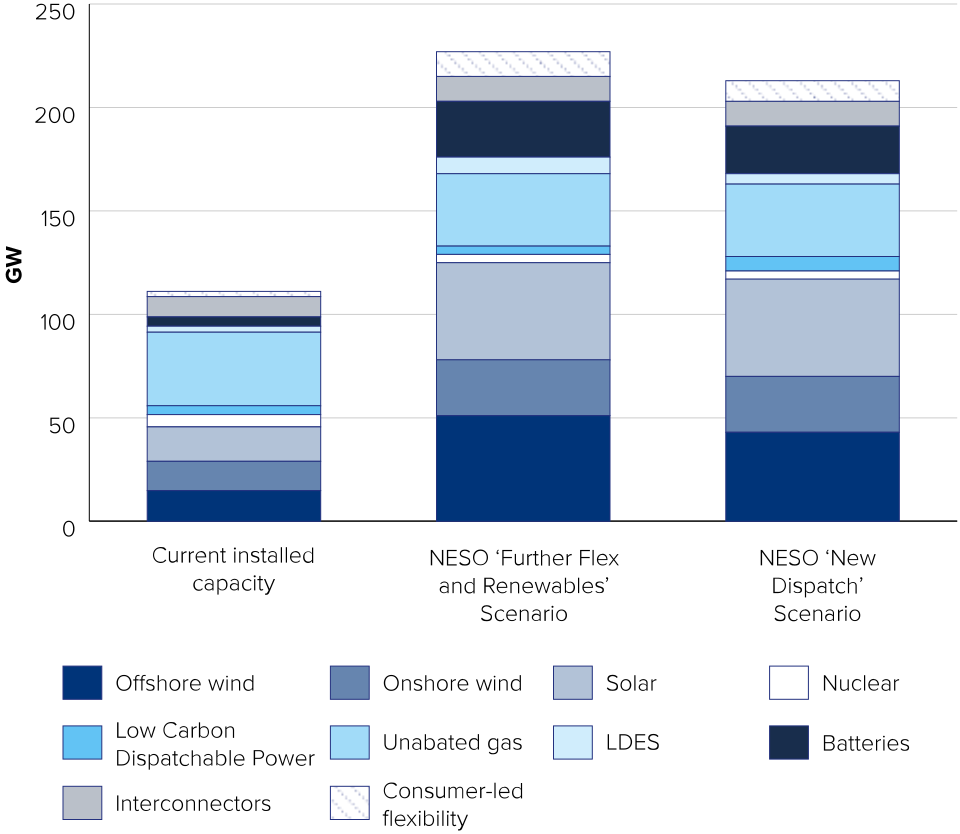
These are changes on an epic scale.
8kW Solis S6-EH1P8K-L-PLUS hybrid inverter; G99: 8kw export; 16kWh Seplos Fogstar battery; Ohme Home Pro EV charger; 100Amp head, HA lab on mini PC

26/02/2026 7:07 am
Perhaps, or perhaps they are going beyond the limits of what is known by anyone, expert or otherwise. If @transparent is to be believed, that is certainly the case, because there is a lot we don't actually know about the future demand, the state of the current network and other factors.
Are decisions 'poor' because, several years later and armed with more information, it turns out that a better decision could have been made had the information been known at the time. I would suggest not.
It depends on the specific topic or problem, but many of the problems are foreseeable and were foreseen, but politicians and civil servants ploughed on regardless and at that point, it is not plausible to argue we didn't know, rather its more a case of we didn't listen, thought we knew best, at which point the responsibility for the decision and outcome falls on them.
That's particularly the case when you start comparing or bench-marking Britain against other countries, on those topics/issues where other countries have taken different approaches to problems, where it was foreseen that Britain was taking an unusual approach, that went against typical international practice.
The classic example of that was smart metering, vast majority of countries completed this as a national roll-out managed by the distribution network owners, optimizing the logistics to ensure efficient delivery of all those installations across their areas. Britain took the rather unique approach of fragmenting its roll-out by making the individual energy suppliers responsible, splitting the installations across all of the suppliers, with multiple parallel installation operations across the whole country, each supplier having a lower density of installations in an area.
Logistically it did not make sense, and it did not make sense given the market structure, where supply is competitive and consumers regularly switch between suppliers, while hardware like a smart meter is a durable piece of equipment that last 10+, 15+ years. outlasting the relationship with the supplier.
Lots of other countries completed their smart meter roll-outs far more quickly the Britain (which still hasn't finished it, not clear when it will finish) and at lower costs than Britain, with Britain's roll out serving as an example of how not to do things. All of this was foreseeable and foreseen.
26/02/2026 8:48 am
It depends on the specific topic or problem, but many of the problems are foreseeable and were foreseen, but politicians and civil servants ploughed on regardless and at that point, it is not plausible to argue we didn't know, rather its more a case of we didn't listen, thought we knew best, at which point the responsibility for the decision and outcome falls on them.
That's particularly the case when you start comparing or bench-marking Britain against other countries, on those topics/issues where other countries have taken different approaches to problems, where it was foreseen that Britain was taking an unusual approach, that went against typical international practice.
The classic example of that was smart metering, vast majority of countries completed this as a national roll-out managed by the distribution network owners, optimizing the logistics to ensure efficient delivery of all those installations across their areas. Britain took the rather unique approach of fragmenting its roll-out by making the individual energy suppliers responsible, splitting the installations across all of the suppliers, with multiple parallel installation operations across the whole country, each supplier having a lower density of installations in an area.
That does not sound even faintly like a case of what you suggested earlier namely
in some areas, particularly energy, civils servants and politicians are increasingly going beyond the limits of their expertise,
Politicians and civil servants are, I have no doubt, quite capable of understanding the difference between energy suppliers, DNOs and density of installations, there is nothing even faintly technical in these concepts.
What it sounds like is a political, even ideological, decision to allow 'market forces' to drive the roll out rather than directing it centrally, quite possibly knowing that it might take longer. As I pointed out earlier in this thread, that follows the preferences of the UK public whose voting decisions have resulted, for better or worse, in a government that is largely anti-regulation, pro 'small government' for 53 out of the 80 years that have passed since WWII.
You don't have to look as far back as smart metering to find examples of decisions which were made for purely political/ideological reasons, where the problems they would cause were well known at the time. These are examples, IMHO, of poor decisions, but ones that are heavily guided, or even mandated, by the British public, for better or worse! Its us, not politicians, that must take responsibility for those!
This post was modified 6 days ago 5 times by JamesPa
4kW peak of solar PV since 2011; EV and a 1930s house which has been partially renovated to improve its efficiency. 7kW Vaillant heat pump.
26/02/2026 10:15 am
Are decisions 'poor' because, several years later and armed with more information, it turns out that a better decision could have been made had the information been known at the time. I would suggest not.
Completely agree, decisions have to be made.
In the last decade if many were made, I do not see much evidence of impact?
That's particularly the case when you start comparing or bench-marking Britain against other countries, on those topics/issues where other countries have taken different approaches to problems, where it was foreseen that Britain was taking an unusual approach, that went against typical international practice.
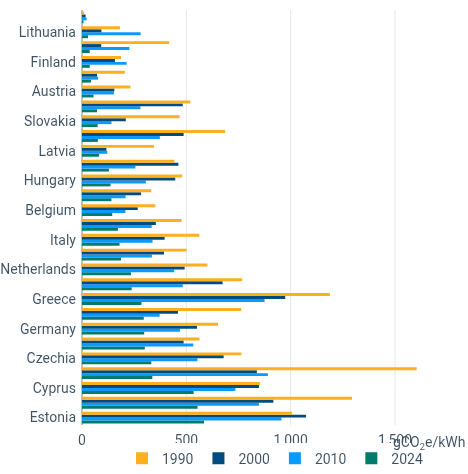
When we compare with EU countries, we are not too bad.
Some countries are almost done on decarbonisation. Others seem to have barely started.
Figure 2. Greenhouse gas emission intensity of electricity generation, country level
Lots of other countries completed their smart meter roll-outs far more quickly the Britain (which still hasn't finished it, not clear when it will finish) and at lower costs than Britain, with Britain's roll out serving as an example of how not to do things. All of this was foreseeable and foreseen.
I think specially considering the strength of our universities, I can only explain some blunders by some fashionable trends of "ignoring experts" .
Still in the past decade, we seem to have had lots of pet projects like ev charging innovation, wood burner incentive programs, corner factories of biomethane from domestic waste. You know what I mean.
But other bets are now being scaled up like offshore wind and cables, so exciting times. Nice to have a home battery! 😉
This post was modified 6 days ago by Batpred
8kW Solis S6-EH1P8K-L-PLUS hybrid inverter; G99: 8kw export; 16kWh Seplos Fogstar battery; Ohme Home Pro EV charger; 100Amp head, HA lab on mini PC
26/02/2026 12:42 pm
In the last decade if many were made, I do not see much evidence of impact?
Much of the last decade was consumed by the consequences of a decision that the UK public made in 2016, and by Covid. I doubt that left much bandwidth for other matters, whether or not the will was present!
4kW peak of solar PV since 2011; EV and a 1930s house which has been partially renovated to improve its efficiency. 7kW Vaillant heat pump.
26/02/2026 2:04 pm
Much of the last decade was consumed by the consequences of a decision that the UK public made in 2016, and by Covid. I doubt that left much bandwidth for other matters, whether or not the will was present!
Perhaps, but it has hardly been perfect elsewhere.
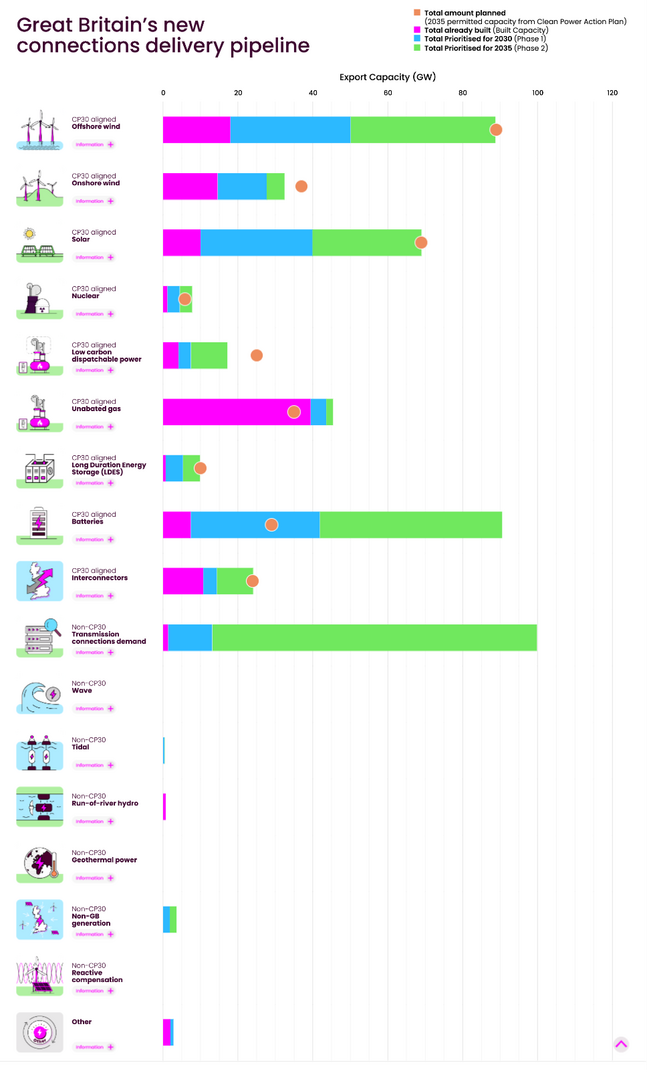
The GB plan is there, clearing of the connections backlog was made a priority.
NESO is talking about a backlog/gridlock becoming a delivery pipeline...
8kW Solis S6-EH1P8K-L-PLUS hybrid inverter; G99: 8kw export; 16kWh Seplos Fogstar battery; Ohme Home Pro EV charger; 100Amp head, HA lab on mini PC

26/02/2026 4:50 pm
@papahuhu You must live in utopia, we unfortunantly suffer numerious cuts, the first 2 years of living here about 25 cuts longest 3 1/2 days. So between the powercuts and low incoming amps, we did an offgrid install @ 8kw hybrid (48 volt) and no mcs. Saved about 50% cost, reduced bought energy by 75%, reduced oil boiler use for hot water and heating, ran last year completely offgrid for 8 1/2 months straight, (8 months no oil boiler). Due to the poor mains, export was not available above 3.68 nor the option of a heatpump. Small cottage but exposed. Now trying to find the lowest standing charge options - looking at prepay with no standing charge?
On an interesting sidenote, we have found our meter has recorded usage despite being isolated in the meter box, this has been raised with our supplier and is now part of an ombudsman complaint.

26/02/2026 5:08 pm
The Times this week carried a story on Electricity Demand by UK Data Centres.
The results were a surprise to me, so I've taken a few days to check the background, and I'd urge other readers to do so too, rather than post a quick opinion.
In May'25 NESO commenced Connections Reform – a process requiring companies with Grid Connection Applications to re-apply, providing details of their project. The idea was to weed out Zombie-projects which were merely an attempt to secure a valuable grid-connection but with no actual need being demonstrated.
The data accumulated by NESO, and published in Dec'25 allowed me to redraw a histogram which I've posted several times over the years:
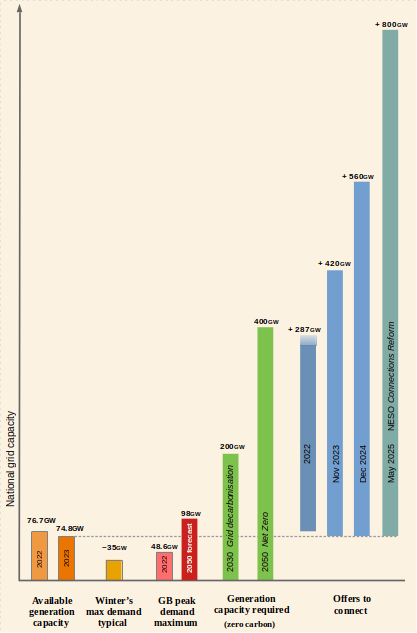
The rightmost bar shows that NESO received over 800GW worth of re-applications.
The green bars show the total amount of electricity which could potentially be available to NESO in order to meet demand for 2030 and 2050. Since the majority of that generation will be from renewable energy sources, it's greatly more than the actual 2050 Demand Forecast of 98GW by 2050, shown in red.
So far, so good.
Note the light-red bar showing the maximum peak demand which Britain has ever encountered, which was 48.6GW back in 2022.
Now let's look at actual-demand as reported by Elexon over the last fortnight:
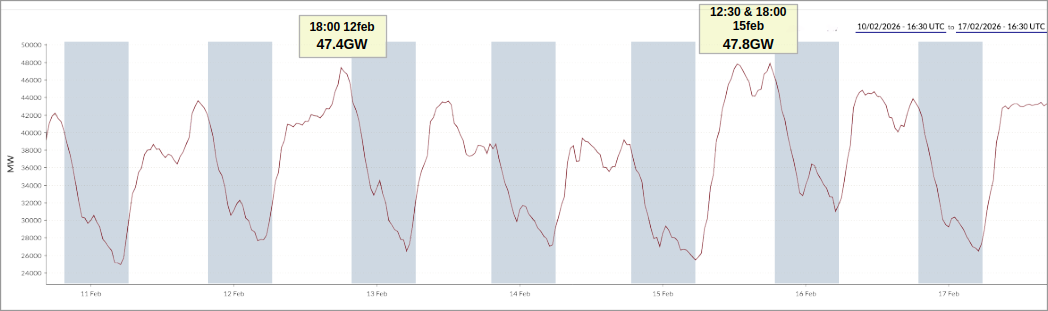
The grey-blue night-time bars and the labels are my additions, for clarity.
We are almost back to the demand peak of 4 years ago. So what's happening?
Although domestic demand is still driving the peaks themselves, the base load now contains an ever-growing proportion of electricity demand from data-centres.
Worryingly, 50GW of the Applications submitted during Connections Reform were directly tied to data-centres.
In light of these recent demand-peaks, Ofgem has announced an urgent Connections Reform Consultation (properly called a "request for input") for which the closing date is 13th March. It was that which triggered The Times' story on Monday 23rd.
NESO and Ofgem are basically telling us that we're not just chasing the need for Britain to meet Net Zero, but we actually have to double that electricity supply in order to satisfy demand from future data centres.
Government policy to lead the world in AI and Data means that we now need twice as much electricity as we would've done to provide for British consumers. That will add to consumer bills in order to build the infrastructure.
This post was modified 6 days ago by Transparent
Save energy... recycle electrons!
26/02/2026 5:40 pm
Worryingly, 50GW of the Applications submitted during Connections Reform were directly tied to data-centres.
It seems we are both saying that growth is expected!
Perhaps the consultation enables bringing back zonal pricing. I suppose the alternative is for the 400kv grid to grow even more?
I wonder to what extent these connections for data centres were already factored in the plan (that was considering some growth of overall consumption of around 35%). According to the IET as of Aug ´25, data centres were set to grow by 20% in 5 years.
Can we really assume these new data centres consumption will just be base load, rather than having peaks?
8kW Solis S6-EH1P8K-L-PLUS hybrid inverter; G99: 8kw export; 16kWh Seplos Fogstar battery; Ohme Home Pro EV charger; 100Amp head, HA lab on mini PC

26/02/2026 5:53 pm
@transparent so if I understand the situation correctly, yet again poor Joe Bloggs is going to get fleeced again to pay for the extra infrastructure so the likes of Amazon Cloud can get even richer? You could not make this up! So glad I have opted to start generating some of my own power!
Regards
5 Bedroom House in Cambridgeshire, double glazing, 300mm loft insulation and cavity wall insulation
Design temperature 21C @ OAT -2C = 10.2Kw heat loss, deltaT = 8 degrees
Bivalent system containing:
12Kw Samsung High Temperature Quiet (Gen 6) heat pump
26Kw Grant Blue Flame Oil Boiler
4.1Kw Solar Panel Array
34Kwh GivEnergy Stackable Battery System
1
26/02/2026 7:00 pm
@transparent so if I understand the situation correctly, yet again poor Joe Bloggs is going to get fleeced again to pay for the extra infrastructure so the likes of Amazon Cloud can get even richer? You could not make this up! So glad I have opted to start generating some of my own power!
Regards
Maybe or maybe not. It depends on how charges for connection and standing charges are structured. If Amazon Cloud (and other big users) pays a fair proportion of the infrastructure costs then your statement would be incorrect, if it doesn't then your statement would be correct.
I genuinely don't know and, until I do know I dont think its right to pass judgement. I would definitely like to know!
One issue that immediately springs to mind is, how do you distinguish between big users? There are frequently articles in the papers which say UK industry is 'disadvantaged' by high energy prices. Data centres and steel production are both big consumers of energy, presumably both equally affected by high energy prices. Do we favour steel over data centres? If a blast furnace in, say Merthyr Tydfil, needs a high capacity energy feed, do we give it a better price than a data centre in, say Harlow (a new town about 30 miles from London)?
I mention Harlow because apparently there is a ring of data centres around London serving the City. Like it or not the City is a big part of our economy. Do we disadvantage data centres (and thus the City) in favour of steel production?
I think this is in reality a much more nuanced and multi dimensional question that it first appears, but I would certainly start with the presumption that bulk users of energy (whatever they produce) should pay the full infrastructure costs of their demand.
4kW peak of solar PV since 2011; EV and a 1930s house which has been partially renovated to improve its efficiency. 7kW Vaillant heat pump.
26/02/2026 7:00 pm
I wonder to what extent these connections for data centres were already factored in the plan
That's why I requested that others here check the background rather than just posting a comment.
There are a great many possible interpretations of what's happening, and this Topic will quickly be inundated with conjecture if we simply chuck all the possibilities into the discussion.
Yes @technogeek the announcement of an additional 50GW demand being 'hidden' within an Ofgem consultation was what The Times had spotted.
I assumed they had misunderstood, which is why I'm checking their sources.
Other technical online sites have similar background detail, which adds to its authenticity.
In effect 'we' are being asked to generate enough zero-carbon electricity to power two countries.
One is Great Britain, and the other is a collection of data-centres being rapidly built in order to satisfy government policy.
Save energy... recycle electrons!

Latest Posts
-

RE: Heat Pump vs New Gas Boiler for Inherited House - Worth the Extra Cost?
*** I now see @jamespa has already posted but will stil...
By cathodeRay , 20 minutes ago
-

RE: Tell us about your Solar (PV) setup
@mk4 Charge to 100%, discharge down to 10%.
By bobflux , 28 minutes ago
-
RE: Daikin Altherma 3 LT compressor longevity question
This mess is intriguing: I wonder if this represent...
By bobflux , 2 hours ago
-
RE: Connecting Growatt SPH5000 over wired ethernet rather than wireless
The simplest wired option is usually the Growatt Ethern...
By Jonatan , 6 hours ago
-
RE: Peak Energy Products V therm 16kW unit heat pump not reaching flow temperature
ASHPs do have a minimum compressor speed. The minimum h...
By bobflux , 13 hours ago
-
RE: Electricity price predictions
@jamespa And it seems some of the nasty public cloud...
By Batpred , 13 hours ago
-
RE: Jokes and fun posts about heat pumps and renewables
Technology is rapidly advancing. BBC News reported th...
By Transparent , 16 hours ago
-
What matters for flow and pressure drop is internal dia...
By bobflux , 17 hours ago
-

RE: Do Fridges and Freezers have COP ratings?
@editor Thank you all for your replies and submitted in...
By Toodles , 19 hours ago
-
I know and yes. The secondary deltaT wont necessaril...
By JamesPa , 23 hours ago
-
RE: Designing heating system with air to water heat pump in France, near Lyon
Just love the way you put it! 🤣
By Batpred , 2 days ago
-
RE: Safety update; RCBOs supplying inverters or storage batteries
Thank you for sharing. So it seems that your Schneid...
By Batpred , 2 days ago
-

RE: Forum updates, announcements & issues
@upnorthandpersonal thanks for the thoughtful, consider...
By Mars , 2 days ago
-
RE: Solar Power Output – Let’s Compare Generation Figures
@mk4 All 21 panels have their own Enphase IQ7a microinv...
By Toodles , 2 days ago
-
RE: Setback savings - fact or fiction?
Great, so you have proven that MELCloud is consistently...
By RobS , 3 days ago
-
RE: Mitsu PUHZ120Y 'Outdoor Temp 'error?
Thanks David & James It almos...
By DavidAlgarve , 3 days ago
-
RE: Surge protection devices SPDs
@trebor12345 - your original Topic about the right type...
By Transparent , 3 days ago
-
RE: Help needed with Samsung AE120RXYDEG
@tomf I’ve been sent this from a service engineer at Sa...
By Mars , 3 days ago
-
RE: Buying large amp bidirectional RCD and RCBO
Yes... I went through this particular headache and ende...
By bobflux , 4 days ago
-
O-oh! Let's take this as an opportunity to 'pass the ...
By Transparent , 4 days ago
-
RE: Homely setup on daikin heat pump
@craigh I refer to our somewhat elevated temperature of...
By Toodles , 4 days ago
-
RE: Air source heat pump roll call – what heat pump brand and model do you have?
My turn, this describes the future installation, only t...
By bobflux , 4 days ago


