Joining the Renewable Heating Hub forums is completely free and only takes a minute. By registering you’ll be able to ask questions, join discussions, follow topics you’re interested in, bookmark useful threads and receive notifications when someone replies. Non-registered members also do not have access to our AI features. When choosing your username, please note that it cannot be changed later, so we recommend avoiding brand or product names. Before registering, please take a moment to read the Forum Rules & Terms of Use so we can keep the community helpful, respectful and informative for everyone. Thanks for joining!
@transparent Some background 🙂 As you know I'm well up for writing constructive and informed comments to government and the discussions here very helpfully inform that. There's a danger though in being parochial and taking a view that neglects all the competing issues that a government department has to face in steering the country through what must be the largest societal change for a century. You alerted me to distribution issues - my musings took me to thinking about actually what needs to be done to make entire areas of early 19th century tenement buildings zero carbon. This is all off-topic so I'd better stop but I found reading the nitty-gritty bits of the relevant reports humbling in that anyone would even contemplate this. It does leave me with a firmer conviction that governments had better get a move on but tempered with a better understanding of the huge challenges they face in creating groundwork before the actual visible work can make much progress.
@transparent Some background 🙂 As you know I'm well up for writing constructive and informed comments to government and the discussions here very helpfully inform that. There's a danger though in being parochial and taking a view that neglects all the competing issues that a government department has to face in steering the country through what must be the largest societal change for a century. You alerted me to distribution issues - my musings took me to thinking about actually what needs to be done to make entire areas of early 19th century tenement buildings zero carbon. This is all off-topic so I'd better stop but I found reading the nitty-gritty bits of the relevant reports humbling in that anyone would even contemplate this. It does leave me with a firmer conviction that governments had better get a move on but tempered with a better understanding of the huge challenges they face in creating groundwork before the actual visible work can make much progress.
Well said. Far too many people IMHO think Government is easy and both civil servants and politicians stupid.
Personally I don't believe either. Government is about balancing tricky and complicated choices in an attempt to change things which have enormous inertia and over which you have limited power and information, in an ever changing and largely hostile world, whilst forever under the spotlight of a largely hostile media. With the best will in the world that's somewhere between horrendously difficult and impossible. Its also clearly impossible to please everyone and probably almost impossible to please anyone in the impatient world we now live in.
Thats why I make my political choices based on values and intent, and then expect delivery of much of what might happen to take more than a single term of office. I don't expect perfection either, politicians are human beings and have to balance the needs/desires of people like me, with the needs/desires of many other disparate groups.
Unfortunately that approach doesn't make newspaper headlines or suit todays low-attention-span world. If it did we might return to a sane and mature political debate (and as a result enable our politicians to make better political choices) rather than the completely inane, self defeating and destructive dog-whistle nonsense that we currently suffer.
This post was modified 8 months ago 3 times by JamesPa
4kW peak of solar PV since 2011; EV and a 1930s house which has been partially renovated to improve its efficiency. 7kW Vaillant heat pump.
@jamespa In fact, it makes me doubt that anyone who wishes to become an MP is actually sane!
I agree as it happens. It seems to me that the job of an ordinary MP largely amounts to following voting orders and fending off a load of complaints from constituents, most of which are about things that are nothing to do with Central Government but are actually functions of local government.
That said Committee work, where an MP gets to examine bills in detail, probably has its moments. I was privileged to be responsible for getting a rather minor private bill through Parliament, and it was very notable that the MPs (and the members of the House of Lords) who were responsible for examining it clearly took a lot of care in their work.
I guess being a minister may be more rewarding, but then you have to face the conflicts that are referred to above and are doubtless always on call, except of course if you are one of those ministers who more or less totally neglect their jobs, which does happen from time to time. It seems to me that the job of Prime Minister, if you both take it seriously and care, is absolutely horrible.
Whilst I despise the politics and cynical manipulation of the people that some of our politicians indulge in, aided and abetted by the media, I still have respect for the job they do.
Whilst I despise the politics and cynical manipulation of the people that some of our politicians indulge in, aided and abetted by the media, I still have respect for the job they do.
Completely agree. Still, I think the system leads to similar types of elected representatives in Westminster.
And whilst I would encourage anyone to join the civil service, there's some way to go until it values maths and science backgrounds as much as the rest of society.
8kW Solis S6-EH1P8K-L-PLUS hybrid inverter; G99: 8kW export; 16kWh Seplos Fogstar battery; Ohme Home Pro EV charger; Vaillant Arotherm Pro 7kW; 100Amp head, HA lab on mini PC
And whilst I would encourage anyone to join the civil service, there's some way to go until it values maths and science backgrounds as much as the rest of society.
I'm not so sure that the rest of society values a maths or science background. Industry does but the average person in your local pub (or on the Clapham Omnibus), not so sure!
4kW peak of solar PV since 2011; EV and a 1930s house which has been partially renovated to improve its efficiency. 7kW Vaillant heat pump.
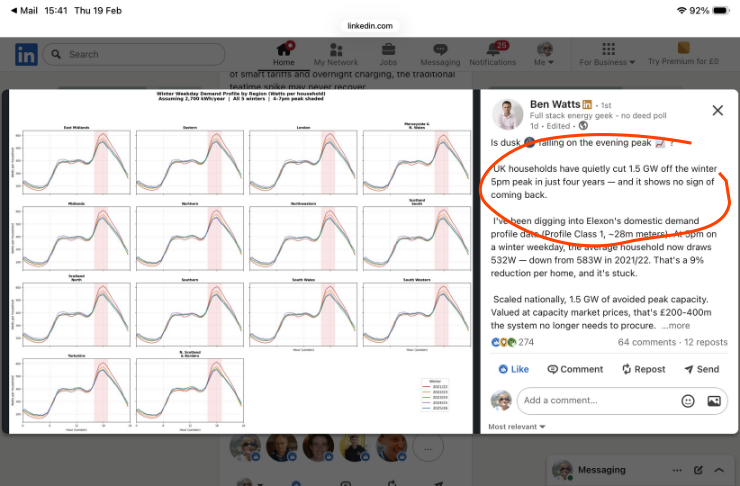
GB's domestic demand has been slowly reduced over the past few years.
That's because we're acting on the messages from Sir David Attenborough, Hugh Fernley-Whittingstall and Greta Thunberg. We've been buying LED lighting and other low-energy appliances for the home.
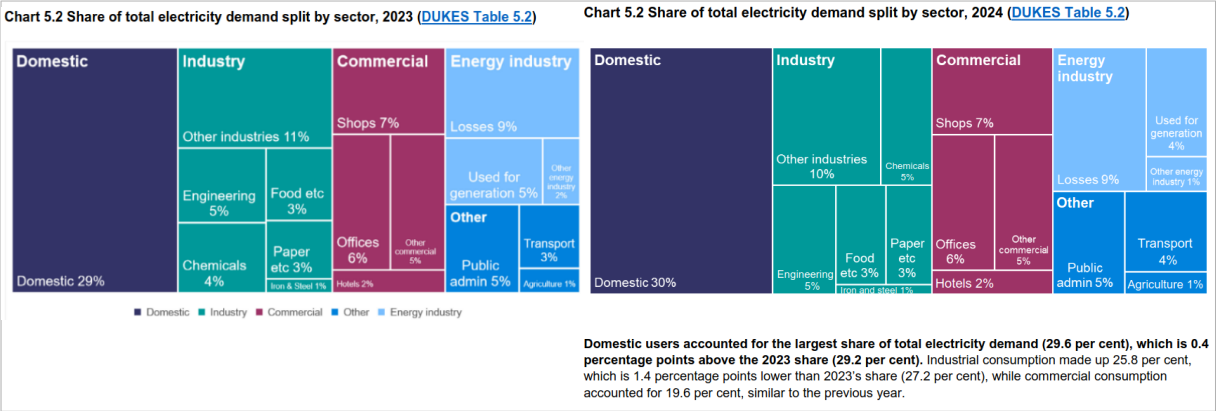
It was only in 2024 that the annual DUKES data showed a small increase in domestic electricity consumption, from 29.2% to 29.6%
I've also checked with National Grid Electricity Transmission (NGET) what are their forecasts for the next decade, by which time the move to EVs will have been the most significant factor. Their in-house modelling is that if Britain switched to EVs instantaneously, the Grid would need to carry an additional 10%.
That's much less than I'd expected, and nowhere near the overall 50% increase for which @batpred provided the link.
This is not the only report.
Unfortunately, (and unusually) the RHH logged me out. So I lost most of what I had written. This may seem a bit rushed, but here it goes...
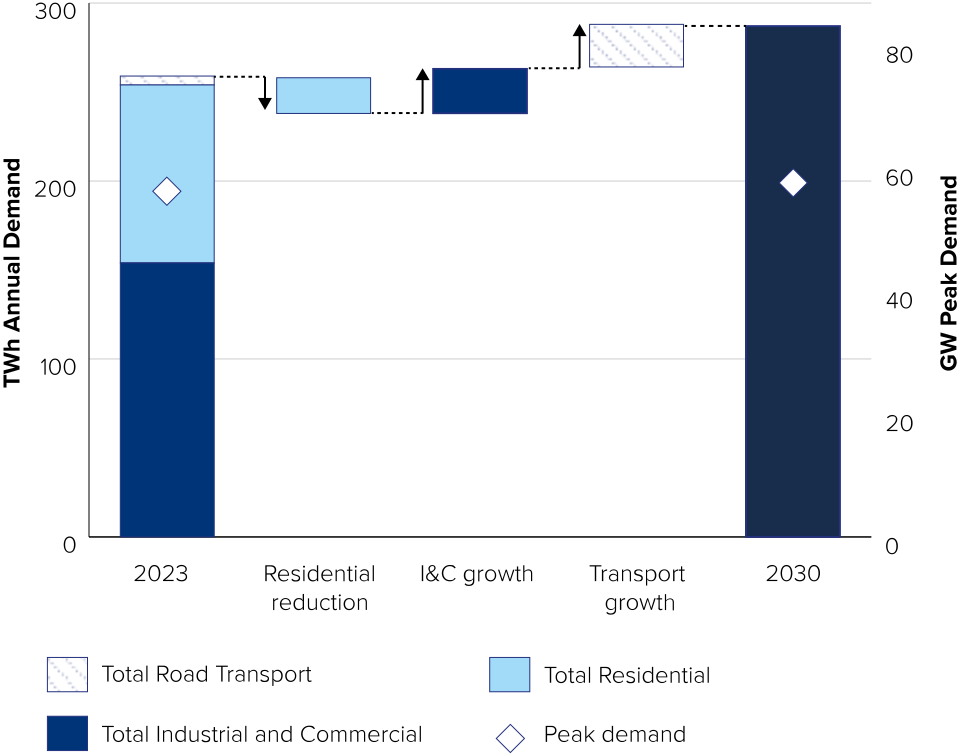
Electricity demand is expected to at least double by 2050, due to the rapid growth in power demand driven by decarbonisation efforts. The main drivers of this increase include the electrification of heating, transport and industrial processes
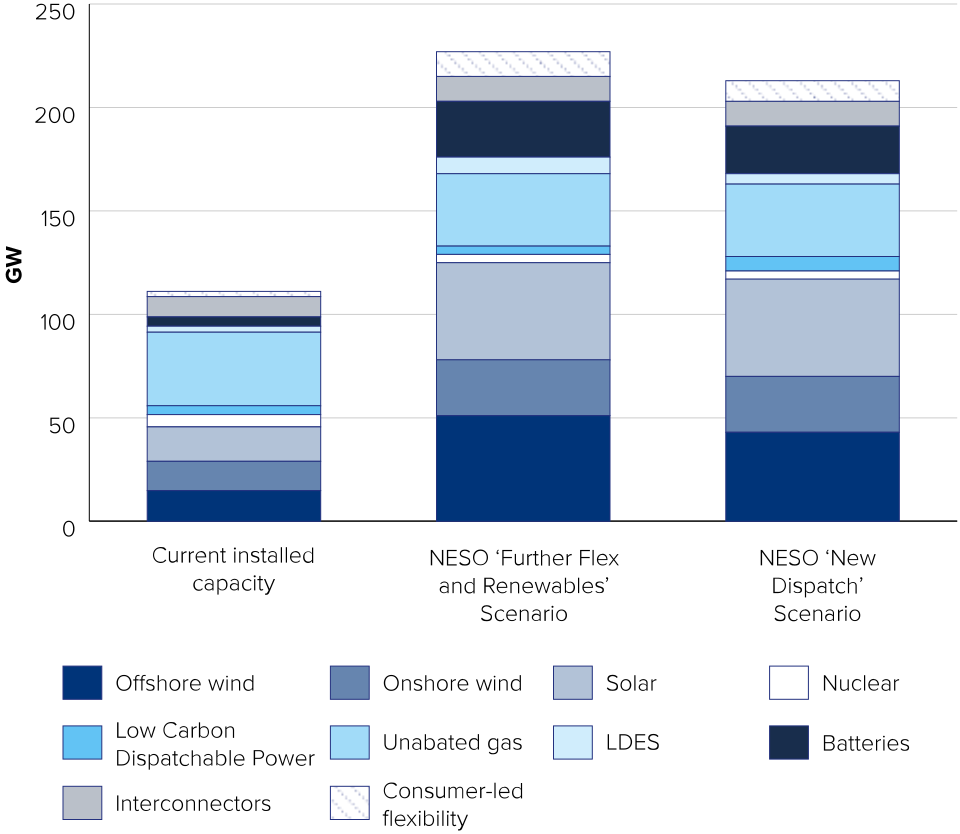
The Clean Power 2030 Action Plan and specifically the graph below shows us that this is expected to be delivered without increasing peak demand by much...
For us, the answer has been local battery storage, so electricity is always cheap (as long as the battery is large enough) and our grid usage is predominantly off peak. Maybe battery storage is part of the solution - you don't need a huge battery to store sufficient energy during the daytime solar glut to see through the evening peak, or at least substantially reduce it (smooth out the peak demand curve). For the cost of upgrading the grid, you could probably install a 10kW battery in every home in the UK (or better yet, mandate batteries for all new builds and landlords/let properties).
I wonder how much would the grid upgrades cost, just the actual planning and capacity increases.. There are 30 million dwellings in the UK, so even if each BESS would only cost 2.5k per household, we are talking about 75 billion.
Again, this is a very useful contribution to the discussion from both contributors.
But I think there's an incorrect assumption about the number of Domestic BESS that are 'required'.
Let me suggest that we could avoid the majority of grid upgrades if only 10% of homes were to have battery storage. That's very achievable within the timescales.
We could mandate a 10kW battery for each new dwelling... ... and provide grant incentives for batteries in all social housing, to be installed over 5 years.
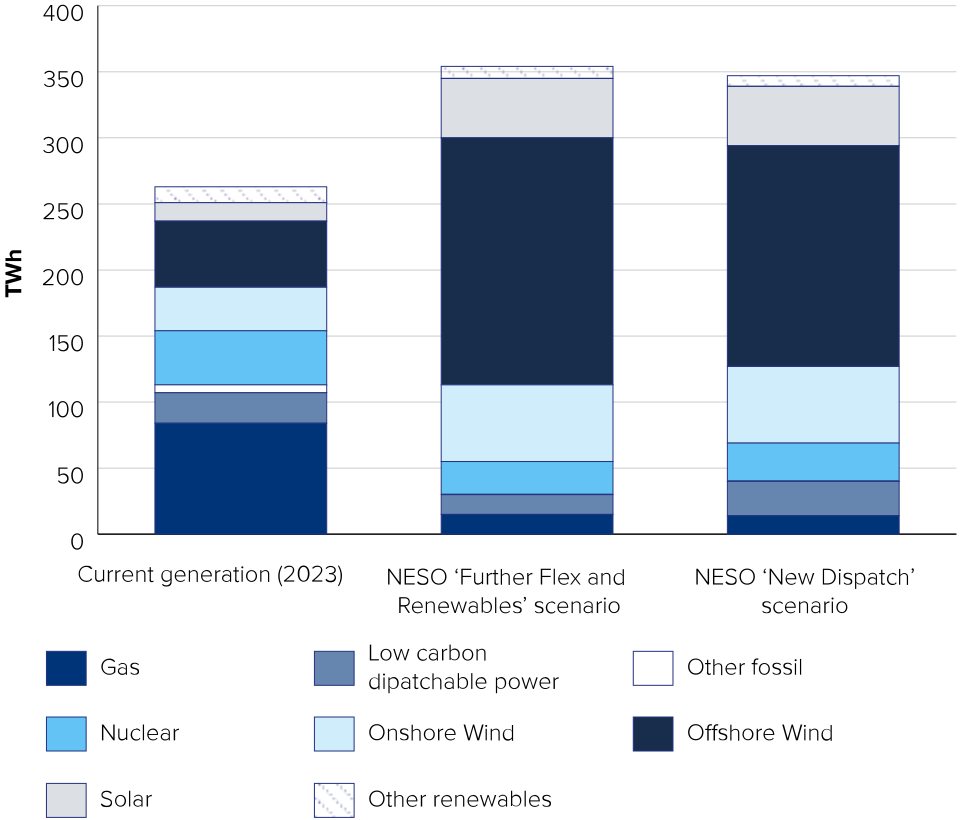
When looking at the above capacity increases, it would be useful to see who could commit to delivering some of the battery capacity using domestic BESS.
I wonder what types of technologies, ownership model, grid connections and to which level of grid, etc is behind those assumptions for battery capacity..
Given all the geo political uncertainty, the "how" cannot have been assumed. What seems relatively clear is that the pace of change needs to accelerate. And since the increase in distribution of energy via the grids is expected to be achieved without much impact to peak usage, this would require a new capability to monitor (and manage?) the grids.
As I am not even providing input into the UK gov policy, I am very comfortable having more questions than answers!
8kW Solis S6-EH1P8K-L-PLUS hybrid inverter; G99: 8kW export; 16kWh Seplos Fogstar battery; Ohme Home Pro EV charger; Vaillant Arotherm Pro 7kW; 100Amp head, HA lab on mini PC
I wonder if things are really so doomy and gloomy. I accept the validity of n=1 is as useful as a politicians promise, however, I remember as a kid in the 70s and 80s, there were constant power cuts, lights flickering etc.
I don’t recall experiencing a power cut in the last 10 years. Feels like the supply is highly reliable and robust, to me as a consumer at least.
Well said. Far too many people IMHO think Government is easy and both civil servants and politicians stupid.
Personally I don't believe either. Government is about balancing tricky and complicated choices in an attempt to change things which have enormous inertia and over which you have limited power and information, in an ever changing and largely hostile world, whilst forever under the spotlight of a largely hostile media.
I suspect part of the problem is that in some areas, particularly energy, civils servants and politicians are increasingly going beyond the limits of their expertise, making major decisions on what are quite complex topics where they don't have a full view and understanding of the implications, which tends to result in poor decisions and equally poor outcomes.
@papahuhu unfortunately not the case. Frequency incidents measured in time have increased. In 2021 alone the EU grid had two major incidents, classed as Scale 2.
Well said. Far too many people IMHO think Government is easy and both civil servants and politicians stupid.
Personally I don't believe either. Government is about balancing tricky and complicated choices in an attempt to change things which have enormous inertia and over which you have limited power and information, in an ever changing and largely hostile world, whilst forever under the spotlight of a largely hostile media.
I suspect part of the problem is that in some areas, particularly energy, civils servants and politicians are increasingly going beyond the limits of their expertise, making major decisions on what are quite complex topics where they don't have a full view and understanding of the implications, which tends to result in poor decisions and equally poor outcomes.
Perhaps, or perhaps they are going beyond the limits of what is known by anyone, expert or otherwise. If @transparent is to be believed, that is certainly the case, because there is a lot we don't actually know about the future demand, the state of the current network and other factors.
Are decisions 'poor' because, several years later and armed with more information, it turns out that a better decision could have been made had the information been known at the time. I would suggest not.
Like it or not we frequently have to make decisions based on partial, some might say inadequate, information. The temptation is to put the decision off, but that too has consequences. At this point you have to ask the question, what is better, the 'wrong' (ie possibly suboptimal but we cant yet tell) decision or no decision. Very frequently its the first of these!
I often liken decision making of this kind to a journey where you don't have any access to a map, GPS or a compass, but do have a very vague idea of the relationship between cities and know about the sun. Suppose you are in London and (with those limitations) want to get to 44, Scotland Street, Edinburgh, by the same time the next day. You cant possibly know how to get there, but you do know that, if you stay put, you will fail. So you head roughly North (judged by the sun) on the grounds that, even if you haven't picked the optimum route its better, almost for sure, than staying in London. You end up in Liverpool but there you encounter people who can tell you how to get to Carlisle, which you know is further North still. In Carlisle you are told that you are actually heading for Glasgow, so you turn right a bit. You may make another course correction or two but eventually, and provided you keep going, you will end up in Edinburgh, which would not have happened if you hadn't set off north in the first place. Once you get to the borders of Edinburgh someone says 'its near the centre' so you head towards the centre. Then you ask around and (in this case) discover it doesn't actually exist, but fortunately number 43 does and it turns out that this will do a whole lot better than being in London!
Did you make sub-optimal decisions, certainly. Did you make wrong decisions - not in the context in which they were made. The same applies to decisions that politicians have to make almost every day.
This post was modified 8 months ago 9 times by JamesPa
4kW peak of solar PV since 2011; EV and a 1930s house which has been partially renovated to improve its efficiency. 7kW Vaillant heat pump.