

Notifications
Clear all
Joining the Renewable Heating Hub forums is completely free and only takes a minute. By registering you’ll be able to ask questions, join discussions, follow topics you’re interested in, bookmark useful threads and receive notifications when someone replies. Non-registered members also do not have access to our AI features. When choosing your username, please note that it cannot be changed later, so we recommend avoiding brand or product names. Before registering, please take a moment to read the Forum Rules & Terms of Use so we can keep the community helpful, respectful and informative for everyone. Thanks for joining!

21/02/2026 3:51 pm
@transparent Thats really helpful Can I summarise what I 'take away' to test if Ive got it rioght
Let's recognise that NESO isn't well placed to make decisions on the 90% of the electricity network which operates at 11kV. It isn't monitored, nor are the local substations which it supplies.
Thats key then. You have said that the 11kV network is the 'main problem' but we dont have any data to monitor it. Thats a bit pants. Is there a reason why voltage data from smart meters cant be used?
Connecting renewable generation/storage sites at the higher voltage levels is easy to assess for upgrades. There's data available for these routes and it's easy to check a map which shows cable routes which are already overloaded. The DNO simply declares that an upgrade is required, for which the DNUoS element in consumer bills must be increased. Ofgem agrees because there's no alternative being presented.
OK so this is monitored and thus its an easier decision, however are you saying that anyone has the right to connect their generation anywhere and the public must pay for the upgrade of the transmission network to allow them to do so?
There's no regional energy plan in place to allow strategic decisions to be made. Companies wishing to add yet more generation simply refer to 'Government policy' to meet Net Zero, and apply pressure to ensure that their applications can't be rejected at the Planning stage.
The earliest that a Regional Energy Strategic Plan could be created is 2029, because NESO need until the end of 2028 to create the maps, governance and methodology on which such a plan could be built.
That half answers my previous question but then it implies that the underlying problem with regulating the transmission network is the time it takes to create a strategic plan, which begs the question - if its needed now (is it?) why wasn't it started earlier (dont feel obliged to answer that).
However returning to what you say is the biggest problem, the 11kV network, we dont have any monitors so we dont know whats going on so we cant make good decisions seems to be the message.
Im still none the wiser how nodal pricing contributes to solving either problem. Is that another reason it was rejected, there isn't an easily understandable reason for it that solves a known problem?
Have I misunderstood anything?
This post was modified 8 months ago by JamesPa
4kW peak of solar PV since 2011; EV and a 1930s house which has been partially renovated to improve its efficiency. 7kW Vaillant heat pump.

21/02/2026 6:29 pm
As @jamespa is recognising, this subject is too massive for me to post all at once.
I'm attempting to use graphics to provide a flavour of what's happening.... and I hope others reading this (incl NESO staff) can pick up the concepts and unearth more data.
Let's recognise that NESO isn't well placed to make decisions on the 90% of the electricity network which operates at 11kV. It isn't monitored, nor are the local substations which it supplies.
Thats key then. You have said that the 11kV network is the 'main problem' but we dont have any data to monitor it. Thats a bit pants. Is there a reason why voltage data from smart meters cant be used?
Smart Meter data is available only in 30-minute chunks.
Every time a licensed data agent sends a command to Smart Meter, DCC levies a fee.
That's why Energy Suppliers gather consumption data for all 48 periods in one go, just after midnight.
It's not a good candidate for monitoring.
We need to think carefully what sort of data is required and how much of it.
To better assess what's happening at the 11kV level, we don't need thousands of readings from measurement points in the same town. Most of those 11kV routes will only be a mile or two long, and there'll be little voltage drop to record.
In rural areas it's different. Cable runs could be 20km or more:
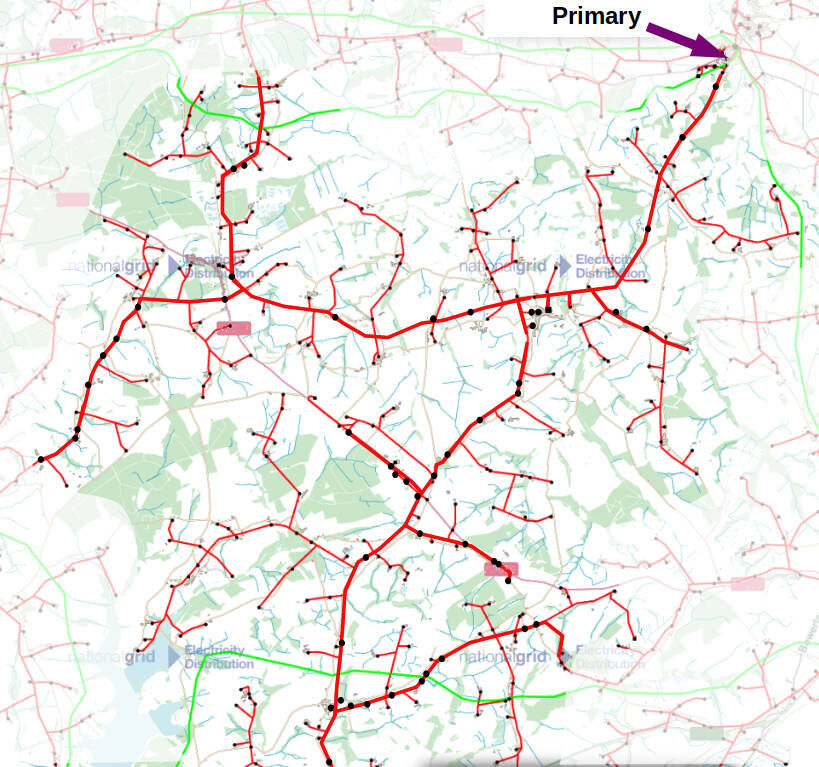
I've emboldened the 11kV (red) routes with 3-phase in order to contrast that with the extensive split-phase routes which supply farms and small clusters of housing.
The anonymised area shown can be supplied from more than one 11kV route. It depends where the DNO engineers have implemented 'Opens' to prevent current flowing. As this particular area is managed by NGED, they've inherited a transformer topology created by Western Power whereby all 11kV routes are in the same 'Vector Group'. That allows more than one Primary Substation to supply the same area simultaneously, as required.
Ask more about Vector Groups if you think you need to know.
Voltage drop is dependent on both demand and the cable thickness, which decreases further away from the Primary.
To obtain an initial idea of what's happening on the 11kV run supplying the West side of the map, we'd probably need just three monitors: One in the middle of the run, one about 1km from the Primary, and the third one 5% – 10% from the end of the route. Data collected at intervals of 5mins would be sufficient to show what's happening.
If those monitors were part of a community-based arrangement, no licence would be required, and the data could be uploaded to the Cloud across domestic WiFi links. That's an option not available to DNOs, which is why community collaboration needs to be encouraged.
It's often the case that the DNO will keep a somewhat higher voltage in the town where the Primary is sited, in order to ensure that the LV won't fall below 216.4v at the extremities. I'm within 1km of my Primary, and I'd usually receive 244v and above.
To allow yet more commercial generation to be added to the 33kv & 132kV levels of the grid, the ENA is proposing to reduce the LV to the 230v standard, rather than retain it at the more common 240v. The same proportion of voltage reduction would occur across all levels of the Distribution Grid. That doesn't require a change of legislation and could be implemented very soon.
Lowering the grid voltage across all voltage levels would indeed provide greater headroom for generation, but it would actually adversely affect the 11kV level. At 240v, a demand of 3kW from a heat-pump would require 12.5A of current. Drop the voltage to 230v and that heat-pump now needs 13.04A.
Drawing more current will result in greater voltage drop at the extremities!
How would nodal pricing help?
To avoid the expense of yet more grid upgrades, it's important to reduce the peaks.
Total demand can continue to rise as we progress towards Net Zero, but grid capacity is measured only in relation to peak demand.
Consumers aren't simply going to avoid drawing power when there's high demand because we're altruistic. There needs to be a financial incentive.
DESNZ intends reducing demand peaks by implementing a centralised control mechanism called Consumer Led Flexibility (CLF).
But without grid monitoring they'll have no idea of how that's affecting the 11kV and LV levels.
CLF allows 3rd party agents to switch off appliances within the home during times of high demand.
My alternative would be to use autonomous controllers, which could double-up as a voltage monitoring site.
There's enough computing power in a voltage monitor to intelligently time-slice demand across the 11kV network, and then reward the household for their participation. The obvious candidates to have such autonomous control assigned to them are in-home storage batteries and EV chargers. Neither will suffer if recharging simply gets spread across a longer period of time.
This post was modified 8 months ago 2 times by Transparent
Save energy... recycle electrons!

21/02/2026 8:25 pm
How would nodal pricing help?
To avoid the expense of yet more grid upgrades, it's important to reduce the peaks.
Total demand can continue to rise as we progress towards Net Zero, but grid capacity is measured only in relation to peak demand.
Consumers aren't simply going to avoid drawing power when there's high demand because we're altruistic. There needs to be a financial incentive.
Having used ToU tariffs for a couple years now, I fear I'm in the minority of people who would respond favourably to financial incentives. My wife and other family members, who don't pay the bill, have little regard for whether electricity is cheap or expensive - it's simply a commodity that is always available at the flick of a switch. My wife doesn't want to be inconvenienced nor have to think about load shifting to cheaper times of day. She wants to do things when it's convenient for her - maybe a behaviour that has been entrenched from a lifetime of flat rate tariffs.
For us, the answer has been local battery storage, so electricity is always cheap (as long as the battery is large enough) and our grid usage is predominantly off peak. Maybe battery storage is part of the solution - you don't need a huge battery to store sufficient energy during the daytime solar glut to see through the evening peak, or at least substantially reduce it (smooth out the peak demand curve). For the cost of upgrading the grid, you could probably install a 10kW battery in every home in the UK (or better yet, mandate batteries for all new builds and landlords/let properties).
Samsung 12kW gen6 ASHP with 50L volumiser and large radiators. 7.2kWp solar (south facing), Tesla PW3 (13.5kW). Net Zero

22/02/2026 1:13 am
How would nodal pricing help?
To avoid the expense of yet more grid upgrades, it's important to reduce the peaks.
Total demand can continue to rise as we progress towards Net Zero, but grid capacity is measured only in relation to peak demand.
Consumers aren't simply going to avoid drawing power when there's high demand because we're altruistic. There needs to be a financial incentive.
I agree incentives are needed. We are an unusual home but we still need an incentive to choose to not switch some appliances during peak times.
@judith shared a few slides describing the emergence of several peaks, as many heatpumps will not be working at the same rate day and night, EV cars will tend to be charged overnight, etc.
Electricity consumption is expected to grow 50% in the next decade. Can this growth be accommodated in the current power lines by using them more efficiently? Do they not need to be more reliable with a reducing role of the separate gas and fuel distribution networks for heating and transport?
For us, the answer has been local battery storage, so electricity is always cheap (as long as the battery is large enough) and our grid usage is predominantly off peak. Maybe battery storage is part of the solution - you don't need a huge battery to store sufficient energy during the daytime solar glut to see through the evening peak, or at least substantially reduce it (smooth out the peak demand curve). For the cost of upgrading the grid, you could probably install a 10kW battery in every home in the UK (or better yet, mandate batteries for all new builds and landlords/let properties).
I wonder how much would the grid upgrades cost, just the actual planning and capacity increases.. There are 30 million dwellings in the UK, so even if each BESS would only cost 2.5k per household, we are talking about 75 billion.. And would most people rush to take them or even accept them? Of course upgrading the grids is likely to face significant opposition and so extra cost.
8kW Solis S6-EH1P8K-L-PLUS hybrid inverter; G99: 8kW export; 16kWh Seplos Fogstar battery; Ohme Home Pro EV charger; Vaillant Arotherm Pro 7kW; 100Amp head, HA lab on mini PC

22/02/2026 10:45 am
For us, the answer has been local battery storage, so electricity is always cheap (as long as the battery is large enough) and our grid usage is predominantly off peak. Maybe battery storage is part of the solution - you don't need a huge battery to store sufficient energy during the daytime solar glut to see through the evening peak, or at least substantially reduce it (smooth out the peak demand curve). For the cost of upgrading the grid, you could probably install a 10kW battery in every home in the UK (or better yet, mandate batteries for all new builds and landlords/let properties).
I wonder how much would the grid upgrades cost, just the actual planning and capacity increases.. There are 30 million dwellings in the UK, so even if each BESS would only cost 2.5k per household, we are talking about 75 billion.. And would most people rush to take them or even accept them? Of course upgrading the grids is likely to face significant opposition and so extra cost.
Sounds a lot, but in context google tells me:
National Grid is undertaking a massive, multi-billion pound upgrade to the UK electricity network to meet 2035 decarbonization targets, with total investment requirements estimated
between £58 billion and £90 billion for the next phase of development.
But as we all know, the cost of inaction will be far greater.
This post was modified 8 months ago 2 times by Old_Scientist
Samsung 12kW gen6 ASHP with 50L volumiser and large radiators. 7.2kWp solar (south facing), Tesla PW3 (13.5kW). Net Zero
22/02/2026 10:47 am
Electricity consumption is expected to grow 50% in the next decade. Can this growth be accommodated in the current power lines by using them more efficiently? Do they not need to be more reliable with a reducing role of the separate gas and fuel distribution networks for heating and transport?
A big part of the problem, at least on this forum, seems to be that we dont know what the problem is! Im beginning to doubt that its known nationally other than in a handwaving way, as so far, whilst @transparent (who clearly has his finger on the pulse) has given us lots of helpful information, he hasn't been able to dimension it, suggesting it may well not be known.
Having used ToU tariffs for a couple years now, I fear I'm in the minority of people who would respond favourably to financial incentives
I think you may well be right, which may be why compulsion is being considered! Financial incentives only go so far, particularly if exploiting them is inconvenient (for example, to do my washing at night time rate, I have to stay up until 10.30 because my washing machine only has a 2 hour delay - thats inconvenient so I dont always do it).
My alternative would be to use autonomous controllers, which could double-up as a voltage monitoring site.
My vote as well. If I take my house as an example, with an EV and a heat pump, a little local control with almost zero inconvenience to me would easily limit peaks to perhaps 3kW, possibly even less, as opposed to the 6kW I occasionally see.
Basically turn the heat pump off when I switch the kettle or grill on, turn it down and stop charging the car when I switch the oven on, a couple of other appliances to deal with that are on for a short time only, job done. All it needs is a CT clamp on the incomer, a bit of intelligence and connections to the existing controls for the EV and heat pump. Link it to a feed from the grid informing the controller whether there was actually a grid level problem (or monitor the voltage) and it could autonomously avoid cutting things when it didn't need to do so. If enforcement is necessary then I could be charged a penal amount if the consumption exceeds a specified figure during periods of grid stress.
This post was modified 8 months ago by JamesPa
4kW peak of solar PV since 2011; EV and a 1930s house which has been partially renovated to improve its efficiency. 7kW Vaillant heat pump.

22/02/2026 11:44 am
Power limits are very common in France, typically 9kVA for a household, although anything from 3-36(3phase) is perhaps available. The higher the kVA rating, the higher the unit charge, hence a financial incentive to manage peak loads!
In contrast the uk public has been pandered to somewhat, and the assumption is electricity is always available - we have a 100A fuse, so I expect up to 20kVA being available. I’ve never managed to get that high, despite trying! Synchronous charging of both elec cars, heatpump, home batt, oven + 2 rings and kettle gave 16kW. Guess I could’ve added toaster and couple more rings, it all seemed too contrived to worry about though.
1
22/02/2026 11:50 am
Electricity consumption is expected to grow 50% in the next decade. Can this growth be accommodated in the current power lines by using them more efficiently? Do they not need to be more reliable with a reducing role of the separate gas and fuel distribution networks for heating and transport?
A big part of the problem, at least on this forum, seems to be that we dont know what the problem is! Im beginning to doubt that its known nationally other than in a handwaving way, as so far, whilst @transparent (who clearly has his finger on the pulse) has given us lots of helpful information, he hasn't been able to dimension it, suggesting it may well not be known.
I agree. The more I read, the more I feel there are multiple disparate organisations, with no clearly coordinated plan of action compounded by the fact that these are long-term issues requiring long-term planning and solutions not befitting of the 5 year electoral cycle.
Having used ToU tariffs for a couple years now, I fear I'm in the minority of people who would respond favourably to financial incentives
I think you may well be right, which may be why compulsion is being considered! Financial incentives only go so far, particularly if exploiting them is inconvenient (for example, to do my washing at night time rate, I have to stay up until 10.30 because my washing machine only has a 2 hour delay - thats inconvenient so I dont always do it).
Haha, even with an 8hour delay available on our washing machine, my wife will still not put it on overnight as she says the washing smells if left in the machine and not hung out when the washing cycle finishes. So rather than wash at 6am on cheap rate and leave it sat in the machine for a couple hours, we wash as 9-10am when we get up. The battery now largely solves the cost issue and effectively shifts our usage to 'cheap rate', but illustrates the complete ineffectiveness of ToU incentives. She does not care if it's twice the cost at 9am. People have busy lives and planning their day around ToU tariffs is apparently not realistic.
My alternative would be to use autonomous controllers, which could double-up as a voltage monitoring site.
My vote as well. If I take my house as an example, with an EV and a heat pump, a little local control with almost zero inconvenience to me would easily limit peaks to perhaps 3kW, possibly even less, as opposed to the 6kW I occasionally see.
Basically turn the heat pump off when I switch the kettle or grill on, turn it down and stop charging the car when I switch the oven on, a couple of other appliances to deal with that are on for a short time only, job done. All it needs is a CT clamp on the incomer, a bit of intelligence and connections to the existing controls for the EV and heat pump. Link it to a feed from the grid informing the controller whether there was actually a grid level problem (or monitor the voltage) and it could autonomously avoid cutting things when it didn't need to do so. If enforcement is necessary then I could be charged a penal amount if the consumption exceeds a specified figure during periods of grid stress.
I have no objections in principle but I think this is rife with issues.
I would not want my heat pump being switched on/off every time I boil the kettle - heat pump compressors are not designed to be short cycled like that (but they could be remotely turned down to minimum to keep things ticking over). I don't see heat pump usage as a huge issue though? When used as continuous low temperature heating, the usage is relatively low (less than 1kWh for many homes) and constant throughout the day so does not cause the peak demand spikes. Banning 3kW kettles and restricting to 1kW kettles may have more effect at flattening the demand curve, at least locally.
If anything, ToU tariffs have now created a surge in our demand. Our cheap rate Cosy slot starts at 1pm, and everything gets turned on. The battery starts pulling 4-5kW for charging, the DHW cycle gets turned on and the heat pump is now drawing 3-4kW instead of 1kW. We cook dinner so the oven or air fryer gets turned on. The smart meter IHD is definitely flashing red from 1-2pm. In summer when we have abundant solar, I try to spread things out a little so much of it gets absorbed by our own generation, but in winter that first hour of cheap rate gets hammered and we can easily pull in excess of 10kW
Samsung 12kW gen6 ASHP with 50L volumiser and large radiators. 7.2kWp solar (south facing), Tesla PW3 (13.5kW). Net Zero

22/02/2026 12:15 pm
Haha, even with an 8hour delay available on our washing machine, my wife will still not put it on overnight as she says the washing smells if left in the machine and not hung out when the washing cycle finishes.
er - rinse hold is the solution to that particular problem assuming that the machine features the facility.
I would not want my heat pump being switched on/off every time I boil the kettle
Most of the time it wouldn't be every time, it would only occur if the heating were high and the kettle was switched on and there was a grid peak. A few time a year most likely!
But its also perfectly fine of you dont want to - you dont have to - you can pay three times the standing charge - or whatever is necessary to cover the cost of the grid strengthening, so that everyone who will exercise a modicum of constraint doesn't have to pay for upgrades for those who wont! Just make the standing charge depend on peak capacity.
This post was modified 8 months ago by JamesPa
4kW peak of solar PV since 2011; EV and a 1930s house which has been partially renovated to improve its efficiency. 7kW Vaillant heat pump.
1

22/02/2026 12:21 pm
@batpred Another non sequitur maybe but I'll justify it as another facet to all this :-): I wrote a couple of letters to our Climate Action and Energy minister (yes, we have one up here). The first went in the "complaint about energy" bin and I got something back about fuel poverty which is pressing but wasn't my point. In my second letter I projected a curve through their installation figures to their target for 2030, pointed out that they were going to miss their target by a factor of somewhere between 8 and 12 and asked what they were going to do about it. I made points about tariffs, an uncertain energy landscape and so on. Previously I have got back "We'd love to but this is a UK decision" but this time I got back that they fully accept the issues about tariffs but are focussing on net zero by 2045 and are shifting the transition into the early 2030s to take advantage of "technological innovation already taking place to build workforce capacity, consumer demand and economies of scale required".
I then started a reply to the gentleman thanking him for his frankness and I was going to go on, "yes but ..." when I realised the double-bind that they are in. If they kick the can too far down the road then we're going to have unachievable targets again, maybe due to sheer numbers in a costly scramble to replace heating systems in 2 million homes or quite possibly due to a lack of trained and competent installers. If they press on now then they'll be encouraging people to adopt what may in hindsight be non-optimal solutions.
I think I'm going to say that they need to press on at least to a degree and incentivise people to keep installing zero-carbon systems even if in 5 or 10 years time they may have made the wrong decision (so offer conversion grants in a few years to offset the risk). If they don't then where is all this installer expertise going to come from? The problem is not new-build estates which are designed with this technology in mind and won't require much heating anyway, rather a shortage of installers who have seen every variety of retro-fits to existing CO2-generating properties, many of which will be one-offs. We're the ones finding all the gotchas, debugging the process and providing a reservoir of examples to go into the general corpus of knowledge.
I managed to get myself a competent and experienced firm of installers but I'm pretty sure that they had never seen an installation quite like mine. They rose to the challenge though, I think they quite enjoyed it and I know that all of us learned from the experience. That experience needs to be multiplied by about 1,000 in Scotland alone within the next 10-15 years.
1

22/02/2026 12:45 pm
@jamespa
What you are describing from a phenomenological perspective is the difference between something being ready to hand and present at hand. As soon as a technology requires a conscious intervention it conceals and devalues our enjoyment of our surroundings, forcing our consciousness to focus on the technology as an object once again.
The only successful technological solutions are ones which require little or no intervention, whether it be Heideggers well made hammer or an electricity supply. Having to make daily decisions on what to turn on and when is doomed to fail.
Something is amiss that is not positive for the human condition. Until the 2000s I never gave a second thought about whether I can flush the toilet after excreting or when to turn on the oven.
22/02/2026 12:58 pm
Power limits are very common in France, typically 9kVA for a household, although anything from 3-36(3phase) is perhaps available. The higher the kVA rating, the higher the unit charge, hence a financial incentive to manage peak loads!
This is the norm in Portugal, Spain and I think much of Italy. Essentially people pay for the guarantee of a service with that max capacity, they would never have 100amp without needing it. If their base load increases with a HeatPump, you could assume they would request more contracted power. And this can be tricky as it may require upgrades.
Their considerations with Increases of electricity consumption with decarbonisation may be less severe but then they have the Aircon increases to deal with (even if PV production is bound to be very aligned to consumption patterns).
8kW Solis S6-EH1P8K-L-PLUS hybrid inverter; G99: 8kW export; 16kWh Seplos Fogstar battery; Ohme Home Pro EV charger; Vaillant Arotherm Pro 7kW; 100Amp head, HA lab on mini PC

SPONSORS

Degrees of Separation

Latest Posts
-

RE: Heat pump branding. Clever, contemporary… or a bit too much?
I think Heat Geek have done an amazing job on their bra...
By Tomtheheatingengineer , 5 hours ago
-
RE: HeatGeek vs Octopus surveys: puzzling disparity - any ideas why?
I have just had 3 heat loss surveys, one by heat geek o...
By David , 5 hours ago
-
RE: Heat Geek Zero Disrupt: Are We Sleepwalking Into Another Race to the Bottom?
I think that's the key question. After all inverter uni...
By Prunus , 7 hours ago
-
RE: battery storage without solar
As of October 1st they need specific qualifications to ...
By EtchedPixels , 8 hours ago
-
RE: How should the Boiler Upgrade Scheme be reformed?
A unit which uses water to transfer the heat/chill from...
By Temperature_Gradient , 8 hours ago
-
RE: Renewables & Heat Pumps in the News
With regards to the BUS grant raid, I gave it more thou...
By ASHP-BOBBA , 8 hours ago
-
RE: Why are ASHP installs so expensive?
The whole system seems to work on the basis of...
By ian33a , 9 hours ago
-
RE: Missing flow temperature in Heat Geek proposal
Good plan. If you can get half hourly meter readings a...
By JamesPa , 14 hours ago
-
RE: Heat Pumps Without Grants: Would You Have Installed One & Will You Now?
@editor Most certainly. The heat pump was an ideal s...
By Abernyte , 14 hours ago
-
Although regulations may well vary from country to coun...
By Majordennisbloodnok , 15 hours ago
-
RE: Does anyone have experience of a smart water meter?
Yep I caught our slow leak from a £100 bill rise 8)
By EtchedPixels , 15 hours ago
-
RE: Do You Need a Buffer Tank or Low Loss Header for Underfloor Heating in a Large Property?
@jamespa in some cases, failing the Turing test might b...
By GrahamF , 18 hours ago
-
RE: Passiv Smart Thermostat - Help & Forum Support
@energystoragetech The heat capacity of some...
By JamesPa , 20 hours ago
-
RE: tepeo ZEB UK Support & Info Thread
Sorry you are correct, I was remembering figures from t...
By JamesPa , 1 day ago




SPONSORS