Joining the Renewable Heating Hub forums is completely free and only takes a minute. By registering you’ll be able to ask questions, join discussions, follow topics you’re interested in, bookmark useful threads and receive notifications when someone replies. Non-registered members also do not have access to our AI features. When choosing your username, please note that it cannot be changed later, so we recommend avoiding brand or product names. Before registering, please take a moment to read the Forum Rules & Terms of Use so we can keep the community helpful, respectful and informative for everyone. Thanks for joining!
@majordennisbloodnok you say "let’s not forget that there’s a whole world of businesses out there who don’t use batteries for time shifting, so there will still be significant peak and trough demand times."
This is doubtless true now and they are bound to be behind the curve but is that always going to be the case? In Scotland 98% of businesses have under 50 employees and the median no. of employees per firm excluding those with zero is in the range 1-4. These will be in small offices, single-fronted shops, working out of home or domestic properties adapted for business, etc, etc. There will be a whole slew of different problems (imagine trying to put heat pumps in all premises in your average High Street) and I'm guessing that the emphasis will be on community heating schemes instead or just blower fires. Many business premises will be deserted out of working hours so the pattern is bound to be different from domestic use. Even if they don't charge battery packs is it not the case that anything that deviates from the domestic pattern is going to level out the usage peaks and troughs eventually?
A big part of the problem, at least on this forum, seems to be that we dont know what the problem is! Im beginning to doubt that its known nationally other than in a handwaving way, as so far, whilst @transparent (who clearly has his finger on the pulse) has given us lots of helpful information, he hasn't been able to dimension it, suggesting it may well not be known.
It takes a lot of effort for someone external to join all the data.
The increase of electricity consumption is inevitable, but the grids need to be sized to cope with the worst case, where Cornwall may not have much usable wind nor solar during a few days in the winter and windpower is plentiful off East Anglia..
It makes sense for folks like Octopus to request all sorts of details about our low carbon technology, but there is a conflict of interest at play. And from what @transparent describes in terms of incentives on DNOs, it is also not ideal that I am providing all details to UKPN. On the other hand, if central government asked me for the same data, they could anonymise it and still make it usable at the right level by the right organisation.. Like AI/ML can analyse a dataset to tell what properties (e.g. the year the house was built, how many rooms, if it has a heatpump, the capacity of the solar panels, etc) correlate with whatever behaviour is being measured, like the power requirement at a particular time.
I agree. The more I read, the more I feel that there are multiple disparate organisations, with no clearly coordinated plan of action compounded by the fact that these are long-term issues requiring long-term planning and solutions not befitting of the 5 year electoral cycle.
That is very much how it seems to me, there are clear goals set at national level but it is much less clear what each of these organisations need to do, the governance of it. But as I am not advising any level of government in any of this, I do not need to know..
@batpred Another non sequitur maybe but I'll justify it as another facet to all this :-): I wrote a couple of letters to our Climate Action and Energy minister (yes, we have one up here). The first went in the "complaint about energy" bin and I got something back about fuel poverty which is pressing but wasn't my point. In my second letter I projected a curve through their installation figures to their target for 2030, pointed out that they were going to miss their target by a factor of somewhere between 8 and 12 and asked what they were going to do about it. I made points about tariffs, an uncertain energy landscape and so on. Previously I have got back "We'd love to but this is a UK decision" but this time I got back that they fully accept the issues about tariffs but are focussing on net zero by 2045 and are shifting the transition into the early 2030s to take advantage of "technological innovation already taking place to build workforce capacity, consumer demand and economies of scale required".
I am glad they are starting to see the questions! These targets were set with agreement from all major parties a decade or so ago.
I am glad this gov made the point that much of the building has not been happening. And pragmatic decisions like to build offshore cables to improve things. I am curious as to the rate of meetings they have with fossil fuel bosses vs decarbonisation champions. But have no sense that it could be any worse than what happened during the previous decade.. I wonder if they made an honest assessment of all the curves that are way off target. As that would probably be needed to instill a sense of urgency and speed up the approval of projects.
8kW Solis S6-EH1P8K-L-PLUS hybrid inverter; G99: 8kW export; 16kWh Seplos Fogstar battery; Ohme Home Pro EV charger; Vaillant Arotherm Pro 7kW; 100Amp head, HA lab on mini PC
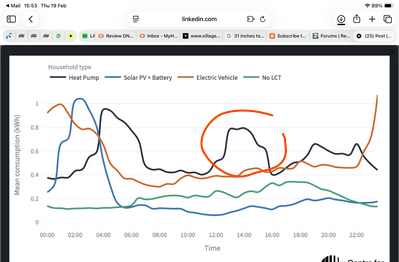
@judith shared a few slides describing the emergence of several peaks, as many heatpumps will not be working at the same rate day and night, EV cars will tend to be charged overnight, etc.
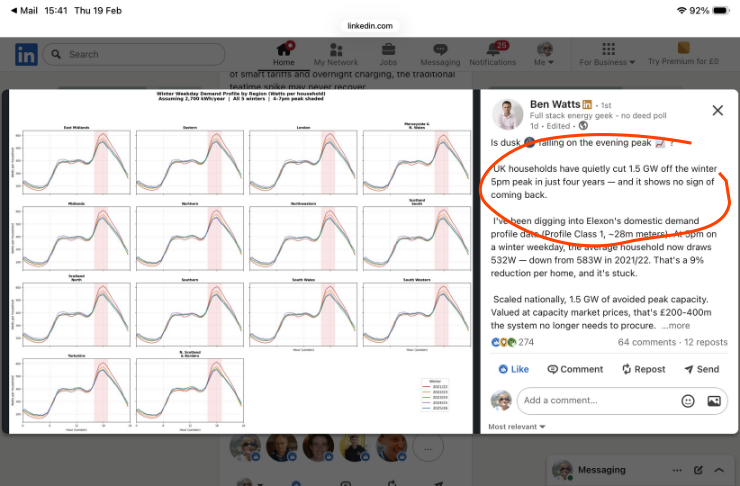
GB's domestic demand has been slowly reduced over the past few years.
That's because we're acting on the messages from Sir David Attenborough, Hugh Fernley-Whittingstall and Greta Thunberg. We've been buying LED lighting and other low-energy appliances for the home.
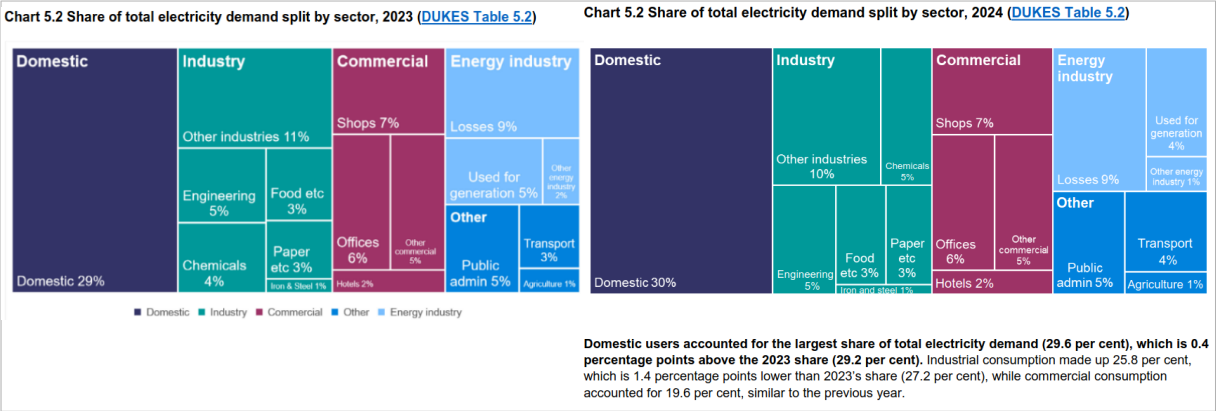
It was only in 2024 that the annual DUKES data showed a small increase in domestic electricity consumption, from 29.2% to 29.6%
I've also checked with National Grid Electricity Transmission (NGET) what are their forecasts for the next decade, by which time the move to EVs will have been the most significant factor. Their in-house modelling is that if Britain switched to EVs instantaneously, the Grid would need to carry an additional 10%.
That's much less than I'd expected, and nowhere near the overall 50% increase for which @batpred provided the link.
For us, the answer has been local battery storage, so electricity is always cheap (as long as the battery is large enough) and our grid usage is predominantly off peak. Maybe battery storage is part of the solution - you don't need a huge battery to store sufficient energy during the daytime solar glut to see through the evening peak, or at least substantially reduce it (smooth out the peak demand curve). For the cost of upgrading the grid, you could probably install a 10kW battery in every home in the UK (or better yet, mandate batteries for all new builds and landlords/let properties).
I wonder how much would the grid upgrades cost, just the actual planning and capacity increases.. There are 30 million dwellings in the UK, so even if each BESS would only cost 2.5k per household, we are talking about 75 billion.
Again, this is a very useful contribution to the discussion from both contributors.
But I think there's an incorrect assumption about the number of Domestic BESS that are 'required'.
Let me suggest that we could avoid the majority of grid upgrades if only 10% of homes were to have battery storage. That's very achievable within the timescales.
We could mandate a 10kW battery for each new dwelling... ... and provide grant incentives for batteries in all social housing, to be installed over 5 years.
Why social housing, I hear you ask?
Because they're more likely to be in energy poverty and have prepayment meters. With no access to ToU tariffs, they contribute proportionally more to peak demand than the rest of us. Moving those households to ToU pricing with home-batteries will significantly reduce the peaks, whilst simultaneously lifting them out of poverty.
Unless GB changes tack, that level of debt would still continue to increase, for which the rest of us will be paying more on our bills to fund the next years' write-offs. It's cheaper to act now to stop that future debt by subsidising domestic battery installations.
If I take my house as an example, with an EV and a heat pump, a little local control with almost zero inconvenience to me would easily limit peaks to perhaps 3kW, possibly even less, as opposed to the 6kW I occasionally see.
Basically turn the heat pump off when I switch the kettle or grill on, turn it down and stop charging the car when I switch the oven on, a couple of other appliances to deal with that are on for a short time only, job done. All it needs is a CT clamp on the incomer, a bit of intelligence and connections to the existing controls for the EV and heat pump.
It's interesting to see @jamespa inventing such a control system... ... because half the work has actually already been done!
Did you know that our SMETS2 meters already have Load Limiting and Load Control features inbuilt? It's just they're not used because there's no profit to be made by Energy Suppliers if they were 'turned on'!
Isn't this what Ofgem is meant to be doing when it's tasked with acting as Energy Regulator for the interests of Consumers?!
have no objections in principle but I think this is rife with issues.
I would not want my heat pump being switched on/off every time I boil the kettle
Don't worry @old_scientist – it doesn't have to be that draconian. 😯
There are several ways in which the features could be implemented, including a higher per-kWh rate if you exceed the Load Limit Threshold for more than 4 minutes.
The organisation who's busy working on switching off domestic heat pumps during peak periods is DESNZ, not @jamespa !
I wrote a couple of letters to our Climate Action and Energy minister...
[...] I was going to go on, "yes but ..." when I realised the double-bind that they are in. If they kick the can too far down the road then we're going to have unachievable targets again
Firstly I'm absolutely delighted to know that you're busy engaging with elected representatives who are charged with these responsibilities. That's excellent news.
Such politicians and Government Officers too seldom hear from those of us who do actually understand the basic science behind our energy supply systems. If we don't brief them, then we can hardly expect them to make decisions which are viable, both in financial terms and in keeping with the laws of physics.
How do you 'brief' an elected representative? Well we could all start by taking information from this discussion, especially the graphics, and send it to them as a PDF!
And don't let's forget NESO either.
They are now 'our' independent Energy Systems Operator, who have been assigned (by Ofgem) the task of setting up the Regional Energy Strategic Plan organisations.
Each region now has around a dozen staff who are busy running webinars and creating 'governance' and 'methodology' to allow these RESPs to form and function.
Perhaps they're spending a bit too much time making up regulations, and too little on understanding the fundamentals of how the lower levels of the electricity supply system actually works. (That's a personal view from a RESP participant!).
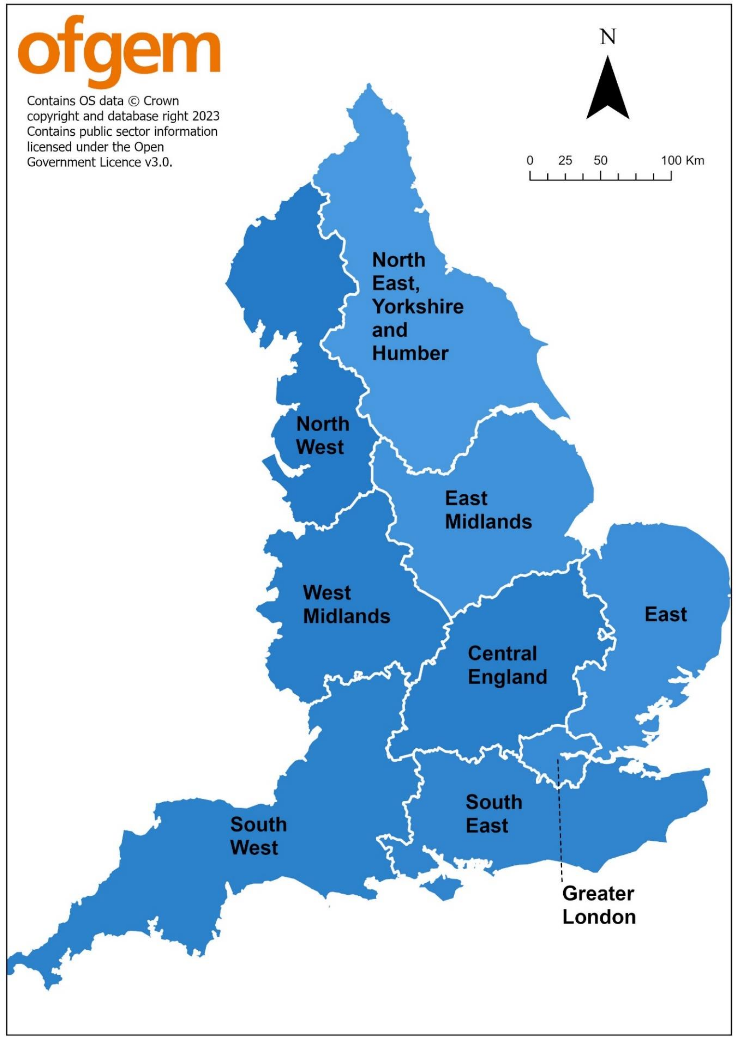
But those RESP Teams can be contacted and asked to consider what we're discussing here. Find which Region you're in (detailed maps from page 72 of this Ofgem Decision Notice), and them send an email to the generic RESP address, marked for the attention of your own regional RESP Team Manager.
You should obviously provide URLs to this Discussion Topic, but try to ask a direct question like "How are the RESP teams able to assess the lower grid levels, which have so little monitoring to create data?" rather than "Please read this entire Topic and comment"!
Don't be surprised if the reply you receive includes an invitation to join in with the next interactive webinar for your region. NESO has to find 'community members' (AKA @batpred 's decarbonisation champions) to take part in working groups and sit on strategic boards.
This post was modified 8 months ago 5 times by Transparent
@judith shared a few slides describing the emergence of several peaks, as many heatpumps will not be working at the same rate day and night, EV cars will tend to be charged overnight, etc.
GB's domestic demand has been slowly reduced over the past few years.
That's because we're acting on the messages from Sir David Attenborough, Hugh Fernley-Whittingstall and Greta Thunberg. We've been buying LED lighting and other low-energy appliances for the home.
Thanks, this is what I referred to. Good question on the peak that the curve for dwellings with a heat pump in the middle of the day, could this be due to TOU tariffs encouraging that behaviour?
The reduction of overall domestic use could well be due to LED use. Ours were installed over a decade ago...
I would have to look more into the 50% growth. But just focusing on new appliances that are adding to electricity use:
heatpump usage will increase domestic consumption (supported by the curve)
much of EV charging is likely to be domestic use
some aircon use can also be expected.
So it did not seem strange to grow 50% in 10 years.. But I also do not know if the effect of replacing economy 7 heaters with heatpumps will be significant, amongst many other things I am missing.
But perhaps the governance of these quangos needs to be assessed to confirm if it is enough to ensure the grid can cope in the post transition scenario. The elected politicians are not naturally able to grasp these topics.
My concern is that if decisions to change it are postponed, they may need to be made later under more pressure and in a political climate of overall distrust of the current regulatory framework. In the past, the public tended to vote for small changes to be made to the system. But these days, the extremes (of no state or full state involvement) seem to be attracting more support.
This post was modified 8 months ago 2 times by Batpred
8kW Solis S6-EH1P8K-L-PLUS hybrid inverter; G99: 8kW export; 16kWh Seplos Fogstar battery; Ohme Home Pro EV charger; Vaillant Arotherm Pro 7kW; 100Amp head, HA lab on mini PC
They are now 'our' independent Energy Systems Operator, who have been assigned (by Ofgem) the task of setting up the Regional Energy Strategic Plan organisations.
Each region now has around a dozen staff who are busy running webinars and creating 'governance' and 'methodology' to allow these RESPs to form and function.
Perhaps they're spending a bit too much time making up regulations, and too little on understanding the fundamentals of how the lower levels of the electricity supply system actually works. (That's a personal view from a RESP participant!).
But those RESP Teams can be contacted and asked to consider what we're discussing here. Find which Region you're in (detailed maps from page 72 of this Ofgem Decision Notice), and them send an email to the generic RESP address, marked for the attention of your own regional RESP Team Manager.
You should obviously provide URLs to this Discussion Topic, but try to ask a direct question like "How are the RESP teams able to assess the lower grid levels, which have so little monitoring to create data?" rather than "Please read this entire Topic and comment"!
Don't be surprised if the reply you receive includes an invitation to join in with the next interactive webinar for your region. NESO has to find 'community members' (AKA @batpred 's decarbonisation champions) to take part in working groups and sit on strategic boards.
That´s a great idea..
But I also wanted to share some simple analysis.
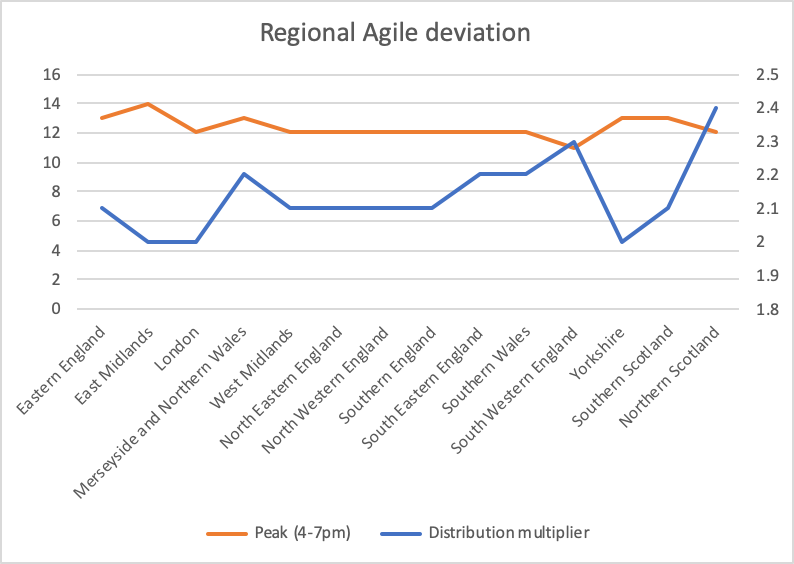
I was trying to investigate Agile pricing and specifically why there are different prices in different regions. But then I am wondering if the regions below are just different names for the ones in the Ofgem map above, or do they cover slightly different areas?
Region Name Eastern England East Midlands London Merseyside and Northern Wales West Midlands North Eastern England North Western England Southern England South Eastern England Southern Wales South Western England Yorkshire Southern Scotland Northern Scotland
Coming back to the agile pricing that Octopus shared, the price in p/kW is essentially min(D x W + P, 95)
• D is a coefficient that includes our distribution costs, which varies based on where you are in Britain; • W is the wholesale cost of electricity for that period in pence per kilowatt-hour (p/kWh); • P is the peak-time premium, which ranges from 11 - 14 based on where you are, and is only applied between 4pm and 7pm. • 95 is chosen to ensure the price is capped at 100p/kWh once VAT is added.
This is what seems to be different across the country, I wonder if this means that initiatives that reduce distribution cost would result in the multipliers reducing and so a reduction overall costs in that region? Below, I used the ones an energy guru shared.
Are the substation losses accounted for at national or at regional level, etc?
8kW Solis S6-EH1P8K-L-PLUS hybrid inverter; G99: 8kW export; 16kWh Seplos Fogstar battery; Ohme Home Pro EV charger; Vaillant Arotherm Pro 7kW; 100Amp head, HA lab on mini PC
@batpred You only need to look at a few figures to see what is being assumed here: Again, this is Scotland - I don't have all the figures for the UK but you can scale up:
There are 700 plumbing firms in the country and the policy statement is to complete 2,000,000 installations by 2045. I make that about 100,000 installations per annum or 150 installations per firm per annum if you start now. If you potter around till "the mid 2030s" (not my words) but say 2034, then that figure goes up to 190. That won't happen overnight. Extrapolating from 2024, there were about 8,800 installations *in the country* last year.
@transparent's post shows another aspect of the government's double bind - move too quickly and the distribution network won't be there.
@batpred You only need to look at a few figures to see what is being assumed here: Again, this is Scotland - I don't have all the figures for the UK but you can scale up:
...
@transparent's post shows another aspect of the government's double bind - move too quickly and the distribution network won't be there.
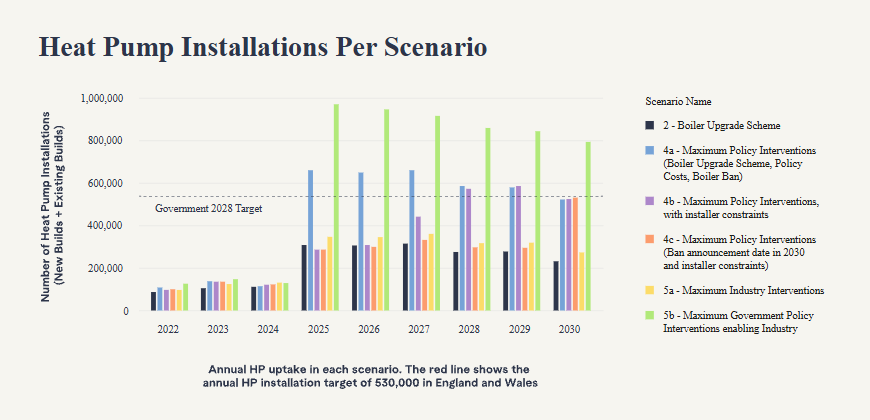
Yes, below are the projected figures from just three years ago...
I came across a 2022 paper that expected 300k boilers gone with BUS in 2025. With our total by all schemes being 60k heatpumps installed in 2025, the grid usage pattern cannot have changed as expected..
So if we can infer anything from the past, this other factor (consumer decisions to take up low carbon technologies) may continue to be very difficult to estimate. Very strong inertial forces....
There´s no risk of moving too slowly to build.. 😀 That Guardian article also mentions a target that electricity should be 95% non fossil fuel sources by 2030.
8kW Solis S6-EH1P8K-L-PLUS hybrid inverter; G99: 8kW export; 16kWh Seplos Fogstar battery; Ohme Home Pro EV charger; Vaillant Arotherm Pro 7kW; 100Amp head, HA lab on mini PC
... the price in p/kW is essentially min(D x W + P, 95)
• D is a coefficient that includes our distribution costs, which varies based on where you are in Britain; • W is the wholesale cost of electricity for that period in pence per kilowatt-hour (p/kWh); • P is the peak-time premium, which ranges from 11 - 14 based on where you are, and is only applied between 4pm and 7pm. • 95 is chosen to ensure the price is capped at 100p/kWh once VAT is added.
This is what seems to be different across the country, I wonder if this means that initiatives that reduce distribution cost would result in the multipliers reducing and so a reduction overall costs in that region? Below, I used the ones an energy guru shared.
Are the substation losses accounted for at national or at regional level, etc?
Distribution costs in Yorkshire are similar to London´s. I wonder how that is achieved, or is it not the case that Yorks includes large sections of rural and so lower density dwellings?
8kW Solis S6-EH1P8K-L-PLUS hybrid inverter; G99: 8kW export; 16kWh Seplos Fogstar battery; Ohme Home Pro EV charger; Vaillant Arotherm Pro 7kW; 100Amp head, HA lab on mini PC
@batpred Has anyone seen anything about electricity tariffs for zero carbon community heating schemes? Nothing leaped out at me.
PS: we don't seem to have topics or forums here for community schemes but that's a whole different ball park. The technical and tariff issues pale into insignificance compared to the legal/building control/asbestos/planning/agreement/... issues in retro fitting such schemes to old city centre apartment blocks.
That's most likely because heat networks come within NESO's remit, and they're busy creating governance frameworks to address the issues.
Yes, it probably needs a new Forum Topic where it can be discussed, but I'm dismayed that the energy authorities are concentrating their efforts on "regulations and methodology" rather than construction and implementation. Worse still, their present interest is in identifying revenue sources to pay for all their administration work.
If we were to be discussing the heat-generation sources and resilience strategies, I could imagine several members here wanting to contribute. But it's unlikely to be a Topic which will inspire contributions if the subject matter is based on Public Consultations to pay for the administration of rules!
@judith shared a few slides describing the emergence of several peaks, as many heatpumps will not be working at the same rate day and night, EV cars will tend to be charged overnight, etc.
Let's just use our own common sense, and ask ourselves what the heck is the midday peak which I've circled in red? 🤔
Part of tackling the energy crisis needs us to question statistics and ensure we're actually focused on solving a real problem.
Thanks, this is what I referred to. Good question on the peak that the curve for dwellings with a heat pump in the middle of the day, could this be due to TOU tariffs encouraging that behaviour?
Absolutely, this is typical usage for Octopus Cosy users, where the daytime cheap rate slot is 1-4pm. I know from my own experience and usage data, that our own peak usage falls between 1-3pm as everything gets turned on - the battery pulls 5kW for recharging, the DHW gets turned on so the heat pump usage ramps up to 3-4kW, the oven/air fryer gets turned on to cook lunchtime meal, and any load shifting such as washing machine. Because it's all concentrated in that first 1-2h, it vastly exceeds our solar generation and results in a large grid spike.
It's not just heap pump usage, but general increased usage for people on a heat pump ToU tariff such as Cosy.
Samsung 12kW gen6 ASHP with 50L volumiser and large radiators. 7.2kWp solar (south facing), Tesla PW3 (13.5kW). Net Zero
Thanks, this is what I referred to. Good question on the peak that the curve for dwellings with a heat pump in the middle of the day, could this be due to TOU tariffs encouraging that behaviour?
Absolutely, this is typical usage for Octopus Cosy users, where the daytime cheap rate slot is 1-4pm. I know from my own experience and usage data, that our own peak usage falls between 1-3pm as everything gets turned on - the battery pulls 5kW for recharging, the DHW gets turned on so the heat pump usage ramps up to 3-4kW, the oven/air fryer gets turned on to cook lunchtime meal, and any load shifting such as washing machine. Because it's all concentrated in that first 1-2h, it vastly exceeds our solar generation and results in a large grid spike.
It's not just heap pump usage, but general increased usage for people on a heat pump ToU tariff such as Cosy.
Similar to what we do with the EV tariff, where we concentrate consumption overnight..
And it seems that in the Cosy case, it could also be that utilities are trying to simplify the tariffs (as some consumption could come from PV production). But clearly electrons do not stay behind to help out on days when it gets dark and cold.. 😀
8kW Solis S6-EH1P8K-L-PLUS hybrid inverter; G99: 8kW export; 16kWh Seplos Fogstar battery; Ohme Home Pro EV charger; Vaillant Arotherm Pro 7kW; 100Amp head, HA lab on mini PC