

Notifications
Clear all
Joining the Renewable Heating Hub forums is completely free and only takes a minute. By registering you’ll be able to ask questions, join discussions, follow topics you’re interested in, bookmark useful threads and receive notifications when someone replies. Non-registered members also do not have access to our AI features. When choosing your username, please note that it cannot be changed later, so we recommend avoiding brand or product names. Before registering, please take a moment to read the Forum Rules & Terms of Use so we can keep the community helpful, respectful and informative for everyone. Thanks for joining!

Topic starter
02/02/2025 6:45 pm
@heacol I recall a considerable amount of discussion (relating to LLH’s mainly rather than buffer tanks as such though) some while back and one of the threads is:
There were other threads along similar lines and this is where I felt a ‘consensus’ was evident. If I am wrong, my apologies to all for leading you astray!
In my own case, I have a Daikin heat pump and I THINK that the primary pump adjusts automatically to maintain a set Delta T. Having an LLH in circuit, I have attempted to adjust the speed of the Wilo Pico pump (secondary pump) to minimise temperature difference between flow to LLH and flow out of LLH to the Wilo pump. Similarly, I have attempted a similar arrangement for the return to the LLH in and the out returning to the heat pump. I find that at times, the balance is within 0.3 degrees C but at other times, this may be as much as a degree of difference!! I think both pumps have a degree of dynamic control and that this is the reason for the apparent variation. Regards, Toodles.
Toodles, heats his home with cold draughts and cooks food with magnets.

03/02/2025 11:35 am
@toodles I am totally against any form of system separation in a domestic environment and most commercial environments. I have installations with over 400 Kw in capacity and 9 heat pumps, all connected to a single flow and return, the separation/buffer arguments just do not stack up. Any form of separation makes things complicated and can cause significant performance losses. In my opinion, simplicity is always best.

03/02/2025 11:50 am
@toodles I am totally against any form of system separation in a domestic environment and most commercial environments. I have installations with over 400 Kw in capacity and 9 heat pumps, all connected to a single flow and return, the separation/buffer arguments just do not stack up. Any form of separation makes things complicated and can cause significant performance losses. In my opinion, simplicity is always best.
If only others took the same approach we would see far, far fewer posts on this forum (and others) complaining about poor performance, and indeed far fewer posts complaining about other problems, the origin of which it is difficult to diagnose due to the presence of system separation.
We would probably see an increase in posts about low flow errors which otherwise are masked by the buffer. But the underlying causes in many cases need to be fixed, so in many ways that's a good thing.
There is probably a business to be made from removing buffer tanks!
4kW peak of solar PV since 2011; EV and a 1930s house which has been partially renovated to improve its efficiency. 7kW Vaillant heat pump.
1

03/02/2025 10:24 pm
Maybe mine as well !As in Buffer remove.
New sensor in place and so to correct the flow indications between from HP to buffer /Tank there is a difference of 2.6 c. That is to say HP to tank and tank to emitters . Emitters return is 33.7 and Buffer/Tank to HP 36c
Too much or ?

04/02/2025 10:43 am
Maybe mine as well !As in Buffer remove.
New sensor in place and so to correct the flow indications between from HP to buffer /Tank there is a difference of 2.6 c. That is to say HP to tank and tank to emitters . Emitters return is 33.7 and Buffer/Tank to HP 36c
Too much or ?
Sorry if Ihave written this somewhere , but it didnt save .
I have visited the sensors this morning and after previously turning the secondary pump down to reduce the turbulance , I have also turned down the circulation pump one notch and results are this :
Flow from HP:41.4c, flow out of LLH :35.3c , return to LLH:31.5c and return from LLH to HP: 36.0c
Still too much of a drop I guess
Not great, 5C = 10-15% efficiency loss (much more according to @heacol). TBH I cant understand whats going on in the buffer, its like there is no stratification at all and you have essentially a vessel sitting there at ~36C, with both outputs therefore at this temperature. Im beginning to wonder if its correctly plumbed but cant remember if we have already discussed this. Is it worth posting (or reminding us of) some pictures indicating flow/return to/from HP/rads. Also please can you remind me how the pumps either side are controlled and in particular can you get to a situation where one is on and the other off for a reasonable period of time (thus, inevitably, 'stirring' the tank)?
04/02/2025 3:11 pm
Here is the layout as much as I can.
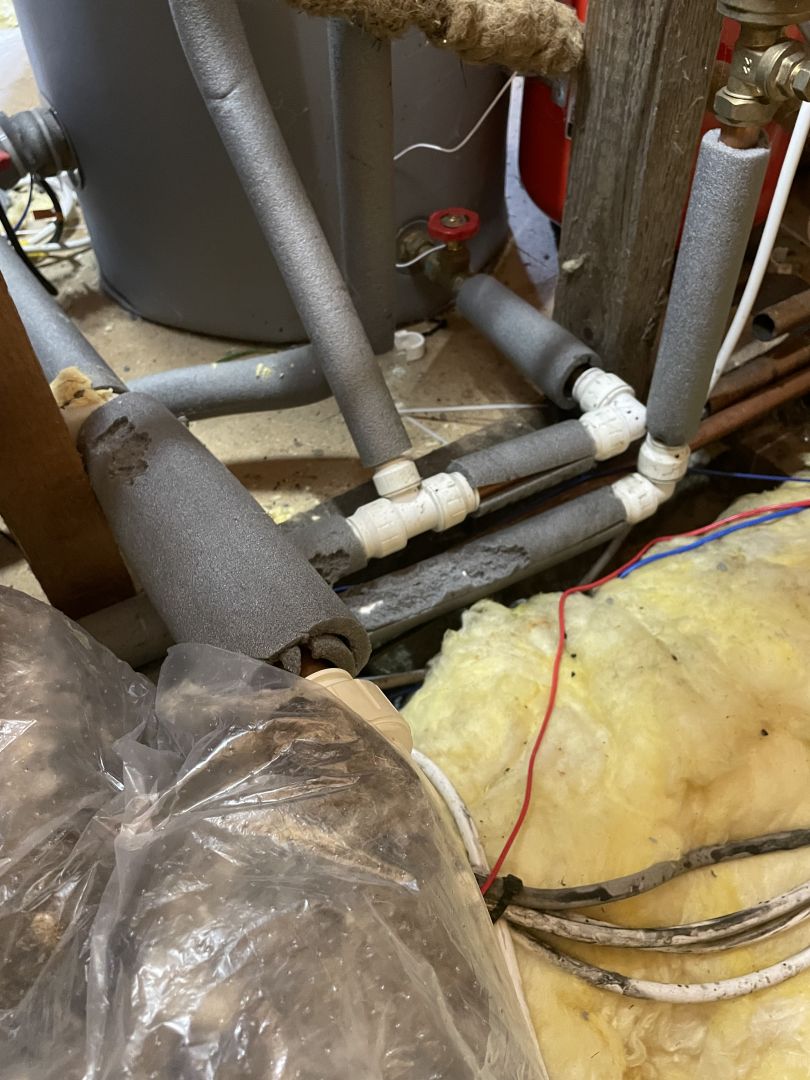
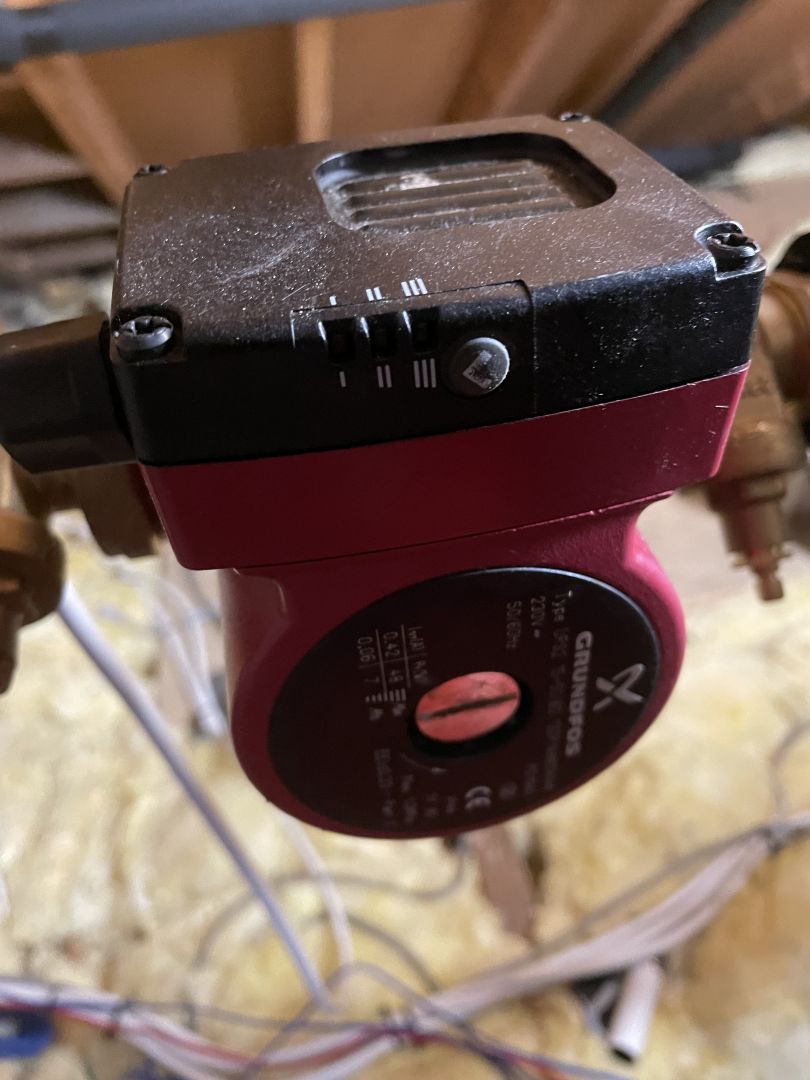
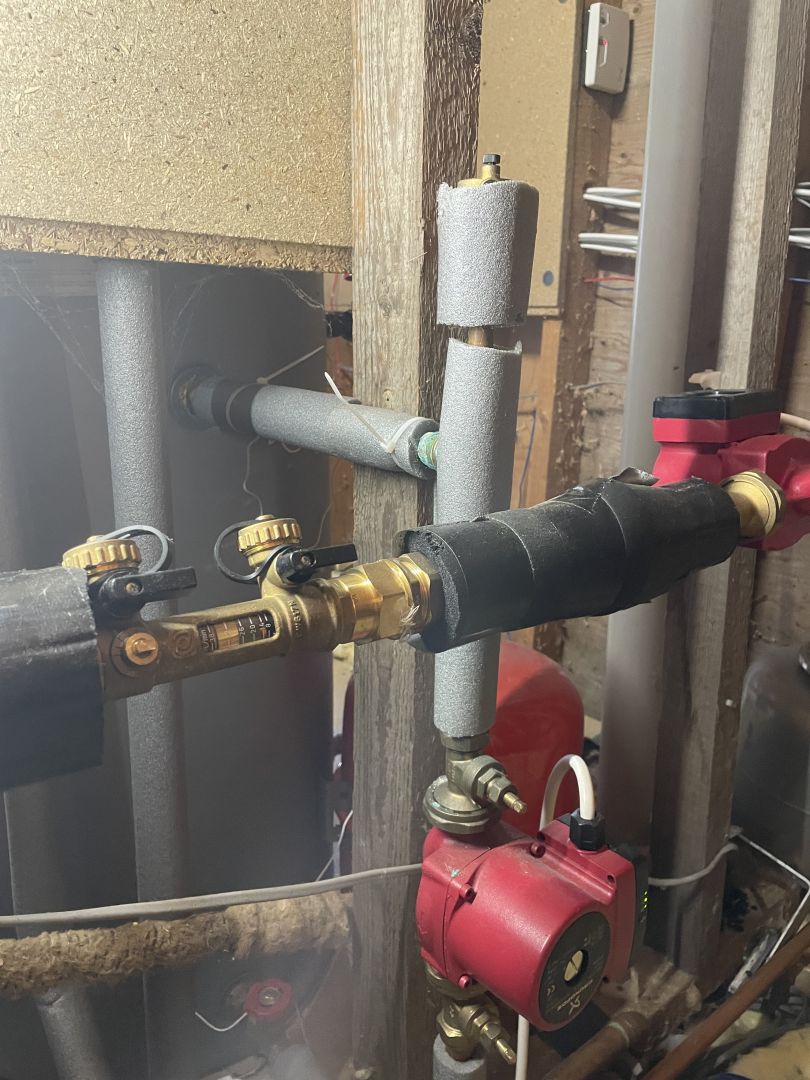
Above left Ch pipes
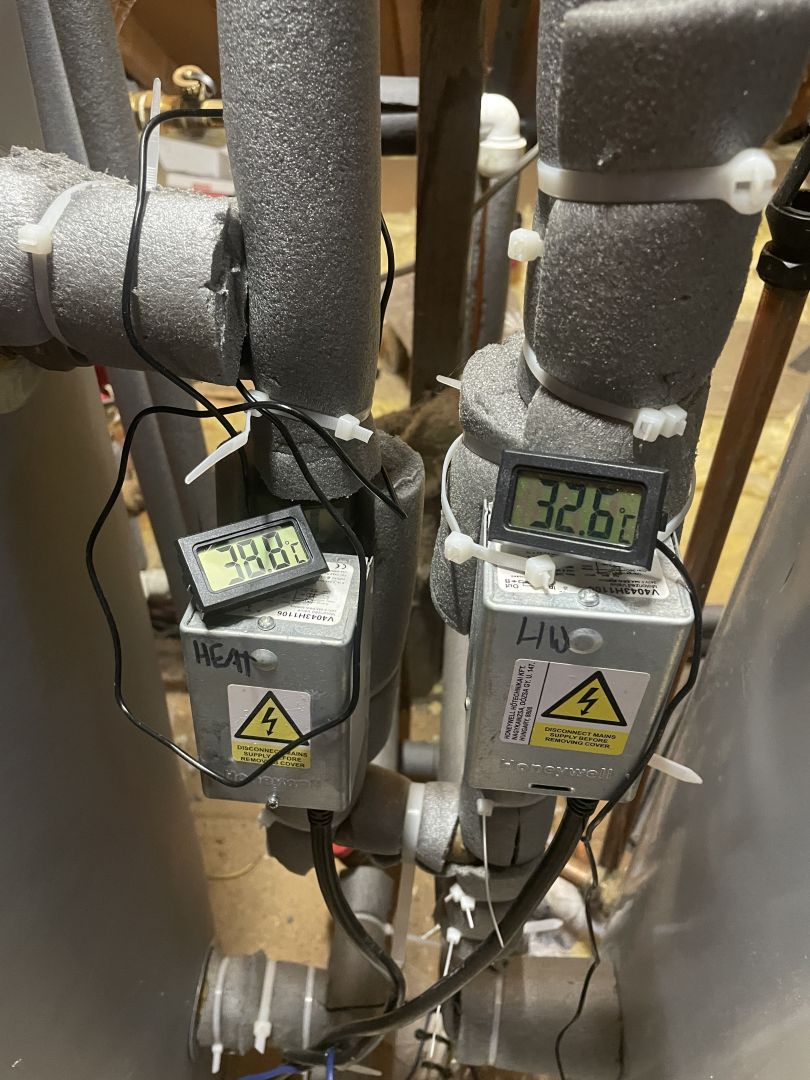
Above zone valves.
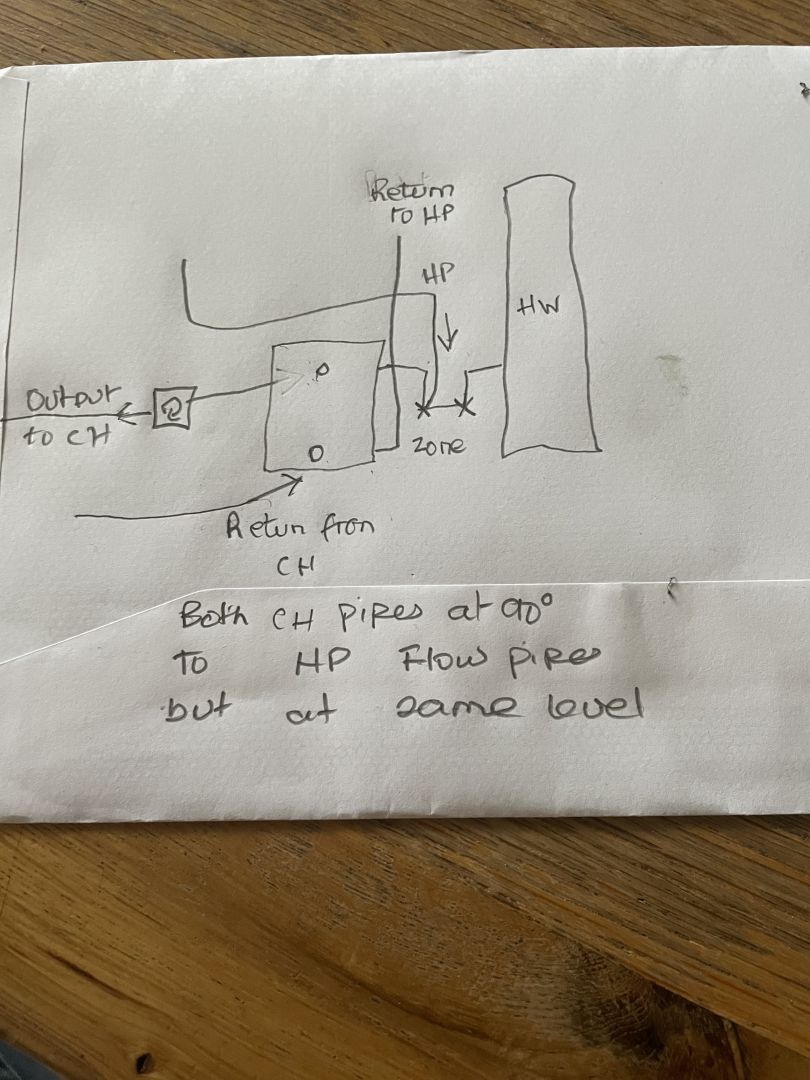
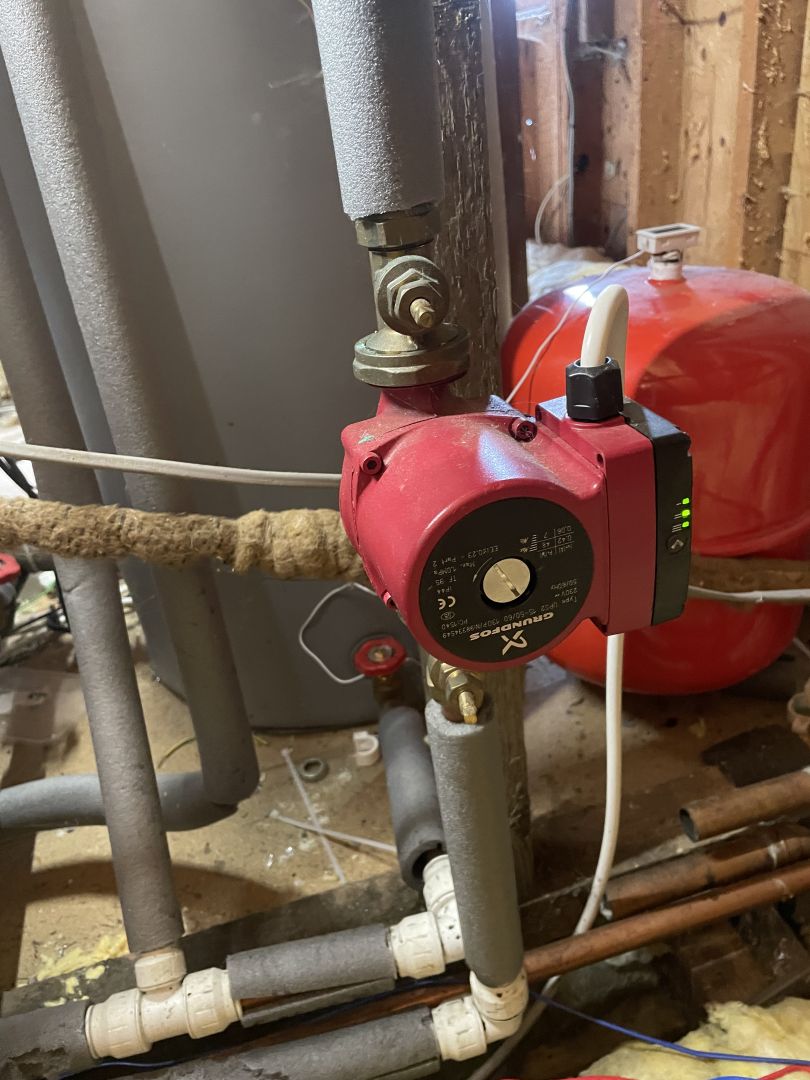
Above right flow from HP.
Above showing Ch pump on white pipes.
If there is anything more specific I will take more.
04/02/2025 3:26 pm
no diagram!
4kW peak of solar PV since 2011; EV and a 1930s house which has been partially renovated to improve its efficiency. 7kW Vaillant heat pump.
04/02/2025 6:49 pm
no diagram!
Ha should I have , sadly not, Only the one I have drawn.
What would you like to see , and I can give you some information

04/02/2025 7:47 pm
Sorry I didn't spot the pictures above.
Buffer tank looks very squat (which would explain lots). How high is it and what is the vertical distance between the ports.
Also what capacity is your heat pump and what diameter the pipes to the buffer tank.
4kW peak of solar PV since 2011; EV and a 1930s house which has been partially renovated to improve its efficiency. 7kW Vaillant heat pump.
04/02/2025 9:37 pm
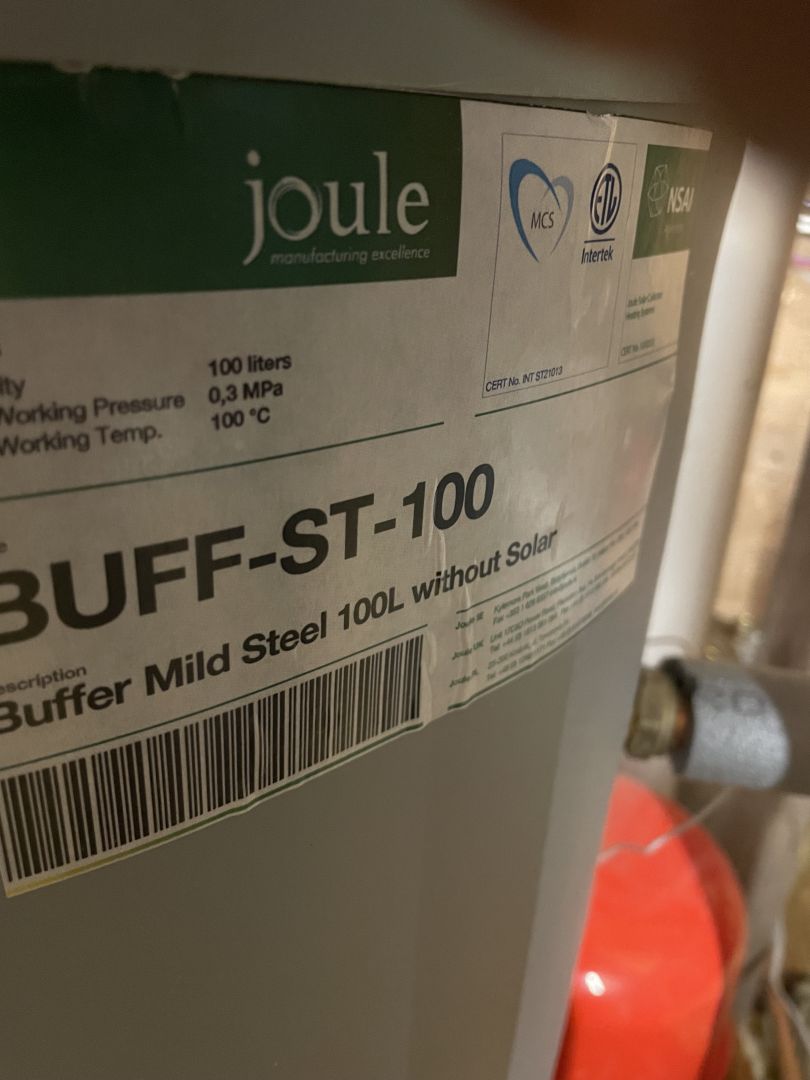
@jamespa Will check James
Tank Capacity is 200l Pipes are 28mm Copper , not sure if you want the size of CH pipes I can check but definitely smaller of course either 24 or 21mm . Tank vertical distance is 65cm for HP pipes and 67 cm roughly for CH.
05/02/2025 10:40 am
Thanks
Sadly with a 60cm high tank I think the chances of maintaining stratification (IE a temperature gradient from top to bottom, which is what you want) is negligible, which accounts for the almost complete mixing you observe with the temp sensors. Whilst the tank remains you are stuck with the 5C drop across it. I suspect that adjusting flow rates will make a marginal difference at best to this.
4kW peak of solar PV since 2011; EV and a 1930s house which has been partially renovated to improve its efficiency. 7kW Vaillant heat pump.
05/02/2025 10:53 am
@jamespa Thanks , looks like I should remove it then . Question I have , if the HP pipes are 28mm and they are directly connected to the smaller CH pipes , does that not cause a problem , except if you had control of the pump speeds ?
SPONSORS

Degrees of Separation
Latest Posts
-

RE: How will removing the standing charge on gas bills benefit heat pumps?
I think it has an enormous impact on air/air users. The...
By EtchedPixels , 16 minutes ago
-
RE: New Build 3 Phase or 1Phase
The solar is baked in by the building regulations these...
By EtchedPixels , 28 minutes ago
-
@editor Ouch, sorry to re start the tick. I had assume...
By DavidB , 17 hours ago
-
RE: Say hello and introduce yourself
@e-a-west as the good Major said, welcome to the forums...
By Mars , 19 hours ago
-
RE: How much of your renewable and home setup would still work if the internet went down?
Yes I actually have a copy of a tool that whenever a ce...
By EtchedPixels , 1 day ago
-
RE: Indevolt Batteries UK Support & Info Thread
@editor Hi, To resolve this, please tap on the A...
By Indevolt Tech , 1 day ago
-
RE: Double or Triple Glazed Windows?
Posted by: @singlespeed With 9 years repairing windo...
By Rob of York , 2 days ago
-
@transparent we’re still running a secure version of PH...
By Mars , 2 days ago
-
RE: How quickly would you want/expect heat recovery to take from setback?
Much longer than that here. The heating isn't even on. ...
By bobflux , 3 days ago
-
RE: Passiv Smart Thermostat - Help & Forum Support
Obviously the weather is changeable but there's a defin...
By Singlespeed , 3 days ago
-
RE: The Changing Jet Stream Could Challenge UK Air Source Heat Pumps
@rob-of-york I must admit that when we had a Daikin hea...
By Toodles , 3 days ago
-
RE: Forum updates, announcements & issues
Get the Renewable Heating Hub heads-up on WhatsApp. I...
By Mars , 3 days ago
-
RE: Safety study for plug in batteries out to tender - looks like Q3 2027 at best before legal
@editor I pointed out to the one of the Fuse execs that...
By dansus , 3 days ago
-
RE: 15kw pump for 225m2 1990's house - over kill?
@seaviews As well as loft insulation, there are othe...
By Rob of York , 3 days ago


SPONSORS

