Joining the Renewable Heating Hub forums is completely free and only takes a minute. By registering you’ll be able to ask questions, join discussions, follow topics you’re interested in, bookmark useful threads and receive notifications when someone replies. When choosing your username, please note that it cannot be changed later, so we recommend avoiding brand or product names. Before registering, please take a moment to read the Forum Rules & Terms of Use so we can keep the community helpful, respectful and informative for everyone. Thanks for joining!
How to control DHW with Honeywell EvoHome on Trianco ActiveAir 5 kW ASHP
Newbi - please be gentle. Got Trianco ActiveAir 5 kW ASHP, , an EV, some pv and batteries.
Have Honeywell Home control with wifi zone control TRV, Mission to discover how to control DHW
At a guess on the heat pump controller itself unless the Honeywell has been wired to control DHW also.
You may be better revisiting the space heating control and letting the heat pump controller do the heavy lifting, relegating the Honewell to a supporting role. If you are interested to hear some ideas please say, but if you are happy with your performance and comfort no need to change if you dont want to.
4kW peak of solar PV since 2011; EV and a 1930s house which has been partially renovated to improve its efficiency. 7kW Vaillant heat pump.
Newbi - please be gentle. Got Trianco ActiveAir 5 kW ASHP, , an EV, some pv and batteries.
Have Honeywell Home control with wifi zone control TRV, Mission to discover how to control DHW
At a guess on the heat pump controller itself unless the Honeywell has been wired to control DHW also.
You may be better revisiting the space heating control and letting the heat pump controller do the heavy lifting, relegating the Honewell to a supporting role. If you are interested to hear some ideas please say, but if you are happy with your performance and comfort no need to change if you dont want to.
sorry should have used quotes:
15/02/2026 10:55 pm
@jamespaHi, Thanks for the reply. I would appreciate some assistance please.
The Honeywell Home has an opportunity to monitor/ control? DHW as well but it wasn't set up during installation and the configuration menu is asking me to 'bind' to the DHW sensor. I'm not sure I have the wifi sensor fitted. There is a wired thermostat to monitor DHW. I saw the radiator wifi trvs being 'bound' during installation.
The hard wired display unit for the ASHP system is reasonably user friendly and will allow me to set DHW and Flow temps, as well as access some system parameters - No I haven't yet. The control is via a wifi link from the Honeywell Home unit which then activates hard wire comms with the ASHP. There is supposed to be a Data Transfer Unit (DTU) connected within the ASHP cabinet which would allow an ability to control the pump via a phone app. I have downloaded the app, scanned and inputted manual serial numbers where required but I cannot connect to the DTU and I have a 'DTU' in a wrapper left with packaging. I am assuming that the DTU has been removed so that comms can be controlled by the HH.
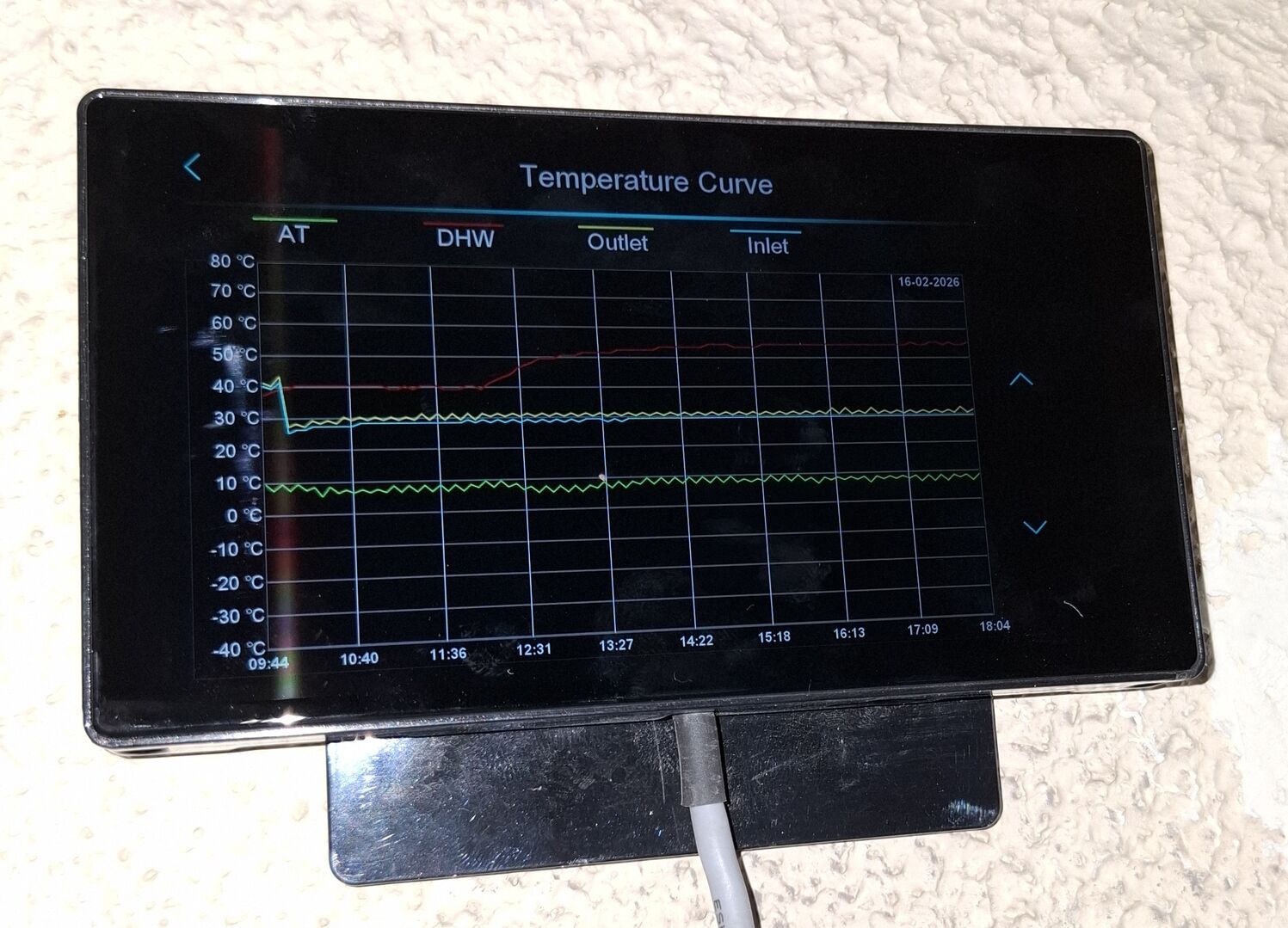
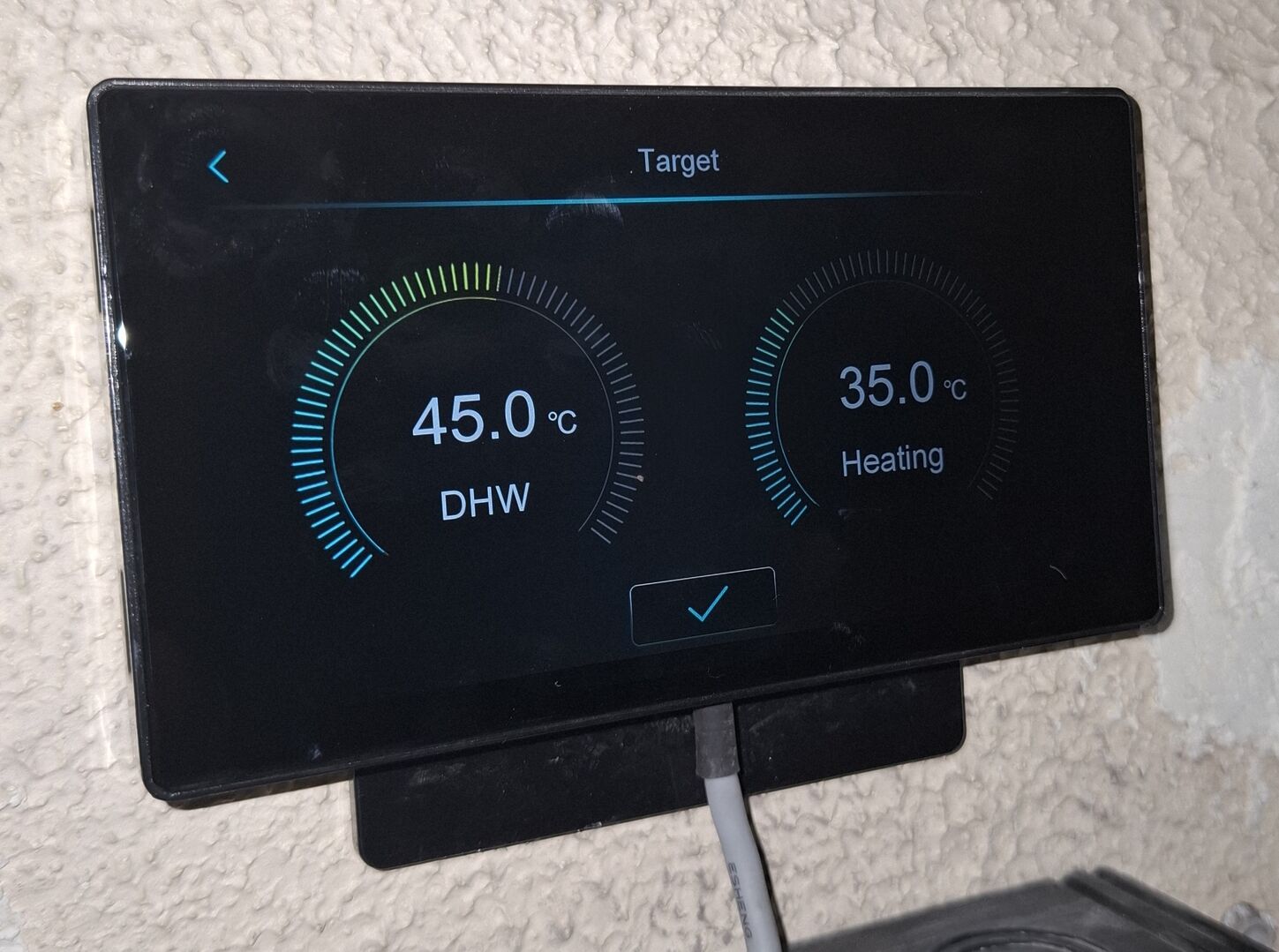
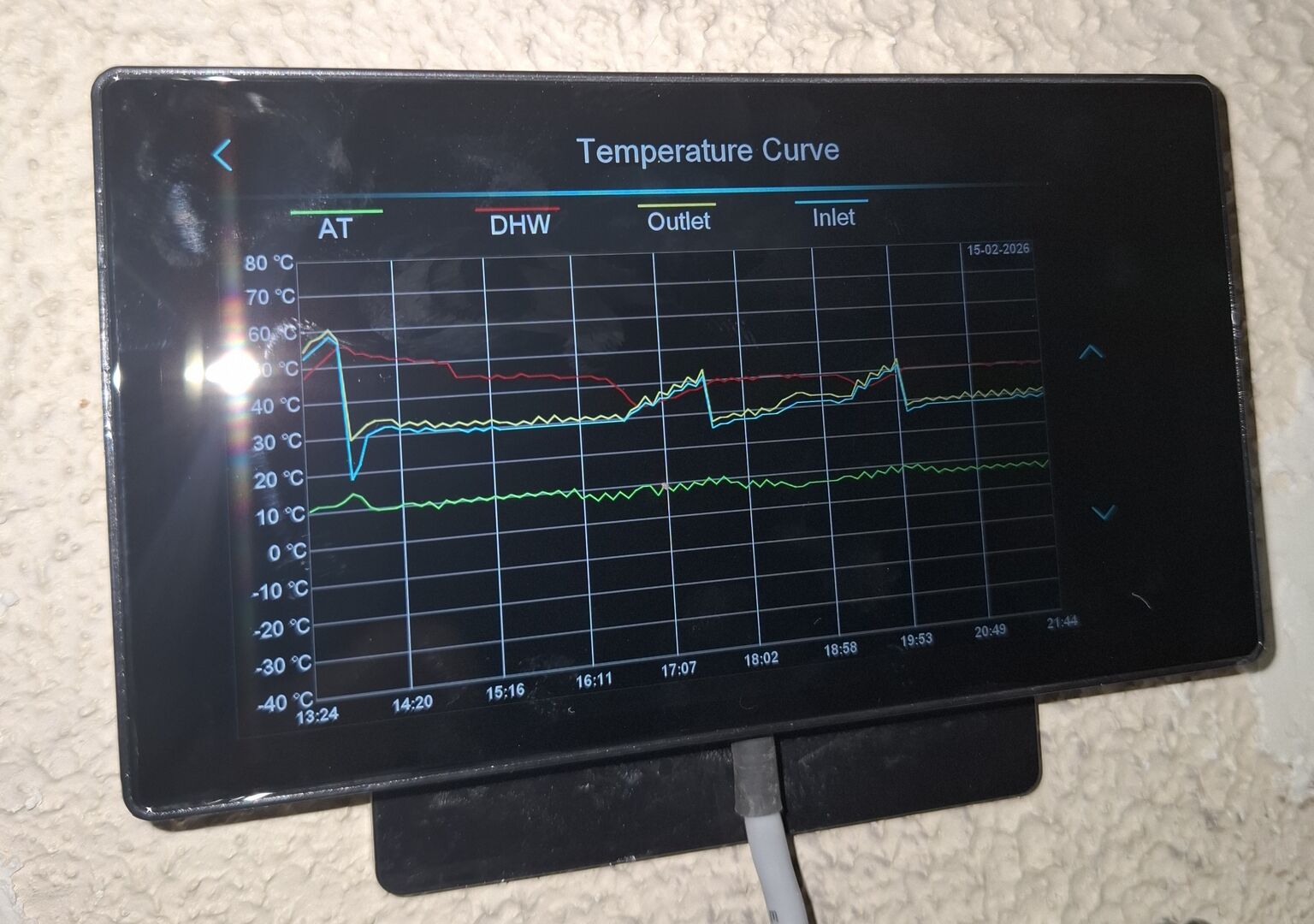
I control temps of the 'zones'- rooms but basically upstairs rads and downstairs rads. When it was installed/ commissioned I was told to keep DHW on 55C and Flow to 50C which were the 'best' settings for the pump because it was a 'high temp' ASHP (expensive). From reading lots re heat pump control and via this forum I now set targets at 45C DHW and and 35C Flow which in practice results in 35-40C DHW and 31-32C Flow, (temp charts showing DHW, Flow, Return and Ambient temps updated at 5 min intervals). At these settings, the pump runs all day, appears to cycle about once every 2 or 3 hours, sometimes longer. Room temps are 20C downstairs and 19C upstairs. I did have lower temps for night time and morning but from information read so far, I now maintain room temps 24/7. I don't understand weather correction so have not used it. Should I?
Whilst the DHW temp is ok for washing hands/ dishes, when we want a shower, I set DHW to 55C and sometimes it ambles up over 2/3 hours, sometimes it doesn't rise and sometimes it rises 'quickly' in around 30 mins but I can't predict which of the three scenarios will unfold. I have noticed that if the heating is calling, it lifts the water temp quicker so sometimes I will raise heating temp demand to force DHW increase and then reduce when DHW is hot enough.
The Honeywell Home has an opportunity to monitor/ control? DHW as well but it wasn't set up during installation and the configuration menu is asking me to 'bind' to the DHW sensor. I'm not sure I have the wifi sensor fitted. There is a wired thermostat to monitor DHW. I saw the radiator wifi trvs being 'bound' during installation.
I dont know the Honeywell home specifically but binding is basically getting the remote sensor and the controller to talk to each other, exactly like pairing bluetooth. Its usually initiated by a button (often on both parts) and/or a menu option.
I wouldn't personally bother doing this because using third party controls cause no end of problems with ASHPs, instead I would use the native controller. Your description of how it interacts with the Honeywell is a little confused, most likely the Honeywell just either enables or disables a call for heat (ie switches the ASHP on or off), nothing more! As such its pretty redundant because the native controller will be able to do this, but you may need to set the Honeywell so it is permanently calling for heat so that it is essentially disabled (I think you may already have done this). Unfortunately I cant tell without a diagram exactly how the it affects DHW, hopefully the native controller can just override it but only experiment will tell.
Weather compensation is something you should definitely learn about because (a) using it will reduce your running costs and (b) using it will increase your level of comfort (yes it really is that good!). Basically it means varying the flow temperature (the temperature of the water leaving the ASHP) according to the outside air temperature (OAT). Because the loss from the house, and hence the amount of energy you need to provide to heat it, is dominated by OAT, this, if correctly adjusted, can result in a very stable house temperature. It overcomes the major problem with control based on an indoor thermostat namely that there is a significant lag between the sensor detecting a change in IAT (indoor air temperature) and the house responding to the heating turning on/off. If you get WC right you need no other controls, not even TRVs, the house just maintains a comfortable temperature 24x7. Its a bit of a revelation TBH which we have sadly missed out on in the UK (other EU countries adopted it for boilers decades ago. Because we didnt our heating has cost 10% more than it needed to and we have enjoyed a reduced level of comfort).
There is a process you need to go through to set WC up optimally, if you decide to do this I can talk you through it. By the end of the process your Honeywell Home will be redundant.
I would set the DHW target temp to something like 48. 55 is unnecessarily high and increases costs quite dramatically. Ideally you want to schedule hot water heating once, max twice per day (typically you can either 'reheat on demand' or 'reheat on timer', you want the latter. Depending on the size of your tank it may take a couple of house but once done and of course on your use pattern should last either half a day of a day. This is done on the Trianco controller.
Newbi - please be gentle. Got Trianco ActiveAir 5 kW ASHP, , an EV, some pv and batteries.
Have Honeywell Home control with wifi zone control TRV, Mission to discover how to control DHW
@giganto I feel compelled to add my thoughts on this, if I may chip in?
I too recently had an ASHP (Vaillant) installed, replacing a gas boiler. We too have a Honeywell EvoHome system, with HR92 TRVs controlling 10 radiators.
We never had the Honeywell connected up for DHW - that was just on a standard hard-wired tank stat on a timer. The Honeywell only controlled the heating - with a BDR91 boiler relay replacing an older wireless room thermostat. Our timer was set to run the CH 24/7, letting the Honeywell system do its thing with each zone having its own schedule. All worked well for at least 10 years.
When the ASHP was installed, we just ripped out the old timer clock and BDR91 boiler relay, replacing these with Vaillant's control panel and a new diverter valve.
The Honeywell system is still there, with its 10 TRVs intact and working - it just can't turn the heat pump on or off. I have this set to have most room's TRVs set to 28 degrees permanently, thus fully open all the time. A couple of south-facing rooms have their TRVs set to 21 - to throttle back the radiators if the room get's too hot due to solar gain.
So, the Honeywell has been relegated to an almost exclusivly monitoring role only.
The heat pump's own controls are set to run in a Weather Compensated mode aiming for 20 degrees indoor temp, with some room influence (what Vaillant calls 'Active' mode) from their temperature sensor in our landing - 24/7.
If you try to run your heat pump like gas boiler, with a fixed (high) flow temp, and room temps controlled by the TRVs, you will get very poor efficiency, the HP will be noisier, and you home less comfortable.
For DHW - just use whatever controls your Heat Pump provides. It will have a tank temp probe - it controls the diverter valve. It will have a schedule. Your Honeywell adds nothing of any use with this.
If you try to run your heat pump like gas boiler, with a fixed (high) flow temp, and room temps controlled by the TRVs, you will get very poor efficiency, the HP will be noisier, and you home less comfortable.
...
And exactly that too, equally well put.
If a thermostat can only choose between heat pump on or heat pump off, it's entirely comparable with a driver choosing to fully depress either the accelerator or the brake. No modulation, poor efficiency, more noise, less comfort.
105 m2 bungalow in South East England
Mitsubishi Ecodan 8.5 kW air source heat pump
18 x 360W solar panels
1 x 6 kW GroWatt battery and SPH5000 inverter
1 x Myenergi Zappi
1 x VW ID3
Raised beds for home-grown veg and chickens for eggs
"Semper in excretia; sumus solum profundum variat"
If you try to run your heat pump like gas boiler, with a fixed (high) flow temp, and room temps controlled by the TRVs, you will get very poor efficiency, the HP will be noisier, and you home less comfortable.
...
And exactly that too, equally well put.
If a thermostat can only choose between heat pump on or heat pump off, it's entirely comparable with a driver choosing to fully depress either the accelerator or the brake. No modulation, poor efficiency, more noise, less comfort.
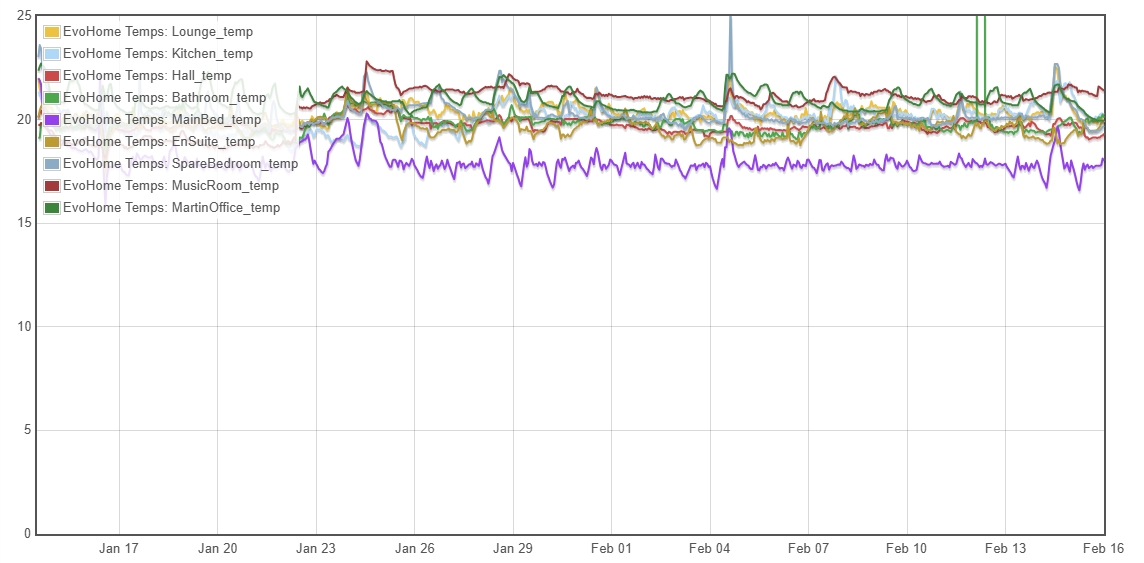
I should add perhaps that will some jiggery-pokery with Python on a Rasberry Pi, and Open Energy Monitor, my EvoHome room temperatures, are all being logged to EMONCMS:
The EvoHome system does include an optional 'Open Therm' interface - so it's boiler control is not necessarily just on/off. But do any heat pumps actually support Open Therm? My Vaillant certainly doesn't.
If you try to run your heat pump like gas boiler, with a fixed (high) flow temp, and room temps controlled by the TRVs, you will get very poor efficiency, the HP will be noisier, and you home less comfortable.
...
And exactly that too, equally well put.
If a thermostat can only choose between heat pump on or heat pump off, it's entirely comparable with a driver choosing to fully depress either the accelerator or the brake. No modulation, poor efficiency, more noise, less comfort.
I should add perhaps that will some jiggery-pokery with Python on a Rasberry Pi, and Open Energy Monitor, my EvoHome room temperatures, are all being logged to EMONCMS:
The EvoHome system does include an optional 'Open Therm' interface - so it's boiler control is not necessarily just on/off. But do any heat pumps actually support Open Therm? My Vaillant certainly doesn't.
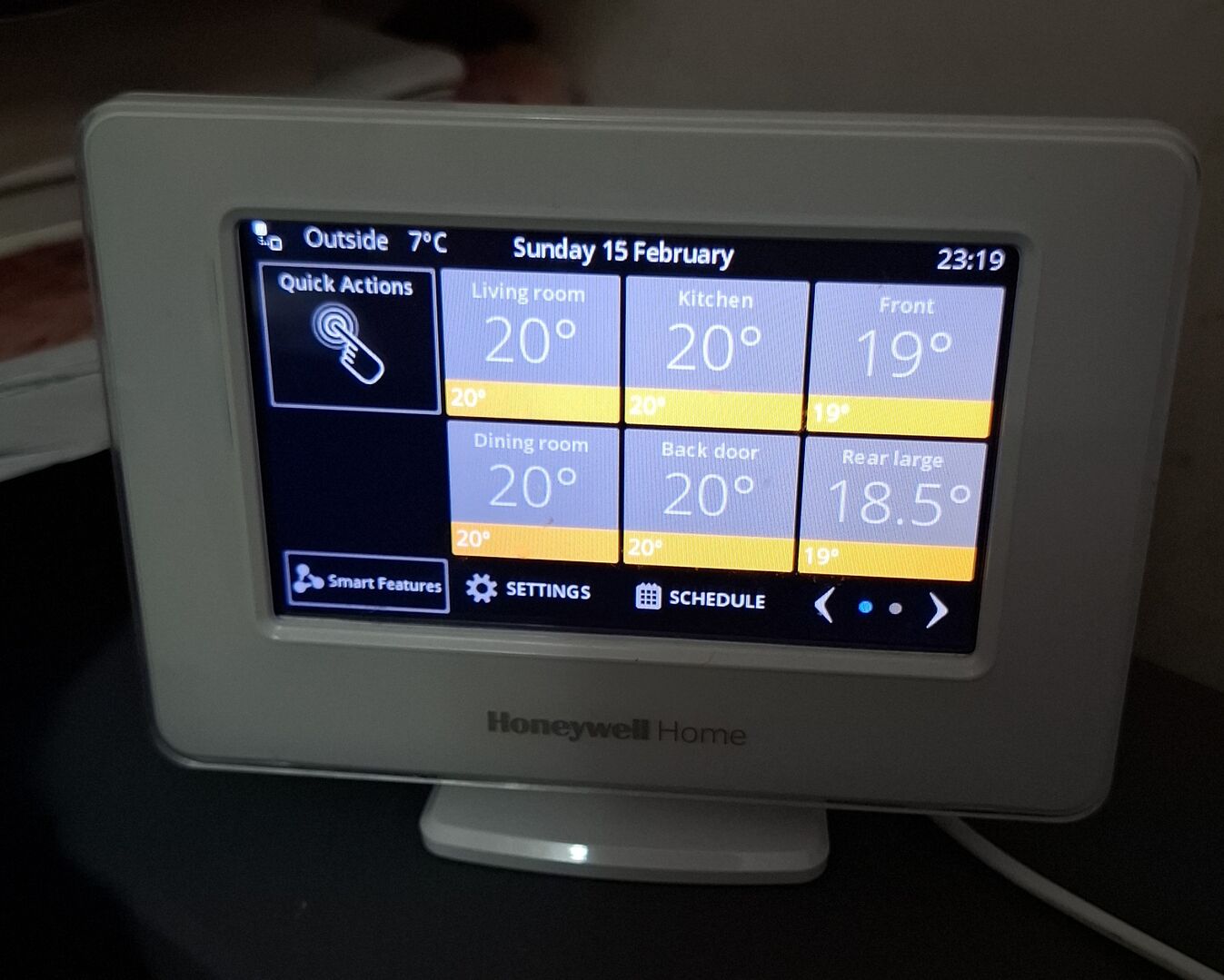
these are a couple of charts for my system showing DHW, FT, RT and AT. I have also included temps off Honeywell Home - BDR91 wireless and 7x wifi HR91 rad controllers
If you try to run your heat pump like gas boiler, with a fixed (high) flow temp, and room temps controlled by the TRVs, you will get very poor efficiency, the HP will be noisier, and you home less comfortable.
...
And exactly that too, equally well put.
If a thermostat can only choose between heat pump on or heat pump off, it's entirely comparable with a driver choosing to fully depress either the accelerator or the brake. No modulation, poor efficiency, more noise, less comfort.
I should add perhaps that will some jiggery-pokery with Python on a Rasberry Pi, and Open Energy Monitor, my EvoHome room temperatures, are all being logged to EMONCMS:
The EvoHome system does include an optional 'Open Therm' interface - so it's boiler control is not necessarily just on/off. But do any heat pumps actually support Open Therm? My Vaillant certainly doesn't.
these are a couple of charts for my system showing DHW, FT, RT and AT. I have also included temps off Honeywell Home - BDR91 wireless and 7x wifi HR91 rad controllers
If you try to run your heat pump like gas boiler, with a fixed (high) flow temp, and room temps controlled by the TRVs, you will get very poor efficiency, the HP will be noisier, and you home less comfortable.
...
And exactly that too, equally well put.
If a thermostat can only choose between heat pump on or heat pump off, it's entirely comparable with a driver choosing to fully depress either the accelerator or the brake. No modulation, poor efficiency, more noise, less comfort.
I should add perhaps that will some jiggery-pokery with Python on a Rasberry Pi, and Open Energy Monitor, my EvoHome room temperatures, are all being logged to EMONCMS:
The EvoHome system does include an optional 'Open Therm' interface - so it's boiler control is not necessarily just on/off. But do any heat pumps actually support Open Therm? My Vaillant certainly doesn't.
these are a couple of charts for my system showing DHW, FT, RT and AT. I have also included temps off Honeywell Home - BDR91 wireless and 7x wifi HR91 rad controllers
So the Honeywell is just a colourful, temp activated on/ off switch for the ASHP, NOT an ASHP controller.
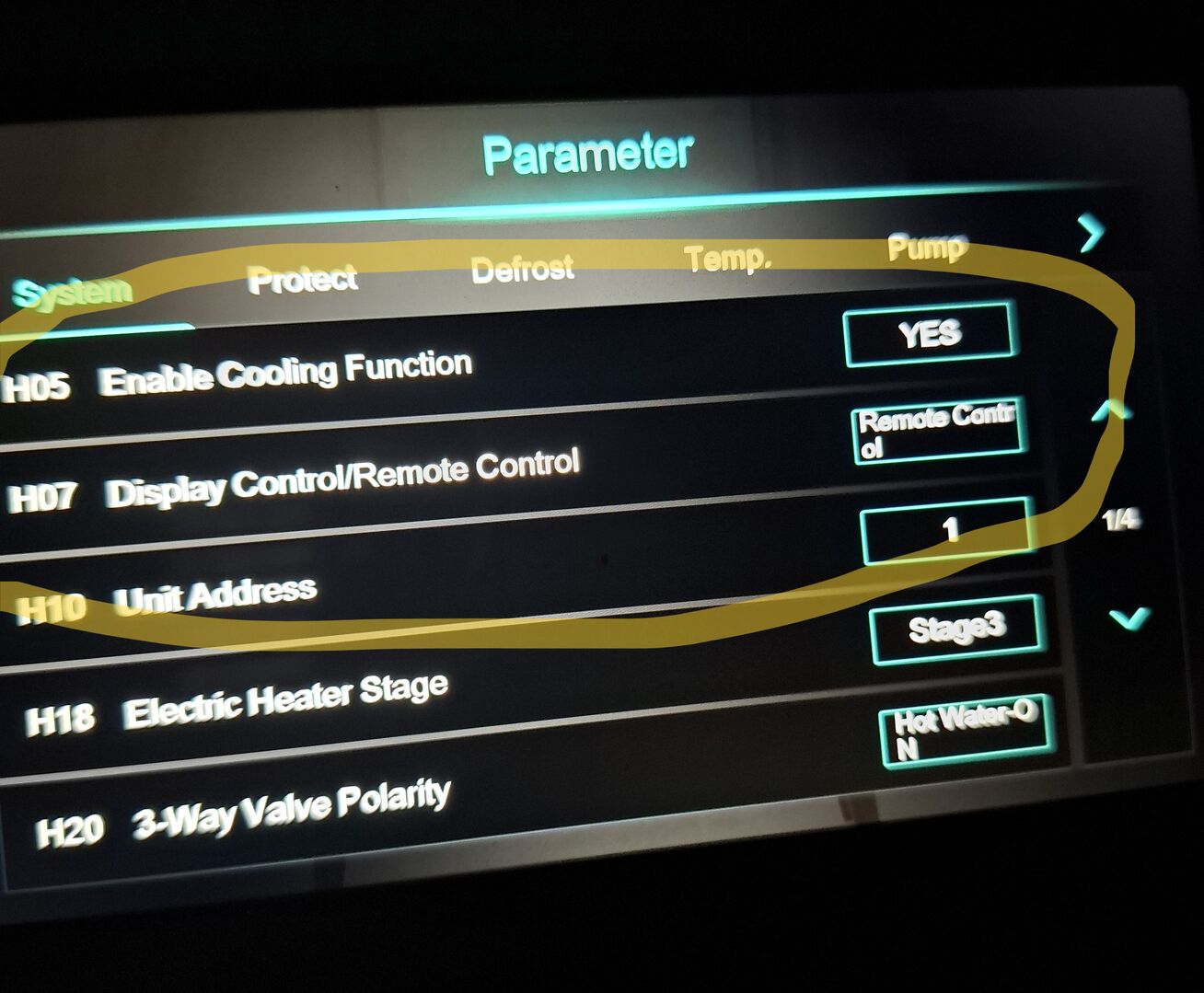
I attach a page from parameters on the display of the ASHP- H07 . If I change that from remote control to display control, will that disable the Honeywell input and work using the heat pump requirements or will I have to remove the BDR91 completely and rewire it?
Thanks for posting the photos which are very useful. You are asking the right questions!
Without knowing exactly how the Honeywell is wired/connected its difficult for me to tell how best to disable it. Can you tell anything from the wiring around? Others, eg someone with one of the Honeywell devices, may well have a better idea.
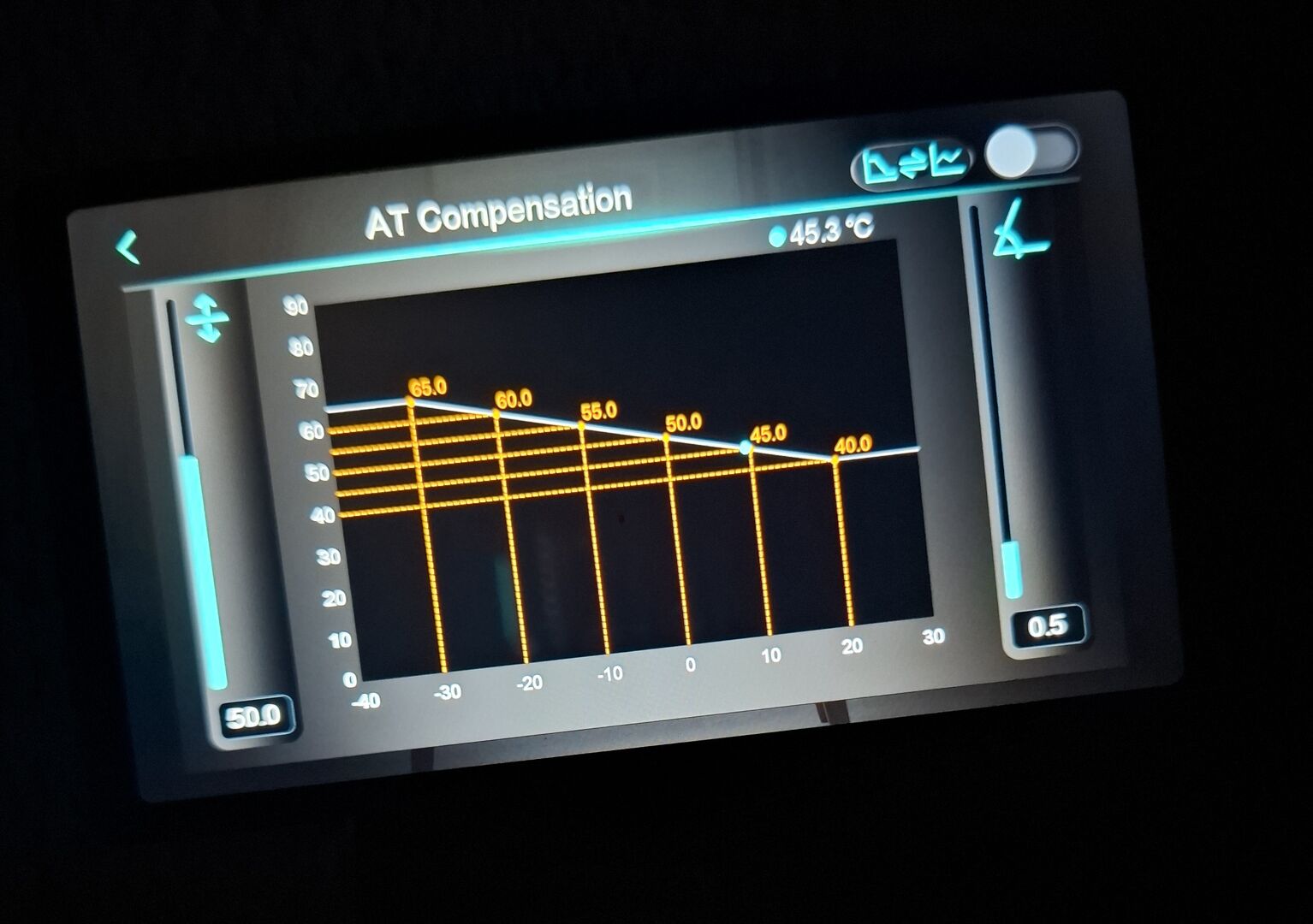
The final picture is your weather compensation curve. This changes the temperature of the water that the heat pump produces to feed the radiators according to the outside temperature. With the current settings its likely you are paying 30% -50% more for your heating than you need to and are less comfortable than you could be. Dont panic though, it can be changed and we will provide help.
Before you start changing anything I recommend you read this introduction to heat pumps which explains some of the key concepts. You need to forget everything you learned about running a boiler (much of which was wrong even for boilers!) and think instead 'low and slow' - on 24x7 at a very low level, just enough to keep the house warm. The weather compensation is key to this.
If you read the introduction and tell us something about how the Honeywell is connected we can talk you through the key steps. If you do this your house should be more comfortable and your heating bills lower.
This post was modified 3 weeks ago 2 times by JamesPa
4kW peak of solar PV since 2011; EV and a 1930s house which has been partially renovated to improve its efficiency. 7kW Vaillant heat pump.