

Notifications
Clear all
Joining the Renewable Heating Hub forums is completely free and only takes a minute. By registering you’ll be able to ask questions, join discussions, follow topics you’re interested in, bookmark useful threads and receive notifications when someone replies. Non-registered members also do not have access to our AI features. When choosing your username, please note that it cannot be changed later, so we recommend avoiding brand or product names. Before registering, please take a moment to read the Forum Rules & Terms of Use so we can keep the community helpful, respectful and informative for everyone. Thanks for joining!

Topic starter
08/01/2023 12:42 pm
Does anyone have any experience of knowledge of the Pure Drive battery solution?
https://puredrive-energy.co.uk/home-3/
I'm very attracted by many aspects of it, not least the fact it's made in UK and it's a lower comparable cost to similar offerings elsewhere. My only reservation is that they are a reasonably new company and there doesn't see to be much feedback on it either good or bad!

09/01/2023 11:12 am
@squeakysim, I've 2 x 5kWh Puredrive (Purestorage II Hybrid) batteries coupled, via a Solis inverter, to a 5.6kW solar array. Can't offer a great deal of insight really, only installed in September so early days yet. I've no direct experience with Puredrive as all my follow-up has so far been with the system installer. No real issues - I was getting the odd 'battery management system' error code at first which was resolved by a firmware update.
2 x 12kW Samsung Gen6 ASHP, 5.6kW solar PV ground mounted c/w 10kWh Puredrive battery & Solis inverter.

09/01/2023 2:39 pm
I've screen-grabbed text from Pure Storage' own website, and present it here above the technical spec from EVE, a Chinese manufacturer of LiFePO4 cells:
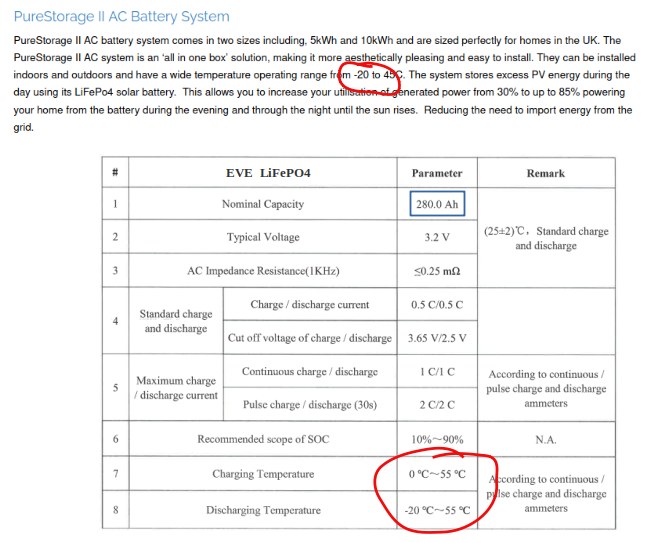
When owners of caravans and RVs install LiFePO4 cells, they usually do so with a heater-plate below the stack of cells.
The BMS unit triggers the heater on once the temperature drops below zero.
It basically throws battery power at the problem
Do you think Pure Storage are using an internal heating plate within the cabinet?
Save energy... recycle electrons!
1
09/01/2023 2:54 pm
@transparent I've no cabinet covering my batteries so no, there's no internal heating. This limitation on charging when <0°C is a current discussion point though and my installer is responding on this.
2 x 12kW Samsung Gen6 ASHP, 5.6kW solar PV ground mounted c/w 10kWh Puredrive battery & Solis inverter.

09/01/2023 3:23 pm
I'm glad to hear that @dunlorn - unless you happen to know who manufactures the cells for Pure, we can't check their actual specs of course.
What about this bit, also snapped from Pure's website?

This feature has previously been attempted by other storage manufacturers, such as PowerVault. They withdrew it about 3 years ago.
It's tricky to power the house during a power-outage from two different viewpoints:
1: How does this system comply with G98 certification, such that electricity may not flow (export) onto the grid during a power cut - in order to protect the DNO engineers?
It's especially difficult for Pure to achieve this because their system is using 3rd-party hybrid inverters.
2: How does the Pure Storage system handle the switch-over if the current household demand is greater than it can sustain?
I can't see how it can provide off-grid power if cooker, oven, heat-pump and tumble-drier all happened to be active at the time the power went down.
Again, it's more usual for the 'decisions' about handling sudden power demands to be made by the hybrid inverter, not the logic which is incorporated in the battery unit(s).
A 20mS switch-over would suggest there's a mechanical contactor in the distribution board.
Do you have one?
Is this an optional extra?
BTW, I have a 'hybrid' house in which some circuits such as lighting, workshop, MVHR (ventilation) and central heating are powered permanently from battery storage.
So I have hands-on experience of what can work and what fails.

Save energy... recycle electrons!
1
Topic starter
10/01/2023 11:47 am
1: How does this system comply with G98 certification, such that electricity may not flow (export) onto the grid during a power cut - in order to protect the DNO engineers?
It's especially difficult for Pure to achieve this because their system is using 3rd-party hybrid inverters.
I'm not sure if that's why they only specific certain inverters to use with the battery maybe...?
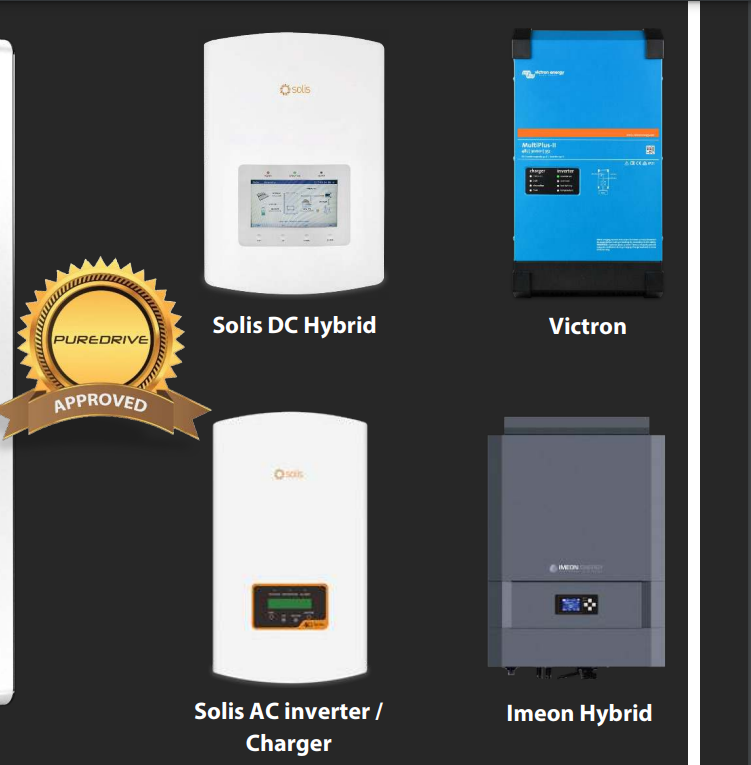
There seems to be some discrepancies between the operating range in your screenshot, and the datasheet...!
The DC states operating temps: Discharge: -5°C to 60°C, Charge: 0°C to 55°C
The AC states operating temps: Discharge: -10°C to 60°C, Charge: -10°C to 55°C
The AC inverter states conditions of use as: Humidity 0 – 90%, Temperature -20°C to 60°C, Degressive power> 40°C
(15W/C)
Very confusing!! I even just found two datasheet versions for the DC model with conflicting data! I've sent them an email for clarification, and also included your questions too @transparent, so we'll see what they have to say!
Topic starter
10/01/2023 11:50 am
@dunlorn was it a recommendation from the installer, or did you choose it for another reason?
Also, yours is the DC version yes?
Topic starter
10/01/2023 12:09 pm
I also came across this comment on solarguide.co.uk:
"1C rating
C-ratings show how quickly a battery can discharge the stored energy. A 1C rating means that the Puredrive Hybrid Battery can charge and discharge at the rate of the size of the battery without losing capacity. For example the 4.8kWh can charge and discharge at 4.8kW and still retain the full 4.8kWh capacity of the battery."
Does mean if you have a 10kW battery that what it can charge and discharge at...?!? Surely not?!!

10/01/2023 12:16 pm
@squeakysim The system was all specified by the installer. I did a bit of internet trawling research before committing, just to make sure nothing worrying emerged but really I was in their hands.
My main motivation was to be able to utilise much more of my PV generation, and battery use as any sort of emergency back-up wasn't at the forefront of my decision making. What I found hard was trying to establish what the 'optimum' size of battery installation was, given my forecast usage and PV yield, but this proved nigh on impossible. It's particularly difficult given PV yields are inversely related to my (ASHP) demand profile and that's before you even start to think about any smart tariff.
Intuitively, it seems 'bigger is better' when it comes to kWh storage but these units aren't cheap so there must be a sensible optimum. In the end I thought a single 5kWh unit would be too small and went for 2 units. I liked the modular aspect of the Puredrive and 10kWh seems like a good balance between daily PV yield (at least for 6 or so months of the year) and basic household consumption.
My installer is working on a fix to address the battery's inability to accept charge in freezing temperatures, which appears to have taken them by surprise. My PV yield is pretty tiny at this time of year but if I ever get on a smart tariff I want the ability to charge the battery in all weathers.
2 x 12kW Samsung Gen6 ASHP, 5.6kW solar PV ground mounted c/w 10kWh Puredrive battery & Solis inverter.
1
10/01/2023 12:17 pm
C-rating refers to the individual (3.2v) cells which are combined to build the battery.
16 such cells make a '48v' battery, which is what those four inverters are expecting to be connected to.
So if the internal cells are 105Ah, they can be charged at a maximum 105A. That's the 1C rating.
In practice you would design a battery system to stay well short of the theoretical 1C charge rate.
No design engineer wants to be working too close to a maximum parameter!
Here's a 16S configuration (16 cells in series) using 280Ah cells:

Using a quick 'back of envelope' bit of maths, a LiFePO4 battery with a capacity of 10KW would most likely be constructed from cells with a 200Ah specification.
Save energy... recycle electrons!
10/01/2023 12:32 pm
@squeakysim I'm far from an expert in this but what I've learned is that the rate at which batteries can accept charge (or discharge) is related to their state of charge and external factors like temperature. The capacity of your inverter also is a limiting factor. The battery management system works out what it should be accepting/discharging at a point in time. Occasionally I see the solis app telling me I'm exporting to grid when the battery is nowhere near full, which is a concern, but thankfully it only happens for short periods and makes a very small difference. I just think it's a function of varying yields/loads and the management system trying to keep up.
Oh, one other thing to be mindful of in confirming battery size is their usable capacity. Mine is 10kWh but in reality it's not quite 9 as the system is set to stop them discharging below 12%. Designed to safeguard battery life but means you have less than you think!
2 x 12kW Samsung Gen6 ASHP, 5.6kW solar PV ground mounted c/w 10kWh Puredrive battery & Solis inverter.
1

15/01/2023 10:20 pm
I have 20 kw of Puredrive storage, 4 x 5kw DC batteries linked to my Solis Hybrid inverter on a string of 4kw panels. I have an older 4 kw system too not tied into the batteries. Only had this set of panels since June 22 and the batteries since August 22. Up until the start of November, I was still getting enough PV to recharge the batteries and run all day and night. From the start of November charging at night on the cheap tariff and depending on the day the storage is lasting to early evening, some days it’s mid morning. Can’t really fault the system but only drawback is that the batteries will only charge and discharge at around 3 kw so periodically having to pull from the grid if the heatpump or air fryers are running. Looking forward to the spring and summer months to see what the system really does.
Can’t fault Solis or Puredrive customer services when I’ve called with minor issues.
2

Page 1 / 3
Next
SPONSORS
Degrees of Separation
Latest Posts
-

RE: Indevolt Batteries UK Support & Info Thread
@editor Hi, To resolve this, please tap on the A...
By Indevolt Tech , 42 minutes ago
-
RE: How will removing the standing charge on gas bills benefit heat pumps?
@toodles GIGO always stands! My Cosy 6, as you can...
By Watcher , 10 hours ago
-
RE: How much of your renewable and home setup would still work if the internet went down?
Interestingly we had an internet outage about a month a...
By Rob of York , 16 hours ago
-
RE: Double or Triple Glazed Windows?
Posted by: @singlespeed With 9 years repairing windo...
By Rob of York , 16 hours ago
-
@transparent we’re still running a secure version of PH...
By Mars , 20 hours ago
-
RE: How quickly would you want/expect heat recovery to take from setback?
Much longer than that here. The heating isn't even on. ...
By bobflux , 1 day ago
-
RE: Passiv Smart Thermostat - Help & Forum Support
Obviously the weather is changeable but there's a defin...
By Singlespeed , 1 day ago
-
RE: The Changing Jet Stream Could Challenge UK Air Source Heat Pumps
@rob-of-york I must admit that when we had a Daikin hea...
By Toodles , 2 days ago
-
RE: Forum updates, announcements & issues
Get the Renewable Heating Hub heads-up on WhatsApp. I...
By Mars , 2 days ago
-
RE: Safety study for plug in batteries out to tender - looks like Q3 2027 at best before legal
@editor I pointed out to the one of the Fuse execs that...
By dansus , 2 days ago
-
RE: 15kw pump for 225m2 1990's house - over kill?
@seaviews As well as loft insulation, there are othe...
By Rob of York , 2 days ago
-
RE: BT cuts you off, Plusnet blames Openreach... welcome to “seamless” broadband switching
Both of which (in most cases) use Openreach for the las...
By JamesPa , 2 days ago
-
RE: Renewables & Heat Pumps in the News
Yes, this is a swiss and german standard I believe, Vai...
By Batpred , 2 days ago
-
RE: Octopus Cosy 12 Heat Pump Regret: Incredibly Loud, Poor Heating & Constant Hum - Help!
@editor FWIW my problem was resolved, eventually, after...
By BigFish , 3 days ago





SPONSORS
