
Notifications
Clear all

27/02/2026 5:59 pm
For my tuppenny worth towards this debate. I have used both methods and quite honestly found little difference in the energy consumed. I therefore now leave the heat pump running 24/7 at 21C IAT and control the bedrooms with the rad thermostats. At least I can guarantee getting up in a warm house in the morning! 😀
5 Bedroom House in Cambridgeshire, double glazing, 300mm loft insulation and cavity wall insulation
Design temperature 21C @ OAT -2C = 10.2Kw heat loss, deltaT = 8 degrees
Bivalent system containing:
12Kw Samsung High Temperature Quiet (Gen 6) heat pump
26Kw Grant Blue Flame Oil Boiler
4.1Kw Solar Panel Array
34Kwh GivEnergy Stackable Battery System
1

27/02/2026 10:16 pm
For my tuppenny worth towards this debate. I have used both methods and quite honestly found little difference in the energy consumed. I therefore now leave the heat pump running 24/7 at 21C IAT and control the bedrooms with the rad thermostats. At least I can guarantee getting up in a warm house in the morning! 😀
Thats pretty much what the simple physics says. To get anything >10% you have to invoke something (as yet unidentified) other than simple physics, and for most scenarios that I have looked at based on simple physics we are talking something between 5% saving and a few percent excess cost because of recovery.
For this reason I currently cant see how we can extrapolate observations which purport to demonstrate greater savings, however reliable the observations themselves are, to any system other than the one on which they were observed. That doesn't mean that they aren't real, just that they don't tell us anything generic.
My personal guess is that some of these observations are not in fact real, but some are, and the saving in the latter case is because the setback has shifted the system from one sub-optimal state to another, slightly less sub-optimal, state. If we could characterise this it might well prove useful, but so far that has unfortunately eluded us.
4kW peak of solar PV since 2011; EV and a 1930s house which has been partially renovated to improve its efficiency. 7kW Vaillant heat pump.
1

28/02/2026 11:23 am
@technogeekk there are other strategies for saving money open to your kind of setup based on the kit and property you have listed. And I’m guessing you are already exploiting it.
“5 Bedroom House in Cambridgeshire, double glazing, 300mm loft insulation and cavity wall insulationDesign temperature 21C @ OAT -2C = 10.2Kw heat loss, deltaT = 8 degreesBivalent system containing:12Kw Samsung High Temperature Quiet (Gen 6) heat pump26Kw Grant Blue Flame Oil Boiler4.1Kw Solar Panel Array34Kwh GivEnergy Stackable Battery System”
Do you have an electric vehicle to make the most of off peak electricity? And do you have time of use tariff supplier? If you do I’m guessing you will be already making savings beyond what a setback like the one I’m talking about might give you.
So I’m Thinking your focus is understandably drawn to a different set of parameters than scheduling a setback.
My experience study is only limited to the insulation of our property and my heat pump operation with a favourable fixed kWh price.
Forgive me but Im trying to make this debate tangible for the many installations of ‘heat pump only’ households. And more specifically I’m only using the software supplied by the manufacturer.
This I believe means the information I’m producing is accessible to the widest audience. It also hopefully answers the binary question do setbacks save energy - yes or no?
What is painfully difficult to present is to find two outdoor conditions which are near-identical in temperature and humidity… just to prove the physics beyond doubt.
However there are situations where the outdoor ambient is near identical for defrost potential but the outdoor air temperatures for the 24 hour operation are considerably milder thus giving the 24 hour continuous operation period the apparent clear advantage that it should use less energy.
The next two graphs show two different 24 hour performances of our heat pump - one is shown operating continuously for 24 hours and the other is shown operating on our scheduled setback. I have written the energy consumption as reported by our MELCloud reporting system.
you can also see the changing outside temperature hour by hour for each period. The red ❌ crosses show the setback periods when a defrost would have been avoided. The black squares show when defrosts are possible depending on humidity.
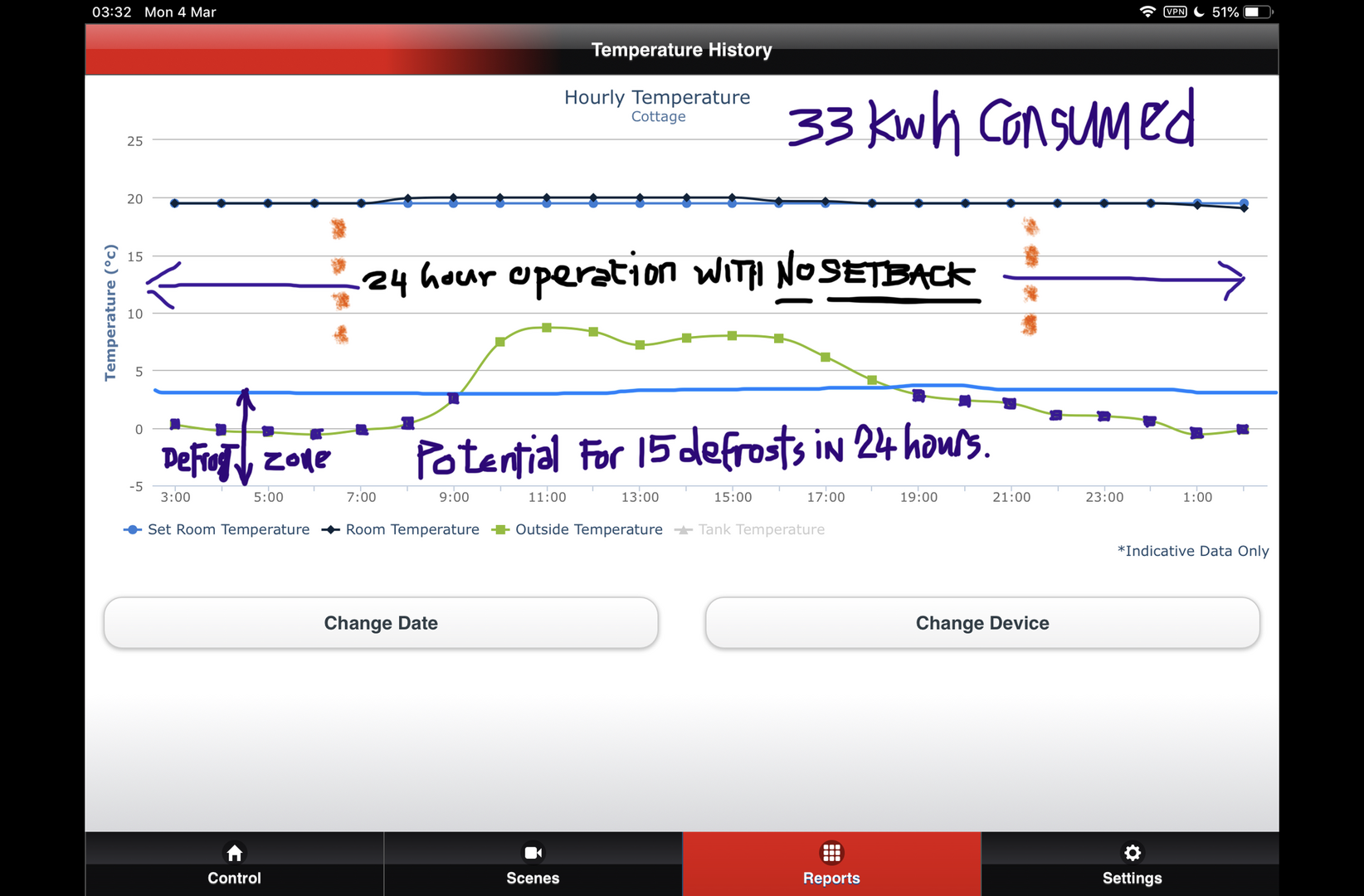
The first graph above is the continuous operation graph which consumed 33 kWh.
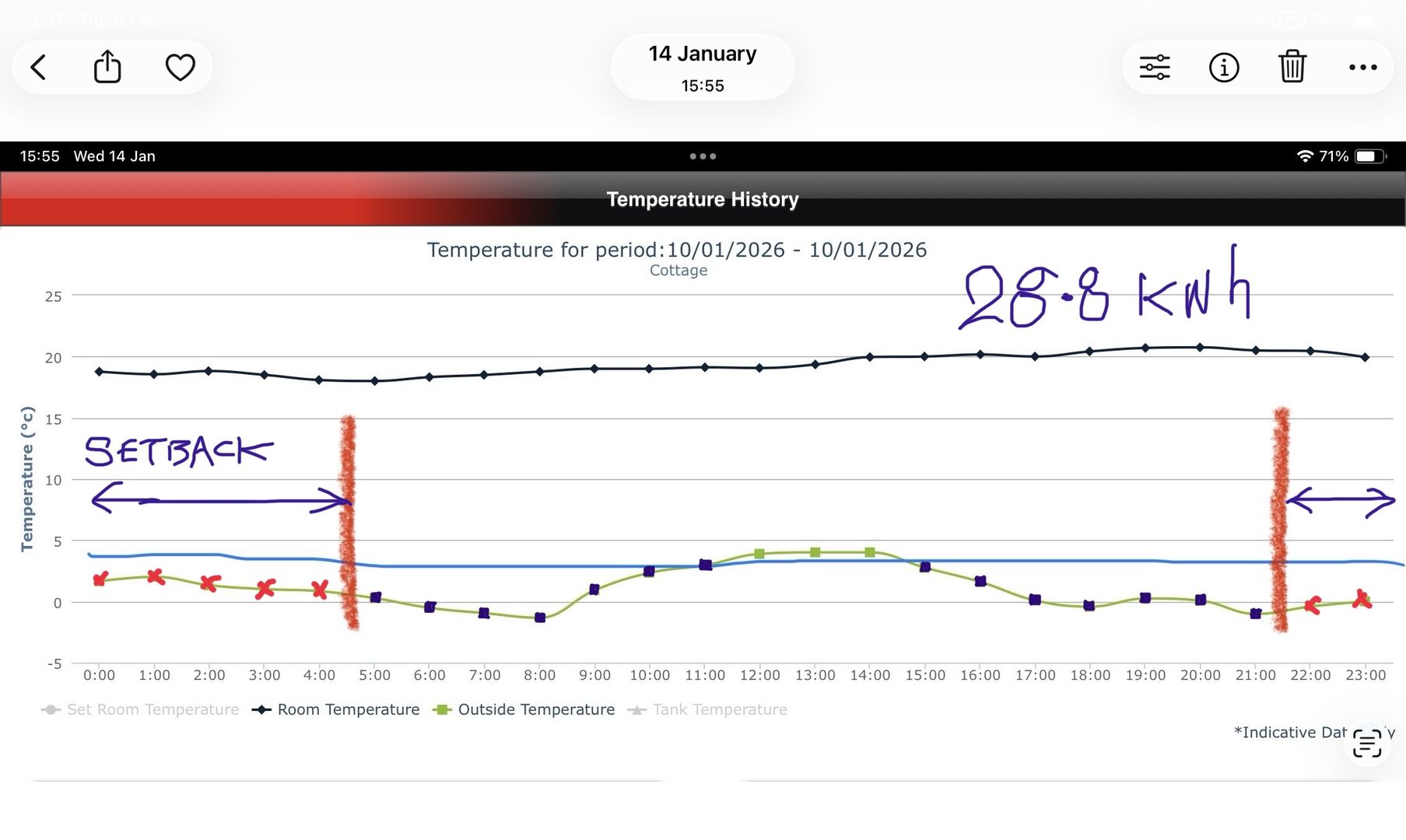
The second is the 24 hour period with a setback. Again, showing the energy for the period 28.8 kWh
You can see that both graphs show roughly the same defrost potential despite the setback period having a 7 hour non-heating period scheduled in it. You can also see that the continuous-heating graph has a 5c warmer outdoor ambient for 8 hours in the middle of the 24 hour continuous-heating period.
This would greatly reduce the energy consumption for that 8 hour period. Yet there is still a 4.8 kWh saving in the setback period. Edit… correction 4.2 kWh saving
In a practical comparison this proves to me that with only the basic heatpump controls, setbacks can be devised to save energy.
This post was modified 4 days ago by SUNandAIR

28/02/2026 5:42 pm
Romans understood heating well enough to use underfloor hot air heating and passive solar heating in their baths, and that was around 2000 years ago. I'd suggest that there are no unknown unknowns that would have an effect sufficient to materially affect any macro (i.e. not micro or nano) level analysis. It is just we are not experts in the field and so are still learning.
Monty Python may have asked 'what have the Romans ever done for us?' but I agree, the Roman achievements are impressive but I suggest they got there empirically, by trial and error, rather than by using theory maths and models (mathematical not physical). I have no doubt they knew that hot air rises, but the units joule and the watt have only been around for 200 years or so, and without the units, you can't do the maths. As a bit of curious trivia, here is the google ngram for the two words joule and watt:
Likewise the key concepts and equations eg heat transfer that we use today only appeared in the 1800s, though there were some preliminary discoveries in the 1700s, notably the concepts of heat capacity and latent heat, and a gradual appreciation of the nature of heat itself as we understand it today.
🙂 I wasn't suggesting the Romans had a complete model but two millennia ago they could heat a building to three different temperatures with some consistency in climates as different as North Africa and Northern England. But yes "modern" mathematical modelling of energy started 200-300 years ago.
But I do accept that even with only 200-300 years of history (plus perhaps a little help from the Romans) there has been plenty of time to become aware of all of the effects that will materially affect a heating system. But, as you say, we are still learning how to apply them. For example, we can see and feel solar gain happening, but so far as I know we don't yet have a way to quantify it beyond saying the IAT appears to be one or two degrees higher than it might have been — and once again we find ourselves up against 'what might have been' if X didn't happen.
When I said we I meant us non-experts. Solar gain is the absorption of infrared radiation, not something us non-experts can easily calculate (maybe, I've never researched the algorithms) but it is part of climate science and meteorology, and in those scientific disciplines it is calculated. Science can calculate the change in temperature but it isn't something that has become mainstream, even for heating geeks.
More recently, we have noted that the ratio between the on and off periods on the cycle appears to be part of the modulation mechanism. However, I think it is fair to say that no one has yet managed to explain why Midea chose to modulate their heat pumps this way, or even in any detail how they do it. Why not stop the ramp up when the actual LWT reaches the set LWT, and chug along in steady state? Why overshoot, and then have to have an off period?
In the other state, steady state, seen on the right in the chart, this is what happens. The actual LWT rises to the set LWT and then stays there, or within a degree or so, apart from relatively rare unexplained anomalies. But this only happens over a relatively narrow band of OATs, around 6-8°C. Why only run in steady state over such a narrow band?
All very good questions! I noticed that there is a discussion on this topic in the "Midea ASHP – how to set weather compensation" thread, maybe that discussion will answer some of these questions.
then something else is happening, and the RWT rising all the way up to the set LWT shows heat isn't being removed from the primary circuit.
I think this needs more thought. For a start, I don't think my emitters are under-sized. For example, at a mean radiator temp of 47 degrees, giving a rad to room delta t of around 27 degrees, their combined capacity is 12.7kW, which is both more than the design (-2°C) heat loss (~9.6kW) and the heat pump's max output (~11.5kW), while the maximum ever calculated hourly output was 10.25kWh (0500 on 04 Mar 2025).
If your radiators have sufficient capacity then it could be the transfer of power/energy across your PXE, or as you say above, it could be the Midea controller algorithm deliberately overshooting the set LWT.
28/02/2026 8:39 pm
So, as James suggests in a thread above. You can’t make a universal statement about a heat pump performance if it only applies to a specific system. This is the case regarding @robs “Detailed Analysis” of his defrost energy usage. The issue with this system is that for what ever reason robS has chosen a 100 minute defrost cycle. It is only operating at an outdoor temperature of 3C with an electrical input of 0.95kwh. The a 100 minute period between defrosts and energy input is well below what other heat pumps of similar size are reporting. Defrosts of a higher energy demand are typically 60 minutes apart whereas a 100 minute period may even be an automated Safety Defrost. A truer reflection of how much energy a defrost requires would be to properly account for all energy inputs from a wider range of typical heatpump brands as already posted. All of the posted brands show electrical inputs of 2 kWh and even 2.5 kWh with a higher drop in flow temperature during the defrost.
Both @cathoderay and I have posted data on defrosts, both show no or limited extra electrical energy used by a defrost. And @cathoderay's flow temperatures are somewhat greater than mine. Higher demand may change the magnitudes but not the laws of physics, as my and @cathoderay's data show. As to generalising, a linear WC curve is common to many heat pump manufacturers and there seems to be no evidence that there is a need for a WC control that allows for a step change to account for defrosts. So @cathoderay's and my results merely reflect what can be surmised from the existence and successful use of linear WC curves offered by many heat pump manufacturers.
I chose that defrost as it was proceeded by a period of continuous running at the same OAT, which could be used to determine an accurate baseline to use in the analysis.
There is no such thing as a typical 60 minutes defrost, the frequency of defrosting varies depending on OAT, humidity and load on the heat pump. For example, here's @cathoderay's heat pump doing defrosts 3 hours apart.
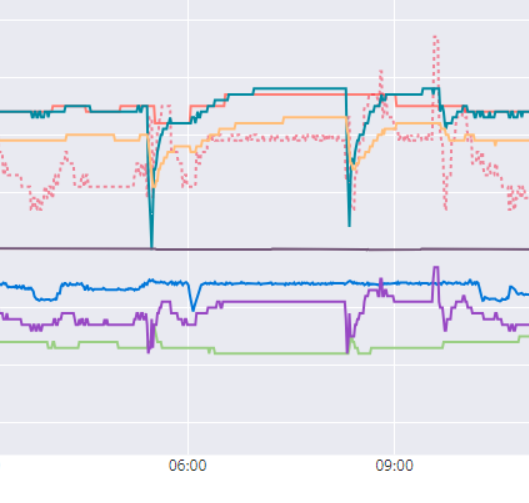
And our heat pump doing defrosts every 50ish minutes.
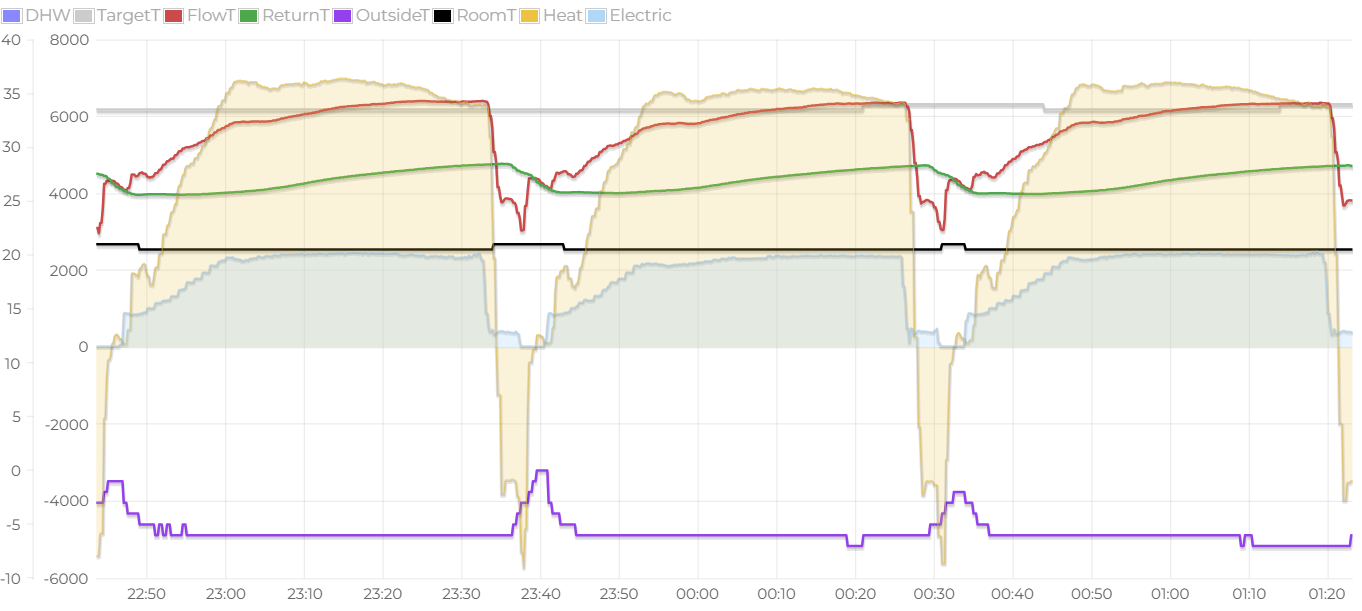
The other manufactures heat pumps I posted are doing defrosts at -1.5C rather than 3C, so you are not comparing like with like.
My position is that the defrost and compressor-reset period is somewhat longer in reality than 11 minutes and that to start the energy count where it has started in this summary is incorrect since there is energy used by the compressor and motorized valves in some cases several minutes before the defrost begins.
The 11 minutes is the time from when the heat pump stops heating and to when it starts to heating again, during this period the heat pump is defrosting itself (hence the time duration of the defrost). Prior to this period the compressor is heating the house and not yet performing the defrost, some of that heat (warm water) will be used by the defrost process (this can be seen in the analysis images as the yellow region below the zero line), is this is the electricity prior to the defrost that you refer to? If so then that adds an additional 0.06 kWh to the electricity deficit (0.254kWh was removed from the heated water and this was generated pre-defrost at a COP of 4.2), so the additional electrical input as a result of the defrost then becomes 0.081kWh - which is still very small.
Also, the electricity used by the motorised value is included in the monitored electricity usage and therefore included in my analysis.
In addition the 11 minute period does not extend to when the compressor has fully re pressurised the refrigerant and returned to full operational mode.
No because that is not part of the defrost process, that is part of the post-defrost reheat. And the electricity to do this is included in my analysis.
My last point has always been that in the end the full recovery energy is controlled by a moving target flow temperature - the weather compensation curve.
The WC curve requested flow temperature didn't change throughout the entire 100 minutes, it's the grey line on the charts. Also, our WC curve, like many, is linear (i.e. a straight line) and does not have (or need) a distinct change at the onset of defrost OATs.
So the rather simplistic view that electrical energy data is all that is needed does not meet the requirement. There needs to be a combined understanding of the electrical energy inputs plus how the compressor stores and replenishes refrigerant liquid, for example what are the volumes used during the defrost and to pressurise and replenish -which is completely invisible to the electrical charts posted by @robs.
My analysis wasn't just electrical energy, but also thermal (thermal energy in the form of warmed or cooled water). How the compressor works, while interesting, isn't material to how much energy (electricity) it uses or how much energy (heat) it puts into a house. The compressor doing such things is entirely visible to my charts, they are some of the electricity used by the heat pump. We get charged by our energy supplier for the electricity we use, not for how our heat pump pressurises refrigerant.
28/02/2026 9:54 pm
And more specifically I’m only using the software supplied by the manufacturer.
It also hopefully answers the binary question do setbacks save energy - yes or no?
Why when the software system that you are using is so inaccurate? And because of this inaccuracy you can't possibly answer that question.
The next two graphs show two different 24 hour performances of our heat pump - one is shown operating continuously for 24 hours and the other is shown operating on our scheduled setback. I have written the energy consumption as reported by our MELCloud reporting system.
The first graph above is the continuous operation graph which consumed 33 kWh.
The second is the 24 hour period with a setback. Again, showing the energy for the period 28.8 kWh
The energy consumption figures in MELCloud are just estimates! And not even very good estimates.
The difference between 33kWh and 28.8kWh is less than the inaccuracy of MELCloud's energy consumption (even when it is averaged over a year, where you'd hope it would average out to something close to an accurate value). Your setback day could be using more electricity than your continuous running day and you'd never know because MELCloud is incapable of giving you accurate consumption data.
To give an example of how inaccurate MELCloud's energy consumption values are in a 24 hour period, let's take yesterday:
MELCloud says a total of 11.1kWh
The OEM monitoring (using SDM-120 electricity meter with accuracy class of 0.1%) says a total of 6.94kWh
The solar inverter says 13.2kWh total for the whole house, the base load is around 4kWh per day and we also had the oven and washing machine on yesterday. So the MELCLoud total is clearly wrong, 13.2 - 4 gives only 9.2 available for the heat pump, oven and washing machine. MELCLoud has overstated the consumption by almost 60% in this 24 hour period!
Topic starter
01/03/2026 9:16 am
To give an example of how inaccurate MELCloud's energy consumption values are in a 24 hour period, let's take yesterday:
MELCloud says a total of 11.1kWh
The OEM monitoring (using SDM-120 electricity meter with accuracy class of 0.1%) says a total of 6.94kWh
@sunandair — this has always been a concern for me about your analyses. I seem to recall that some time ago I asked you to include energy in in your charts, but it was never forthcoming, and I gave up asking for it, concluding you did not have the data. Even now, you only include it by pencilling it on the chart, giving the source as 'as reported by our MELCloud reporting system'. But we need to know what level of MELCloud reporting you use, as there are different levels with different accuracy. My understanding is the standard MELCloud monitoring only estimates energy use from other parameters (compressor frequency?), to get better data you have to add monitoring instruments (eg kWh meters). Can you please clarify what monitoring setup you have?
Note that I consider my own energy in monitoring is far from perfect. I calculate it from the amps and volts in as reported by the wired controller over modbus. I do have a kWh meter that supplies only the heat pump, but it is manual read only, no modbus connection. However, using manual readings, I have established that on average the amps x volts x time estimate is less than the kWh meter value, and needs a correction factor of 1.18 to bring it into line with the kWh meter reading. Even then it is not perfect. Here are the values for 2024 and 2025, Midea sum is based on the Midea cumulative kWh used value, Calculated is my amp x volts x time x 1.18 correction factor, Meter is the metered value:
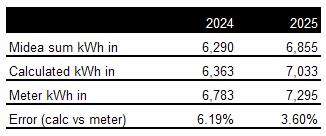
This is the way the cookie crumbles. It's not perfect, some crumbs get lost on the floor. Big bang (opening all the lock shield valves fully) happened in late Jan 2025, maybe that reduced the error by allowing the heat pump to operate freely at its full range, maybe not.
Does this variable error matter for setback calculations? Very possibly. If I compare a no setback period from 2024 with a setback period from 2025 and found the setback period used 2% more energy, that might just be measurement error. Nor do I know how the error varies during a year, all I know (from a few squints at the data) is that it varies. The energy monitoring policeman's lot is not a happy one.
What we probably can say with some certainty is that @robs's data is likely to be the most accurate, mine is somewhere in the middle, and @sunandair's is the least accurate, unless it to is based on external metering, which I do not think it is.
Midea 14kW (for now...) ASHP heating both building and DHW
1
01/03/2026 10:36 am
@robs and @cathoderay
I can understand that you may well have anxiety about accuracy of data being so keen on data, but this isn’t a concern of mine. In short you are panicking about something you think you cannot control.
I can understand @cathoderay that you wouldn’t know much about MELCloud and you may have valid curiosity questions about it.
But worse than that for @robs you are using it as a weapon to discredit my valid posts. On several posts since page 14 of this topic you- Rob have systematically denigrated MELCloud and by default inferred my post uses shaky data. You have also denigrated energy claims I’ve made when you haven’t even asked how I had arrived at the values.
The important thing to know is how MELCloud adds energy prediction to account for unknown energy consumption from external/unknown pumps and the continuously active monitoring system. It would appear, RobS you would rather speculate and presume on your invented negative point scoring as you try to defend fairly minor mistakes in your post rather than understand how MELCloud actually works.
I have found MELCloud is consistent and I have a known value to correct it if I ever need it.
Topic starter
01/03/2026 11:08 am
Panicking? I'm not Corporal Jones!
I can understand @cathoderay that you wouldn’t know much about MELCloud and you may have valid curiosity questions about it.
Exactly, I do, and that is why I asked. But you have still not provided any detail, just assurances that your data is 'consistent' (with what?). You say 'The important thing to know is how MELCloud adds energy prediction to account for unknown energy consumption from external/unknown pumps and the continuously active monitoring system' but then give no detail of what you do (or don't know) about how MELCloud 'adds energy prediction to account for unknown energy consumption from external/unknown pumps'. How can it possibly do this? What does it use to know about unknown pumps? Astrology?
It is a tenet of scientific enquiry at all levels including the amateur level that you provide raw data and methodology when asked for them. You have consistently not done this, and it is therefore legitimate to raise concerns about your conclusions.
Midea 14kW (for now...) ASHP heating both building and DHW
1
01/03/2026 12:53 pm
@robs and @cathoderay
I can understand that you may well have anxiety about accuracy of data being so keen on data, but this isn’t a concern of mine. In short you are panicking about something you think you cannot control.
Accuracy of the data is no concern of yours? So you are happy to spread your opinion based on nothing but wishful thinking?
There is no panic, just a wish for factually correct information to be posted on this forum.
But worse than that for @robs you are using it as a weapon to discredit my valid posts. On several posts since page 14 of this topic you- Rob have systematically denigrated MELCloud and by default inferred my post uses shaky data. You have also denigrated energy claims I’ve made when you haven’t even asked how I had arrived at the values.
You are using hopelessly inaccurate data for your posts and as a result are posting factually inaccurate information. MELCloud is more or less garbage, it's temperature sensors are thermistors with +/- 0.5C accuracy so at a dT of 5C can introduce a +/- 20% inaccuracy (also these are installed by the installer, so the quality of the install could introduce further inaccuracy). It's flow meter is a vortex based Silka unit that is susceptible to turbulence in the water flow (so how accurate this can be is again dependant on the installer) and MELCloud's consumption values are just poor estimates (as my previous example shows). It is literally garbage in = garbage out.
The important thing to know is how MELCloud adds energy prediction to account for unknown energy consumption from external/unknown pumps and the continuously active monitoring system. It would appear, RobS you would rather speculate and presume on your invented negative point scoring as you try to defend fairly minor mistakes in your post rather than understand how MELCloud actually works.
I have found MELCloud is consistent and I have a known value to correct it if I ever need it.
MELCloud adds fixed values to the estimated consumption value to account for external pumps, you can configure these fixed values in the installer settings to whatever values you want! I understand how MELCloud works but you don't seem to.
Consistent? In the last few days our MELCloud's energy consumptions figures have varied between 46% and 60% from the accurate figure.
And this "known value to correct it" is what? And how did you derive it?
01/03/2026 2:08 pm
I can understand @cathoderay that you wouldn’t know much about MELCloud and you may have valid curiosity questions about it.
Exactly, I do, and that is why I asked. But you have still not provided any detail, just assurances that your data is 'consistent' (with what?).
Hi Captain @cathoderay, When have you asked for any data from any charts I have produced and I have refused you?
It’s all simple really. The charts and the data are all MELCloud charts so the data is what it is. I only report figures produced by the Ecodan operating system which has not been altered. if I write on a chart then the value is exactly what the operating system has generated.
For example: like the setback chart I posted previously, I wrote the energy use quoted = 28.8 kWh.
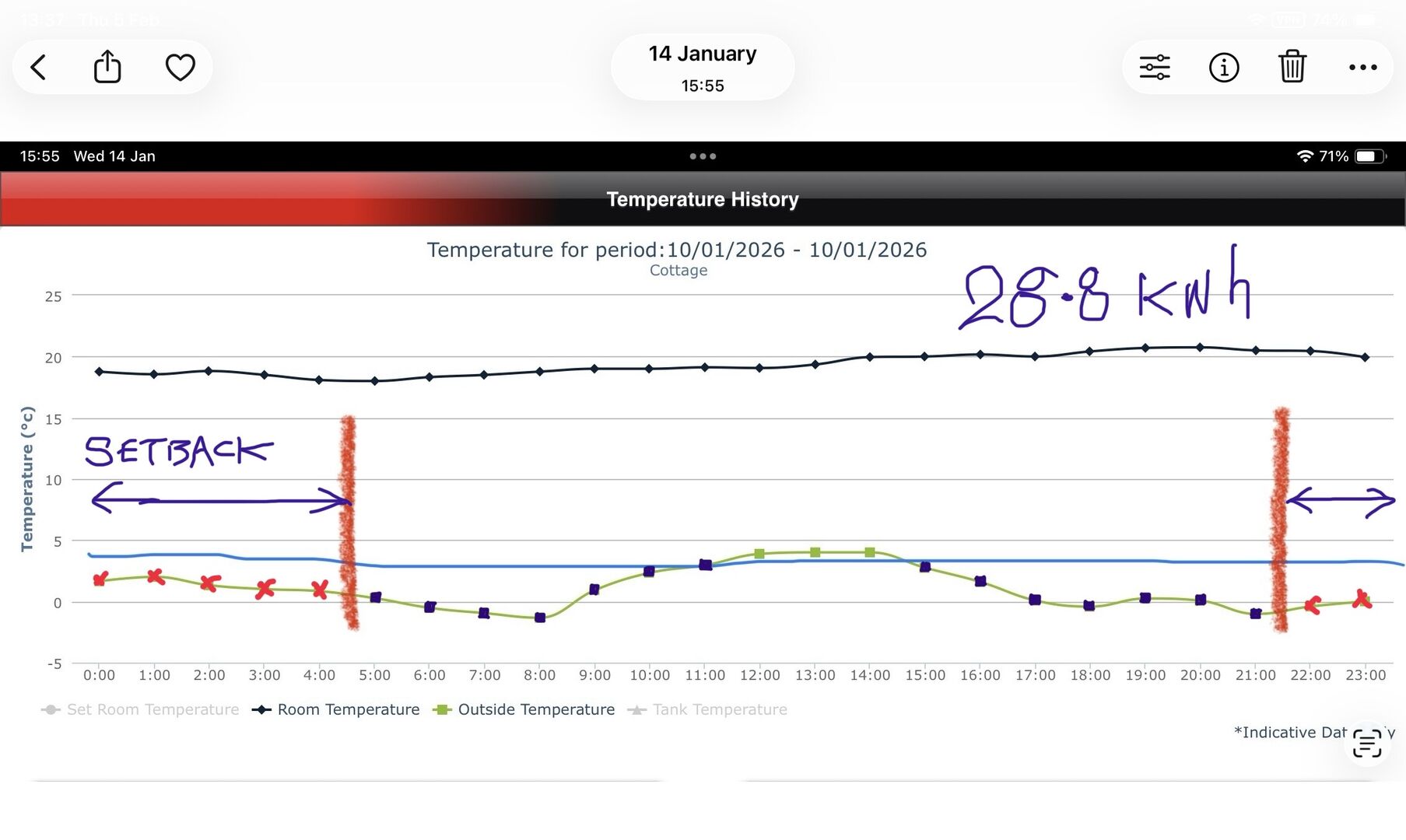
The data is contained in the energy-used report and is recorded exactly as displayed but it’s more convenient in terms of published pages if it is written on the chart itself and there’s less downloads to do.
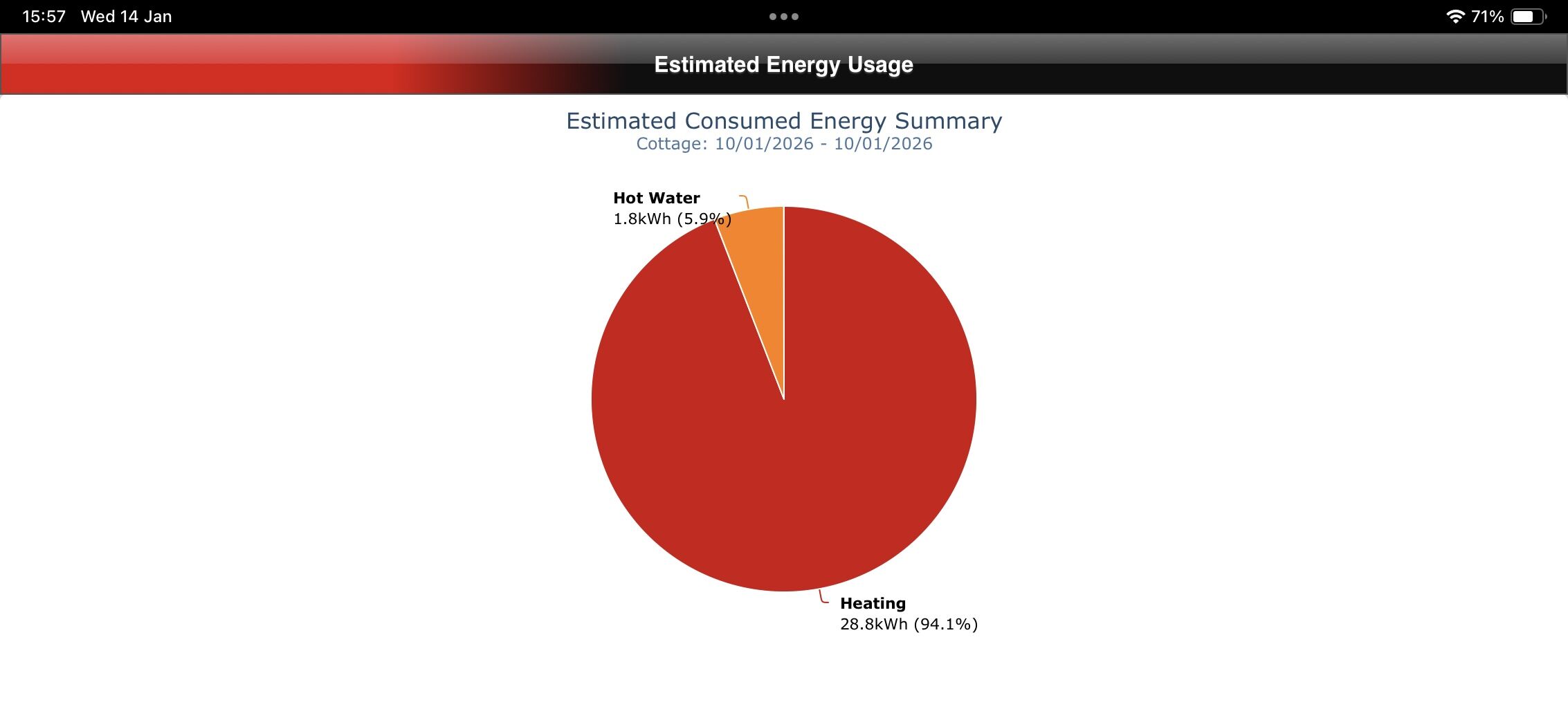
No manual alterations are ever done. Since the system is operating 24/7 even on a setback. Therefore the inbuilt energy markup is the same for both 24 hour time periods and is quoted exactly as reported.
In our case our system is the FTC6 controller and is pre set with 2.8 kWh add on in a 24 hour period. So the pre installed consumption over estimates our daily use. This may be different for the newer FTC7 which may be more programmable.
if you only have 1 circulating pump like we have. Our circulating pump only consumes 29w per hour. (696w in 24 hours.) The FTC 6 monitoring system consumes around 600w in a 24 hour period. So our total monitoring/circulating consumption is 1.296 kWh per 24 hour period.
This means our data typically reports 1.5 kWh higher daily, than the actual energy use.
I do not deduct this amount so there is no question of altering the reported data. So as you can see there is nothing to hide it’s just the raw data.
01/03/2026 2:11 pm
Accuracy of the data is no concern of yours? So you are happy to spread your opinion based on nothing but wishful thinking?
There it is…. That panic I was talking about.

Latest Posts
-

RE: Daikin Altherma 3 LT compressor longevity question
This mess is intriguing: I wonder if this represent...
By bobflux , 15 minutes ago
-
RE: Say hello and introduce yourself
Hi. I'm Mike. Thank you for letting me join. My partn...
By Fretless6 , 2 hours ago
-
RE: Connecting Growatt SPH5000 over wired ethernet rather than wireless
The simplest wired option is usually the Growatt Ethern...
By Jonatan , 4 hours ago
-
RE: Peak Energy Products V therm 16kW unit heat pump not reaching flow temperature
ASHPs do have a minimum compressor speed. The minimum h...
By bobflux , 11 hours ago
-

RE: Electricity price predictions
@jamespa And it seems some of the nasty public cloud...
By Batpred , 12 hours ago
-
RE: Tell us about your Solar (PV) setup
Location: near Lyon, France 12kWp on the roof, 2x Sol...
By bobflux , 12 hours ago
-

RE: Jokes and fun posts about heat pumps and renewables
Technology is rapidly advancing. BBC News reported th...
By Transparent , 15 hours ago
-
What matters for flow and pressure drop is internal dia...
By bobflux , 15 hours ago
-

RE: Do Fridges and Freezers have COP ratings?
@editor Thank you all for your replies and submitted in...
By Toodles , 18 hours ago
-
I know and yes. The secondary deltaT wont necessaril...
By JamesPa , 22 hours ago
-
RE: Designing heating system with air to water heat pump in France, near Lyon
Just love the way you put it! 🤣
By Batpred , 2 days ago
-
RE: Safety update; RCBOs supplying inverters or storage batteries
Thank you for sharing. So it seems that your Schneid...
By Batpred , 2 days ago
-

RE: Forum updates, announcements & issues
@upnorthandpersonal thanks for the thoughtful, consider...
By Mars , 2 days ago
-
RE: Solar Power Output – Let’s Compare Generation Figures
@mk4 All 21 panels have their own Enphase IQ7a microinv...
By Toodles , 2 days ago
-
RE: Setback savings - fact or fiction?
Great, so you have proven that MELCloud is consistently...
By RobS , 3 days ago
-
RE: Mitsu PUHZ120Y 'Outdoor Temp 'error?
Thanks David & James It almos...
By DavidAlgarve , 3 days ago
-
RE: Surge protection devices SPDs
@trebor12345 - your original Topic about the right type...
By Transparent , 3 days ago
-
RE: Help needed with Samsung AE120RXYDEG
@tomf I’ve been sent this from a service engineer at Sa...
By Mars , 3 days ago
-
RE: Buying large amp bidirectional RCD and RCBO
Yes... I went through this particular headache and ende...
By bobflux , 4 days ago
-
O-oh! Let's take this as an opportunity to 'pass the ...
By Transparent , 4 days ago
-
RE: Homely setup on daikin heat pump
@craigh I refer to our somewhat elevated temperature of...
By Toodles , 4 days ago
-
RE: Air source heat pump roll call – what heat pump brand and model do you have?
My turn, this describes the future installation, only t...
By bobflux , 4 days ago