@cathoderay yes there is an indication of quite a bit of recovery energy being used. Do you have any way of quantifying numerically the energy being used?
@robs - I was also looking at @robs graph….. please forgive my limited knowledge of these graphs, but the recovery graph shows several additional portions of energy if I’m reading it correctly.there also looks like an increased heat output for a period after the defrost which isn’t noticeably visible in the energy line… presumably it does mean more energy being used to make up for the loss of heating during the defrost? Just wondering if there’s any way of getting a value for all these aggregated energy extras? Possibly @robs might have some way of pulling them together. Also
This might obviously be a naive question, so apologies if it is… my only experience is the limitations of MELCloud.
That’s an interesting stat. I’m thinking that the 0.1 KWh might be the energy used during the flow reversal process….? I’m also thinking that the real energy which provides the heat for the defrost isn’t recorded during the defrost because it is the hot water which is already created and stored in the radiator circuit. Is it possible that the 0.1kw you refer to plus the 1 kWh water heat to provide the defrost was created at a cop of circa 3.8 and would result in the total energy for the defrost?
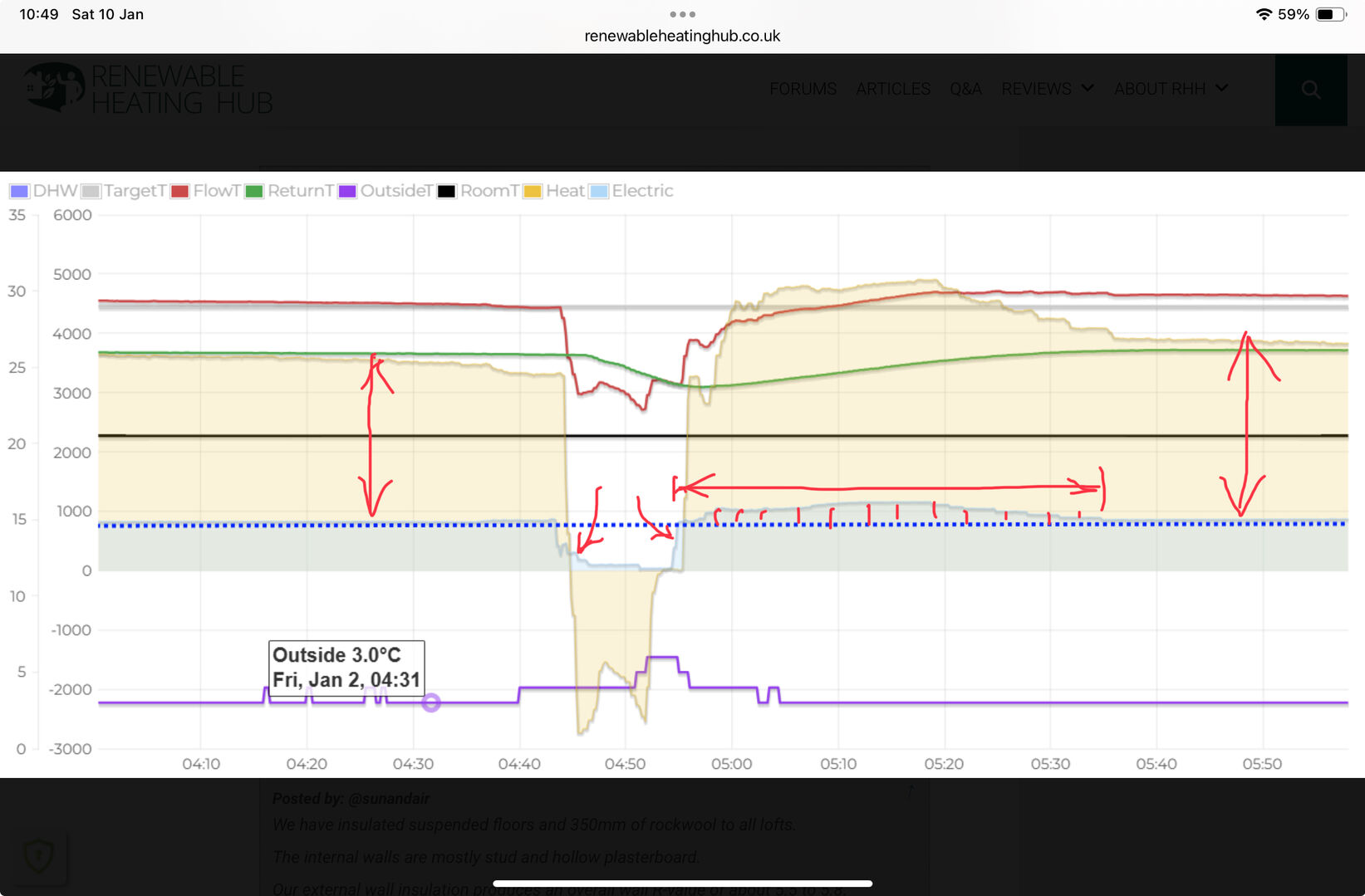
Yes the bulk of the energy comes from the already heated water, you can see that as the yellow area above the blue dashed line in the image below:
But as already mentioned, the energy in (electricity) to achieve this is approximately the same as the energy saved during the defrost (as the compressor isn't using as much electricity during the defrost).
So one thing puzzles me, given such good insulation and draft proofing, why do you need flow temperatures of 38-40C? Are you radiators (IIRC you have fancoils?) very small and low power output? Because with larger radiators or UFH you could be running flow temperatures 5-10C lower.
Yes you’re quite right I’ve worked out we should have at least 3 more radiators to give us enough output to operate at a lower flow temperature. This is a legacy issue from the original design. The extra volume would also allow us to operate at higher ambient temperatures without cycling….
Thank you for your comments they are very helpful regarding the effects of thermal insulation and heat retention. Regarding drafts we are about half way… Our house is old and we are still working on a few leaky doors and an old thin walled fireplace but it is all being addressed one step at a time.
Ah, puzzle solved! I'm sure you'll enjoy lower flow temperatures and greater efficiency once these changes have been made.
@cathoderay yes there is an indication of quite a bit of recovery energy being used. Do you have any way of quantifying numerically the energy being used?
@robs - I was also looking at @robs graph….. please forgive my limited knowledge of these graphs, but the recovery graph shows several additional portions of energy if I’m reading it correctly.there also looks like an increased heat output for a period after the defrost which isn’t noticeably visible in the energy line… presumably it does mean more energy being used to make up for the loss of heating during the defrost? Just wondering if there’s any way of getting a value for all these aggregated energy extras? Possibly @robs might have some way of pulling them together. Also
This might obviously be a naive question, so apologies if it is… my only experience is the limitations of MELCloud.
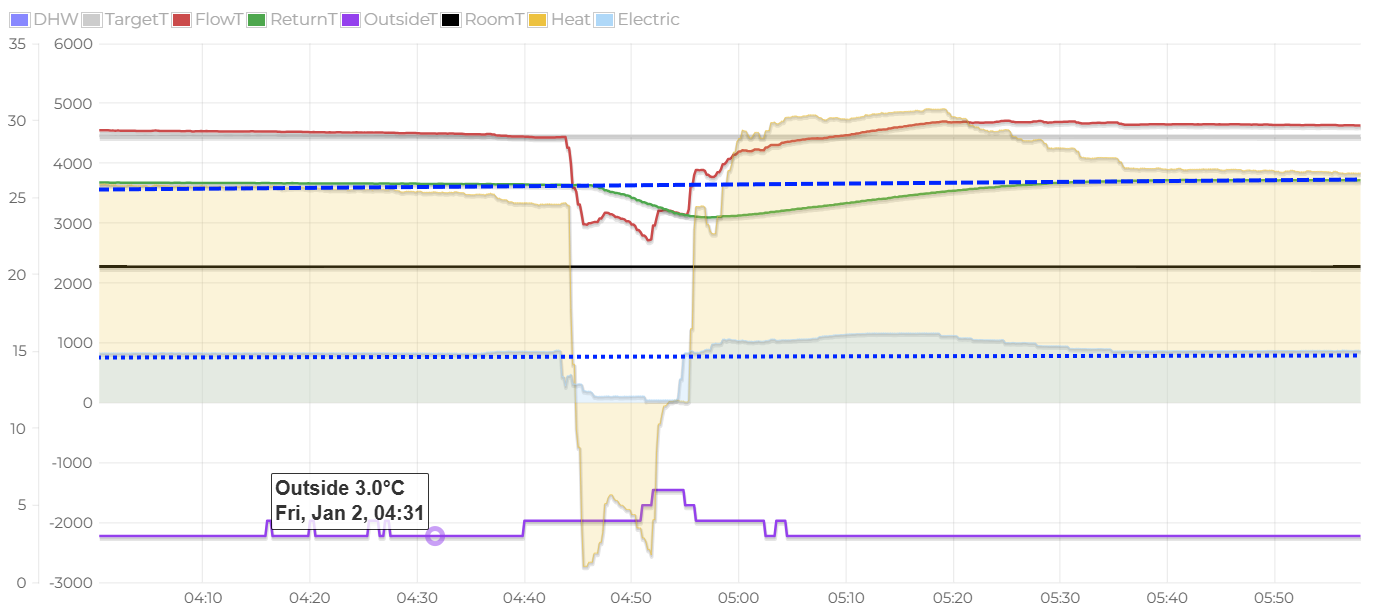
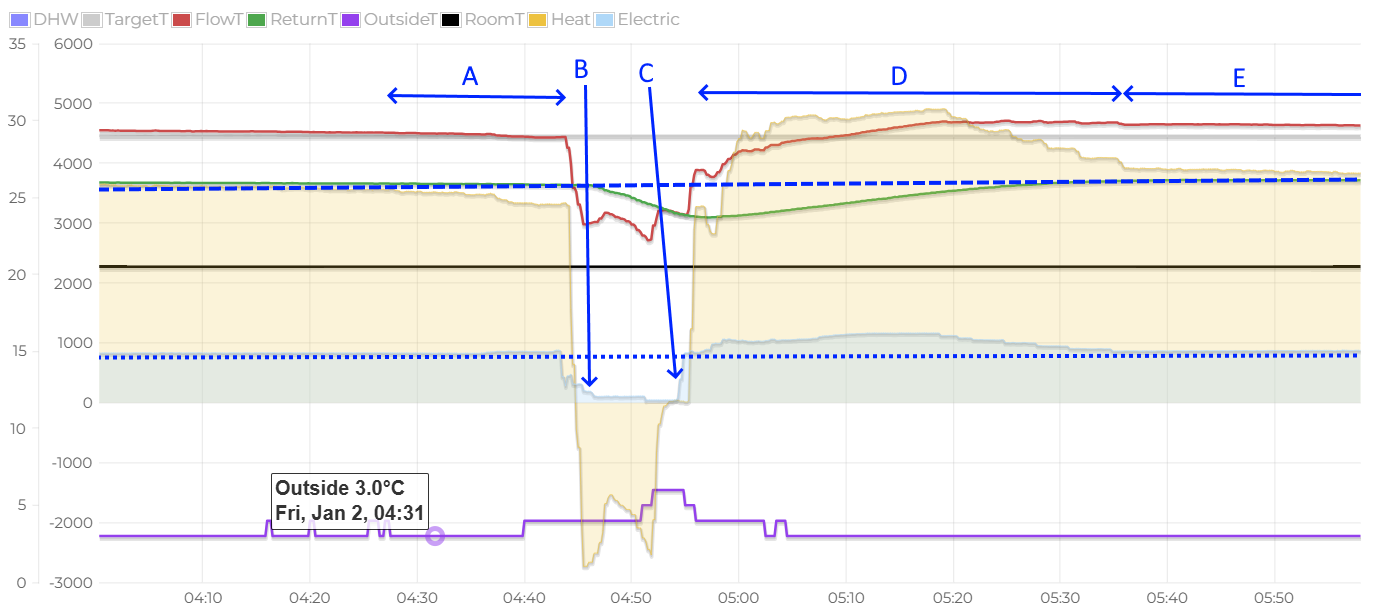
I hope the annotated image and description below helps describe what is happening.
A) Output falling due to evaporator starting to frost/ice up.
B) Compressor and water pump running to defrost evaporator, note the negative heat is shown as the yellow area below (from B to C).
C) Compressor starts heating again, heat output not immediately seen due to lag caused by distance from heat pump outside and plant room inside that has the flow/temperature monitors.
D) Duration of extra heat pump input (and hence output) post defrost.
E) Input back to pre-defrost but boost in flow temp during D results in additional "free" heat output (due to thermal lag of the system).
Do you have any way of quantifying numerically the energy being used?
Yes, by calculating it manually from the minute data, which doesn't happen automatically as it does for hourly data. It's in the manually calculated minute data energy in values that you see the negative flow, ie the energy in is flowing the wrong way (from house to heat pump). I'll do a sample, probably later today, for a period covered in the chart.
But as already mentioned, the energy in (electricity) to achieve this is approximately the same as the energy saved during the defrost (as the compressor isn't using as much electricity during the defrost).
I agree, that is what I was also getting at when I waffled my way through this:
"I dare say the extra amps in during the bulges approximate to the amps in saved during the defrost trough, meaning the defrost has little overall effect on the energy in over time"
Midea 14kW (for now...) ASHP heating both building and DHW
@cathoderay yes there is an indication of quite a bit of recovery energy being used. Do you have any way of quantifying numerically the energy being used?
@robs - I was also looking at @robs graph….. please forgive my limited knowledge of these graphs, but the recovery graph shows several additional portions of energy if I’m reading it correctly.there also looks like an increased heat output for a period after the defrost which isn’t noticeably visible in the energy line… presumably it does mean more energy being used to make up for the loss of heating during the defrost? Just wondering if there’s any way of getting a value for all these aggregated energy extras? Possibly @robs might have some way of pulling them together. Also
This might obviously be a naive question, so apologies if it is… my only experience is the limitations of MELCloud.
I hope the annotated image and description below helps describe what is happening.
A) Output falling due to evaporator starting to frost/ice up.
B) Compressor and water pump running to defrost evaporator, note the negative heat is shown as the yellow area below (from B to C).
C) Compressor starts heating again, heat output not immediately seen due to lag caused by distance from heat pump outside and plant room inside that has the flow/temperature monitors.
D) Duration of extra heat pump input (and hence output) post defrost.
E) Input back to pre-defrost but boost in flow temp during D results in additional "free" heat output (due to thermal lag of the system).
Excellent graphics and description Rob…. But to my mind there are amounts of energy that need replacing in this defrost event which aren’t portrayed in this chart.
1. The 12 minutes of zero heat (water heat) production needs to be replaced to maintain the room heating status quo.
2. The chart doesn’t graphically represent the 180 litres of chilled water which has entered the heating system in the 12 minutes of defrost. (12 minutes X 15 ltrs per minute flow rate)
So in order for the heating system to replace all the heat lost due to the above (to act as though there had never been a defrost) the system would have to increase flow temperature to match the steady state heating into the room space…
This to my mind can only be done by the weather compensation curve being set higher than the steady state WCcurve. Or using Auto Adaptation which would automatically compensate for the drop in heating delivered.
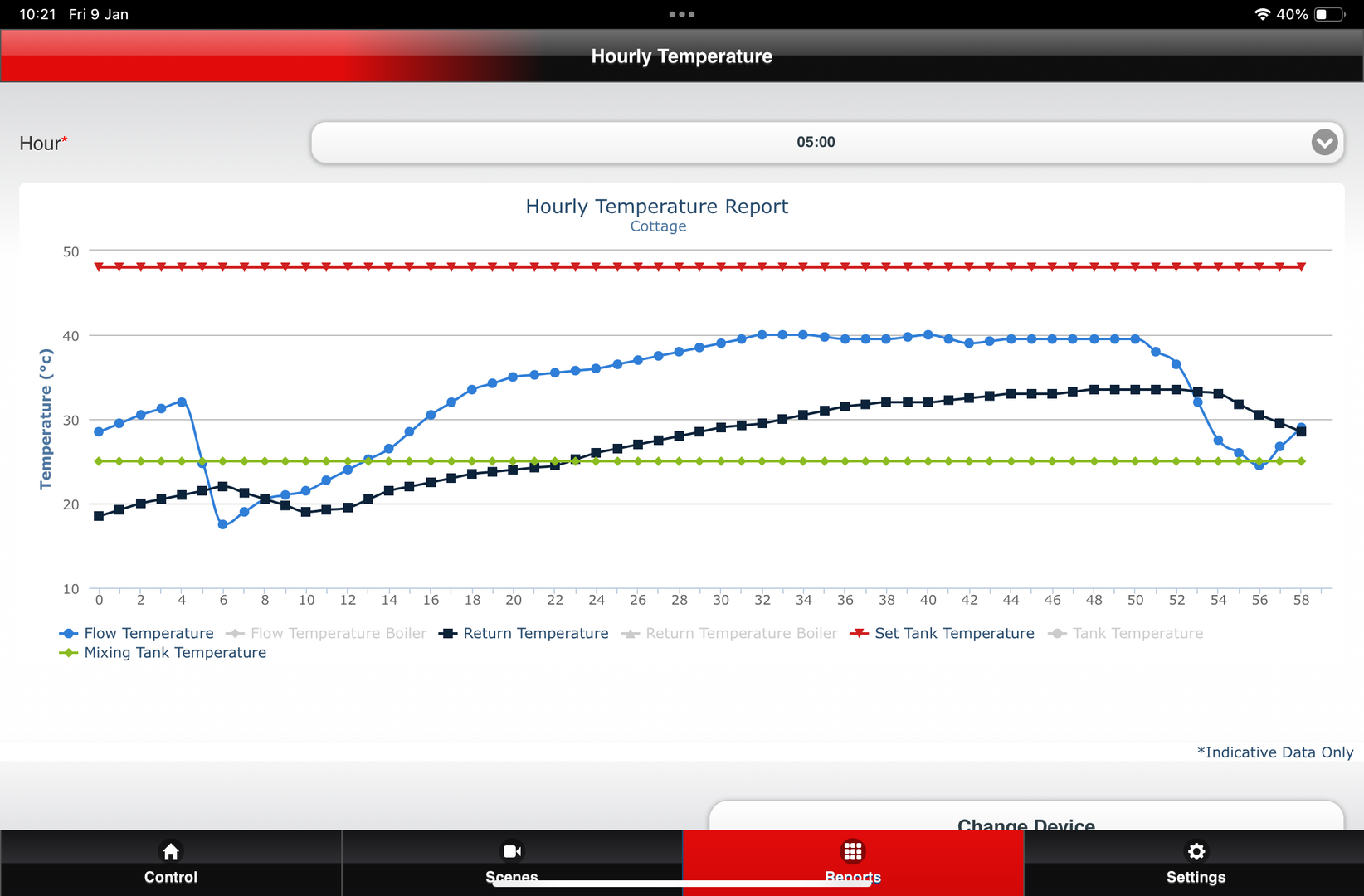
The cold slug of water in our system is typically dropped by 15c in a +3c defrost as can be seen at the end of this chart.
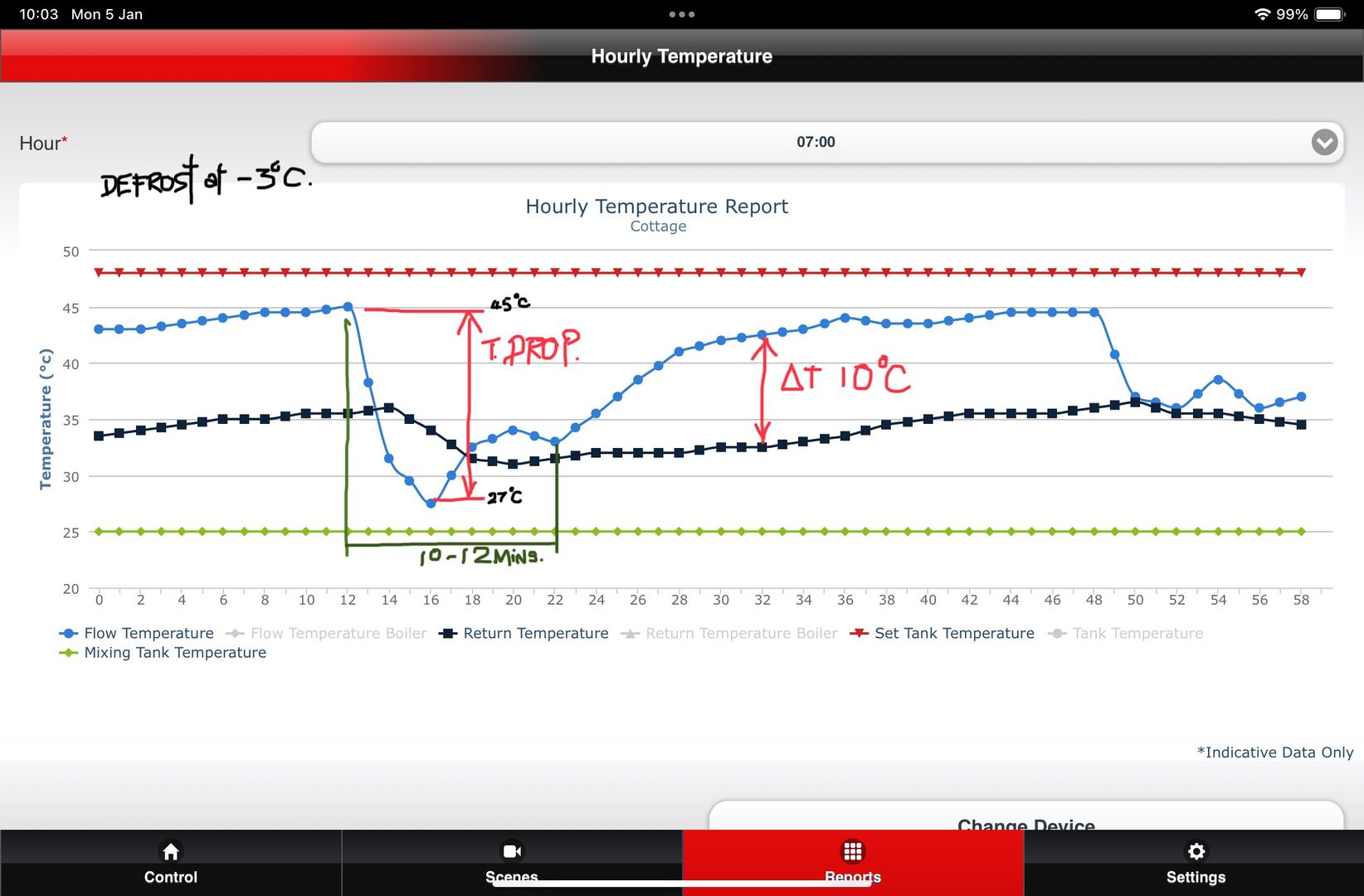
and there is a substantially larger drop in water temperature in a defrost when at -3C outdoor temperature. I’ve tried to represent it in this sketched chart below.
At this colder temp the HP has also gone into high output creating a huge DeltaT of 10.
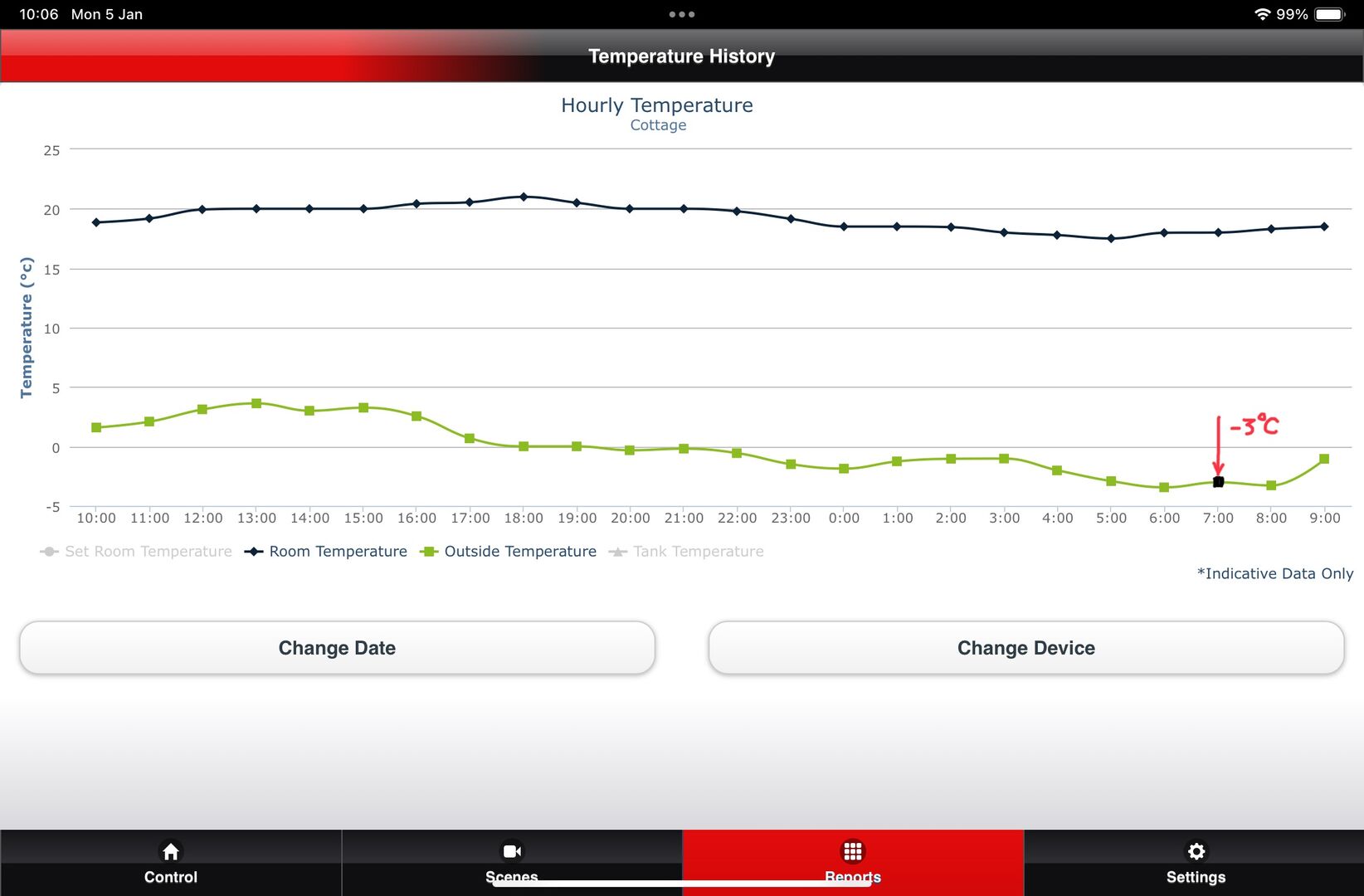
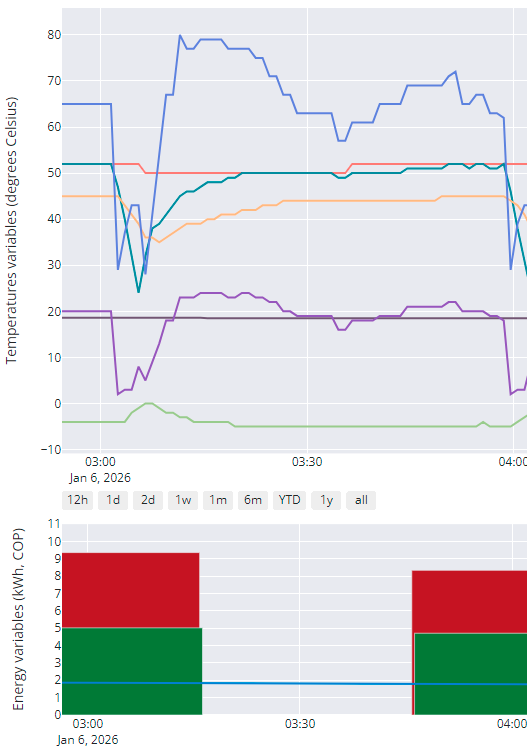
this high energy consumption which coincides with defrosts due to continuous operation must be accounted for to accurately compare a nighttime setback with continuous operation. here is a graph showing the time when the defrost took place. I’m sure this is typical of many HPs during defrost.
Food for thought -
This also raises other questions such as how many weather compensation curves do not adequately provide enough heat for the homes during defrost cycles. Most WCcurves on systems appear to be linear straight slopes and do not allow for a ramped up section for 3C onwards when recovery is needed. To compensate, this would mean a curve would need to be set at a higher slope to accommodate the defrost zone and possibly over supplying heat during 4, 5 and 6C ambients when there are no defrosts happening?
I hope the annotated image and description below helps describe what is happening.
A) Output falling due to evaporator starting to frost/ice up.
B) Compressor and water pump running to defrost evaporator, note the negative heat is shown as the yellow area below (from B to C).
C) Compressor starts heating again, heat output not immediately seen due to lag caused by distance from heat pump outside and plant room inside that has the flow/temperature monitors.
D) Duration of extra heat pump input (and hence output) post defrost.
E) Input back to pre-defrost but boost in flow temp during D results in additional "free" heat output (due to thermal lag of the system).
Excellent graphics and description Rob…. But to my mind there are amounts of energy that need replacing in this defrost event which aren’t portrayed in this chart.
1. The 12 minutes of zero heat (water heat) production needs to be replaced to maintain the room heating status quo.
2. The chart doesn’t graphically represent the 180 litres of chilled water which has entered the heating system in the 12 minutes of defrost. (12 minutes X 15 ltrs per minute flow rate)
Thanks. The chart shows all the power/energy flows in the heating system, electrical and thermal.
1. The energy to replace the defrost event is the yellow area above the blue dashed line.
2. That is the yellow area at the bottom, you'll note that the power output is negative during this period, this is the thermal energy taken from the warm water for the defrost.
So in order for the heating system to replace all the heat lost due to the above (to act as though there had never been a defrost) the system would have to increase flow temperature to match the steady state heating into the room space…
This to my mind can only be done by the weather compensation curve being set higher than the steady state WCcurve. Or using Auto Adaptation which would automatically compensate for the drop in heating delivered.
Which you see in the chart post defrost where the flow temperature rises to above the target flow temperature (the grey line), it remains above the target flow temperature for over an hour - most (50 mins) of that is the E period where the electrical input has returned to the pre-defrost level and the increased flow temperature is from thermal lag in the system.
We are running WC and not auto-adapt, so there is no IAT based boosting of flow temperature happening.
The cold slug of water in our system is typically dropped by 15c in a +3c defrost as can be seen at the end of this chart.
and there is a substantially larger drop in water temperature in a defrost when at -3C outdoor temperature. I’ve tried to represent it in this sketched chart below.
At this colder temp the HP has also gone into high output creating a huge DeltaT of 10.
this high energy consumption which coincides with defrosts due to continuous operation must be accounted for to accurately compare a nighttime setback with continuous operation.
Ouch, your lower system volume is being seen here with big flow temperature drops. Our larger system volume results in only a ~7C drop in flow temp at 3C OAT and 11C drop at -6C OAT. Hopefully the 3 extra radiators you have identified as needed will help with this, also have you considered a volumiser (or bigger volumiser)?
Your dT prior to the defrost was approximately 9C and your return water temp has only dropped ~3C post defrost when compared to pre-defrost, so your heat pump post defrost isn't doing that much more than pre-defrost steady state.
This also raises other questions such as how many weather compensation curves do not adequately provide enough heat for the homes during defrost cycles. Most WCcurves on systems appear to be linear straight slopes and do not allow for a ramped up section for 3C onwards when recovery is needed. To compensate, this would mean a curve would need to be set at a higher slope to accommodate the defrost zone and possibly over supplying heat during 4, 5 and 6C ambients when there are no defrosts happening?
Radiator output is not linear with mean water temperature (hence flow temperature), it is to the power of 1.3 (IIRC).
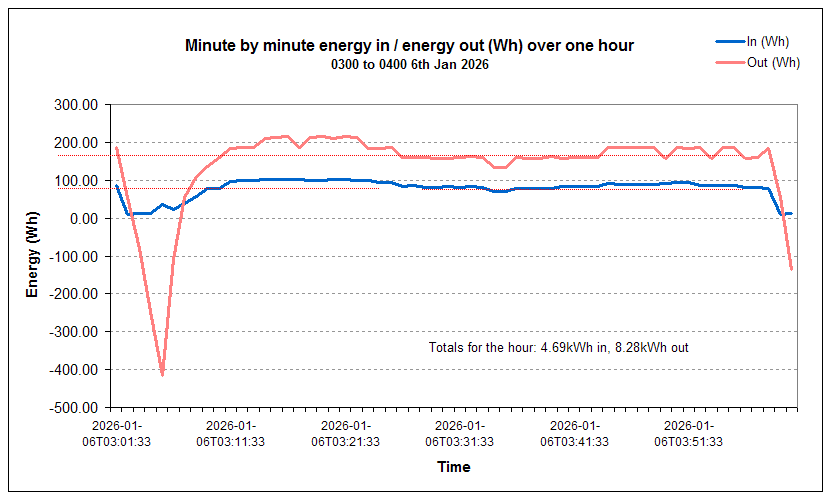
I've now calculated the minute by minute energy flows during the first hour in my previous chart, which had a defrost right at the start of the hour. I can make the numbers available as well, but here are two charts showing what happened. The first one is an excerpt from the previous chart, the second show the minute by minute energy in and out:
The thin red dotted lines are the Mk I Eyeball estimates of what the steady state might have been without the defrost. The bits for each curve above and below the lines should we reckon be roughly equal - what the defrost steals is then returned during the recovery. But is it?
Worth noting the defrost 'deep dive' into negative territory squishes the 'normal' part of the chart (0-300Wh) into the top third of the chart, greatly distorting the apparent relative difference between the energy in and out (I moved the x-axis to -500 on the y axis to stop it cluttering up the middle of the chart). In the 'normal' part of the chart, away from the defrost, the energy out is not quite twice the energy in (COP < 2).
Midea 14kW (for now...) ASHP heating both building and DHW
Anyway, we used to have the rad flow temperature set to about 65 in the vaillant boiler and at some stage when I reduced it to like 45 to "see if the rads would keep it warm", simulating ASHP flow temperature, that sparked a general uprising in my household! I sensed (correctly) this would push back any discussion on a potential switch by a few months.. Well, I am an optimist..
I did something similar with my boiler. I set it to a fixed 50 for most of the time, bumping it up to 55 in the very coldest weather. Greater comfort, lower cost. Then I got my ASHP.
Given the weather has been relatively stable, the empirical results seem worth sharing. 🙂 I am assuming it is condensing
I dropped the maximum flow temperature from 65 to 55. Gas consumption seems to have dropped from 95kwh/day to 80-85 without loss of comfort. 😀
Our set back temp is 15C and we target 21 in the early morning and then starting mid afternoon. Our consumption is heavily concentrated in two periods - 3.5 hours early morning and 5 hrs starting in the afternoon.
8kW Solis S6-EH1P8K-L-PLUS hybrid inverter; G99: 8kw export; 16kWh Seplos Fogstar battery; Ohme Home Pro EV charger; 100Amp head, HA lab on mini PC
Ouch, your lower system volume is being seen here with big flow temperature drops. Our larger system volume results in only a ~7C drop in flow temp at 3C OAT and 11C drop at -6C OAT. Hopefully the 3 extra radiators you have identified as needed will help with this, also have you considered a volumiser (or bigger volumiser)?
I don’t think you can compare the two systems. Ours is entirely radiator system while yours appears to be under floor heating possibly with volumiser of some kind. A volumiser, depending on where it’s placed will mask a lot of performance as it blends and mixes before the temp sensors.
Your system does however show high delta T at minus temperatures - which was all I was interested in showing our -3 delta T image.
There is no ‘ouch’ in our defrosting it is simply operating within its capacity with no secondary pumps and no blending tanks or valves. Regarding capacity It is just a personal decision that I would like to extend the system at some point mainly to allow us to operate at lower temperatures.
My thoughts are I’d like to get back to the topic in question. As far as the recent posts has been, how much electrical energy is used in a defrost and what are all the elements that make up that energy. To that end it would appear there are 3 items unless someone knows of others?
1. the electrical energy used to reverse the flow in the compressor for defrosting purpose
2. the energy to replace the 12 minutes heating lost while the defrost took place and
3. the energy needed to reheat the 180 litres of water which has been chilled and sent around the heating system after the defrost.
I have some figures on this but interested if any views on other energy usage which might be relevant to this total.
@sunandair I think you will also need to take account of the energy lost through Latent heat of fusion e.g. To turn 1 kg of ice at 0°C into water at 0°C (condensate), you need 334,000 Joules (J) or 334 kilojoules (kJ) of energy, a value known as the latent heat of fusion, which is the energy absorbed for a phase change without a temperature change.
This is lost energy from the system to the environment.
@sunandair I think you will also need to take account of the energy lost through Latent heat of fusion e.g. To turn 1 kg of ice at 0°C into water at 0°C (condensate), you need 334,000 Joules (J) or 334 kilojoules (kJ) of energy, a value known as the latent heat of fusion, which is the energy absorbed for a phase change without a temperature change.
This is lost energy from the system to the environment.
Totally agreed (and hopefully this is the major contribution to energy) - but isnt that contained within
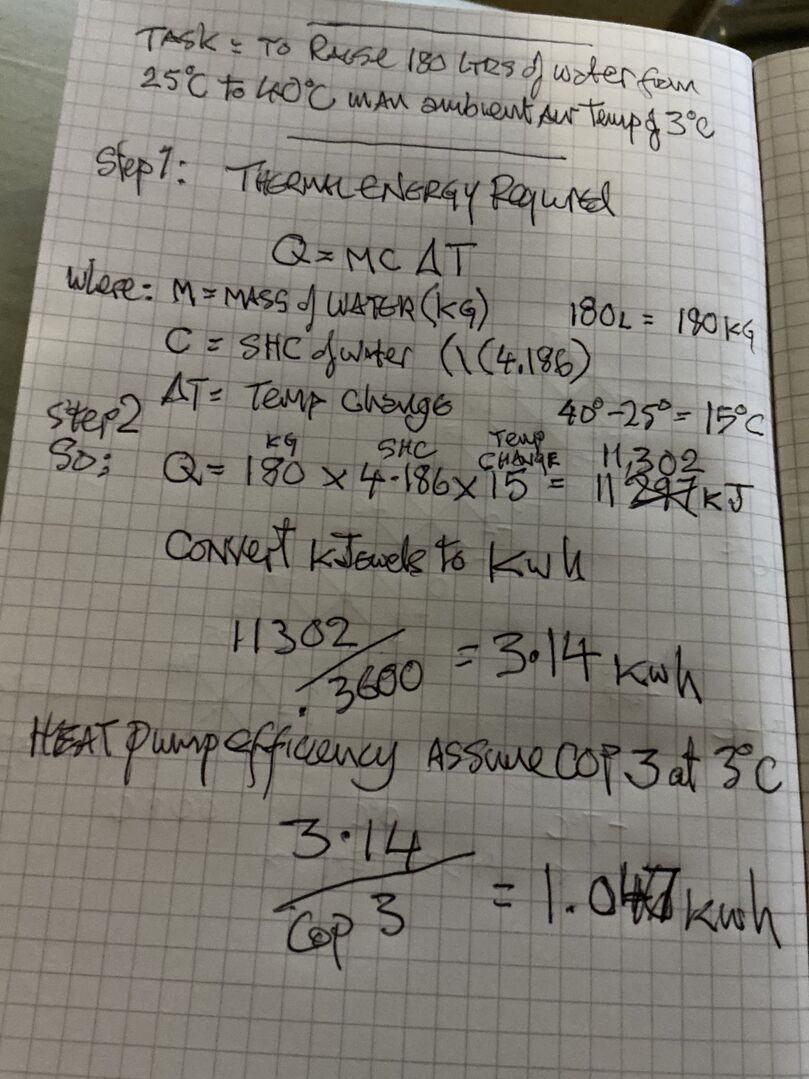
@jamespa, thank you both @iaack so far I haven’t calculated this latent heat of fusion. Just the raising of the 180L of water temperature from 25C to 40C. It doesn’t seem insignificant. But please let me know if my maths is wrong.
As you can see I’ve based it on a CoP of 3 but it still comes in at just over 1KWh.
the operation of the compressor reversal pump appears on @robs post as 100watts
Which leaves the Latent Heat of Fusion contribution and the electrical energy to replace the 12 minutes when the HP is not adding heat energy to the system during the defrost.