
Notifications
Clear all

24/12/2025 9:18 am
My preference would be to keep it simple. I'd say that if two days share similar maximums, minimums and averages then it's a close enough profile.
Somehow Google matches images, but I suspect the techniques are quite sophisticated.
Building on @majordennisbloodnok suggestion could it be as simple as average temps equal to within (say) 2C AND Max-Min equal to within (say) 3C. Numbers chosen at random but this would be relatively easy to try whilst making the limits adjustable to see what it turns up.
It strikes me that the fact we are having this discussion at all illustrates the extreme difficulty of answering the question experimentally (unless of course you have access to a house in a lab).
Im still not convinced that comparing similar days is sufficient, I think you may well need to include the previous day at least. Of course that still doesn't account for solar gain or wind.
This post was modified 2 months ago by JamesPa
4kW peak of solar PV since 2011; EV and a 1930s house which has been partially renovated to improve its efficiency. 7kW Vaillant heat pump.
Topic starter
24/12/2025 9:26 am
My preference would be to keep it simple.
Always my preference too, but I fear it is going to be too simple! I first considered much the same as you did, min, max, mean, standard deviation (though strictly speaking meaningless, but nonetheless two similar profiles should generate similar SDs), easy to calculate, and maybe useful as a screening tool. But consider two imaginary profiles, one where the OAT goes from 5 to 10 degrees in a straight line, and the the other goes from 10 to 5 degrees in a straight line: the min, max, mean and SD will all be the same, but the profiles are rather different!
I'm currently thinking about things like imageJ which I have used before for image processing, possibly ImageMagick and duplicate image finders. The latter may work, especially with the right similarity setting, but any image processing approach needs images, meaning I will need to write some code to extract hundreds of images...
There is another thing that bothered me a while ago, which I then forgot, but it has now come back to me. Because I use a pivot table to get the daily sums and means, they are conventional days, midnight to midnight, but that means they contain two half setback periods, the last three hours of one, and the first three hours of the second. I don't think this matters if all we are doing is comparing energy use - but maybe it does? Any thoughts?
Somehow Google matches images, but I suspect the techniques are quite sophisticated.
See above - there are desktop programs that can do this (duplicate image finders). But it means generating the images first. Whenever I have tried google similar image searches, I have not been impressed. It's that blasted AI rubbish again.
Im still not convinced that comparing similar days is sufficient, I think you may well need to include the previous day at least. Of course that still doesn't account for solar gain or wind.
I can but try. I think the initial values of a 24 hour period will probably capture at least the ending state of the previous day. Weather effects, again, see above. There will be ways and means...
Midea 14kW (for now...) ASHP heating both building and DHW
24/12/2025 9:28 am
I can but try. I think the initial values of a 24 hour period will probably capture at least the ending state of the previous day. Weather effects, again, see above. There will be ways and means...
I completely agree, just sounding a note of caution!
Because I use a pivot table to get the daily sums and means, they are conventional days, midnight to midnight, but that means they contain two half setback periods, the last three hours of one, and the first three hours of the second.
I cant think of a reason why it would matter but, that said, when I did something similar (I cant remember exactly what and it may even have been on your data) I did use an offset day. If it makes a difference at all I would guess that the best approach would be a day that starts as setback occurs (or maybe one hour before to capture the starting IAT/OAT) and ends 24hrs later. But Im not saying I have an argument for why it would make a difference!
This post was modified 2 months ago 2 times by JamesPa
4kW peak of solar PV since 2011; EV and a 1930s house which has been partially renovated to improve its efficiency. 7kW Vaillant heat pump.
Topic starter
24/12/2025 9:37 am
I have just tried a program called Visipics (olden but golden...) on nine manually grabbed 24 hour period images and using loose match criteria, it matched these two images:
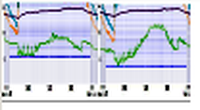
They are not the same, but they are similar...
Midea 14kW (for now...) ASHP heating both building and DHW
1

24/12/2025 10:26 am
Always my preference too, but I fear it is going to be too simple! I first considered much the same as you did, min, max, mean, standard deviation (though strictly speaking meaningless, but nonetheless two similar profiles should generate similar SDs), easy to calculate, and maybe useful as a screening tool. But consider two imaginary profiles, one where the OAT goes from 5 to 10 degrees in a straight line, and the the other goes from 10 to 5 degrees in a straight line: the min, max, mean and SD will all be the same, but the profiles are rather different!
I agree, but the “similarity categorisation” could just as easily include first/last values as well to cover that. That would also at least partly address @jamespa’s concern about effect of previous day.
Im still not convinced that comparing similar days is sufficient, I think you may well need to include the previous day at least. Of course that still doesn't account for solar gain or wind.
Actually, if the OpenWeatherMap API data is included, solar gain and windchill wouldn’t be difficult to include. That historical data includes cloud cover percentage, sun elevation and wind direction/speed. It couldn’t calculate the effect of solar gain/windchill on a particular home but would allow for comparison of similar solar gain/windchill conditions.
105 m2 bungalow in South East England
Mitsubishi Ecodan 8.5 kW air source heat pump
18 x 360W solar panels
1 x 6 kW GroWatt battery and SPH5000 inverter
1 x Myenergi Zappi
1 x VW ID3
Raised beds for home-grown veg and chickens for eggs
"Semper in excretia; sumus solum profundum variat"
Topic starter
24/12/2025 10:51 am
It couldn’t calculate the effect of solar gain/windchill on a particular home but would allow for comparison of similar solar gain/windchill conditions.
Exactly. We only need to compare conditions, to decide whether they are similar or not.
I now have the python code to get a simple 24 hour plot of OAT, I just need to run a loop to get a series of plots. It is a simple matter of changing a couple of numbers to change the start and end hour:
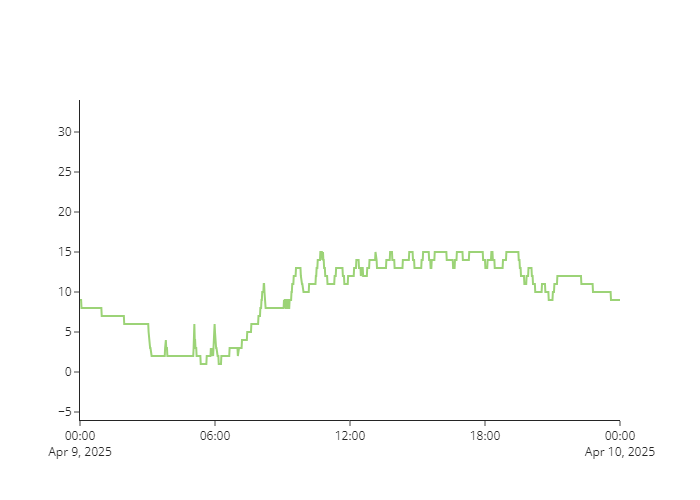
But it is also Christmas Eve, and I have chestnuts to roast, final presents to deliver, and holly to cut for some decorations! Python will have to wait!
Merry Christmas all!
Midea 14kW (for now...) ASHP heating both building and DHW
3

31/12/2025 1:02 pm
I thought I’d re-post my comment on this thread which was posted on 4th March 2025. Last night we had a night time setback through definite defrost weather. In that time we could have expected to have around 6 or 7 defrosts and 6 or 7 ramp up operations of the HP at around 40C (our WComp setting for zero OATs.)
by 4am our internal temperature had only dropped to 19C so when the HP started to reheat using a fine tuned WCcurve it was back to 20.5c in 5 hours (9am). How much energy would have been used if the HP operated through all those defrosts?
There are many house types which can save energy this way. Physics is more complex and in some ways more subtle than many people realise. There are however some house types which don’t perform as well in a setback and recovery situation
I thought we’ve been here…. It’s fact isn’t it?
Topic starter
31/12/2025 2:59 pm
Physics is more complex and in some ways more subtle than many people realise.
I agree, and I think there are two things in play here. First understanding the concepts, which can be complex, though some, eg the conservation of energy, aren't, but just as importantly the concepts need to be applied correctly. Thus we may know the conservation of energy principle, and know that it applies, but have we applied it correctly?
I'm waiting for the month to end (not long now) and then i am going to run my find and compare similar days with and without setbacks study and see what comes out of that. I did have a preliminary peek at some of the data the other day and rather suspect it isn't going to be conclusive, not enough similar days spread across both setback and no setback days, but we shall have to wait and see, and over time the data set will get larger, which should increase the number of close matches.
Midea 14kW (for now...) ASHP heating both building and DHW
Topic starter
04/01/2026 11:34 am
I have now done the daily OAT plots for 2025 but finding valid matched pairs is easier said than done. Visipics does find visually similar plots:
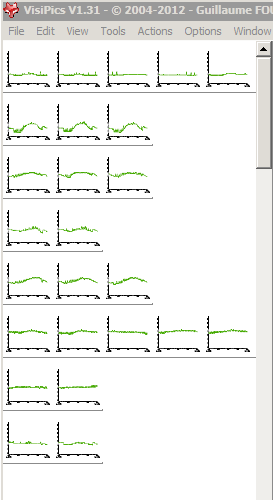
but more often than not the visually similar plots turn out to have significantly different 24h mean OATs and so are not matched. There is also a curious effect: there appear to be more visual matches within each group (setback or no setback) than there are between the groups ie a matched pair, one from the setback group, the other from the setback group. Furthermore, the spread in kWh in for each mean OAT is far from trivial, as this chart shows (2025, Feb to Dec ie post big bang and only hours when space heating only was on):
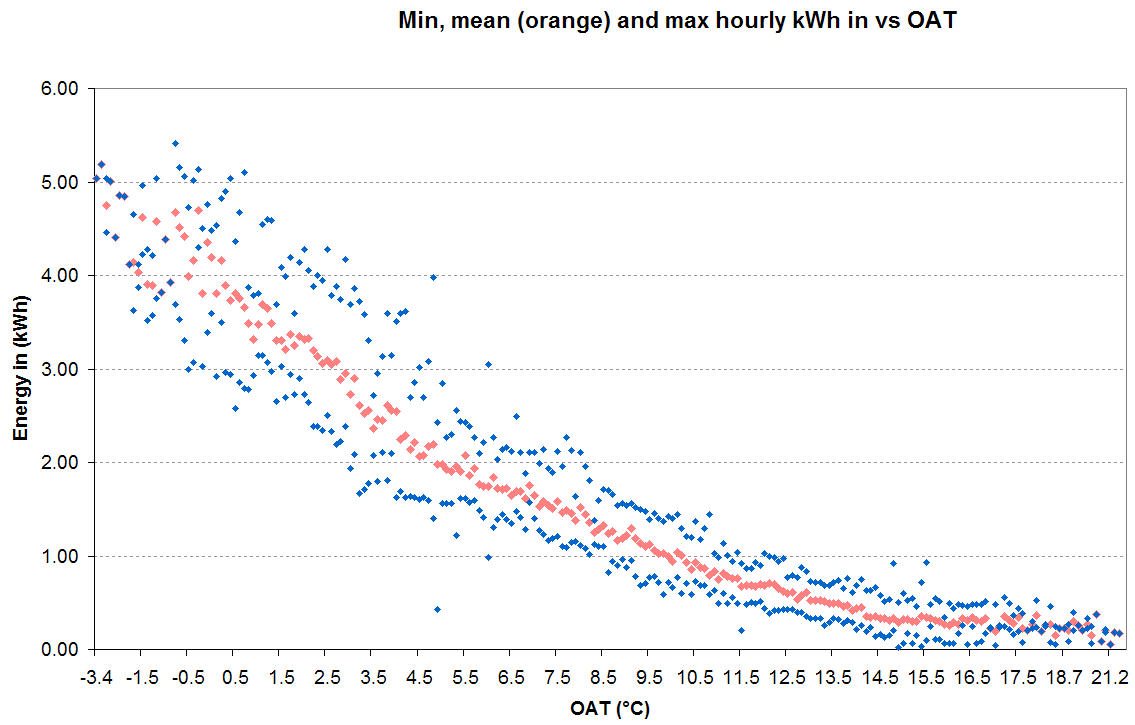
These are hourly mean OAT values against energy in for the hour, the orange points being the mean values for the mean OAT, the blue points the min and max for that mean hourly OAT. Although there is a clear relationship between mean OAT and mean energy in (R squared = 0.989), the spread at each mean OAT is considerable. For example, there are 69 hours with a mean OAT of 8°C, with a mean energy in of 1.51kWh, but the actual values range from 1.11 to 2.11kWh, which is both somewhat surprising (the heat pump was on weather compensation throughout) and something of a nuisance for any setback vs no setback analysis (the random variation in each value being more than enough to mess up any setback vs no setback comparision).
I need to do some more thinking on this! Meanwhile, as ever, any thoughts and/or comments are very welcome.
Midea 14kW (for now...) ASHP heating both building and DHW
04/01/2026 11:44 am
I need to do some more thinking on this! Meanwhile, as ever, any thoughts and/or comments are very welcome.
My first comment is that this is a heroic effort to eliminate variables and illustrates how difficult this problem is. I might suppose that the fact it is difficult suggests that the effect, whatever it is, is in reality small (on your system at least), but of course that may be extrapolating too far.
There is also a curious effect: there appear to be more visual matches within each group (setback or no setback) than there are between the groups ie a matched pair, one from the setback group, the other from the setback group
Is an interesting observation and shows yet again the difficulty of this task. My guess is its season related, from what I recall your setback and non setback were at different times of year (spring, autumn) and the pattern and extent of diurnal variation does shift quite significantly with the seasons. Initially I would have thought that spring and autumn might be similar but perhaps not. Spring starts with very cold ground, autumn starts with very warm ground, and that may well make a difference leading perhaps to a moderating effect in Autumn which does not occur in spring. I think its also a common experience that spring tends to have greater extremes than autumn.
4kW peak of solar PV since 2011; EV and a 1930s house which has been partially renovated to improve its efficiency. 7kW Vaillant heat pump.
Topic starter
04/01/2026 11:54 am
from what I recall your setback and non setback were at different times of year (spring, autumn)
That is correct, the setback period was Feb to Apr 2025 inclusive, the no setback period Oct to Dec 2025 inclusive, and I agree that subtle, or perhaps more accurately less visible, seasonal variations may well have effects.
My efforts may or may not be more or less heroic, but I do enjoy the challenge of trying to make sense of things!
Midea 14kW (for now...) ASHP heating both building and DHW
05/01/2026 6:07 pm
I also have some concern about an excessive focus on the energy balance in the fabric. What matters to the inhabitants is not that energy balance, but the IAT. Is it possible that while the IAT is OK, the house is still out of balance, and so in fact the conservation of energy (which I don't dispute) doesn't apply in the short term, but only in the (much) longer term? Yes, the house loses X amount of energy during the setback, and X ultimately needs to be put back in, but what about the short term. Maybe the fabric is forever playing catch up, while the IAT is OK for the inhabitants?
@cathoderay regarding Catchup I agree… this is the opinion I’ve had since early last year. Heat loss will obviously be a different scenario for different house fabric… whether it’s modern insulated cavity construction, stone vs brick vs aerated block or SIPS construction. But my view is that external wall finishes which have some internal insulating properties will create a lead/lag effect during the short term cooling event of an overnight setback. Furthermore any Internal walls will only be exposed to a small environmental temperature drop of 2 or 3 degC therefore heat loss will also be small. As I understand it, Fabric requires a big temperature difference to permit large heat loss. I would think that Drafts may prove a bigger problem in many house types.
On our home the external walls have *INTERNALLY INSTALLED* floor to roof insulation which gives us extremely low mass exposure to the heated envelope. This means that during a night time setback there is very little heat loss to the fabric of the building. So by the time the heating comes back on the recovery is within the normal weather compensation curve operation.
We have insulated suspended floors and 350mm of rockwool to all lofts.
The internal walls are mostly stud and hollow plasterboard.
Our external wall insulation produces an overall wall R-value of about 5.5 to 5.8.
I hope this is useful information
This post was modified 2 months ago by SUNandAIR

Latest Posts
-

@petch Same with me, I had to insist and taking a le...
By MK4 , 47 minutes ago
-
RE: Tell us about your Solar (PV) setup
Since you seem to quite thoroughly investigate every st...
By MK4 , 2 hours ago
-
RE: How to control DHW with Honeywell EvoHome on Trianco ActiveAir 5 kW ASHP
Well I've had an interesting few days and would like to...
By giganto , 14 hours ago
-

RE: Peak Energy Products V therm 16kW unit heat pump not reaching flow temperature
Yes, here's mine. From the service manual parts numbers...
By bobflux , 18 hours ago
-
RE: Underfloor Heating Installation Issues with Heat Pump
Thanks for sharing your observations, both of you. From...
By Jonatan , 18 hours ago
-
Had to learn the hard way 🤣 now I'm sharing T...
By bobflux , 18 hours ago
-
RE: Issue with a Grant Air Source Heat Pump & Tado Smart Thermostat
Im assuming from your original post that hysterisis ref...
By JamesPa , 19 hours ago
-
RE: Heat Pump vs New Gas Boiler for Inherited House - Worth the Extra Cost?
Hi @fretless6 Mike, I have experience with Taggas (Re...
By Old_Scientist , 21 hours ago
-
RE: Daikin Altherma 3 LT compressor longevity question
@bobflux With my limited HA skills I can't ad...
By Ubert767 , 22 hours ago
-
RE: Testing new controls/monitoring for Midea Clone ASHP
Now seems a good time to summarise the costs and effici...
By benson , 1 day ago
-
RE: Connecting Growatt SPH5000 over wired ethernet rather than wireless
The simplest wired option is usually the Growatt Ethern...
By Jonatan , 1 day ago
-

RE: Electricity price predictions
@jamespa And it seems some of the nasty public cloud...
By Batpred , 2 days ago
-

RE: Jokes and fun posts about heat pumps and renewables
Technology is rapidly advancing. BBC News reported th...
By Transparent , 2 days ago
-

RE: Do Fridges and Freezers have COP ratings?
@editor Thank you all for your replies and submitted in...
By Toodles , 2 days ago
-
I know and yes. The secondary deltaT wont necessaril...
By JamesPa , 2 days ago
-
RE: Designing heating system with air to water heat pump in France, near Lyon
Just love the way you put it! 🤣
By Batpred , 3 days ago
-
RE: Safety update; RCBOs supplying inverters or storage batteries
Thank you for sharing. So it seems that your Schneid...
By Batpred , 3 days ago
-

RE: Forum updates, announcements & issues
@upnorthandpersonal thanks for the thoughtful, consider...
By Mars , 3 days ago
-
RE: Solar Power Output – Let’s Compare Generation Figures
@mk4 All 21 panels have their own Enphase IQ7a microinv...
By Toodles , 3 days ago
-
RE: Setback savings - fact or fiction?
Great, so you have proven that MELCloud is consistently...
By RobS , 4 days ago
-
RE: Mitsu PUHZ120Y 'Outdoor Temp 'error?
Thanks David & James It almos...
By DavidAlgarve , 4 days ago
-
RE: Surge protection devices SPDs
@trebor12345 - your original Topic about the right type...
By Transparent , 4 days ago
-
RE: Help needed with Samsung AE120RXYDEG
@tomf I’ve been sent this from a service engineer at Sa...
By Mars , 4 days ago