Joining the Renewable Heating Hub forums is completely free and only takes a minute. By registering you’ll be able to ask questions, join discussions, follow topics you’re interested in, bookmark useful threads and receive notifications when someone replies. Non-registered members also do not have access to our AI features. When choosing your username, please note that it cannot be changed later, so we recommend avoiding brand or product names. Before registering, please take a moment to read the Forum Rules & Terms of Use so we can keep the community helpful, respectful and informative for everyone. Thanks for joining!
Our Experience installing a heat pump into a Grade 2 Listed stone house
Do you need IAT for this to work? Don’t currently have it in OEM but could add it. I could just assume 20 Deg as that is what I have the Mistsi set at.Can you add it in manually?
You don't need to record IAT to use the tool, if your IAT is usually 20C then as the tool defaults to 20C you shouldn't need to change anything. What happens when you press the Auto Fit button?
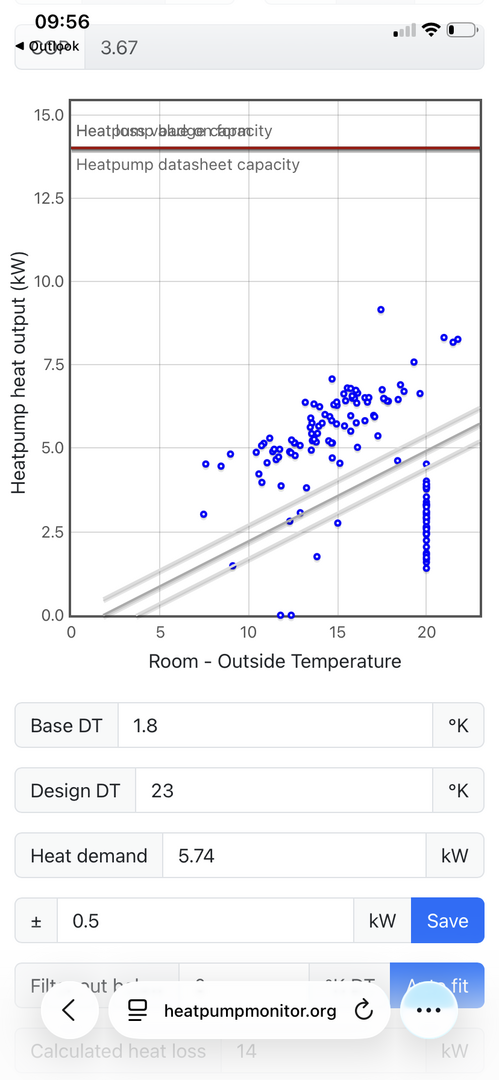
Here is my results from heatpump monitor.org. Not sure what the vertical line of points at 20 degc is about and it seems to be skewing the line. But the general scatter suggest about 8kw heat loss at -3
Can I just add another 'vote' in favour of measuring heat loss using consumption if you can. Here is the data (from my gas boiler) which I used to size my (~8kW) heat pump; measured loss is 7kW, two three hour surveys said 16kW
Agreed, however it is not so easy when replacing an oil boiler. When replacing my oil boiler I did not think to time on/off usage over a fixed period as suggested earlier in this thread, and estimating annual usage is not trivial when the oil tank is filled on different dates and the amount of oil in the tank is never accurately known. Then combine this with guesstimates of boiler efficiency anywhere between 60-85% and you end up with a figure with large margins of error.
We estimated annual usage of ~1600L of oil which at 90% efficiency (boiler was ~7 years old) would equate to around 15,000kWh of heat per year, and this aligned reasonably well with our heat loss survey.
Our heat pump has delivered around 10,000kWh of heat per year, so our estimates and survey heat loss figures were very much on the high side. At 60% boiler efficiency, the numbers would have been spot on. In reality, the real boiler efficiency was somewhere in between as we also had some insulation upgrades performed at the same time and have no real handle on how much difference these contributed to reducing the heat loss.
Samsung 12kW gen6 ASHP with 50L volumiser and large radiators. 7.2kWp solar (south facing), Tesla PW3 (13.5kW). Net Zero
Agreed, however it is not so easy when replacing an oil boiler.
Indeed not, I think, unless you take measurements regularly, it reduces to a 'sense check' in this case based on annual consumption or the like. Still good enough to spot a factor of 2 oversizing, which clearly occurs, but not good enough to decide exact size.
4kW peak of solar PV since 2011; EV and a 1930s house which has been partially renovated to improve its efficiency. 7kW Vaillant heat pump.
however it is not so easy when replacing an oil boiler. When replacing my oil boiler I did not think to time on/off usage over a fixed period as suggested earlier in this thread, and estimating annual usage is not trivial when the oil tank is filled on different dates and the amount of oil in the tank is never accurately known. Then combine this with guesstimates of boiler efficiency anywhere between 60-85% and you end up with a figure with large margins of error.
Again, agreed. There is also the likely change from timed to continuous heating, which further complicates things. For all practical purposes, using past oil consumption to determine heat loss is in effect a non-starter. But with a gas boiler, which is what most people have, and either a smart meter or another way of accurately measuring energy use over time, it can be done.
Midea 14kW (for now...) ASHP heating both building and DHW
Here is my results from heatpump monitor.org. Not sure what the vertical line of points at 20 degc is about and it seems to be skewing the line. But the general scatter suggest about 8kw heat loss at -3
however it is not so easy when replacing an oil boiler. When replacing my oil boiler I did not think to time on/off usage over a fixed period as suggested earlier in this thread, and estimating annual usage is not trivial when the oil tank is filled on different dates and the amount of oil in the tank is never accurately known. Then combine this with guesstimates of boiler efficiency anywhere between 60-85% and you end up with a figure with large margins of error.
Again, agreed. There is also the likely change from timed to continuous heating, which further complicates things. For all practical purposes, using past oil consumption to determine heat loss is in effect a non-starter. But with a gas boiler, which is what most people have, and either a smart meter or another way of accurately measuring energy use over time, it can be done.
I wouldn't say its a non starter. If you can get annual consumption somehow it is still a sense check that will point out any survey results that are way out (particularly those that are grossly overestimated). Very far from ideal, but perhaps still better than no measurements at all.
4kW peak of solar PV since 2011; EV and a 1930s house which has been partially renovated to improve its efficiency. 7kW Vaillant heat pump.
I wouldn't say its a non starter. If you can get annual consumption somehow it is still a sense check that will point out any survey results that are way out (particularly those that are grossly overestimated). Very far from ideal, but perhaps still better than no measurements at all.
I beg to differ. I really could not make any useful predictions from my past heating oil use. Common sense based checks will kick in before oil use based checks kick in. Consider (as @old_scientist suggests):
1. you only have annual consumption, if that. How do you account for that late Feb top up, and the tanks still had oil in it (how much?) when you turned the heating off? How did you measure the volume in the tank?
2. How efficient is my 10 year old boiler? 20 year old boiler?
And then:
3. when did you turn the heating on and off, both overall (for the season) and during the day? How and when did any daily timing's change? Did you keep records, or is it just a vague recollection? Did usage patterns change, and you have simply forgotten what the changes were?
I think it is worth looking in more detail at what happens if you try to do an oil use based assessment. Let's say it is likely I used around 1000L per annum. That was almost all heating, as I used an immersion heater for DHW in the summer and even sometimes in the winter. Given 10.35 kWh per litre, that is 10,350 kWh per annum. Boiler efficiency? Haven't got a clue, really. Lets say 75%, 10,350 becomes 7762 kWh. Winter DHW use? Who knows, lets say 5%, heating energy delivered is now 7374 kWH. Was the system on a timer, meaning an unstable IAT? Almost certainly. How do I account for this? Mean daily IAT? Do I know what that was? No. And so on. All I can say is I might have delivered around 7400 kWh of heat to the house over a year, but what that actually achieved beyond 'warming the house and some hot water' I have no way of knowing. There is no sensible way I can turn that into a kW loss at my design temperature, which is what I need to do a heat loss sense check on an installer recommendation.
Bear in mind we are focusing in energy delivered, not used. What was the figure on my quotation (the one used for the installation)? 26,389 kWh per year. By any sane sanity check, 7,374 vs 26,389 fails. Where do I go from here? That is why I suggest oil based sanity checks are a non-starter. If you do start doing them, you will very likely end up more confused that had you not started doing them.
What is the actual heat energy delivered to the house, now that the heat pump is installed? 23,079 kWh in 2025, 19,821 kWh in 2024. This is a LOT more than the oil use predicted. Those with long memories may recall we discussed this some time ago. The most likely explanation we came up with is that the increase came from changing patterns of use, from timed use, perhaps 12 out of 24 hours per day, maybe even less (2 hours in the morning, 6 in the evening ie 8 hours per 24 hours?) to 24/24 hour running. With the heating on for three times as long, one might expect it to deliver rather more energy. Or maybe not (oil boilers and heat pumps are very different beasts).
If the oil heating was only on for 8 hours a day, perhaps we should multiply it by 3 to get a 24 hour equivalent. If we do that 7374 becomes 22,122 kWh per annum, much close tor actual heat pump usage. But that's with hindsight. At the quotation stage, I had no way of knowing what that factor might be, unless I had a meticulous record of how I had run my oil based system in the past, which I didn't have. I could only guess.
The empirical methods of determining heat loss either need careful measurements of heat delivered to the house at design OAT and a stable IAT (rarely done) or a series of measurements over time at various OATs and a stable IAT, which are then plotted to get the design OAT (by far the most common method). The '1000L of heating oil used over a season' just doesn't have enough other data attached to it to be of any practical use.
Midea 14kW (for now...) ASHP heating both building and DHW
Most of those comments also apply to a gas system, the material differences are the fact that you cant get daily/hourly data from an oil system and (perhaps) a greater uncertainty in efficiency. The former does prevent you doing a plot vs OAT, but most of the matters you point out will affect this plot so equally affect one based on gas consumption. In summary I think what you are saying applies almost equally to a gas based system and therefore your argument is tantamount to saying that sanity checks based on measured consumption are not practical. In fairness some argue that this is the case, but you aren't one of those!
Obviously any sanity check depends on certain assumptions, mostly that you actually heat the house to a reasonably comparable level and that it stays reasonably warm throughout the day, whether or not it is heated. Some you can estimate a correction for, others you cant. Perhaps these assumptions weren't the case with yours. Im really struggling to understand how you got away with 1000l of oil (10.3MWh/year) but now need 23MWh/year; that's a factor of 2 even ignoring efficiency, suggesting that the average difference between the house temperature (which is the main variable) and outside temperature was half what it is now. Perhaps that is in fact the case. Something quite dramatic must have changed to explain this, its very unlikely to be due solely to uncertainties in the calculation.
This post was modified 8 months ago 3 times by JamesPa
4kW peak of solar PV since 2011; EV and a 1930s house which has been partially renovated to improve its efficiency. 7kW Vaillant heat pump.