Joining the Renewable Heating Hub forums is completely free and only takes a minute. By registering you’ll be able to ask questions, join discussions, follow topics you’re interested in, bookmark useful threads and receive notifications when someone replies. Non-registered members also do not have access to our AI features. When choosing your username, please note that it cannot be changed later, so we recommend avoiding brand or product names. Before registering, please take a moment to read the Forum Rules & Terms of Use so we can keep the community helpful, respectful and informative for everyone. Thanks for joining!
Our Experience installing a heat pump into a Grade 2 Listed stone house
@cathoderay To be fair - the 28kw was coming from an initial enquiry where the company concerned looked up the EPC for the property - on this basis they more or less declined to quote!!
Not quite sure how these EPCs are calculated but given that you can't let a property if its does not reach a certain level it seems a bit more emphasis should go into making sure they actually mean something.
Regarding calculating true heatloss from OEM - I must admit my data analytical skills with OEM are not to that level yet - so I am more or less just picking points in time - but I think as long as conditions are reasonably stable this should give a reasonable idea.
My next endeavor will be trying to decide if to invest in some Solar PV and battery storage - so a bit more number crunching will be the order of the day. I do have planning permission and LBC for a small array on our garage roof - can't decide if Its worth the bother to be honest - I guess a subject for a new topic.
Just a bit more context/personal experience on the importance of air tightness - Our previous property was also a G2 listed stone cottage (gluten for punishment). If I compare this current building with our previous house - whilst both more or less the same basic construction they were like chalk and cheese in terms of comfort during the winter. Regardless of heat source - oil or heatpump this house has always seemed to be a much easier house to heat - the last house was hard work in the winter time - quite Dickensian at times. What's the difference ? the main one I think was the old place had suspended timber ground floor with a gale running beneath. Also remember taking the wall paper off in the bedroom and the plaster below was literally breathing in and out as the wind blew!! The people who bought our old place did a full back to bones renovation - so presume its better now but has probably lost some character in the process.
Here is the SPAB (Society for the Protection of Ancient Buildings) research on measured in situ U-Values vs calculated (spreadsheet standard tables etc) U-Values for old walls (2012, very recent compared to the age of some of the buildings studied!):
COTTAGE, Selborne, Hants (Upper Greensand), 325mm total wall thickness, in situ U-value 1.45 W/m^2K, calculated is spreadsheet U-value 3.02 W/m^2K, Natural sedimentary rock
which is similar to my property (sandstone, 300mm). In the SPAB report, the calculated value is more than twice the measured in situ value. In my installer calculated heat loss, the U-value used for the walls was 2.78 W/m^2K, possibly getting on for double what it may actually be. Wall losses are a major component of heat loss, these U-values matter.
I think if you buy a listed building you have to accept the restrictions that come with it
Absolutely. I'm also in a National Park. But it is a beautiful building in a beautiful setting and I am happy to put up with restrictions, that is part of the deal, until they get silly. My planning office does employs some people with shall we say interesting CVs, I believe they find it hard to get the staff these days given the financial cuts, but we got there in the end. The point I was making is you may have to persevere.
@cathoderay To be fair - the 28kw was coming from an initial enquiry where the company concerned looked up the EPC for the property - on this basis they more or less declined to quote!!
Not quite sure how these EPCs are calculated but given that you can't let a property if its does not reach a certain level it seems a bit more emphasis should go into making sure they actually mean something.
But this sort of nonsense is part of the problem! EPCs are little more than collections of random numbers. And I have to say if a company was prepared to quote on the basis of some random numbers, then they would be off my shortlist pronto. But it all feeds into the old buildings and heat pumps don't work well together old wives tale.
Edit: I see now that I have posted the company was responding to an initial enquiry, but even so they came to a conclusion that was out of touch with the reality. The point remains the same, these companies are not doing anyone any favours.
@cathoderay thanks for the SPAB link - very interesting - a lot to digest.
Interesting points for me
1. The methodology of heat flux measurement. In fact I was vaguely aware of this in relation to cooling of chocolate. Wasn’t aware it’s application to building materials but seems sensible.
2. Best correlation between calculated and measured tends to be simple wall build ups- I guess kind of obvious that this would be the case but interesting to see real Data.
3. I presume similar studies have been done on modern building materials and wall make ups- I have read a bit about the performance gap of modern insulation materials - in particular PIR which is very sensitive to workmanship during installation . In this case opposite problem of under estimating heat loss.
Thinking on about possible ways to measure heat loss - I guess a fairly simple method would be to heat a room with direct electric heaters with a controlled temperature set point and measure electrical consumption over a sufficiently long period of steady state. Probably in combination with external temperature measurement and some analytics you mentioned earlier to compensate external variations.
Thinking on about possible ways to measure heat loss
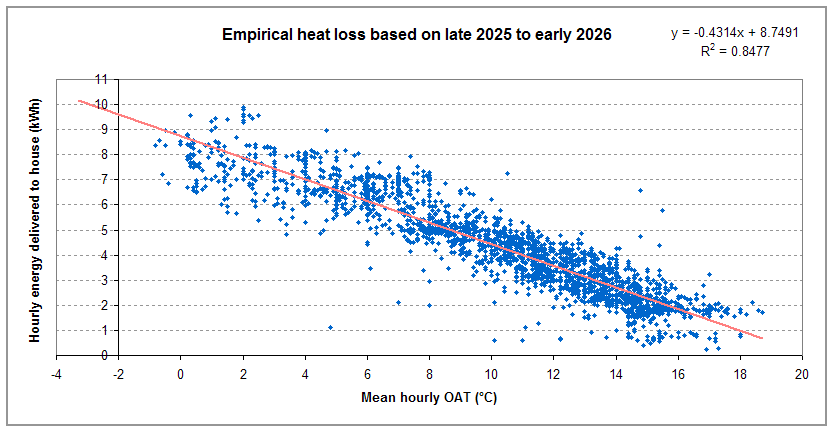
It really is very easy if you have a monitored heat pump. Given a steady IAT, then your energy delivered to the building, ie the energy out from the heat pump, is the heat loss at whatever the OAT is. By plotting energy delivered to the building against OAT you get a plot will almost certainly include your design OAT, if it doesn't, you can just extend the regression line a bit, and bingo! Here's my heat loss based on the current heating season:
The spread is more than it sometimes is but the result is the same, a heat loss of 9.6kWh per hour, or 9.6kW expressed as power rather than energy, at an OAT of -2°C, my design temp. Some of the low outliers with be hours where the output was divided between space and DHW heating, so the space heating for that hour will be less than it would otherwise have been. It took less than 10 mins to produce that chart. This is of course the whole building, not individual rooms, and the caveats made earlier about additional heat sources apply if you have them running. Your individual room method should certainly work in principle, but collecting enough data over a long enough period for a number of rooms could lead to terminal boredom!
I am not sure how heatpumpmonitor.org stores data, I presume you can access it and download it in a suitable (csv) format if it isn't already on your system somewhere.
The Freedom heat Pumps spreadsheet calculated heat loss used by my installer gave a heat loss of just over 12.3kW, a considerable over-assessment. But it worked out OK in the end because the 14kW specified heat pump has an actual output of just over 11kw at my design OAT of -2°C, ie enough and just a bit in hand.
Midea 14kW (for now...) ASHP heating both building and DHW
Suggestion about using an electric heater was more about getting a better handle on heat loss before installing a heatpump.
Agree if you already have one with a heat meter that is accurate then it should be relatively easy but by then it’s too late if the pump is too small or too big.
Just reading another thread about a peak systems heatpump which makes for grim reading especially as their website brags about it being ‘the British heat pump’ how embarrassing 😡- but interesting that a 150 M2 house with cavity wall insulation and double glazing is coming in at 11kw - makes my situation seem rather remarkable. Beginning to wonder if I have some unknown geothermal heat source under my house😀
Agree if you already have one with a heat meter that is accurate then it should be relatively easy but by then it’s too late if the pump is too small or too big.
That is undeniably true and is something I meant to mention. But sometimes it can be good news, as it was for me. I thought I had 11kW trying to cover a 12.3kW loss, when in fact the loss is below 10kW. And the method can also be used with gas boilers with with smart meters, but less easily, as previously noted, with oil boilers.
Midea 14kW (for now...) ASHP heating both building and DHW
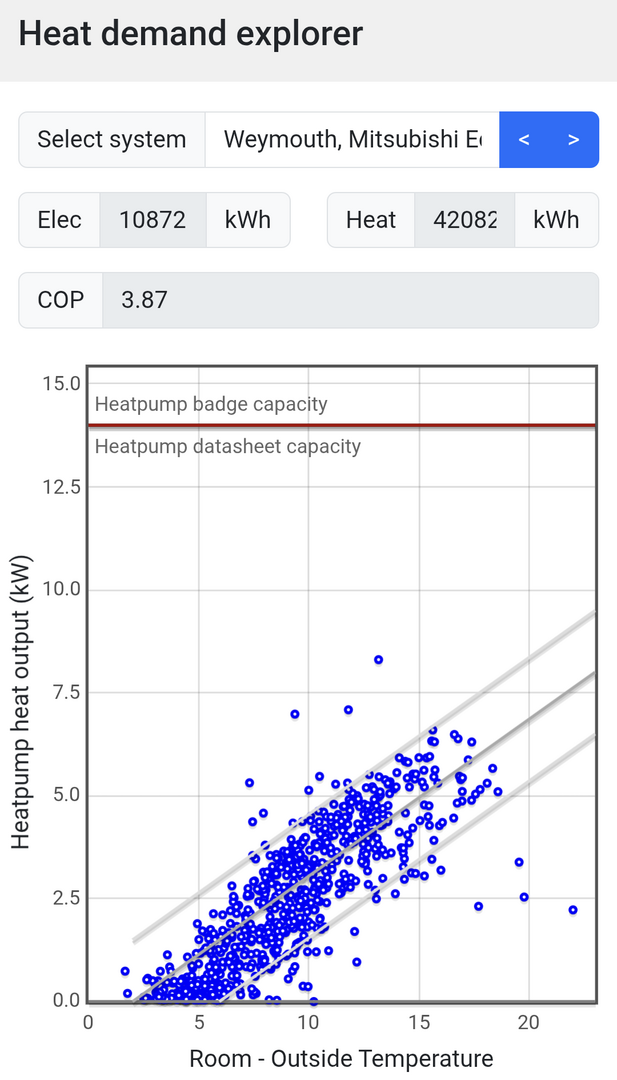
If your system is on heatpumpmonitor.org then a chart similar to what @cathoderay is suggesting is already available. If you go to your system page (a random 14kW Mitsubishi as an example) and press the Heat Demand button, you'll get a chart like this:
Press the blue Auto Fit button below the chart and the values will be updated.
The heat demand box contains the (extrapolated) power requirement at the room-outside design dT (typical value for this is 23 from 20C room temp and -3C outside temp).
Naturally, the greater the number of days of data recorded the more accurate the extrapolated power requirement value can/will be.
Do you need IAT for this to work? Don’t currently have it in OEM but could add it. I could just assume 20 Deg as that is what I have the Mistsi set at.Can you add it in manually?
If your system is on heatpumpmonitor.org then a chart similar to what @cathoderay is suggesting is already available. If you go to your system page (a random 14kW Mitsubishi as an example) and press the Heat Demand button, you'll get a chart like this:
Press the blue Auto Fit button below the chart and the values will be updated.
The heat demand box contains the (extrapolated) power requirement at the room-outside design dT (typical value for this is 23 from 20C room temp and -3C outside temp).
Excellent that it is there, but to me it is another example of hpm.org's less than clear labelling. At first, I read the x-axis label as Room hyphen Outside Temperature and wondered what on earth that meant, only to realise it means Room Temperature minus Outside Temperature, ie it uses inside/outside delta t rather than absolute OAT, which is why the slope goes the other way, indeed that was the clue.
Despite that minor criticism of mine, it is still very useful.
Yes, you do, to calculate the X values, see above explanation. Some see this version (using the inside/outside delta t rather than the absolute OAT) as a purer version of the assessment.
Midea 14kW (for now...) ASHP heating both building and DHW
Can I just add another 'vote' in favour of measuring heat loss using consumption if you can. Here is the data (from my gas boiler) which I used to size my (~8kW) heat pump; measured loss is 7kW, two three hour surveys said 16kW