
Notifications
Clear all
Air Source Heat Pumps (ASHPs)
18
Posts
6
Users
16
Reactions
362
Views

Topic starter
20/01/2026 9:35 am
@editor suggested that I start a thread in relation to the progress and Qs around our planned heat pump installation, so here it is. I hope it’s in the correct place? As I previously mentioned, we are replacing a very old Potterton Kingfisher floor standing gas boiler (so non-condensing) which has recently failed beyond repair. We have a gravity fed hot water cylinder.
I’ll start with some context. Our property is a 1960s build (cavity walls with blown insulation, decent loft insulation, triple glazed windows, high quality bifold doors with decent u values), detached, located south central on the edge of the New Forest. Our floor area is ~180 m^2, 4 bedrooms and two bathrooms. In recent years we’ve done some building work and when doing so I’ve had one eye on a future ASHP installation, so we have some well insulated floors with UFH in the screed across parts of our ground floor.
Prior to boiler failure, our plan was to dig up the ground floor in the rest of the property (kitchen and family room), insulate with 100-120 mm of Celotex and then install UFH in the same fashion as our living room and study (as referenced in building works above). This would all have been completed prior to a new ASHP. Alas, our boiler failure has shifted our priority and one immediate Q I have is whether any designers/installers would be able and willing to deliver a system which will ‘work’ (albeit sub-optimally) now, but be ready for the UFH when it is commissioned later (probably next year).
I’ve had a go at using heatpunk to calculate a heat loss for our property and it’s telling me 10.3 kw. Interestingly, our gas usage for a year was 16,000 kWh for 2025, so using the rule of thumb I’ve read in articles from @editor, that gives me around 8 kWh. I would say that we err on the side of caution though with our heating, using TRVs and lots of zones to control use. This is something that, frankly, I’m looking forward to moving away from, as is my wife, who feels the cold! A consistent (spatially and temporally) 20-21 sounds wonderful. I’m interested to see what size HP we are ultimately recommended.
We have our first visit from a company (Aira) this afternoon, so I’ll be interested to see what they say. Honestly, I’m already swaying away from the Aira system due to it not (obviously at least) using weather compensation. Nonetheless, I’m keen to see their process, costs, thoughts etc.
Happy to report back and will certainly have many more Qs as we progress.

20/01/2026 11:21 am
That's a beautiful area of the English countryside @jleyland
West of the R.Test and Southampton Water is often used as an illustration of an area which has sparse access to mains gas.
So I'm intrigued that you did have a gas boiler.
Is your partial UFH system a self-install?
Would you do self-install pipework for the rest of the ground floor?
Do you recall the spacing between the UFH pipes for what you already have?
The lower the water temperature, the closer the pipe runs need to be.
one immediate Q I have is whether any designers/installers would be able and willing to deliver a system which will ‘work’ (albeit sub-optimally) now, but be ready for the UFH when it is commissioned later
In broad terms, tell us what you'd expect to buy-in from such a designer and installer.
It's a slightly loaded question because I've long since decided to use no designers, contractors or installers for my own home renovation work.
Everything I do is hands-on DIY.
That means I have great flexibility to leave systems part-completed, with pipes and wires ready to extend to other rooms later! 😎
I would say that we err on the side of caution though with our heating, using TRVs and lots of zones to control use.
That would be treating a heat-pump as a direct replacement for a boiler. Yuch!
That's not how HPs work.
The internal firmware adjusts the Flow to deliver the required heat energy using an 'always on' principle.
By definition, any thermostat or TRV will operate as an on-off switch.
The result would a heat-pump which continuously cycles on/off.
That's inefficient.
Save energy... recycle electrons!
2

20/01/2026 12:04 pm
I would say that we err on the side of caution though with our heating, using TRVs and lots of zones to control use.
By all means keep these controls so that you can use them, but plan not to do so. Instead set them all to max, operate the heat pump 24x7, and adjust the weather compensation curve to the lowest possible consistent with heating your house, if necessary balancing the zones on the flow control valves/lockshield valves. Lots of external controls randomly switching zones and the heat pump on and off will cost more, be less comfortable, and during frosty weather when defrosts are happening, even could lead to your heat pump failing to defrost and shutting down.
Once you have achieved that then some minor tweaks (eg to deal with solar gain) may make sense, but most likely you will find that this is both the most comfortable and the cheapest way to run, unless you have a large slab and oversized pump which might allow you to make particularly good use of a ToU tarrif.
You have to forget everything you learned about running a boiler. Most of it was wrong even for boilers (but foisted on us by the aftermarket controls industry so they make more profit), its doubly wrong for heat pumps.
More explanation possible if you need it.
This post was modified 1 month ago 2 times by JamesPa
4kW peak of solar PV since 2011; EV and a 1930s house which has been partially renovated to improve its efficiency. 7kW Vaillant heat pump.
2
Topic starter
20/01/2026 12:22 pm
Thanks for the reply!
Is your partial UFH system a self-install?
Would you do self-install pipework for the rest of the ground floor?
Do you recall the spacing between the UFH pipes for what you already have?
The lower the water temperature, the closer the pipe runs need to be.
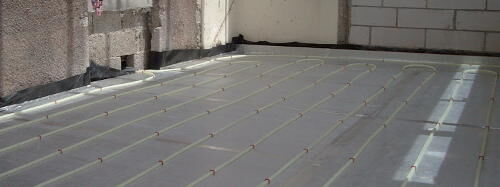
Yes, I installed the UFH in our extension, including a living room and study, and would like to do so again. I used a Wunda designed system, at 15mm spacing (16mm pipe). I did do some heat output calcs somewhere that I'll dig out.
In broad terms, tell us what you'd expect to buy-in from such a designer and installer.
I'm looking for a company to install the ASHP and plumb a new DHW tank etc. which could work temporarily with our current setup, but then be optimised with the new UFH. Don't forget that we are being driven somewhat by a need for some heating soon! So, I'd hope that they might design the system with future UFH plans, but consider hooking up to rads in kitchen/family room temporarily.
That would be treating a heat-pump as a direct replacement for a boiler. Yuch!
That's not how HPs work.
Yes, I'm looking forward to NOT using lots of zones and TRVs for variable heat, as per my post! Low and slow with consistency is part of the attraction of an ASHP for us!
This post was modified 1 month ago by JLeyland
1
Topic starter
20/01/2026 12:24 pm
@jamespa Yes, as I mentioned, we are looking forward to moving away from that setup and having more consistency all being well. I've definitely gleaned from these forums that a weather compensated setup is a must! That has already steered me away from an Aira system I think, but I'm going to let them quote and see what they come back with.
1

20/01/2026 12:56 pm
@jamespa Yes, as I mentioned, we are looking forward to moving away from that setup and having more consistency all being well. I've definitely gleaned from these forums that a weather compensated setup is a must! That has already steered me away from an Aira system I think, but I'm going to let them quote and see what they come back with.
Using the collective wisdom of the forum members here is a great start, @jleyland. I'd echo what @transparent and @jamespa have said, but what you mentioned about Aira reminded me of something else.
Even a cursory glance at the forum topics will show that the end goal should be a heat pump designed and installed by a reputable company who know what they're doing and then delivered ready-configured to run under weather compensation. However, it's also readily apparent from forum topics that pretty much no installer - even a reputable one - has the time necessary to properly optimise that delivered system, and a small amount of the homeowner's time spent properly balancing the heat emitters and tweaking the parameters of that weather compensation curve will usually make a good system into a great system. Anything that gets in the way of the homeowner's ability to see the stats and perform some simple fettling is worth treating with caution.
I say this because unless I'm reading the other Aira threads wrong, Aira appears to me to try very hard to keep the homeowner away from the stats. There is one pretty current thread where they're suggesting adding sensors to pipes coming from the heat pump (to measure actual heat delivered rather than rely on what Aira says it is) may invalidate the warranty. To me that is a big red flag even though I'm also well aware we do have forum members who are satisfied Aira customers.
There are a lot of technophobes who love the idea of a service that does that after-market fettling for them, so I'm not suggesting everyone wanting a heat pump must become a heat pump expert and DIY demon. However, that historical data is yours and should be kept available so you can use it to make informed decisions in one, two, five years time.
105 m2 bungalow in South East England
Mitsubishi Ecodan 8.5 kW air source heat pump
18 x 360W solar panels
1 x 6 kW GroWatt battery and SPH5000 inverter
1 x Myenergi Zappi
1 x VW ID3
Raised beds for home-grown veg and chickens for eggs
"Semper in excretia; sumus solum profundum variat"
2
Topic starter
20/01/2026 1:01 pm
@majordennisbloodnok Thanks for the reply. Yes, I'm definitely getting that sense in relation to the Aira system. I'm somebody that is hands on and would want to fully understand my own system and be able to adjust as necessary to optimize. Your point is very valid.
1
20/01/2026 1:09 pm
I installed the UFH in our extension, including a living room and study, and would like to do so again. I used a Wunda designed system, at 15mm spacing (16mm pipe).
Possibly 150mm spacing?
Or else your 16mm pipes are overlapping! 🤗
I've just a quick look at the Wunda website.
It looks pretty generic stuff to me... which is good.
That means you're not locked into a unique manifold & pipe system when you want to extend later.
But a bit too heavy on the glossy marketing, and light on the technical specifications for me!
I bought a lot of my UFH components from a warehouse in Solihull, which is sadly no longer trading.
A lot of that stuff was manufactured by Tiemme in Italy, and they're a possible supplier to Wunda.
Save energy... recycle electrons!
2
Topic starter
20/01/2026 1:17 pm
@transparent Oh, yes, 150 mm!
I was pleased with Wunda. The components are of good quality and the design they did (for free ahead of purchase) was sensible. I do see that they are now quite aggressively marketing their ‘rapid response’ system, even going so far as to say that in-screed systems are not really suitable for domestic dwellings! This is tosh in my view, especially if one is running the system low and slow with an ASHP. I can see how a rapid response system might be attractive for a high temp gas boiler user perhaps.
1
20/01/2026 2:17 pm
I do see that they are now quite aggressively marketing their ‘rapid response’ system, even going so far as to say that in-screed systems are not really suitable for domestic dwellings! This is tosh in my view,
I agree with you.
I have both in-screen UFH and pipework installed between joists of suspended floors.
In my experience they behave differently, which I wouldn't have known if I'd stuck to just one approach.
The main in-screed UHF area is on the south side of the house.
It takes hours to reach temperature, but is a useful store of heat which has been captured by my 30-vacuum-tube array on the roof.
I also have a section of UFH pipe in the screed used to bed-in a walk-in shower tray.
It's pleasant to turn on the shower and step in immediately without treading on a stone-cold surface (literally!).
The suspended floors are emitting radiation within about 10mins of water flowing through the pipes...
... but I usually leave these running continuously at a low rate.
When building those floors I've avoided placing pipework and heat-spreader plates below areas where there will be furniture.
That reduces the length of pipe-runs, and hence increases flow-rates.
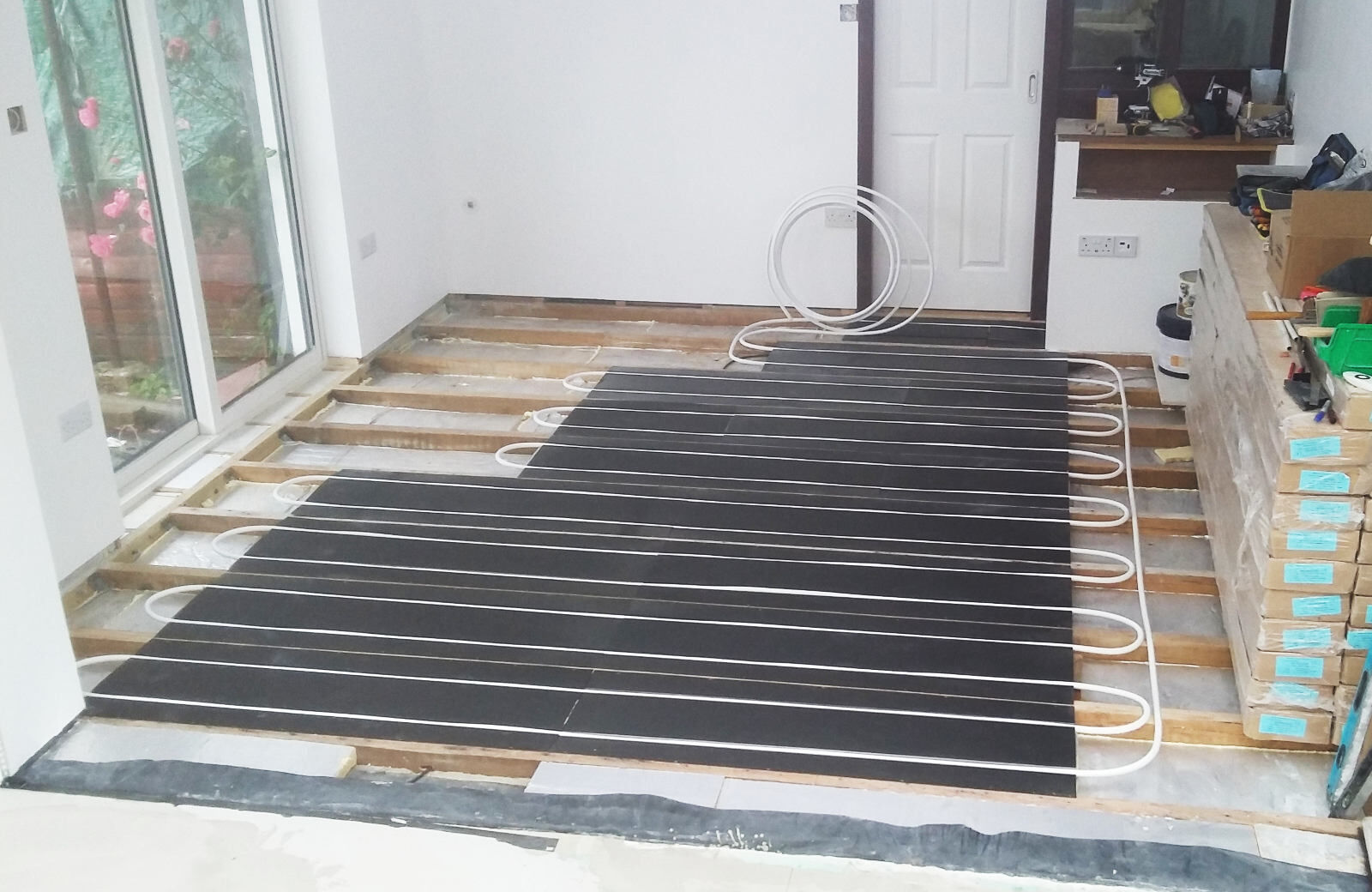
This forum doesn't yet have enough content about UFH, and I hope you'll be able to share what you do and why you make particular design decisions.
Our interest isn't confined to your choice of heat-pump!
Graphics, photos and diagrams, are very welcome.
Save energy... recycle electrons!
3
20/01/2026 3:29 pm
@jamespa Yes, as I mentioned, we are looking forward to moving away from that setup and having more consistency all being well. I've definitely gleaned from these forums that a weather compensated setup is a must! That has already steered me away from an Aira system I think, but I'm going to let them quote and see what they come back with.
Please accept my apologies that I had misunderstood your intent. Please do post any further questions/ask for any advice you need as your journey progresses.
4kW peak of solar PV since 2011; EV and a 1930s house which has been partially renovated to improve its efficiency. 7kW Vaillant heat pump.
1

20/01/2026 7:15 pm
@jleyland looks like your getting great advice, there will be companies that will help you with what you are looking for, we do offer this kind of service in Kent. You can have the ASHP matched to your home with assumed improvements and if the later improvements are insulation in your loft for example you must just have to accept until you make them improvements the ASHP will cost a bit more to run and not heat the house perfectly.
If your later improvements are changing rads or adding rooms if rooms are to be switched off for a while your installer should be able to either set up a temp heat dump (a oversized rad in the hall) to ensure minimum emitter output for the ASHP to operate at its lower capacities.
You may not find this service in the much larger companies though, some often want to install and move on.
AAC Group Ltd covering the Kent Area for design, supply and installation of ASHP systems, service and maintenance, diagnostics and repairs.
Professional installer. Book a one-to-one consultation for pre- and post-installation advice, troubleshooting and system optimisation.
Page 1 / 2
Next

Latest Posts
-
RE: Connecting Growatt SPH5000 over wired ethernet rather than wireless
The simplest wired option is usually the Growatt Ethern...
By Jonatan , 4 hours ago
-

RE: Peak Energy Products V therm 16kW unit heat pump not reaching flow temperature
ASHPs do have a minimum compressor speed. The minimum h...
By bobflux , 11 hours ago
-

RE: Electricity price predictions
@jamespa And it seems some of the nasty public cloud...
By Batpred , 11 hours ago
-
@bobflux My apologies, they somehow were removed in ...
By Ubert767 , 11 hours ago
-
RE: Tell us about your Solar (PV) setup
Location: near Lyon, France 12kWp on the roof, 2x Sol...
By bobflux , 12 hours ago
-
RE: Jokes and fun posts about heat pumps and renewables
Technology is rapidly advancing. BBC News reported th...
By Transparent , 14 hours ago
-
What matters for flow and pressure drop is internal dia...
By bobflux , 15 hours ago
-

RE: Do Fridges and Freezers have COP ratings?
@editor Thank you all for your replies and submitted in...
By Toodles , 18 hours ago
-
I know and yes. The secondary deltaT wont necessaril...
By JamesPa , 21 hours ago
-
RE: Designing heating system with air to water heat pump in France, near Lyon
Just love the way you put it! 🤣
By Batpred , 1 day ago
-
RE: Safety update; RCBOs supplying inverters or storage batteries
Thank you for sharing. So it seems that your Schneid...
By Batpred , 2 days ago
-

RE: Forum updates, announcements & issues
@upnorthandpersonal thanks for the thoughtful, consider...
By Mars , 2 days ago
-
RE: Solar Power Output – Let’s Compare Generation Figures
@mk4 All 21 panels have their own Enphase IQ7a microinv...
By Toodles , 2 days ago
-
RE: Setback savings - fact or fiction?
Great, so you have proven that MELCloud is consistently...
By RobS , 3 days ago
-
RE: Mitsu PUHZ120Y 'Outdoor Temp 'error?
Thanks David & James It almos...
By DavidAlgarve , 3 days ago
-
RE: Surge protection devices SPDs
@trebor12345 - your original Topic about the right type...
By Transparent , 3 days ago
-
RE: Help needed with Samsung AE120RXYDEG
@tomf I’ve been sent this from a service engineer at Sa...
By Mars , 3 days ago
-
RE: Buying large amp bidirectional RCD and RCBO
Yes... I went through this particular headache and ende...
By bobflux , 4 days ago
-
O-oh! Let's take this as an opportunity to 'pass the ...
By Transparent , 4 days ago
-
RE: Homely setup on daikin heat pump
@craigh I refer to our somewhat elevated temperature of...
By Toodles , 4 days ago
-
RE: Air source heat pump roll call – what heat pump brand and model do you have?
My turn, this describes the future installation, only t...
By bobflux , 4 days ago
-
RE: Say hello and introduce yourself
@liam-dr, I’d like to echo James’ welcome, and we look ...
By Mars , 4 days ago