
Notifications
Clear all
Joining the Renewable Heating Hub forums is completely free and only takes a minute. By registering you’ll be able to ask questions, join discussions, follow topics you’re interested in, bookmark useful threads and receive notifications when someone replies. When choosing your username, please note that it cannot be changed later, so we recommend avoiding brand or product names. Before registering, please take a moment to read the Forum Rules & Terms of Use so we can keep the community helpful, respectful and informative for everyone. Thanks for joining!

08/03/2026 8:09 pm
Im not sure its worth doing in this case.
Heresy!
Unless the property is huge, which it isn't, it won't take long to do a heat loss (half a day or so for a first timer, particularly with modern laser measurement tools which make getting dimensions a doddle), and it really is one of the most basic requirements. You can also run it with and without the 'insulation defects' to get an idea of what difference they might make, and generally get a feel for what does and doesn't affect heat loss.
Fair enough, particularly the last comment.
However for me it depends on how op is approaching this. If he wants to diagnose and fix it himself then I agree with you. If he isn't wanting to follow this through then I would keep the case simple, it doesn't work, please fix it or I will sue.
In this latter case, the more the argument with the developer is complicated by results that are never going to be anything more than indicative, the greater the attack surface becomes for the developer to exploit. In this case I would KISS and stick to 'house not warm, fix it'.
This post was modified 4 days ago by JamesPa
4kW peak of solar PV since 2011; EV and a 1930s house which has been partially renovated to improve its efficiency. 7kW Vaillant heat pump.
09/03/2026 7:46 am
@jamespa — I agree the OP needs to make his plan of action clear. I've often said there is only one number that really matters, the IAT (indoor air temperature), because (a) it is the sum of everything else and (b) it is what we humans perceive. COP (performance) is not far behind, but even the COP doesn't matter so much if the property is too cold. You need to fix the latter, then worry about the former.
@newby — can you give us an idea of how you plan to proceed with this? If you intend to go down the legal route, then I agree with @jamespa, keep it simple, my house is too cold, fix it, a basic not fit for purpose claim. If you want to fix it yourself, cut out the AI crap, engage your little grey cells, and proceed to do the things you need to do, starting with a DIY heat loss assessment.
Midea 14kW (for now...) ASHP heating both building and DHW
2

09/03/2026 9:44 am
@newby - What you've written about the action of the builder/developer doesn't comply with the requirements of the Building Regulations.
It's the (legal) responsibility of your Local Planning Authority to ensure that Building Regs are implemented, and I can advise you further on this.
Two points to bear in mind:
- although the LPA has Building Regs responsibility, it is often the case that the actual work is delegated to an area-wide private company. Even so, the LPA has "powers of enforcement" which can be brought to bear, and it is to them that you would turn for assistance
- larger house developers are members of the National House Building Council, who provide them with building regs assurance and post-construction warranties. The NHBC operates more like a private club, which favours the developer rather than the homeowner, but your LPA still has powers of Enforcement which they can exercise over NHBC Developers.
If the above information is of interest, then please say so, and let's start by knowing who your LPA is please.
There will be others who are likely to find this Topic in future, who could also be helped by reading about this issue. Let's bear that in mind as we address your specific circumstances.
Save energy... recycle electrons!

Topic starter
11/03/2026 10:28 am
Thanks for the detailed questions — here’s the extra information that might help clarify the situation.
We don’t have any of the formal design documentation (no SAP, no BREL, no emitter sizing, no heat‑loss calcs, no commissioning sheets). The builder hasn’t provided them, so everything we know is based on measured performance, thermal imaging, and the limited radiator output sheet we were given. The house is a standard Redrow Henley layout, roughly 200–210 m², rectangular footprint, not unusually exposed, and nothing about the geometry suggests an extreme heat‑loss profile.
Thermal imaging has already confirmed several insulation defects: missing insulation in multiple areas, cold bridging, an uninsulated bathroom floor cassette above the garage, an uninsulated WC ceiling, an uninsulated garage ceiling, and voids in the loft. These defects line up with the heating behaviour — rooms sitting at 9–12°C in winter with the system running continuously. Just to clarify, the thermal imaging didn’t show cold patches in the UFH loops themselves (UFH is only downstairs and the camera can’t see through screed). What it did show was cold areas in the garage ceiling and in the floor cassette above the garage. Because the UFH pipework runs across that part of the ground floor, missing insulation there could allow heat to sink downward into the garage rather than into the room. So it’s not confirmed that the UFH slab is uninsulated, but the thermal pattern and the known cassette defect make downward loss a realistic possibility.
On the heating side, the weather compensation is currently set to 45°C at –3°C and 30°C at +15°C. Even at 45°C flow, the system can’t lift rooms above 16°C. Electricity consumption is around 40–55 kWh/day on mild winter days, yet room temperatures still sit in the mid‑teens. That suggests the system is delivering a lot of energy but not converting it into usable room heat, which fits with the insulation defects and possible downward loss from the UFH. COP looks to be roughly 1.8–2.2 based on usage. Pipework is 28mm primaries into the house, splitting to rads and UFH, no secondary pump, and several uninsulated sections in voids and the garage ceiling. DHW works normally.
If you can help interpret this or estimate what the Daikin should realistically be delivering at –3°C, that would be really helpful. The combination of insulation defects, radiator undersizing and UFH performance issues makes it hard to isolate which part is the dominant failure, so any insight you can offer would be appreciated.
Topic starter
11/03/2026 10:36 am
Thanks for the information — yes, this is definitely of interest. Just to give you a quick overview of where things currently stand with NHBC: we’ve already raised the issues formally and they’ve opened a case. They’ve contacted the developer and asked for their response, but at this stage NHBC haven’t carried out their own inspection or assessment. We’ve made it clear to them that the problems go beyond snagging and include insulation defects, heating performance issues, and missing statutory documentation (SAP, BREL, commissioning etc.). We’ve also provided them with the thermal imaging results, the snagging survey and temperature logs showing that the house can’t reach 21°C even at high flow temperatures.
NHBC are currently waiting for the builder to reply to their enquiry, and we’ve asked NHBC to confirm that their investigation will cover the heating design, insulation defects and regulatory compliance, not just cosmetic items. So far, we’re still at the stage where NHBC are gathering information from the builder, and we’re waiting for their next update.
11/03/2026 10:37 am
Hi
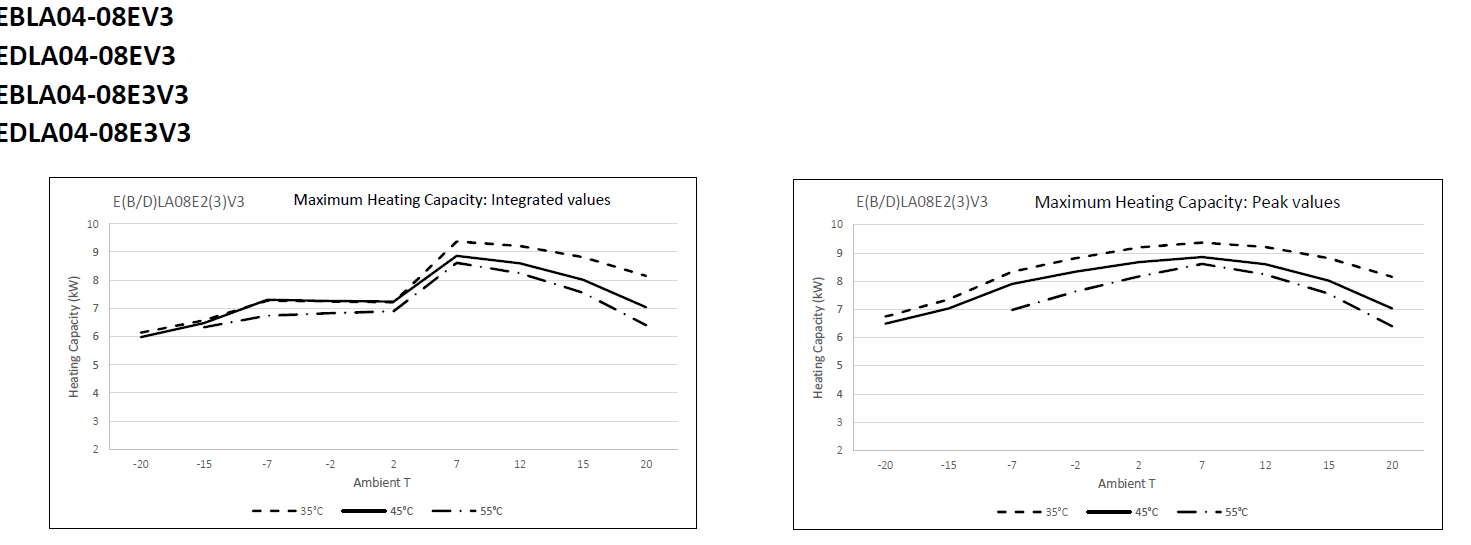
I will give it some thought but in the mean time I found these capacity tables, basically its 7kW in practice. I have no recollection where I got them from because finding this data for Daikin can be like finding hens teeth, but its in a Daikin data book so should be correct. 'Integrated' means including the effect of defrost (in unspecified conditions which may be more benign that the UK!).
COP of 2 is appalling, something seriously at fault.
I will give it more thought, probably the first experiment is to turn up the WC curve to 55 @ -3 on a couple of cold days. This will give you a handle on whether the the undersizing problem lies with the heat pump or the radiators/excess loss in pipework. As @cathoderay says a crude heat loss calculation would also give a useful indication including maybe an indication of the effect of missing insulation (note however that this calculation wont properly include the effect of insulation missing below the UFH). I would also log everything I can, particularly daily energy consumption and, if you can daily energy to the house as measured by the heat pump
4kW peak of solar PV since 2011; EV and a 1930s house which has been partially renovated to improve its efficiency. 7kW Vaillant heat pump.
Topic starter
11/03/2026 10:48 am
I’m going down the formal route rather than trying to redesign the system myself. The house is too cold, it can’t reliably reach 21°C, and I’ve already raised this with NHBC and the developer as a basic “not fit for purpose” issue. NHBC have opened a case and asked the builder for their response, and I’ve given them temperature logs, the snagging report and the thermal images.
While that is in process in the background, I’m trying to understand the system better so that, when someone finally turns up with a clipboard, I’m not fobbed off. I’ll keep it simple in any formal complaint, house too cold, fix it, but I do still want to get a handle on the likely heat loss and whether the current kit could ever meet it.
1

11/03/2026 10:48 am
I don't feel this is an ASHP problem, it's a whole lot bigger than that. You need to contact the NHBC (at least).
11/03/2026 10:58 am
These [insulation] defects line up with the heating behaviour — rooms sitting at 9–12°C in winter with the system running continuously.
That's around 10°C below the desired IAT. These are the sorts of IATs you get with no heating. Given these IATs, something is seriously wrong.
Do you have a historical times series of IAT data, not just spot readings?
I still think it is worth doing a DIY heat loss calculation, factoring in the insulation defects. Are those defects really able to account for IATs 10°C below where they should be?
Edit: Ah, I see we have cross posted.
I’ve given them temperature logs, the snagging report and the thermal images.
Any chance you can post some/all of them here? The more data and information we have, the more we can see what is going on.
I’m trying to understand the system better so that, when someone finally turns up with a clipboard, I’m not fobbed off.
Very prudent, I still think a DIY heat loss calculation will help you greatly with that!
This post was modified 1 day ago by cathodeRay
Midea 14kW (for now...) ASHP heating both building and DHW
1
11/03/2026 1:01 pm
OK here are my considered thoughts based on info so far:
I’m going down the formal route rather than trying to redesign the system myself. While that is in process in the background, I’m trying to understand the system better so that, when someone finally turns up with a clipboard, I’m not fobbed off.
Very sensible!
General comments:
I think its unlikely, but not impossible, that you house loss, when properly insulated, exceeds 7kW and if it does it will be by a small margin. This being the case I would NOT push for the unit to be uprated at present, because you will end up with the 16kW Daikin (they do intermediate models but they are just the 16kW derated) which is double the required size. Only if the house loss is proven to be greater than 7kW would I go for an upgrade, and then I would be reluctant to accept a Daikin because of the large jump to the next model.
I do think its worth doing a heat loss calc, but Im not sure it will change your course. An estimate of the extra loss due to the failed insulation is definitely interesting.
It would help to do the experiment I suggest above (up FT to 55C) to get a better indication whether its rads or heat pump that is limiting. It wont be definitive though given the insulation failures! I dont think you have said anything about pipework diameter or material, it could be that so perhaps post some info. For 7kW your primaries leaving the heat pump should be 28mm copper, dividing perhaps into 2 pairs of 22mm copper with 15mm drops to rads. If they are less than this or plastic please post full details for assessment
If you are really seeing a COP of 2 then it could be a faulty heat pump which is not unknown. Worth trying to ferret this out by interrogating the pump further. Likewise posting any of the data @cathoderay has mentioned may help narrow down. Also where does the figure of 2 come from?
I think you confirmed that there was no buffer, LLH or plate heat exchanger between heat pump and emitters but could you reconfirm.
First step for me remains getting the insulation fixed. Until it is (a) you are losing lots of heat and (b) you cant redesign the heating system, if that is what it needs.
I will post more if I think of more, in the mean time I hope that helps. The mystery is clear - 7kW is almost certainly enough or very nearly enough for the house if correctly insulated, so why is the house falling so far from being heated.
This post was modified 1 day ago 2 times by JamesPa
4kW peak of solar PV since 2011; EV and a 1930s house which has been partially renovated to improve its efficiency. 7kW Vaillant heat pump.

12/03/2026 1:40 am
A few comments as someone who is towards the end of self building 2 houses so have a reasonable understand of the process.
I would follow @transparent advice as your heating doesn't meet building regs. It has to be properly sized, not over or under. (seeing the amount of new builds with large HP's the building inspectors can't be following up on this) If you can't get the indoor temperature above 16° when it is cold with a 7kW HP then I expect your insulation doesn't meet regs. As Transparent said, building control are the ones to enforce this. I don't know where NHBC's loyalties lie as I have no experience of them but if you have an NHBC warranty and they did the building control inspections contacting your LBC (local building control) would be another path to explore if you aren't getting anywhere with the builder.
If the building control application was submitted after October 2023 then the builder should have been required to submit photograph evidence to confirm the insulation was properly fitted. These photo's are supposed to be geo-tagged to prove they were taken at your property and not one set of photos to cover several houses on the site. They don't require a picture of every part of the building so there is no proof every area is fully insulated but it would be a start. The application can be submitted in advance and it is quite common for developers to submit BC applications in advance of building regulation changes so your 2025 build could be submitted previous to the photo's being required. Previous to this the inspector will have taken pictures of the foundations and the build up to damp proof course and this should give a good indication of the space that was allowed for insulation under the concrete screed that has your UFH pipes in, but if the BC inspections were done by NHBC this won't be held by your LBC. There should be a set of plans submitted with the BC application that detail the insulation it was designed with to meet the regs, along with SAP calculations etc that I realise you can't get from the builder.
LBC inspect at structure up and then don't come back until final inspection. Our house was a timber frame shell when he last inspected so no insulation, not much at all really. There is a lot that goes on between the structure being signed off and the building being completed that isn't physically inspected, hence now requiring photos to confirm the heat loss part of the regs is being adhered to.
There is a requirement to submit a building control application to the LBC even if the developer used an independent inspector so your LBC will have a record of your site and when the application was submitted. They may know who the building control inspections were done by, I'm not sure on that one.
Do you have neighbours on your development or is it a one off? I wondered how they are getting on if you have any.
How warm does your floor get if you lay a thermometer on the floor? What temperature are the rads at? I would describe mine as luke warm or even cool as at the moment the water leaving the HP is mostly 25-26° so the floor tiles don't feel very warm. I think the highest I have seen the floor tiles is 25° when we have a cold snap, I had a temperature gauge laying on the floor most of the first winter.
To me this sounds like a problem with the insulation and/or air tightness but if your floor and rads are not above indoor temperature obviously there's a problem.
As an example of our heat requirements. When we had the initial assessment for the heating, from the plans based on meeting building regs standard figures the heat loss for our 185 sq mtr house at -2° was just under 5kW. The design assessed SAP gave a heat loss of 4.2kW, so we are building to insulation levels that are about 15% better than 2023 building reg minimums. Our bedrooms have a heat loss of around 200 watts each so the rads only need to be small. Our main bedroom has a vaulted ceiling and 3 external wall and this pushed the heat loss up to just over 500W, still small rads even at 30° flow temperature.
I have 5kW HP's for both houses, 2 heat pumps not shared. I'm in East Anglia so it isn't a cold part of the country. The heating was commissioned in the 185 sq mtr house in February this year as the cold snap happened, minus 2-3° at night for a few days. Previous to this I had been using the woodburner at evenings and weekends to try to keep the chill off but it was only getting to around 13°. Within 36 hours the temperature was up to 18° downstairs with a max flow temperature of 35°. After the first 48 hours I switched to running the heating for 6 hours overnight only, when the electric is cheap. We don't have the upstairs heating connected yet so this was just from the UFH downstairs but the heat spread through the whole house after about a week. The UFH pipes downstairs are 16mm dia and at a standard 150 centres. I turned it off after about 2 weeks as the house was getting over 20°. Since then the sun on the windows and the woodburner at weekends has been enough to keep it between 16-18°. Our insulation is a little better than building regs but not by much and I still have issues with the french doors and a window not closing fully so we have a little extra ventilation.
We are currently living in the smaller house (130 sq mtrs) and don't notice the cold outside unless the temperature drops below -5° or there's a very cold wind, but even then the house is still warm inside. The heating has not needed to run 24 hrs a day at any point to keep the house warm and this also has a max WLT of 35°. I haven't fitted the rads in the bedrooms and our bedroom does get down to 14° if it is cold and windy but most of the time is 17-18°. Our boys sleep with their windows open most of the winter as they think it is always too hot.
12/03/2026 10:55 am
Apologies for the slower response @newby - Wednesday is usually my 'day off'.
I'm also pleased to see that you've been commenting on the quality of insulation which has been installed. Outside of the publicly accessible part of this Forum, @jamespa has been looking into what's involved with retrofitting existing housing stock to achieve greater energy efficiency. Although yours is a new-build, and the insulation specification is probably 'correct' on the plans, it's the shoddy installation which then undermines the theoretical SAP score.
That's going to be the case irrespective of the age of the property.
Poor installation practice renders the survey calculations utterly useless.
1: Now let me highlight a separate issue regarding new-builds done by the larger firms who are members of the NHBC.
These homes are not necessarily built to the current standards for either Building Regs or SAP scores.
At any time in the past, the Developer can 'pre-register' the site with NHBC for a small nominal fee.
When that happens the clock stops for all Building Control issues. Whatever was the then-current set of regulations is the standard to which the Developer is required to comply.
The site doesn't have to be owned by the Developer at that moment, nor does Outline Planning Permission need to have been sought.
A Developer who is a member of the Vistry Group is presently constructing new houses near me which only meet the 2006-level of Building Regs, and the 2009 edition of the SAP (Standard Assessment Procedure) energy-efficiency criteria. At the point of sale, the new owners are provided with an EPC Certificate, whilst unaware that it isn't based on the current standards.
In your case you should ask to see a multi-page printout of the SAP which was undertaken for your new home, based on the approved plans. At the foot of each page the software prints the edition/version of the SAP which is being applied, and the software licence number of the assessor. That can be very useful information in a dispute.
2: Irrespective of these homes being signed off by NHBC, you should still be communicating the issues to your elected Councillors at the level of LPA (Local Planning Authority). Unless you're in a Unitary or Metropolitan Authority, the LPA is the District or Borough Council.
Since that Council holds the powers of enforcement, they need to be put in the picture regarding breaches of regulations.
Always do this by email. Not only is it then in writing, but the date-time stamp might later be required as part of dispute-resolution.
Elected Councillors are not expected to know the technicalities of the regulations, but they have the power to require Council Officers to undertake any investigation. In most cases that will start by them forwarding your email to the Head of Planning, and requesting a response (to them, not you!).
For that reason, I always provide Councillors with photographs and diagrams within my emailed PDF. They will find that very useful.
Here's an example of how I've raised a complaint about a Developer wanting to plant species with edible fruit on an estate where the soil is contaminated with arsenic.
I've taken a snapshot of the Developer's Landscaping Drawing (presented during the planning application), and superimposed screenshots of the 'key' from the side of that Plan, with arrows pointing to the problematic locations on-site:

That allows a Councillor to immediately see what I'm concerned about, without having to wade through 100+ pages of Application Documents.
They can forward that to their Planning Officers with a cover-note which simply says "Investigate this complaint and send me a report detailing the safety risks".
The section of the page which I've used here by way of illustration is the start of a 5-page PDF which progressively gets more technical. I quote my source references and any relevant 3rd-party experts. There's no wriggle-room for the Planners to dismiss what I'm stating.
3: Here's the relevant sections you need from the current Part-L of the Building Regs. That Approved Document addresses Heating and Power, and will therefore cover all issues regarding a heat pump.
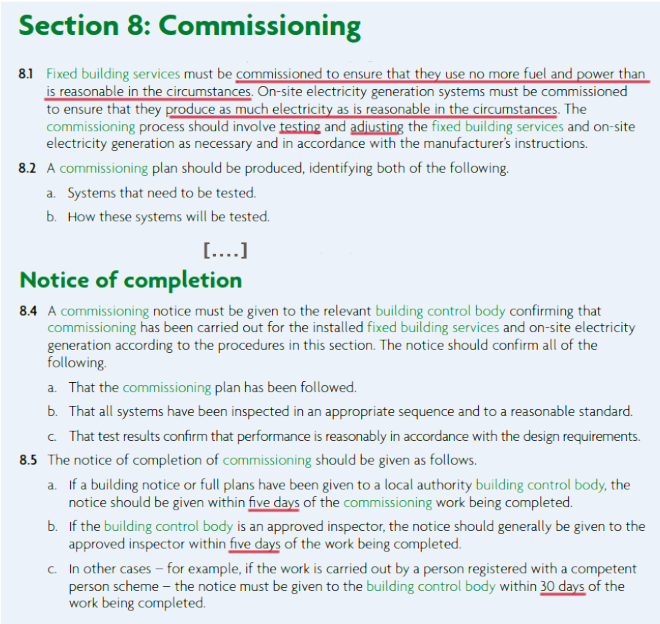
and Section 9
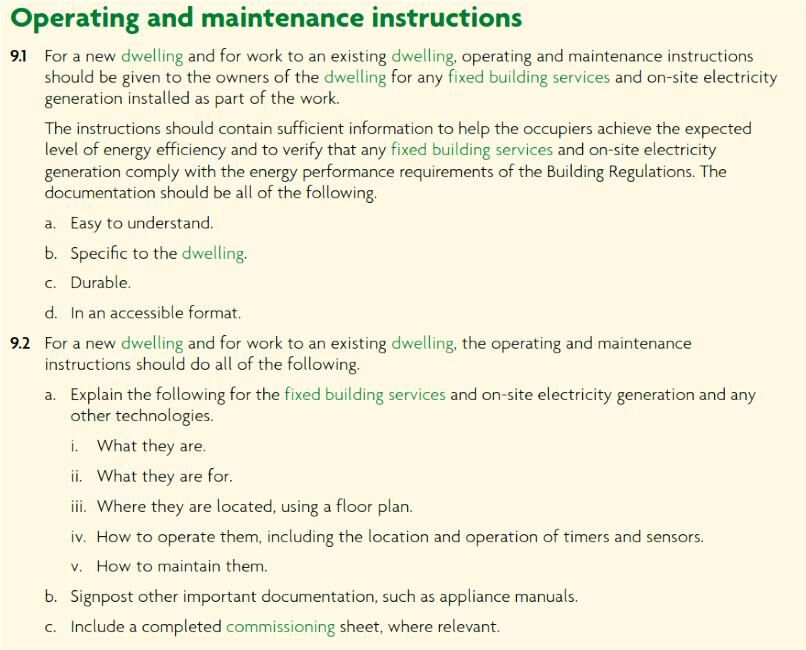
The two sections stipulate what should've been done to properly commission the system, and documents which they are required to hand over to you.
Those documents must be site-specific, for your particular house. It's not sufficient to give you manuals from a manufacturer and generic operation instructions. You need to have sufficient training/instruction to operate the heating system so as to minimise the amount of energy (electricity) it uses.
I could write more, but I'm going to stop there and let you respond to the above.
This Post from me forms part of your 'evidence', and can be sent to your Local Councillors.
They may wish to also post here, requesting clarifications. That's fine, of course!
This post was modified 12 hours ago 2 times by Transparent
This post was modified 11 hours ago by Transparent
Save energy... recycle electrons!

Latest Posts
-
RE: Octopus Cosy 12 Heat Pump Regret: Incredibly Loud, Poor Heating & Constant Hum - Help!
Balancing is a long process and its possible to mess th...
By JamesPa , 22 minutes ago
-
RE: Daikin Altherma 3 LT compressor longevity question
Up to a point yes. However every heat pump (and every ...
By JamesPa , 1 hour ago
-
Thanks everyone for the help, Havenwise now diasbled. q...
By Boycey , 3 hours ago
-
RE: Advice needed after a successful "leftfield" experiment.....
@pauli Depending on whether you can get an EV tariff, I...
By ChandyKris , 4 hours ago
-
-
RE: New Build ASHP Defects - Looking for Advice, Support & Shared Experiences
Is that a single pair only? If so it may be part if th...
By JamesPa , 6 hours ago
-
RE: Solar Power Output – Let’s Compare Generation Figures
@technogeek I think you are correct, but, it didn’t inf...
By Papahuhu , 6 hours ago
-

@batpred, you’re quite right; it does work well. I don’...
By Majordennisbloodnok , 7 hours ago
-

@Mars at the time of writing heating oil is £1.28 / ltr...
By TechnoGeek , 7 hours ago
-
RE: Ecodan Cylinder Possible Weeping Around Thermostat Port
Update: Mitsubishi sent an engineer around. It was li...
By Gruff2001 , 10 hours ago
-
RE: A Smarter Smart Controller from Homely?
@benson Agreed. I believe the COP gains with homely, i...
By Papahuhu , 10 hours ago
-
RE: Samsung Gen 7 16kW Integrated unit Modbus monitoring
The setup for this is a Samsung Modbus card. Connected ...
By antonical , 12 hours ago
-

RE: Forum updates, announcements & issues
@davidalgarve, if the emails are more than roughly a mo...
By Mars , 12 hours ago
-
How to Find All Your Posts and Topics on the Forum – A Quick Guide
If you’ve ever posted something on the forum and then s...
By Mars , 12 hours ago
-
RE: If a heat pump can only heat DHW to 50C then what? Issue with 18KW Heliotherm heat pump
Sorry to hear that but I'm not surprised TBH. Stratifi...
By JamesPa , 13 hours ago
-
RE: Say hello and introduce yourself
@pt151 welcome to the forums, and looking forward to he...
By Mars , 1 day ago
-
RE: Setback savings - fact or fiction?
The answer was in two parts in my reply, the second par...
By RobS , 1 day ago
-
Samsung Gen 7 16kW Integrated unit Modbus monitoring
Looking for some assistance to get modbus monitoring wo...
By antonical , 1 day ago
-
Ecodan control return to Melpump from Havenwise trial. settings check
Hi, Just got control back after being on the hav...
By Boycey , 1 day ago
-
RE: Refrigerant R32, is it now banned in the EU from 1st Jan 2027 for monobloc ASHPs?
I wonder if heat pump manufacturers will tone these sit...
By JamesPa , 1 day ago
-
RE: Who’s Caved and Switched the Heating On Already?
@editor yesterday we used 12kW of electricity for heat,...
By Judith , 1 day ago
-
RE: Rate the quality of your heat pump design and installation
Loss assessments can be a very serious case of GIGO. I...
By JamesPa , 1 day ago
-
RE: Who's your electricity provider and what's your tariff?
@jamespa Just bizarre. This is our data. I really don't...
By antonical , 2 days ago
-
RE: Mitsubishi Ecodan 11.2kW review
I think you said its an 11.2kW model and your house is ...
By JamesPa , 2 days ago


