
Notifications
Clear all

Topic starter
30/12/2025 10:23 am
I would appreciate any comments on the performance of my ASHP as demonstrated by the following recent graph from Melpump.
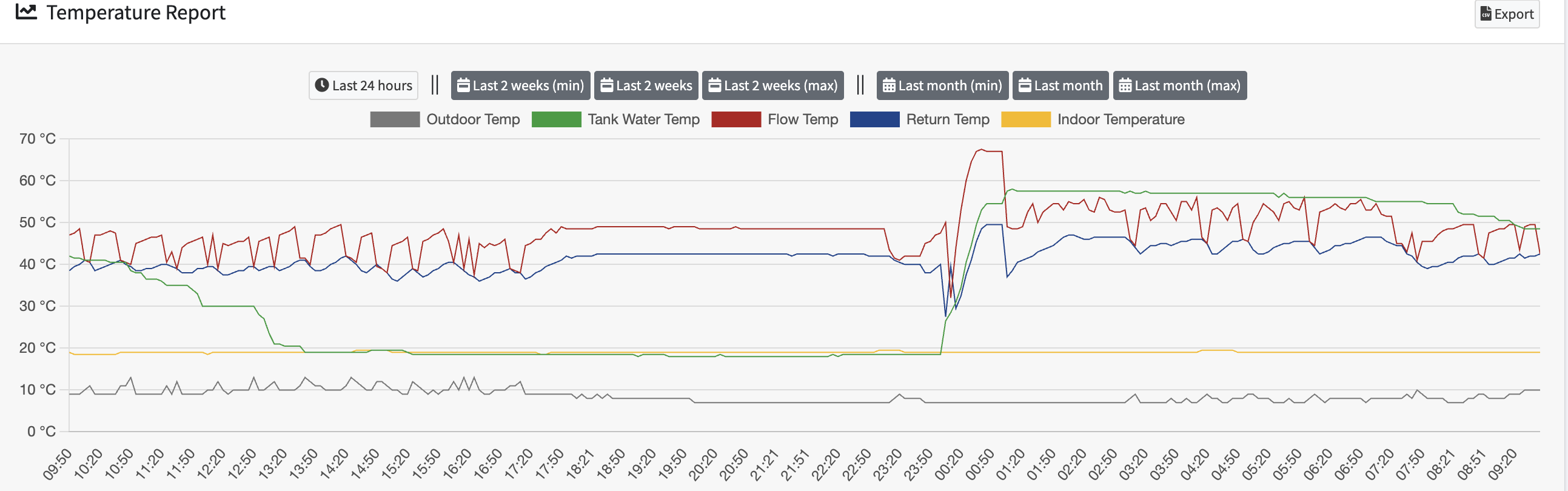
On the one hand, I am particularly struck by how sensitive the control is to minute OAT changes.
On the other hand, I wish the heat output could be steadier for inside heat demand although Havenwise are critical of the granularity of the Mitsu PAR 60 (+/- 0.5C) and this may be part of the problem.
The location of the PAR 60 has proved to be critical, but in general we now have acceptable temperatures upstairs and down and N vs S.
COP is another matter and daily figures at these ambients (5-10C night time) are between 2.6 and 2.9 and perhaps I could expect higher.
I will have to decide if I can do better with straight weather compensation or adaptive but the PAR 60 has been disappointing in its performance and application.
342sq m "Upside down" house in Algarve. Portugal
Mitsubishi PUHZ-120YUK 12kW ASHP
12 Solar Panels Growatt Inverter
2 x Growatt 7.5kW Batteries
Fronius EV Charger
Kia e- Niro 64kW

30/12/2025 1:06 pm
Fwiw my house is more stable with pure WC than it is with any room influence , with the exception of the extreme ends of the season where solar gain can dominate. That's not entirely surprising given the fact that the house takes 12hrs plus to react to changes, so any iat based control system is compromised from the outset due to this delay. With the boiler, which didn't feature WC and therefore only had iat based control, stability was much worse.
You seem to be running at a pretty high ft and a pretty high deltaT flow/return despite mild oat. That's going to compromise cop quite considerably. Are your emitters large enough and have you got a buffer tank/LLH. How and where are you measuring COP?
This post was modified 2 months ago 3 times by JamesPa
4kW peak of solar PV since 2011; EV and a 1930s house which has been partially renovated to improve its efficiency. 7kW Vaillant heat pump.
Topic starter
30/12/2025 3:57 pm
@jamespa Thanks for your comments James.
The answer to your question is not quite straightforward. We live mainly on the 1st floor which is either South facing or gets some sun early or late and the emitters in these rooms (Roca alumnium) are probably adequate.
The downstairs rooms were converted when we moved in 20 years ago and consist of a family room and master bedroom/ en suite.
These rooms are North facing and the emitters are probably not big enough, but I could not contemplate changing them at this stage and we don't need them as warm as our main upstairs living room
It has been necessary to locate the PAR 60 in the coldest room (our bedroom!) where it is chasing 23C but never getting much above 19C.
It is subjective but I think we had less difficulty heating downstairs last year with weather compensation and I see that I achieved a COP of 3.3 in December 2024 even with a buffer tank! However, I am now heating up a large DHW tank at some time in the night as you can see on the graph.
342sq m "Upside down" house in Algarve. Portugal
Mitsubishi PUHZ-120YUK 12kW ASHP
12 Solar Panels Growatt Inverter
2 x Growatt 7.5kW Batteries
Fronius EV Charger
Kia e- Niro 64kW
30/12/2025 4:16 pm
@jamespa Thanks for your comments James.
The answer to your question is not quite straightforward. We live mainly on the 1st floor which is either South facing or gets some sun early or late and the emitters in these rooms (Roca alumnium) are probably adequate.
The downstairs rooms were converted when we moved in 20 years ago and consist of a family room and master bedroom/ en suite.
These rooms are North facing and the emitters are probably not big enough, but I could not contemplate changing them at this stage and we don't need them as warm as our main upstairs living room
It has been necessary to locate the PAR 60 in the coldest room (our bedroom!) where it is chasing 23C but never getting much above 19C.
It is subjective but I think we had less difficulty heating downstairs last year with weather compensation and I see that I achieved a COP of 3.3 in December 2024 even with a buffer tank! However, I am now heating up a large DHW tank at some time in the night as you can see on the graph.
All understood.
Obviously its a bit house dependent but many people do find that pure weather compensation is the way to go both for comfort and cost so, if you do come to this conclusion, don't be surprised.
The manufacturers of smart controls have been misleading us for decade, certainly in the UK, into micro-zoning in time and space. For many all it does is reduce comfort whilst increasing costs or at best not materially reducing them. Even with my old gas boiler dropping all the fancy controls and just operating it 24x7 at the lowest flow temperature it could saved about 10% and improved the comfort of the house!
4kW peak of solar PV since 2011; EV and a 1930s house which has been partially renovated to improve its efficiency. 7kW Vaillant heat pump.

Latest Posts
-
RE: Connecting Growatt SPH5000 over wired ethernet rather than wireless
The simplest wired option is usually the Growatt Ethern...
By Jonatan , 3 hours ago
-

RE: Peak Energy Products V therm 16kW unit heat pump not reaching flow temperature
ASHPs do have a minimum compressor speed. The minimum h...
By bobflux , 10 hours ago
-

RE: Electricity price predictions
@jamespa And it seems some of the nasty public cloud...
By Batpred , 10 hours ago
-
@bobflux My apologies, they somehow were removed in ...
By Ubert767 , 10 hours ago
-
RE: Tell us about your Solar (PV) setup
Location: near Lyon, France 12kWp on the roof, 2x Sol...
By bobflux , 11 hours ago
-

RE: Jokes and fun posts about heat pumps and renewables
Technology is rapidly advancing. BBC News reported th...
By Transparent , 14 hours ago
-
What matters for flow and pressure drop is internal dia...
By bobflux , 14 hours ago
-

RE: Do Fridges and Freezers have COP ratings?
@editor Thank you all for your replies and submitted in...
By Toodles , 17 hours ago
-
I know and yes. The secondary deltaT wont necessaril...
By JamesPa , 20 hours ago
-
RE: Designing heating system with air to water heat pump in France, near Lyon
Just love the way you put it! 🤣
By Batpred , 1 day ago
-
RE: Safety update; RCBOs supplying inverters or storage batteries
Thank you for sharing. So it seems that your Schneid...
By Batpred , 1 day ago
-

RE: Forum updates, announcements & issues
@upnorthandpersonal thanks for the thoughtful, consider...
By Mars , 2 days ago
-
RE: Solar Power Output – Let’s Compare Generation Figures
@mk4 All 21 panels have their own Enphase IQ7a microinv...
By Toodles , 2 days ago
-
RE: Setback savings - fact or fiction?
Great, so you have proven that MELCloud is consistently...
By RobS , 3 days ago
-
RE: Mitsu PUHZ120Y 'Outdoor Temp 'error?
Thanks David & James It almos...
By DavidAlgarve , 3 days ago
-
RE: Surge protection devices SPDs
@trebor12345 - your original Topic about the right type...
By Transparent , 3 days ago
-
RE: Help needed with Samsung AE120RXYDEG
@tomf I’ve been sent this from a service engineer at Sa...
By Mars , 3 days ago
-
RE: Buying large amp bidirectional RCD and RCBO
Yes... I went through this particular headache and ende...
By bobflux , 4 days ago
-
O-oh! Let's take this as an opportunity to 'pass the ...
By Transparent , 4 days ago
-
RE: Homely setup on daikin heat pump
@craigh I refer to our somewhat elevated temperature of...
By Toodles , 4 days ago
-
RE: Air source heat pump roll call – what heat pump brand and model do you have?
My turn, this describes the future installation, only t...
By bobflux , 4 days ago
-
RE: Say hello and introduce yourself
@liam-dr, I’d like to echo James’ welcome, and we look ...
By Mars , 4 days ago