

Notifications
Clear all
Joining the Renewable Heating Hub forums is completely free and only takes a minute. By registering you’ll be able to ask questions, join discussions, follow topics you’re interested in, bookmark useful threads and receive notifications when someone replies. Non-registered members also do not have access to our AI features. When choosing your username, please note that it cannot be changed later, so we recommend avoiding brand or product names. Before registering, please take a moment to read the Forum Rules & Terms of Use so we can keep the community helpful, respectful and informative for everyone. Thanks for joining!

07/10/2026 7:23 pm
I had the same problem with heat geek.
My heat loss was 6.4kW (similar to other surveys). All my radiator are Type11 single panel convection ones on 10mm microbore on a 140 sqm 2004 property.
We were given 2 options for heat pumps 5kW Vaillant aroTHERM plus or 7kW pro. We were considering the plus for the added warranty.
We were given 0 radiator changes at 355% efficiency or 1 radiator change at 365% efficiency.
No flow temp given and Installer didn't have the info.
All my radiators were deemed sufficient based on their delta T50 outputs. Most of my radiators barely meet my heat loss at Delta T50 so was confused as to how they would work with heat pumps. When asked the installer advised to trust the algorithm and the guarantee is there of We need it.
I did a bit of digging and the 5kW unit can do 6.4kW when at or under 40 deg C flow temp.
However my radiator outputs are considered at Delta T50, implying a 75 deg c flow.
How can a 5kW heat pump work with my radiators for a 6.4kW heat pump is baffling. This doesnt even consider defrost cycles and DHW reheat.
Interestingly 1 of my rooms is already not meeting the heat loss at Delta T50 yet it is still sufficient according to heat geek.
Someone online commented that heat geek look at the whole house as 1 big Emitter as air flows which I dont agree with as many doors stay shut at night for bedrooms, toilets etc.
But entertaining that idea (even if I dont agree with it). My total radiator output for my whole house is 9.6kW at delta T50. So my flow temp has to be atleast 57 deg C for it to output 6.4kW. Even with this approach the 5kW unit is undersized.
This is again ignoring my 22 year old radiator condition and sticky TRVs.
Posting here as I have a very similar situation, although different type of house.
1900s end terrace, solid brick walls, double glazing, some insulation in a 20 year old loft extension, suspended timber floors with no insulation - 125sqm.
The pre-survey estimate heat loss from heat geek was around 9kw.
The survey came back with 6.3kw - the guy surveying was great and talked through the whole thing, about how he was changing some of the default assumptions and somewhat gaming (not his words but my understanding) of the app to give a heat loss figure that was in his experience closer to reality.
Despite the heat loss, I was presented with the same two options: 5kw arotherm plus or 7kw arotherm pro, the latter being £50 more expensive.
No radiator changes, 210L cylinder - £8,200 total cost (which includes £900 additional pipework recommended by the surveyor, which was explained and would be necessary), and a 415% efficiency guarantee.
A lot of aspects of this slightly surprising to me:
1 - my pre-survey estimate from HG was £6,050 - for an 11kW Vaillant AroThermPro, 210L cylinder, and 1 radiator change. Even with the extra plumbing required, I don't really understand how the price has increased so much for a smaller ASHP and fewer radiator changes
2 - as others have said, no flow temperature mentioned anywhere. But as also discussed, I'm happy with this given the guarantee - I do feel like this should be the target of the industry, "if we set it up right you will achieve this outcome" rather than just "this is our recommended set up".
3 - one room where no radiator change seems odd, and its the largest room. A kitchen diner which is 21sqm and heat loss measured at 1350W. There is a currently a large column radiator there which assessed at 1400W dt50. My understanding is that would only cover the target heat loss (21inside, -2 outside) if the flow temperature was 71, which it is never going to be. Using gemini to do the maths, at a 55 degree flow temperature, this radiator wont provide enough heat to the room once the external temperature drops below 8 degrees. I have reasonably sized column radiators and type 22s elsewhere, all providing at least double the heat loss wattage at dT50 so understand why these don't need to be replaced - maybe the heat geek model sees the radiators as a whole being sufficient to heat the house and isn't looking too closely at one room? But I am concerned that this is the largest downstairs room and there are only 3 radiators downstairs. But then also, Heat Geek are guaranteeing the internal temperature as well as the efficiency.
4 - given some of the above, surprised that the guarantee is so high. I was expecting around 350-370%.
As I say I was very impressed with my heat geek firm - I want to go with them, they seem very knowledgeable and have been responsive to many of my questions. But wanted to lay out my experience here for others to see and comment on, particularly as it seems to fit with a pattern.
Perhaps HG have got enough real world data from their installs and models that they're more relaxed about the bounds of what they can offer, that in many parts of the country -2 degree periods are vanishingly rare, and a good modern heat pump set up to just tick over will be more than good enough!?
1

07/10/2026 7:30 pm
@donciccio thats interesting.
I really cant understand how the radiators would work in that case.
What is the total output of all radiators combined for your house ?
It will be interesting to see if the total radiator output can supply the heat loss and at what flow
1

08/10/2026 7:03 am
one room where no radiator change seems odd, and its the largest room. A kitchen diner which is 21sqm and heat loss measured at 1350W. There is a currently a large column radiator there which assessed at 1400W dt50. My understanding is that would only cover the target heat loss (21inside, -2 outside) if the flow temperature was 71, which it is never going to be.
Another way of looking at this is to say that at heat pump flow temperatures, a radiator will output around half of what it would put out at fossil fuel boiler flow temperatures. This is a ball park figure but often isn't far out, and makes sense, the rad to room delta t at heat pump flow temperatures is around half what it is at fossil fuel boiler flow temperature. There are standard tables that give the de-rating factors eg this one from Stelrad.
What this means is your 1400W large column radiator will output around 700W at heat pump flow temps (give or take, depending on actual flow temperature). If the room's heat loss is 1350W, then 700W is a significant shortfall. Your installer needs to explain how this will work in practice.
Midea 14kW (for now...) ASHP heating both building and DHW

08/10/2026 7:12 am
@donciccio You might be better posting these concerns on FB HeatGeeks for Homeowners. I say that because the forum often gets responses from someone from Heat Geek HQ.
FWiW, the installer might not have any answers for you. They just export the survey data and design options are churned out seconds later by Heat Geek’s systems.i have also seen comments that Heat Geek HQ is happy to look into any concerns about its design options.


08/10/2026 9:18 am
Having looked at all the posts I'm pretty certain that Heat Geek are betting that the 'standard' heat loss calculation is in fact an over estimate and that they can run at a sufficiently low flow temperature (perhaps not super low, maybe in the low 50s) to achieve the guaranteed SCOP.
I am also fairly confident that they are 'playing a numbers game', ie reckoning that occasionally their bet won't work out, but building in enough margin on average to honour the guarantee.
I suspect they can do this commercially because they have a lot of accumulated data from many installs.
It's a very sensible and customer focussed approach - guarantee what the customer cares about (running cost) and take the risk, rather than giving the customer lots of detail they don't really care about and thereby shift the risk to the customer.
Had the industry started out this way we wouldn't be questioning it. Unfortunately the industry didn't start out this way, it started out by transferring almost all design risk to the customer by asking the customer to sign up to lots of design detail and _not_ guaranteeing the outturn efficiency.
Of course its validity does depend on your level of confidence in the guarantee. I cannot comment on that but the principle is, IMHO, much more sound from a customer standpoint than the more common way of doing business that we have become used to (and on which all the advice here, including the advice I give, is based)!
4kW peak of solar PV since 2011; EV and a 1930s house which has been partially renovated to improve its efficiency. 7kW Vaillant heat pump.
1
08/10/2026 9:41 am
However, with MCS and BUS involved, I’m struggling to understand how this works in practice. As a business, Heat Geek can size a system however they consider appropriate for the property much like sizing a gas boiler, because they can carry out their own detailed heat-loss assessment and design the system accordingly.
But when the BUS grant is involved, it seems to become more complicated, as the installer has to meet certain MCS/BUS criteria and requirements. So how does that more flexible, property-specific approach fit within the MCS/BUS framework?
Also, what is the point of providing a detailed heat-loss figure if the heat pump/system selected isn’t actually capable of meeting that calculated heat loss under the relevant design conditions by default? Surely the purpose of calculating the heat loss so accurately is ultimately to ensure the system can meet that demand.
If this is actually the approach Heat Geek is taking, I think the best thing they could do is show the customer exactly what their calculated heat loss is, what design conditions they are using, what output they expect from the chosen heat pump at those conditions, and therefore exactly why they believe the system is appropriately sized. That would give the customer complete clarity about what is being installed and why.
I’m genuinely interested in understanding how these two things reconcile, as the heat-loss calculation is such an important part of sizing the heat pump right
@l8again I have already asked the question regarding the dt50 sizing on the heating forum and got nowhere.
Adam Chapman replied intially on my post in the heat pumps u.k. group but when asked for clarification he didn't respond
08/10/2026 10:08 am
Ultimately I think I agree with @jamespa that while there's a level of opaqueness to what HG are providing, they are providing something that is more simple and requires less expertise from the user to say:
- this is the heat pump (and radiator changes, pipework) required to heat your house to 21 degrees all the time
- we will guarantee that temperature and a SCOP figure for a 5-year period
- If we are wrong, we will fix that at no additional cost to the consumer
Yes in any single home they may recommend something that raises questions to knowledgeable consumers like us on this forum - but I would still wager that HG, their model and their accredited installers know more about real world performance than we do!


08/10/2026 10:15 am
Thanks @jo2255, @donciccio and others... your posts are making this discussion interesting because we now have two very similar proposals raising the same basic questions.
@jamespa may well be right that Heat Geek is confidently playing the averages. They may know that traditional heat loss calculations generally come out too high, and be willing to fix the occasional installation where that assumption proves wrong. If the guarantee really protects the customer, there is potentially a lot to like about that approach.
However, a guarantee across thousands of installations is slightly different from showing that the design works for one particular house. With MCS and BUS involved, I still think Heat Geek should be able to explain how the selected heat pump and radiators meet the stated heat loss under the same operating conditions.
That is why I think @jo2255 has landed on the right question. Nobody is asking Heat Geek to reveal how its algorithm works. I certainly don't care. We just need the conclusion in plain English that people understand... the design heat loss, outdoor design temperature, expected flow temperature, heat pump output at that point and confirmation that the rooms will reach their intended temperatures while still achieving the guaranteed efficiency. If the software can produce several fully priced options in seconds, surely it can produce that short explanation too.
I think @l8again’s experience shows how good the offer can look when everything connects with a defined efficiency target, a corresponding max flow temperature and specific radiator changes to achieve it. @batpred’s comment that the flow temperature only appeared around commissioning is interesting too, because information received after committing to an installation is not as useful as information provided while choosing between options.
@l8again and @batpred, have your systems now completed a full year under the guarantee, and did the measured result match what was promised? It would also be helpful to know whether every room remained comfortable during the coldest spells and whether you can see the monitoring data being used. Sorry if you've already answered this somewhere already.
Please keep us updated, @jo2255, @donciccio, @franszo and others. If Heat Geek replies through its Facebook group, as @l8again suggested, please bring the answer back here too. There may be a very clever and completely sound method behind these proposals, but at the moment the homeowners (and apparently some of the installers) are being asked to trust a conclusion that nobody seems able to explain.
🔥 Britain’s Heat Pump Shitshow
How Installing a Heating System Became a National Nervous Breakdown
Free UK shipping.
📗 Heat Pumps Explained
A Jargon-Free Guide for Homeowners
Rewritten and updated for 2027
📘 From Zero to Heat Pump Hero
🛠️ Bodge Buster
New to heat pumps?
Take the Heat Pump Fundamentals course and use INTRO50 at checkout for 50% off.

08/10/2026 10:18 am
You may be overthinking this.
The maximum heat output of a 5kW Vaillant aroTHERM plus air source heat pump reaches up to 7.9 kWunder optimal conditions (at +7°C outside air temperature and higher compressor modulation), and around 4.84 to 5.4 kW under nominal or colder outdoor ratings (Source: Valliant)
As I have posted previously, my property has a 5.68kW at an OAT of -3C. This is clearly explained in the very detailed Heat Geek survey. As you can see from the above, a 5kW heat pump is capable of meeting tye heating loss demand most of the time. There are advantages/disadvantages of going for a smaller heat pump: a smaller heat pump has a lower modulation figure with the disadvantages of a higher flow temperature with more frequent de-icing cycles.
In my situation, changing 8 radiators increased the radiator surface area and system volume. The Heat Geek algorithm then favoured a bigger heat pump. I was told that this was down primarily to the lower flow temperature that a bigger system could run at to meet the predicted heat loss. The disadvantage is more frequent cycling which is offset by less frequent deicing cycles.
To put the above into the context of a gas boiler. Previously, I lived in a 5 bed property with a 24kW boiler. A heat loss survey for a heat pump showed quite clearly that an 18kW boiler was sufficient for our heat loss - however, Ì was told that most gas boilers are over-sized just to meet the hot water reheating demand.

08/10/2026 10:18 am
Honestly I would just ask for the radiators to be replaced in the rooms you are concerned about. They don't cost much. You could do it separately but I think if they get fussy it's a red flag? In any case, bigger rads will improve the COP.
Likely the problem is that some rooms have oversized rads and others have undersized rads, but on average across the whole house they will output enough heat to match heat loss. Problem is the heat will be located in the wrong places: some rooms will be cold while others will be warm. You'll end up turning down the radiators in the oversized rooms, which will reduce the total heat output and require a higher flow temperature across the building. This will reduce the COP. I'd just get the rads replaced personally.
One other thing is that kitchens are assumed to get hot by themselves because you cook in them. Standalone kitchens aren't required to have heat emitters at all iirc. Perhaps they're assuming that the heat generated from the kitchen will be sufficient to supplement the undersized radiator. Or only looking at the "dining" floor area when determining the radiator size and saying that it's adequate for the 50% of the room that is allocated to dining.
ASHP: Mitsubishi Ecodan 8.5kW
PV: 5.2kWp
Battery: 8.2kWh
08/10/2026 10:29 am
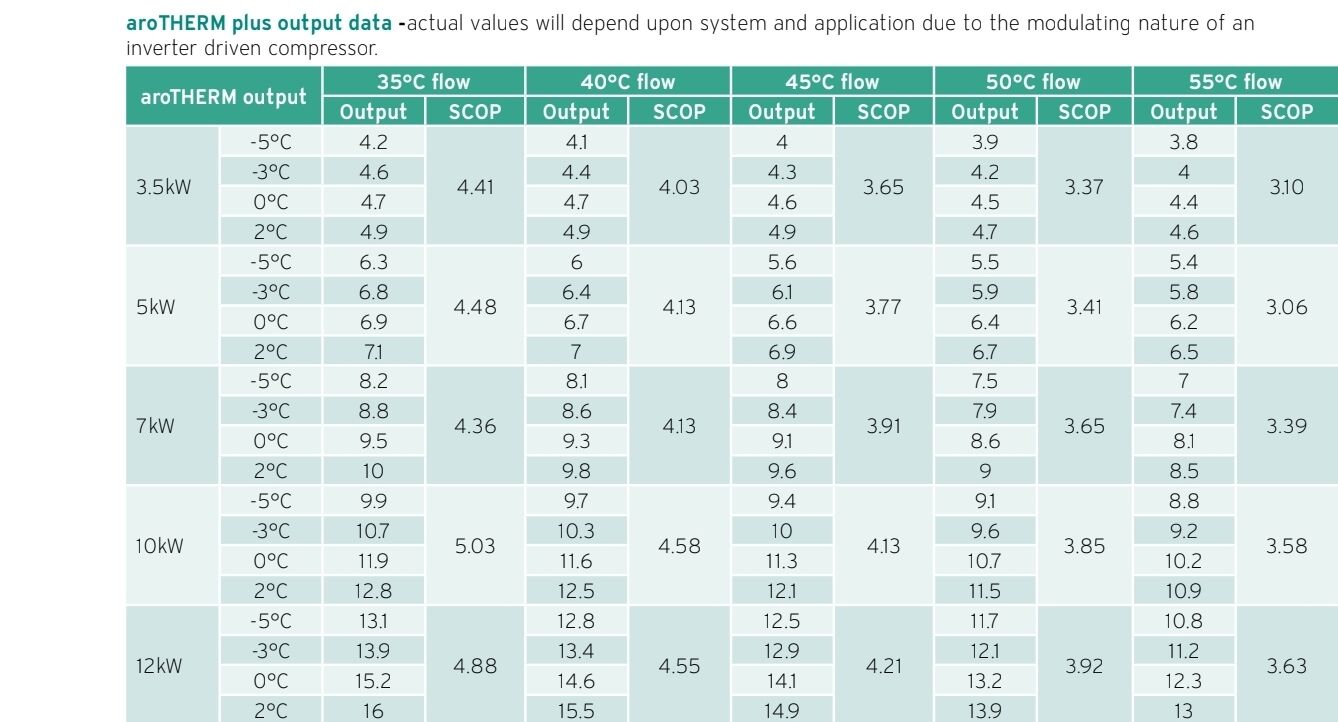
@l8againagain I think you need to look into it in depth.Heat geek proposal says the heat loss are for -3.6 deg C outdoor and 21 deg C indoor temp
Vaillant spec for 5kW attached shows the unit can indeed do 6.4kW (my heat loss according to heat geek). But they can do 6.4kW at -3 deg c only if flow temp is 40deg C or below.
My existing T11 radiators cannot output 6.4kW at 40deg C.
Not overthinking here. My exisitng radiators wont work with 5kW unit from Vaillant for 6.4kW heat loss
3
08/10/2026 10:29 am
Ye Gods! Trying to penetrate this stuff is like trying to drill a hole in concrete with a cocktail stick! And it is not helped at all by the recent MCS guidance and requirement changes.
First, what I think is the case, with backing evidence where possible. If I am wrong, then please say so, with backing evidence.
Pre-installation MCS compliant quotes: these must contain among other things the flow temperature, which is then used to determine the SPF (Seasonal Performance Factor) by way of a spreadsheet lookup. This is whatiffery (what if the flow temp is X? Then the SPF is Y).
Evidence:
(1) MCS guidance (source):
What is MCS 031 and its purpose?
MCS 031 seeks to give consumers a reasonable and impartial assessment of heat pump performance by estimating the annual energy consumption of the proposed heat pump system during a typical year. It is a requirement under MCS that this estimate is provided to the customer at the quoting stage, so they are better able to make an informed decision.
(2) the actual MCS 031 spreadsheet (source) (emphasis in red added):
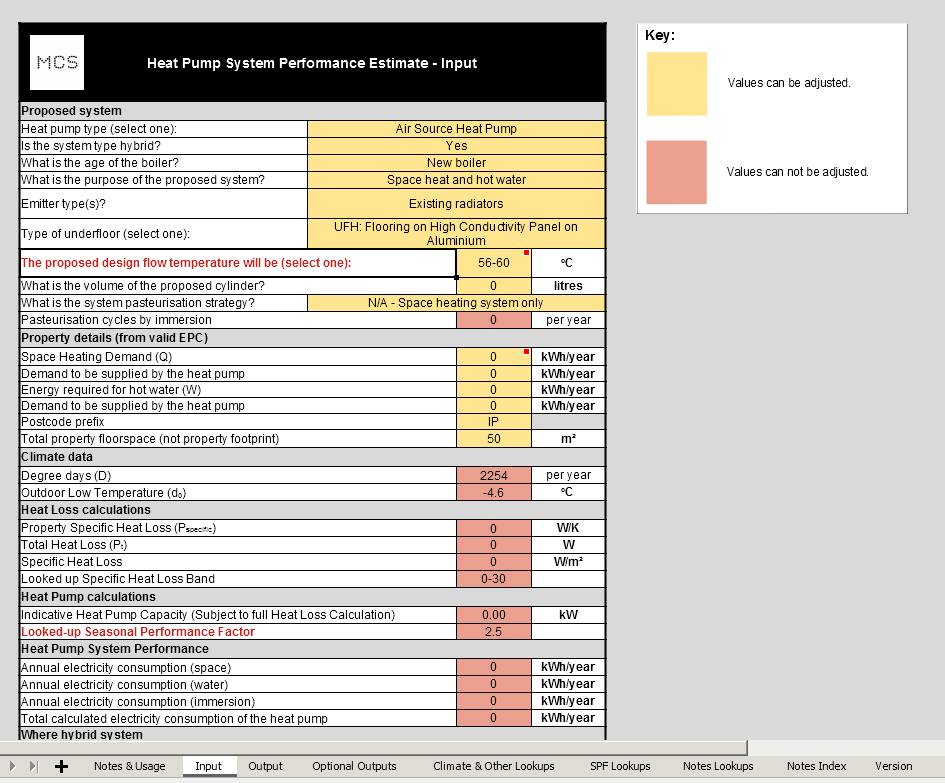
The differences between a SCOP (Seasonal Coefficient of Performance) and a SPF are moot. On paper, the difference is is probably the SCOP is manufacturer/ideal/lab conditions based, while the SPF is 'real world'. But the MCS guidance/spreadsheet uses whatiffery to lookup a generic SPF that does not appear to take into account any 'real world' factors. If the flow temp is X, then the SPF is Y.
Furthermore, the Heat Pump Performance Estimate Standard (MCS 031) guidance (source) says:
4 PRESENTATION FORMAT
The results of the preceding calculation shall be given to the customer using the format given
below along with the Key Information from Section 5.
and that does include the flow temperature (emphasis added in blue highlight):
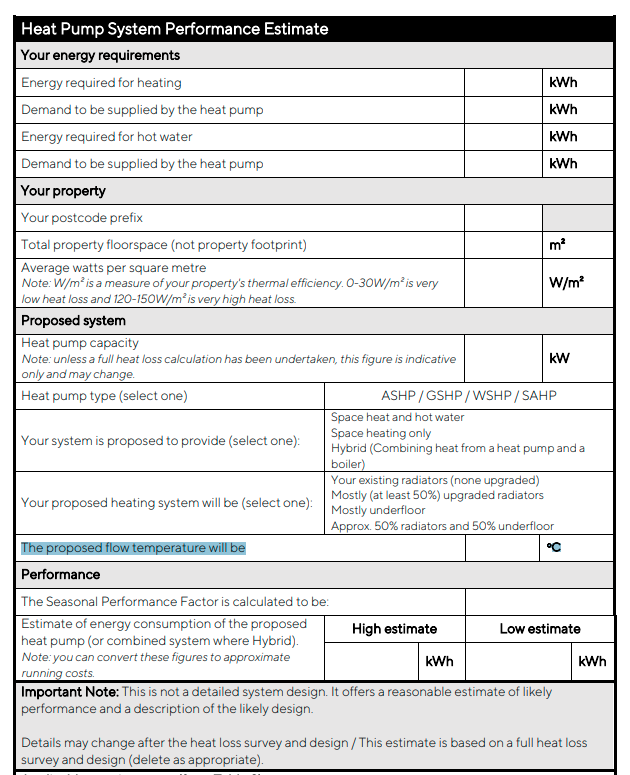
The Key Information in Section 5 just says it is all just a load of whatiffery, without using that word.
Further guidance says the flow temp can be changed should more detailed assessments suggests it should be changed.
Given the above, it seems to me that MCS require the system designer/installer to provide the potential customer with the system flow temperature at an early stage. If Heat Geek do not tell the customer the flow temp at any stage, let alone an early stage, then they are not strictly speaking MCS compliant.
Does that matter? To the deontologist, of course it does. To the consequentialist, perhaps not. However I (and I am primarily a consequentialist, though with occasional deontological tendencies) would insist on knowing the flow temperature, because it is one of they key numbers in any heat pump design. If the designer/installer was coy about it, I would almost certainly look elsewhere. But others may be happy enough with the Heat Geek approach, it's all so very AI so it must be good, mostly they get it right, and in any event it is all covered by their performance guarantee anyway. Isn't it?
Midea 14kW (for now...) ASHP heating both building and DHW

SPONSORS
Degrees of Separation
Latest Posts
-

RE: I need help with Ecodan ASHP
@f1p It turns out there have been a solar panel install...
By Andris , 1 hour ago
-
RE: 15kw pump for 225m2 1990's house - over kill?
@seaviews your installer would be right to say that the...
By GrahamF , 2 hours ago
-
RE: Vaillant ecoTEC Plus - Flow Temp and Set Up
@trebor12345 That curve looks healthy to me. I woul...
By JamesPa , 3 hours ago
-
RE: Tradespeople on Their Phones: What’s Acceptable When They’re Working in Your Home?
Actually, that's a very important point. I've only ev...
By Majordennisbloodnok , 10 hours ago
-
RE: The Changing Jet Stream Could Challenge UK Air Source Heat Pumps
@susannasaunders can I just add to @rob-of-york s comm...
By JamesPa , 13 hours ago
-
RE: Aerotherm and weather compensation
These are likely inked. The basic explanation is tha...
By JamesPa , 13 hours ago
-
RE: Electrical works for air to air heat pump
agree with above. I have not had extra costs added wh...
By Batpred , 14 hours ago
-
Good to hear that you found a solution. Absolutely a...
By Batpred , 15 hours ago
-
RE: Are there any comparisons of DHW heat stores around?
@sarahemmm I have done things the opposite way round I ...
By Toodles , 1 day ago
-
RE: How will removing the standing charge on gas bills benefit heat pumps?
The BUS grant funding for 2026/27 will run out at the c...
By Rob of York , 2 days ago
-
-
RE: Say hello and introduce yourself
@e-a-west as the good Major said, welcome to the forums...
By Mars , 4 days ago
-
RE: How much of your renewable and home setup would still work if the internet went down?
Yes I actually have a copy of a tool that whenever a ce...
By EtchedPixels , 4 days ago
-
RE: Indevolt Batteries UK Support & Info Thread
@editor Hi, To resolve this, please tap on the A...
By Indevolt Tech , 5 days ago
-
RE: Double or Triple Glazed Windows?
Posted by: @singlespeed With 9 years repairing windo...
By Rob of York , 5 days ago


SPONSORS
