

Notifications
Clear all
Joining the Renewable Heating Hub forums is completely free and only takes a minute. By registering you’ll be able to ask questions, join discussions, follow topics you’re interested in, bookmark useful threads and receive notifications when someone replies. Non-registered members also do not have access to our AI features. When choosing your username, please note that it cannot be changed later, so we recommend avoiding brand or product names. Before registering, please take a moment to read the Forum Rules & Terms of Use so we can keep the community helpful, respectful and informative for everyone. Thanks for joining!

Topic starter
19/11/2026 3:17 pm
Introduction & Background
I have a 7kW heat pump, and EV and 4kW peak of solar panels (installed in 2011) and I have been looking at adding a battery to my home for 2 years, but have struggled to get the numbers to work. For sure you can find 16kWh batteries plus inverter on Alibaba for less than £2000, but if you aren’t an electrician and want to do it legally then you will need to involve a professional installer, and the prices then go up a lot, at least in part because professionals want to use particular products which they trust and have support.
I had been more or less resigned to waiting for plug-in to become legal (likely end 2027), but I thought I would give it one final shot. Its proved an interesting exercise which may assist orientating others and illustrating the ‘state’ of the battery installation industry.
The Quotes
I sought quotes from 3 installers listed on the Frogstar site. Frogstar are often quoted as a reasonable benchmark for prices of assembled batteries of known good quality.
The brief I gave was:
“I am seeking a quote for the supply and installation of a ~10kWh battery system, for example the Fogstar Energy 10kWh 48V Battery + 8-12kW Inverter Bundle currently retaining at £3001.
I attach some photos of the CU and the area around, which is in a garage. I will 'clear' the space so you have a straight run at it.
In addition to its main use for time shifting, I would like 'simple' islanding capability (to be quoted as an optional extra) by which I mean:
- Manual switchover acceptable (my time critical devices are already ups-protected)
- Islanding to serve the whole of existing CU, protected from overload (if necessary) by a suitable device; I will switch off devices/circuits if necessary to manage the load
The second bullet is because I do not want to be forced to designate at instal time which devices will run when the grid goes off, which some arrangements force you to do.
There is an existing 4kWp (3.68kW output limit) PV system which is to be AC coupled and is to continue working in island mode.”
I received three quotes summarised in the table below. For comparison I have also included the current price (excluding installation) of a system based on the Indevolt products. These are designed to be ‘plug-in’ but, until that becomes legal (expected late 2027) will need to be professionally installed, albeit that the installation should be fairly simple. However it is, for me, the benchmark for which I will wait if necessary. Of course a plug in system cannot provide whole house backup or charge from AC-coupled solar panels in a power cut; off-grid working is limited to a socket on the rear and whatever charge is present at the time the grid goes down.
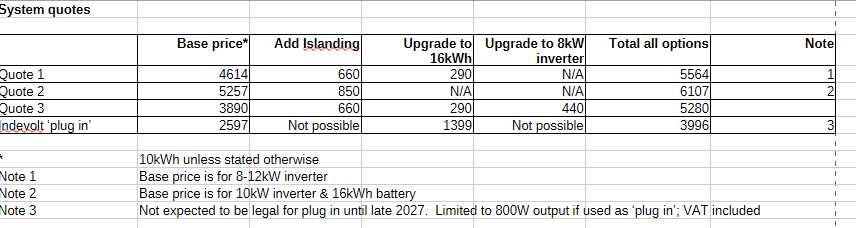
More detail of the specs, in which there are some interesting features, is appended at the end of the post.
Projected Savings
I also have a model of savings. This is based on 10 months of half hour meter readings Jan-October 2026; I assume (until I have actual data) that Nov-Dec is near enough the same as Jan-Feb so can estimate annual figures from this. The model is actually a battery simulator: for each half hour period it either ‘discharges’ or ‘charges’ the battery according to the state of charge and tariff, which allows me to calculate the ‘adjusted’ import and export figures. Arbitrage is not modelled, its pure time shifting. The results, which are based on Octopus Intelligent Go and include import costs and export compensation but NOT legacy FIT payments (which are not affected because they are based on generation not export) are as follows:
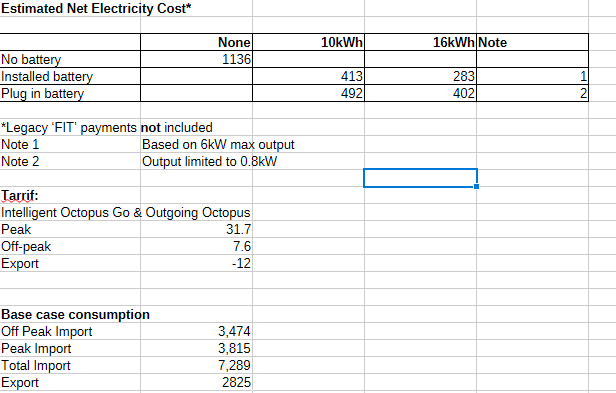
The model will very slightly overestimate the saving for the ‘plug-in’ system because it relies on comparing the maximum output power with the average power over a half hourly period, thus ignoring peaks with which the plug in device cannot cope. I don’t think this makes a massive difference for someone with a heat pump however, there is little energy in most of the peaks and much of the time the energy that the model incorrectly predicts will be discharged will in reality be discharged later in the day, when the model predicts that the battery is exhausted. I have tested this by adjusting the input limit and this test seems to confirm my hypothesis.
With this reservation it is notable that the output capacity limit of the plug-in device doesn’t make a big difference, which is what I would intuitively think given the load pattern (again provided that you have a heat pump)
Business case
For batteries I like to look at the business case, albeit that there are reasons other than pure finances to invest in them. For example its certainly possible that by time shifting consumption your electricity is greener, although the figures on this seem obfuscated. At the same time there are legitimate concerns about the source of the minerals used in most batteries.
My starting point to assess the business case is to look at the lowest quoted system price, subject of course to it coming with a satisfactory spec and having some confidence in the installer, and look at how long it takes to pay back at current electricity prices. Any such calculation is highly speculative, electricity prices change all the time and anyone who can predict future tariffs has career options not open to ordinary mortals, however there is not much else to go on!
In calculating payback I have allowed for the ‘cost of capital’. To do this I have assumed that the money to pay for a system is taken from savings earning 4% interest which is taxed at 20%.
The figures for my house, based on the tarfifs and consumption set out above, are as follows:
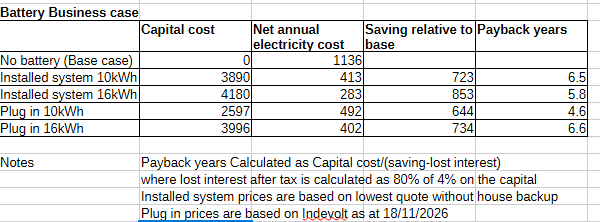
Based on this calculation the case for the 10kWh ‘plug-in’ system looks fairly compelling. the 16kWh ‘plug-in’ much less so, because of the high cost of the add on modules. However, given that, at the time of writing (November 2026), plug in is not expected to be legal for another year at least, the payback date is very similar to a 16kWh installed system bought now, which is a worthwhile consideration. Put simply the lowest price installed system if installed now is, arguably, on a par financially with a plug-in system for which one will have to wait another year. For me this is an interesting conclusion.
Whole House Backup
The relative small cost (£650-£850) of adding backup is another notable feature. In my earlier attempts to get a quote I have found that backup is quoted only with the very high end systems, such as Tesla Powerwall. However there may be a distortion in play; my consumer unit is not compliant with the very latest regulations (principally because it has a plastic case). The lowest price installer tells me that, if I opt for backup, it will not need to be replaced because he wont need to work on it (instead installing a "gateway" between incoming mains and the exiting CU, whereas if I do not not for backup it will need to be replaced because it will need to be worked on. The gateway, incidentally, is essentially a packaged prebuilt CU with an automatic transfer switch and various breakers/protection devices
Alternative approaches
There are at least two alternative approaches to the mainstream ones of ‘installed system’ vs plug in. These are:
Partial DiY – for example getting a regular electrician to do the work that must be done by a qualified person and doing various levels of configuration/assembly/fixing yourself
Installed ‘plug-in’ – buying one of the ‘plug in’ devices now and having it fitted by a ‘regular electrician’
I have not sought quotes these options, the second may well be attractive depending on what electrical arrangements the electrician deems necessary.
Conclusion
For me this has been an interesting exercise. Up until now I have been unable to make the business case for installed batteries work, given all the uncertainties. This ‘time’, because of keener quotes and increased battery capacity, perhaps I can, at least if I accept the lowest price quote. That said plug in, when it is available in (probably) 12 months time, makes a compelling case as an alternative, provided that whole house backup is not required. The higher quotes received for installed systems look well out of the question.
At the time of writing I am still working through some detail and have not decided whether to proceed or not but this is the first time I have been seriously tempted. Perhaps I will receive some comments which will help.
Quote details
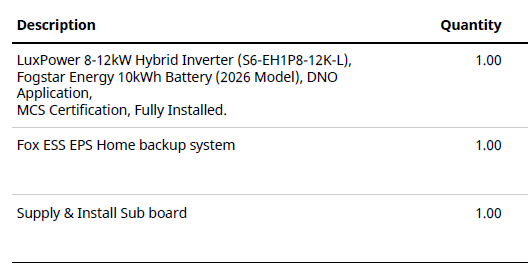
The detail of the quotes, to the extent that they have been provided, is summarised below. There are outstanding questions in all cases, but I do not intend to waste the time of installers with further questions until I have made the decision, in principle, to proceed.
Quote 1
Quote 2
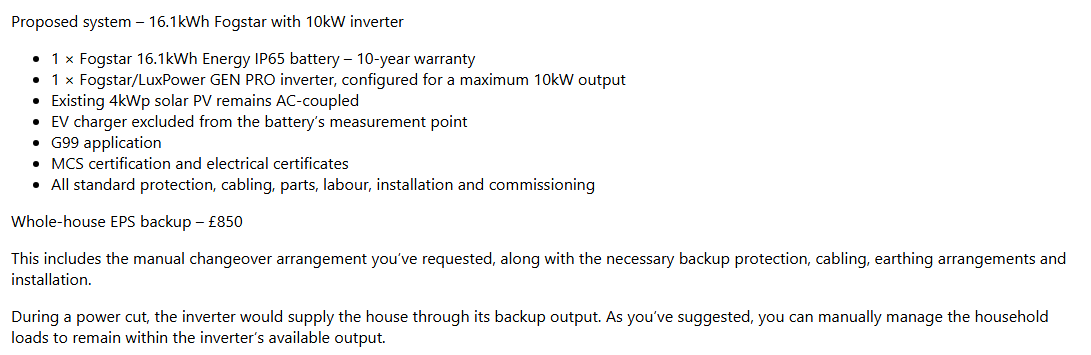
Quote 3
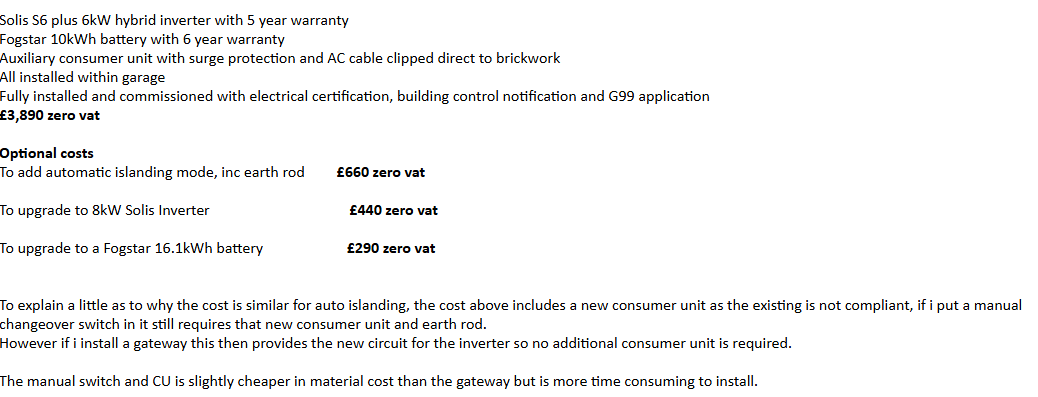
The Installation site
In case anyone is interested, here is a picture of the probable installation site, in a garage adjacent to the CU. As you can see its a pretty clear space thats available, so it should be an easy install.
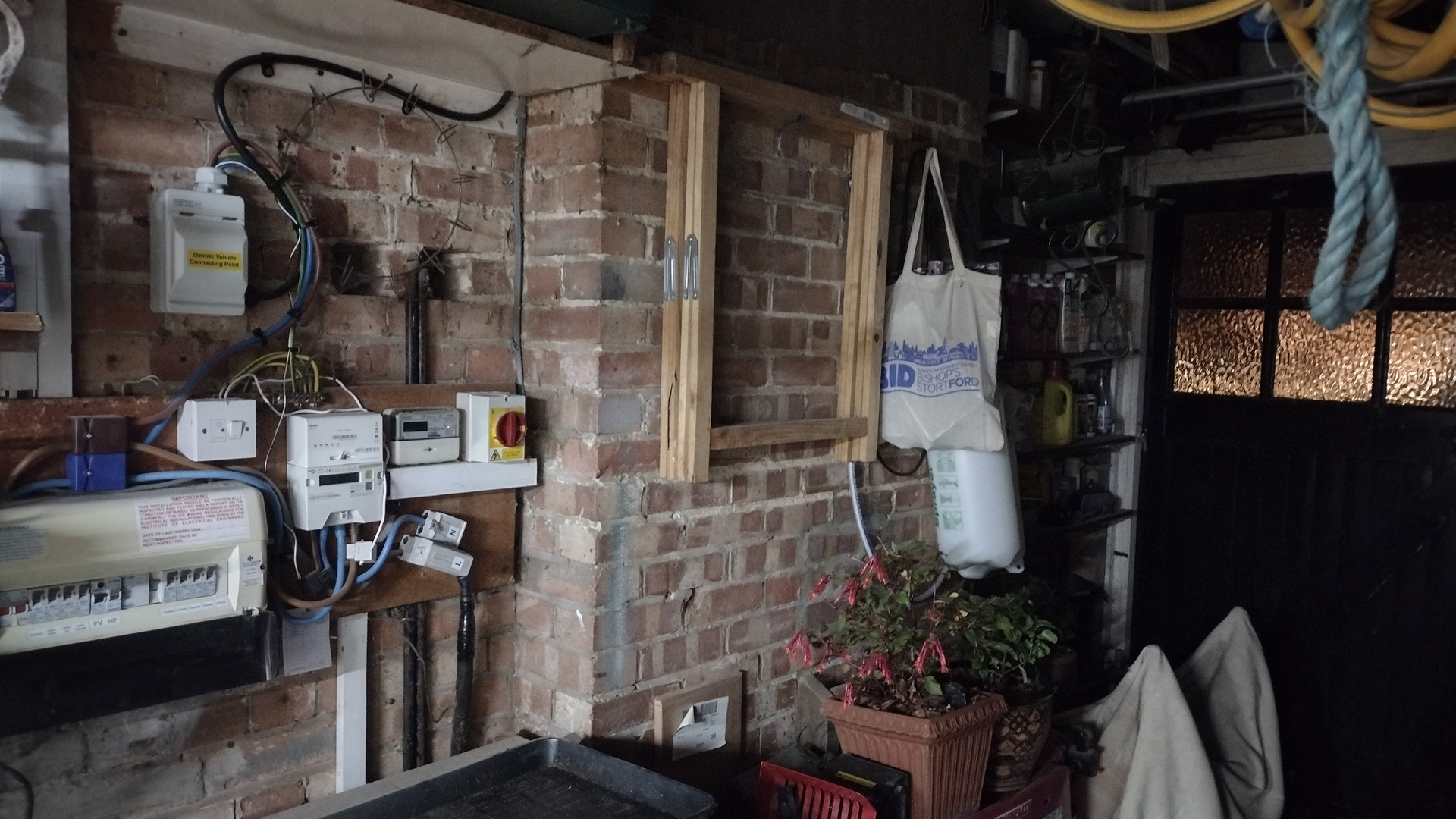
This topic was modified 2 hours ago 8 times by JamesPa
4kW peak of solar PV since 2011; EV and a 1930s house which has been partially renovated to improve its efficiency. 7kW Vaillant heat pump.

19/11/2026 3:54 pm
Something worth noting is that in quote 3 the 10kWh Fogstar battery is IP rated and therefore able to be installed outside whereas I'm fairly sure the £290 uplift would be to the non-IP rated 16kWh battery which could not. This is unlikely to be an issue for you if you decide to install in the garage, but worth bearing in mind if there is any likelihood you might choose to install on the external face of one of your garage's walls.
I mention because my preference is for an external install - all other things being equal - since as well as moving any potential fire risk (low though it may be) outside it also puts the battery and inverter somewhere with enough ventilation that the chances of any overheating in hot weather are minimised. I believe there is also an ISO standard which an external install complies with, but I'm also aware it's not a mandatory standard. @transparent would know more.
That said, I'm certainly not militant about external installs and a well ventilated garage would certainly allow you to take advantage of the slight reduction in costs associated with non-IP rated kit.
105 m2 bungalow in South East England
Mitsubishi Ecodan 8.5 kW air source heat pump
18 x 360W solar panels
1 x 6 kW GroWatt battery and SPH5000 inverter
1 x Myenergi Zappi
1 x VW ID3
Home Assistant to make it all play nicely together
Raised beds for home-grown veg and chickens for eggs
"Semper in excretia; sumus solum profundum variat"
Topic starter
19/11/2026 4:01 pm
Something worth noting is that in quote 3 the 10kWh Fogstar battery is IP rated and therefore able to be installed outside whereas I'm fairly sure the £290 uplift would be to the non-IP rated 16kWh battery which could not.
You are right. The 16kWh battery is also floor standing not wall mounted which makes it a little less convenient to place, but not impossible.
4kW peak of solar PV since 2011; EV and a 1930s house which has been partially renovated to improve its efficiency. 7kW Vaillant heat pump.

1

19/11/2026 5:06 pm
I'm going to post this information for others who may not know whilst I suspect you probably do James.
I'd say a 6kW inverter is too small and I am recommending to people who might be interested to get a minimum 8kW. This is really due to the load that can be generated when high power devices run together, e.g. ASHP, oven turned on, hob turned on etc.. Some of these are "peak" high usage and settle down but it's worth consideration if you want to avoid grid draw. I get the impression that some installers size these based on PV sizing and export allowance because in-the-main it will probably be alright but it's not much more expensive to actually cover your load.
The main consideration I had with islanding was how much to leave in the battery for resilience - how long would I want it to be able to power the house for? That becomes a baseline discharge level OR you take the risk. That baseline cuts down the actual battery size you have for powering the house during the peak rate period. If you need to save 5kW for an emergency, you really have the equivalent of 2 x 5kW battery, one of which is kept in reserve.
The plug in batteries that are coming out now are going to be limited to 800W supply to the house which almost certainly won't provide the power you need for an ASHP plus other devices so this route is going to require you to turn off devices - almost certainly forego heating given it will peak at more than that and when not, consuming a big chunk of it. Additionally, you need to be careful on their output capacity if you plug anything in to them (they can work both ways) as it gets quite expensive for models that can cope with 3kW instant loading (kettle etc.) I wouldn't consider the plug-in route as a viable house support in a power cut, more of a backup of last resort and thus the financials probably don't stack up unless you go camping or caravanning etc.
The main months you should consider for battery running out are December - February. With a 10kW battery and 4kW PV you'll likely get some depletion in October and March but a lot less than other months. November will drain on quite a few days and you might consider the whole month for caution but last year and so far this year November is a lot better than January and February. At the worst I guess that puts your model on somewhat of a pessimistic footing so if the financials work there's a good chance it will be better. Here's my actual breakdown, in kWh:
Nov 25: 43.40
Dec 25: 93.76
Jan 26: 186.98
Feb 26: 60.10
Mar 26: 2.53
It's worth remembering that my Cosy is running thermostatically so would spend periods of time not drawing any energy when the room was up to temp. I had the thermostat in the highest heat loss room.
I run 10kW PV plus 16kW battery with a typical 0.5kW background load plus the Cosy 9 and an EV on Octopus Intelligent Go. Last year (June 25 to June 26), I spent £110 on peak rate electricity so about £80 more than I would have done running purely on off-peak. That £110 would have cost around £30 in off-peak units if I wanted to cover all my peak rate with battery capacity. That additional capacity would have come in at around £5k early this year but probably a bit cheaper now - in any case, not worth it to save around £80. Islanding would have cost me an extra £1k and would have necessitated additional storage, say an extra 8kW, at a cost of an additional £2.5k. In Milton Keynes all our power lines are underground and in the 36 years I've lived here I can't recall any unplanned cuts. I couldn't justify the additional spend.
I don't know the actual building regs for a consumer unit upgrade in this scenario but it's probably worth doing anyway.

