

Notifications
Clear all
Joining the Renewable Heating Hub forums is completely free and only takes a minute. By registering you’ll be able to ask questions, join discussions, follow topics you’re interested in, bookmark useful threads and receive notifications when someone replies. Non-registered members also do not have access to our AI features. When choosing your username, please note that it cannot be changed later, so we recommend avoiding brand or product names. Before registering, please take a moment to read the Forum Rules & Terms of Use so we can keep the community helpful, respectful and informative for everyone. Thanks for joining!

18/04/2026 10:06 am
Thanks for the update, it'll be good to read more, especially after a Winter of course.

19/04/2026 7:37 am
On the subject of whether to keep an existing DHW cylinder...
We kept our existing cylinder in a recent HG zd install. It is a 120l copper vented cylinder probably dating from the 80's, with a small coil. Replacing this with a new unvented one would have been a total pain in the ar... as there is no viable route to run the drain pipe without major disruption. We could have had a new cylinder but plumbed as vented, but it was hard to justify the cost.
Our 7kW Vaillant heats this up to 50 C in about on hour from cold, and could get it hotter if I wanted. The flow temp though goes up to 65C and the COP for the hw is poor at about 2. It is totally silent while doing this. The only noise is the diverter valve humming for a few seconds at each on the DHW cycle.
A cylinder with a larger coil would not necessarily reheat the tank any faster, but would do so at a lower flow temp and better COP.
I have an Eddie too, which on a sunny day will boost the HW up to 60 c, but the HP alone is perfectly capable of meeting our HW needs.
We are two adults, who shower once a day and rarely use the bath.
2

Topic starter
19/04/2026 8:19 am
@martinrobinson I thought about getting a new cylinder but, as you say, even with my dodgy ‘man maths’, I couldn’t justify it. My present cylinder is only 8 years old and it is well insulated. Running the heat pump HW cycle once a day provides us with enough hot water with power usage of 0.5 to 1kWh/ day.
A new cylinder would have been an additional £1900. Prior to getting the heat pump, I was reheating the cylinder via the immersion heater on an EV tariff at a cost of less than £100 per year. If I stuck with this, I would be looking at a 19 year payback period. Reheating my present cylinder should cost c.£50 per year which undermines the business case even more.
I may be missing something but I wonder whether the pursuit of a high CH and DHW SCOP has muddled some people’s thinking? I would have thought that it is just the CH SCOP that really matters.
I have just noticed that my installer has tweaked my curve down to 0.2 as I awoke this morning to find that both the set and target temperatures were at 20C with at OAT of 4C. The house was running at 1C above the target temperature for the past couple of days.

19/04/2026 8:20 am
@martinrobinson you’ve addressed all of the key issues about changing the cylinder. We concluded that we could live with the slower heat up time (but only just, because it was a 200l one) and COP but not the potential for noise. In our case the noise was critical since the airing cupboard is in our bedroom.
The key is to make the right decision for your circumstances which means understanding it well (time for the learning curve) or trusting the installer, (I can rarely do that, a personal quirk).
2kW + Growatt & 4kW +Sunnyboy PV on south-facing roof Solar thermal. 9.5kWh Givenergy battery with AC3. MVHR. Vaillant 7kW ASHP (very pleased with SCOP >4) open system operating on WC
1

19/04/2026 8:41 am
@judith what potential for noise? Why this idea that an old cylinder would be noisier then a new one?
19/04/2026 1:05 pm
It’s the flow through the pipe. If the pump is trying to push more through into the cylinder than the diameter allows then it can “sing”. I probably should have done the calculations but didn’t (yes lazy) since the cylinder was also probably covered in limescale in our area, because we skipped the water softener in our initial house refurbishment.
2kW + Growatt & 4kW +Sunnyboy PV on south-facing roof Solar thermal. 9.5kWh Givenergy battery with AC3. MVHR. Vaillant 7kW ASHP (very pleased with SCOP >4) open system operating on WC

19/04/2026 3:26 pm
@judith what potential for noise? Why this idea that an old cylinder would be noisier then a new one?
Where this goes wrong is when you need 32l/pm on a larger heat pump verses 15l/pm on a smaller heat pump, there is usually little noise when connected to a 4, 5,6 or 7kW but as you start to go above this it gets a bit of noise coming through, some companies plate the cylinders.
The thing to remember is that ASHP tend to run full power when in DHW mode, its like running it on a fixed speed but not quite, its looking to get the heat in as quickly and efficiently as possible so its runs it pump often at full speed.
AAC Group Ltd covering the Kent Area for design, supply and installation of ASHP systems, service and maintenance, diagnostics and repairs.

20/04/2026 7:00 pm
If you have the info (and assuming the house is heated) take your annual gas consumption in kWh and divide it by 2000h. Separately divide it by 3000h. The loss is very likely somewhere in between. So for example my gas consumption was 18,000-20,000kWh, divide by 2000h and you get 9kW, divide by 3000h and you get 6kW. The actual measured loss is 7kW. For oil just assume 10kWh/l and do the same calculation. If the survey result isnt in this bracket, it should be interrogated.
I just tried this and got 7.2kW on the HG site. Using our gas consumption, based on the last 2 years, I get 4.17 - 6.26 kW. It seems that we can cope with a 5kW pump?
I put the higher HG estimate down to the very conservative epc we had after we completed through insulation of our home. Anything the surveyor could not see, he assumed the worst, despite me telling him we had personally made sure the insulation was in fact installed...
8kW Solis S6-EH1P8K-L-PLUS hybrid inverter; G99: 8kW export; 16kWh Seplos Fogstar battery; Ohme Home Pro EV charger; Vaillant Arotherm Pro 7kW; 100Amp head, HA lab on mini PC


20/04/2026 8:04 pm
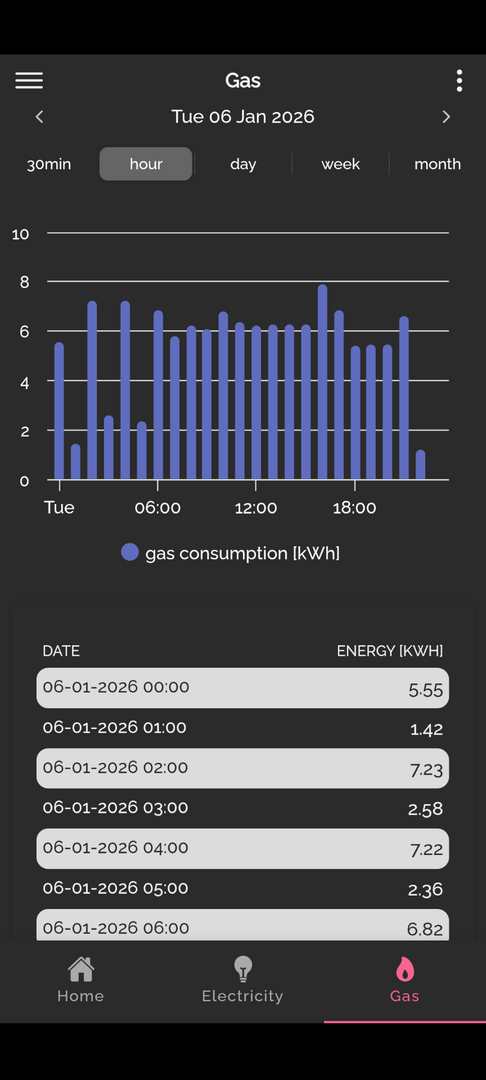
Another option is to get your energy consumption data from the bright app and turn your gas boiler down to 45c flow temp (although that'll be a little trickier now it's warmer).
I did this last year and it proved to be very useful confirming our heat loss at cold temperatures was about 5-6kwh, pretty much bang on our surveyors calculation.

20/04/2026 8:14 pm
Anything the surveyor could not see, he assumed the worst, despite me telling him we had personally made sure the insulation was in fact installed
Exact same for me in my 'first round', plus double counting room to room losses.
That's why I ended up telling prospective installers what my measured loss was and making it clear that, if they weren't prepared to find a way to come to a broadly similar conclusion using their gigo spreadsheets, I wasn't prepared to purchase from them (I didn't actually mention gigo spreadsheets of course). Do you have access to more detailed consumption figures, if so you can do a more detailed (and thus more conclusive) analysis.
This post was modified 6 months ago 5 times by JamesPa
4kW peak of solar PV since 2011; EV and a 1930s house which has been partially renovated to improve its efficiency. 7kW Vaillant heat pump.
20/04/2026 8:26 pm
This was our gas data on a cold day running the boiler 24/7 at 21c with a 1c setback over night and 45c flow temp.
It was very useful, as it also confirmed the cold spots in the house where I knew I'd definitely need more heat with bigger emitters.
20/04/2026 8:42 pm
Thanks guys.
I was referring to the epc surveyor.
We have not yet entered the paid ASHP survey stage, but it is great to have a good basis to steer it in the right direction.
What makes the 5 kW Vaillant attractive to us is that it seems to be able to deliver almost as much as the 7 and it modulates to lower power. Which should reduce the cycling in warm weather.
This post was modified 6 months ago by Batpred
8kW Solis S6-EH1P8K-L-PLUS hybrid inverter; G99: 8kW export; 16kWh Seplos Fogstar battery; Ohme Home Pro EV charger; Vaillant Arotherm Pro 7kW; 100Amp head, HA lab on mini PC
SPONSORS

Degrees of Separation

Latest Posts
-

RE: Heat pump branding. Clever, contemporary… or a bit too much?
I think Heat Geek have done an amazing job on their bra...
By Tomtheheatingengineer , 5 hours ago
-
RE: HeatGeek vs Octopus surveys: puzzling disparity - any ideas why?
I have just had 3 heat loss surveys, one by heat geek o...
By David , 5 hours ago
-
RE: Heat Geek Zero Disrupt: Are We Sleepwalking Into Another Race to the Bottom?
I think that's the key question. After all inverter uni...
By Prunus , 7 hours ago
-
RE: battery storage without solar
As of October 1st they need specific qualifications to ...
By EtchedPixels , 8 hours ago
-
RE: How should the Boiler Upgrade Scheme be reformed?
A unit which uses water to transfer the heat/chill from...
By Temperature_Gradient , 8 hours ago
-
RE: Renewables & Heat Pumps in the News
With regards to the BUS grant raid, I gave it more thou...
By ASHP-BOBBA , 8 hours ago
-
RE: Why are ASHP installs so expensive?
The whole system seems to work on the basis of...
By ian33a , 9 hours ago
-
RE: Missing flow temperature in Heat Geek proposal
Good plan. If you can get half hourly meter readings a...
By JamesPa , 14 hours ago
-
RE: Heat Pumps Without Grants: Would You Have Installed One & Will You Now?
@editor Most certainly. The heat pump was an ideal s...
By Abernyte , 14 hours ago
-
Although regulations may well vary from country to coun...
By Majordennisbloodnok , 14 hours ago
-
RE: Does anyone have experience of a smart water meter?
Yep I caught our slow leak from a £100 bill rise 8)
By EtchedPixels , 14 hours ago
-
RE: Do You Need a Buffer Tank or Low Loss Header for Underfloor Heating in a Large Property?
@jamespa in some cases, failing the Turing test might b...
By GrahamF , 18 hours ago
-
RE: Passiv Smart Thermostat - Help & Forum Support
@energystoragetech The heat capacity of some...
By JamesPa , 19 hours ago
-
RE: tepeo ZEB UK Support & Info Thread
Sorry you are correct, I was remembering figures from t...
By JamesPa , 1 day ago




SPONSORS
