

Notifications
Clear all
Joining the Renewable Heating Hub forums is completely free and only takes a minute. By registering you’ll be able to ask questions, join discussions, follow topics you’re interested in, bookmark useful threads and receive notifications when someone replies. Non-registered members also do not have access to our AI features. When choosing your username, please note that it cannot be changed later, so we recommend avoiding brand or product names. Before registering, please take a moment to read the Forum Rules & Terms of Use so we can keep the community helpful, respectful and informative for everyone. Thanks for joining!

Topic starter
29/07/2026 7:35 pm
All, thank you for your constructive and helpful comments.
One thing I need to correct is the thought that Heat Geek are looking to downgrade 2 radiators. I don't believe this is the case - they are saying to upgrade at least 2 bedrooms from single to double panel units, my added puzzlement being that the existing units are already above the heat loss for the rooms. Octopus suggest nothing upstairs but propose downstairs upgrades, which difference is the basis of my query here.
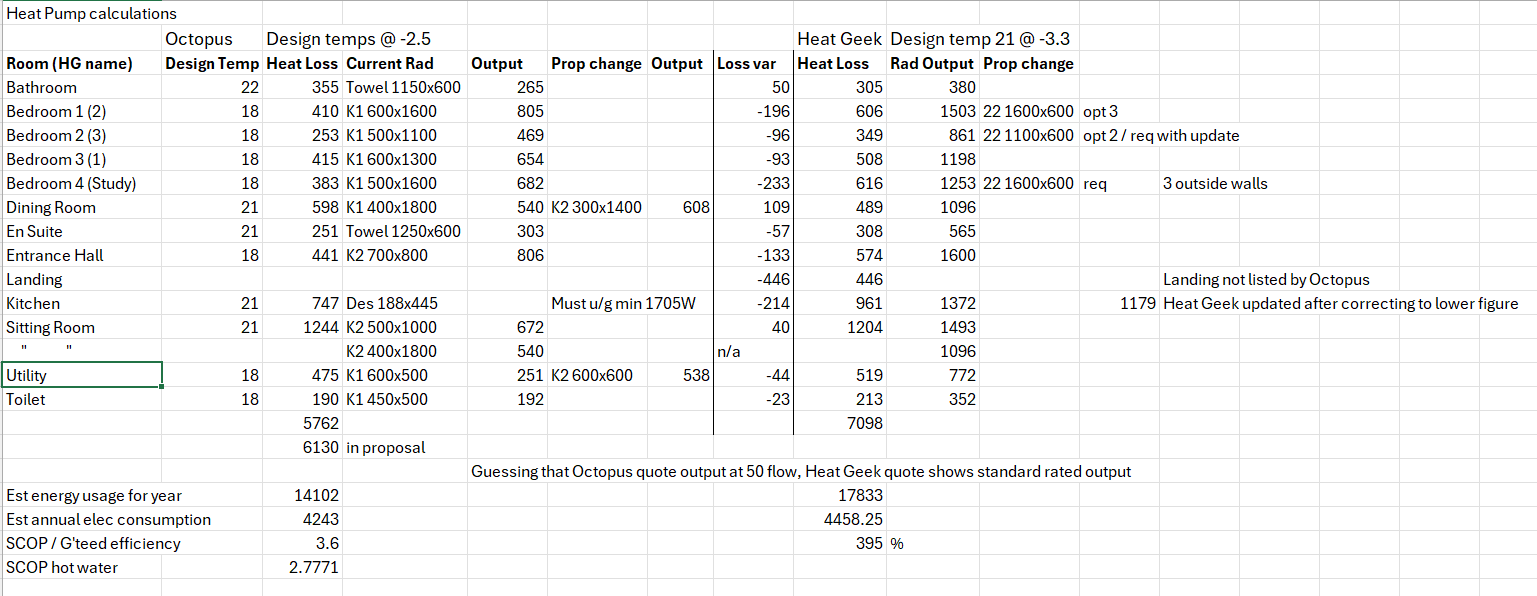
FYI I have put the respective Octopus and Heat Geek measurements and suggested changes into a spreadsheet and attach a screen shot so you can see the figures.
The Heat Geek figures do refer to 2 calculations, because their initial one overstated the output of the kitchen designer radiator. On recalculating with the corrected, lower, figure for the kitchen their outcome changed to a requirement to upgrade 2 rather than 1 bedroom radiators (2nd and 3rd bedroom upgrades were originally optional).
PS: just noted an error in the chart - kitchen radiator is 1800x445, not 188x445
This post was modified 3 months ago 3 times by baroquebank
29/07/2026 7:49 pm
One thing I need to correct is the thought that Heat Geek are looking to downgrade 2 radiators. I don't believe this is the case - they are saying to upgrade 2 bedrooms from single to double panel units, my added puzzlement being that the existing units are already above the heat loss for the rooms.
Mea culpa, I was the one that started the downgrade myth, in my post at 8:47am yesterday, apologies for that.
The side by side comparison is useful, one thing I have noticed straight away is the design outside air temps are different, -2.5 vs -3.3°C and that will make a difference. I will look in more detail at the rest of the numbers, probably sometime tomorrow morning, and post back, unless someone else gets there first!
Midea 14kW (for now...) ASHP heating both building and DHW
1

29/07/2026 9:51 pm
..... Post deleted, but website won't let me!
This post was modified 3 months ago 4 times by JamesPa
4kW peak of solar PV since 2011; EV and a 1930s house which has been partially renovated to improve its efficiency. 7kW Vaillant heat pump.

30/07/2026 7:37 am
HeatGeek - we must upgrade 2 upstairs bedroom radiators, both in rooms where the calculation shows existing radiators exceed heat loss
Octopus - we must replace 2 downstairs radiators, both in rooms where I do feel current radiators are marginal. Indeed one of these, in the kitchen, Octopus are saying must be significantly upgraded (or I must provide an additional heat source) in order to qualify for the government grant.
Having just had an install by HG which i am very happy with, I gave you say I was not impressed with their heat loss calculations. Given the survey data is sent to their central servers, the surveyor is not given much info to try to explain it as well. In my case they had massive ventilation losses that are apparently assumed for a property of our age.
The key thing for us was to change the rads we knew were struggling (as we had the gas boiler working at 45-50C). This should mean we do not need to push our pump to a higher flow temperature (lower scop) just because of a poorly sized rad. So if you go with HG, you may want to upgrade the rad capacity in the kitchen anyway.
octopus was not an option for us as they would not wall mount the pump nor install on a flat roof. They have stricter requirements but given the more standard design, if it works in the property it can be the most cost effective solution.
8kW Solis S6-EH1P8K-L-PLUS hybrid inverter; G99: 8kW export; 16kWh Seplos Fogstar battery; Ohme Home Pro EV charger; Vaillant Arotherm Pro 7kW; 100Amp head, HA lab on mini PC

30/07/2026 9:33 am
@baroquebank — I have now had a look at the side by side Octopus/Heat Geek numbers. Some observations and comments:
1. As you have already noted, the Heat Geek (HG) room heat loss estimates are generally but not always higher than the Octopus (OP) ones, sometimes considerably so.
2. The OP rad output numbers appear to be for a rad/room delta t of around 30°C, ie a flow temp of around 50° with rooms at around 20°. It just so happens the correction factor from a delta t of 50 to 30 is give or take 50%, or in simple English, the output is halved. Thus a rad with an output of 1200W at a delta t of 50 will have an output of 600W at a delta t 30.
3. The HG rad outputs appear to be closer to the room/rad delta t 50 numbers, but with considerable variation. For example, a typical K1 600x1300 (Bedroom 3 (1)) had a delta t 50 output of around 1260W (Ultraheat catalogue), HG has the output as 1198W. OP on the other hand give the output as 654W ie close to the delta 30 value. Furthermore, if you sum all the HG proposed rad outputs, they come to 13,348W, way way over the actual heat loss. Have they even quoted the rad outputs at a room/rad delta t of 30? The same total output number for the OP proposal is 6534W, much more in line with their actual heat loss estimate.
My hunch is the HG quote is the one that is out, but to confirm or refute that (and indeed check the OP and any other quote you get) you need to do your own checks. It's the only way. Use a spreadsheet based heat loss calculator (the Freedom Heat Pumps one is widely available see this link on the forum, it is still whatiffery but better than using a random number generator which is what some installers appear to use) and double check a few rooms. Then get the radiator catalogue for the relevant brand(s) of radiators in your proposals and double check the outputs (one column for the output at delta t of 50, then a column with corrected values for a delta t of 30 (or whatever it is). The Stelrad correction factors are available here, others will be very similar. It should then become clearer if not entirely clear which if any of the design proposals makes sense.
Midea 14kW (for now...) ASHP heating both building and DHW
1
30/07/2026 11:12 am
3. The HG rad outputs appear to be closer to the room/rad delta t 50 numbers, but with considerable variation. For example, a typical K1 600x1300 (Bedroom 3 (1)) had a delta t 50 output of around 1260W (Ultraheat catalogue), HG has the output as 1198W. OP on the other hand give the output as 654W ie close to the delta 30 value.
We selected and bought most of the rads. Most were fit by our usual plumber, and one by our heat geek.
The HG quotation process appears to be very inflexible, but our experience was that, with the right installer (you can choose one not local to you), much can be adjusted.
Not even worth me going into the details and the back and forth on the hot water cylinder sizing and choice of model! As we were particularly restricted in terms of space.
8kW Solis S6-EH1P8K-L-PLUS hybrid inverter; G99: 8kW export; 16kWh Seplos Fogstar battery; Ohme Home Pro EV charger; Vaillant Arotherm Pro 7kW; 100Amp head, HA lab on mini PC
Topic starter
30/07/2026 5:32 pm
2. The OP rad output numbers appear to be for a rad/room delta t of around 30°C, ie a flow temp of around 50° with rooms at around 20°. It just so happens the correction factor from a delta t of 50 to 30 is give or take 50%, or in simple English, the output is halved. Thus a rad with an output of 1200W at a delta t of 50 will have an output of 600W at a delta t 30.
3. The HG rad outputs appear to be closer to the room/rad delta t 50 numbers, but with considerable variation. For example, a typical K1 600x1300 (Bedroom 3 (1)) had a delta t 50 output of around 1260W (Ultraheat catalogue), HG has the output as 1198W. OP on the other hand give the output as 654W ie close to the delta 30 value. Furthermore, if you sum all the HG proposed rad outputs, they come to 13,348W, way way over the actual heat loss. Have they even quoted the rad outputs at a room/rad delta t of 30?
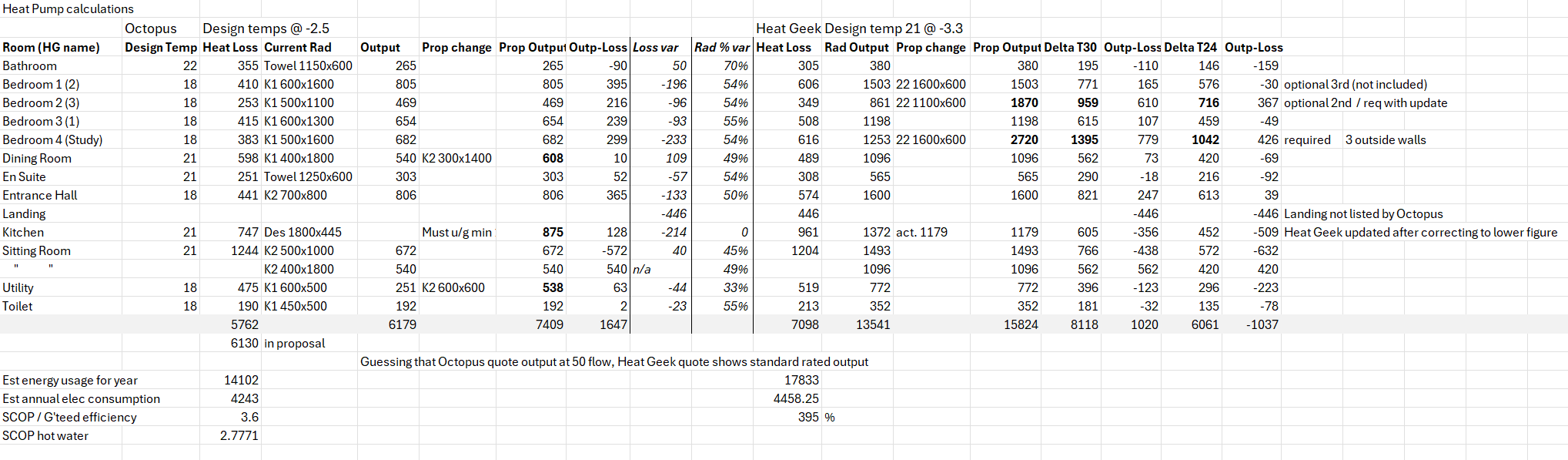
Thanks again, this is very informative. Based on this info I've extended my calculation (note, not gone into full details but broadly to test thinking) which then shows:
a: HeatGeek and Octopus values for current radiators vary considerably
b: HeatGeek calculations fit a delta 30 model but if that drops to say delta 24 (design flow temp is 45) then the solution falls significantly short. I doubt that is their intention, so assumptions in my spreadsheet are presumably wrong.
c: Whatever HeatGeek values I use end up with upgraded upstairs bedrooms significantly exceeding their heat loss and the kitchen and utility room radiators falling well below the heat loss.
This last (c:) is the core of my concern: why do I have a proposal which apparently leaves the kitchen significantly under-heated and bedrooms over-heated (in direct contrast to the Octopus proposal). Can both be right?
This is my updated spreadsheet...
This post was modified 3 months ago by baroquebank
30/07/2026 6:40 pm
@baroquebank — some more comments on the latest version of your spreadsheet:
a: HeatGeek and Octopus values for current radiators vary considerably
This tells us that either one (or possibly both) are wrong.
b: HeatGeek calculations fit a delta 30 model but if that drops to say delta 24 (design flow temp is 45) then the solution falls significantly short. I doubt that is their intention, so assumptions in my spreadsheet are presumably wrong.
The Heat Geek Prop Output numbers are almost certainly very wrong, but I don't think they are using a rad/room delta t of 30 or 24. Compare OP Prop Output values with corresponding HG Prop Output, the latter are much higher, and the total is almost double the OP total. This suggests they are not using a lower delta t and have not applied a lower delta t correction factor to the rad outputs (or if the have, it is detailed somewhere else). If you are not sure what this is all about, run through the principles again, but it is basically a lower rad/room delta t means, as you would expect, a lower output. The correction factor quantifies that. I think you probably do get it, because I think that is what you have done in the right-most columns.
c: Whatever HeatGeek values I use end up with upgraded upstairs bedrooms significantly exceeding their heat loss and the kitchen and utility room radiators falling well below the heat loss.
This last (c:) is the core of my concern: why do I have a proposal which apparently leaves the kitchen significantly under-heated and bedrooms over-heated (in direct contrast to the Octopus proposal). Can both be right?
Can both be right? No! But Octopus might be.
To get to the bottom of this you need to:
(1) do some room heat loss calculations of your own, to verify the the heat losses. Ideally all rooms, but even a few will tell you whether each installer is probably OK, or definitely not OK. My guess is the HG ones will be considerably out. The process is tedious and boring, but not complicated.
(2) some of this you have already done - for each installer, for each room, have a column for the heat loss, a column for the proposed rad (be it new or unchanged), a column for the rads delta t 50 output (which you must get from the manufacturer's catalogue, the installer may have pulled up some random numbers) and then a column for the lower delta t output. Do this by putting the correction factor in a separate cell, and then multiply the delta t 50 value by the correction factor, that way you can easily change the correction factor and see the effect. Then all you need to do is make sure the corrected rad outputs are a bit above the room's heat loss. If you are feeling fancy, you can use conditional formatting to have OK values (say 1.1 x the heat loss values) show as green, and anything less show as red.
It would also be helpful if you post the spreadsheet itself (as an xls file) as well as the image, at the moment I have to OCR the image to get the data in a form I can do something with.
Midea 14kW (for now...) ASHP heating both building and DHW
1

Topic starter
31/07/2026 3:44 pm
@cathoderay thanks again. I'm not someone who spends a lot of time on discussion groups so not sure of the protocols which is why I'd posted screen grabs of the spreadsheet rather than the thing itself. More than happy to share it, attached.
Re the heat loss calculations, I will have a look at that over the weekend as you suggest, beginning with the most significant divergences. Meanwhile I've added a column looking at the % difference between the assessments. Most are within ~25% which doesn't feel so unreasonable to me. I note that the 3 bedroom radiator upgrades suggested by HG are where their loss figures exceed Octopus's by more than this.
Whilst there are room by room differences their overall property heat loss assessments differ by less than 15%, with Heat Geek feeling probably more likely to me.
But I then come back to the different recommendations: fix upstairs for HG, downstairs for Octopus. This is what bemuses me, though I wonder if there is a hint in what I noted above.
This post was modified 3 months ago by baroquebank
31/07/2026 5:43 pm
not sure of the protocols which is why I'd posted screen grabs of the spreadsheet rather than the thing itself. More than happy to share it, attached
Thanks. I do both, depending on purpose. For a quick point, a screengrab is usually best, for more complex stuff and showing workings etc, the spreadsheet is better, as in this case.
I will have a look at that over the weekend as you suggest, beginning with the most significant divergences.
I think that is a good way forward. If you can bear to do the whole lot, so much the better. Don't forget that as I think I said a while ago, the total heat losses may be similar by coincidence, while the room losses are some way out. For what you are doing, you really do need the best possible estimate of each room's heat loss.
Midea 14kW (for now...) ASHP heating both building and DHW
1
Topic starter
02/08/2026 4:32 pm
Have passed my time today with measuring tape and spreadsheet... My calculations spreadsheet is now updated with a column of heat loss calculations using the Freedom Heat Pumps model linked above. There are certain factors where I was unsure of what to use so have gone with what seems "best fit". The one I was most uncertain of is the "Ventilation / air loss change" factor so I defaulted to "2006-2015 Regs" as a standard - using room styles seemed to make a large difference. I have included a table in my spreadsheet showing all the assumptions I used.
Thoughts on this activity... Pretty much all the results I have produced are higher than Heat Geek or Octopus, tending to support my feeling that Heat Geek was more accurate. There's mostly a reasonably consistent proportionate difference between my numbers and HG's.
Still leaves me concerned that HG proposal is upgrading upstairs radiators that don't look so far out to ones that look like definite overkill, whilst leaving perhaps marginal downstairs radiators
02/08/2026 5:24 pm
@baroquebank — what a way to spend a warm August weekend! But very worthwhile.
I've done a quick chart of the losses, as the brain (well, at least mine) can assimilate visual cues more readily than columns of numbers, and agree, your estimates tend to be higher. The Freedom Calculator in common with many others tends to over-estimate air changes per hour, it might be worth sense checking the numbers it used. The chart:
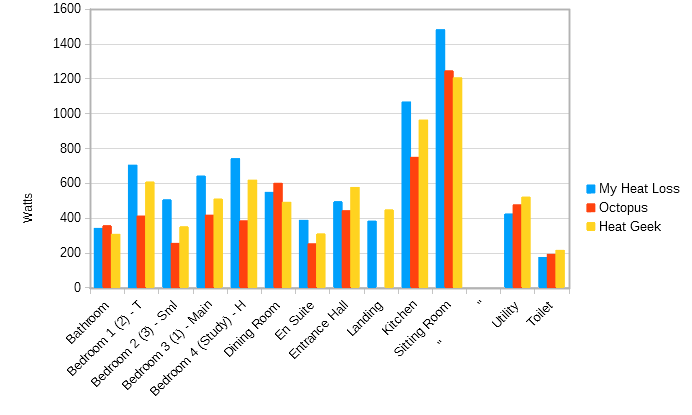
I would be inclined to use your figures, you are motivated to get them right, and then select radiators that match or slightly exceed your heat loss estimates. Then I would ask your currently preferred installer (or indeed both) why, in rooms where there is some variance either way, they think their selection is the right one. How they reply and what they say is all part of the installer selection process.
It's definitely worth getting the rad sizing right, or at least ensuring none are too small, rather, all are matched to the loss and a bit, and ideally none are too large (manageable by turning the rad down a bit, but you loose wall space and have a slightly higher initial outlay).
Midea 14kW (for now...) ASHP heating both building and DHW
2
SPONSORS

Degrees of Separation
Latest Posts
-

RE: Indevolt Batteries UK Support & Info Thread
@editor Hi, To resolve this, please tap on the A...
By Indevolt Tech , 2 hours ago
-
RE: How will removing the standing charge on gas bills benefit heat pumps?
@toodles GIGO always stands! My Cosy 6, as you can...
By Watcher , 11 hours ago
-
RE: How much of your renewable and home setup would still work if the internet went down?
Interestingly we had an internet outage about a month a...
By Rob of York , 17 hours ago
-
RE: Double or Triple Glazed Windows?
Posted by: @singlespeed With 9 years repairing windo...
By Rob of York , 18 hours ago
-
@transparent we’re still running a secure version of PH...
By Mars , 21 hours ago
-
RE: How quickly would you want/expect heat recovery to take from setback?
Much longer than that here. The heating isn't even on. ...
By bobflux , 2 days ago
-
RE: Passiv Smart Thermostat - Help & Forum Support
Obviously the weather is changeable but there's a defin...
By Singlespeed , 2 days ago
-
RE: The Changing Jet Stream Could Challenge UK Air Source Heat Pumps
@rob-of-york I must admit that when we had a Daikin hea...
By Toodles , 2 days ago
-
RE: Forum updates, announcements & issues
Get the Renewable Heating Hub heads-up on WhatsApp. I...
By Mars , 2 days ago
-
RE: Safety study for plug in batteries out to tender - looks like Q3 2027 at best before legal
@editor I pointed out to the one of the Fuse execs that...
By dansus , 2 days ago
-
RE: 15kw pump for 225m2 1990's house - over kill?
@seaviews As well as loft insulation, there are othe...
By Rob of York , 2 days ago
-
RE: BT cuts you off, Plusnet blames Openreach... welcome to “seamless” broadband switching
Both of which (in most cases) use Openreach for the las...
By JamesPa , 2 days ago
-
RE: Renewables & Heat Pumps in the News
Yes, this is a swiss and german standard I believe, Vai...
By Batpred , 2 days ago
-
RE: Octopus Cosy 12 Heat Pump Regret: Incredibly Loud, Poor Heating & Constant Hum - Help!
@editor FWIW my problem was resolved, eventually, after...
By BigFish , 3 days ago





SPONSORS
