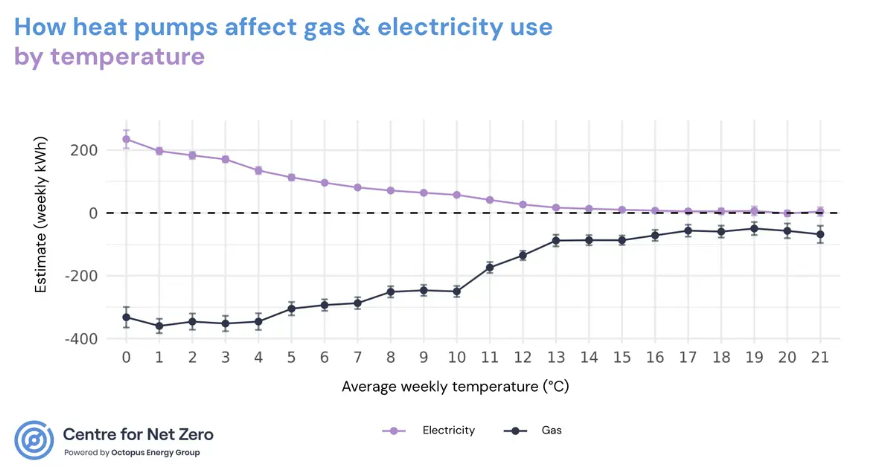
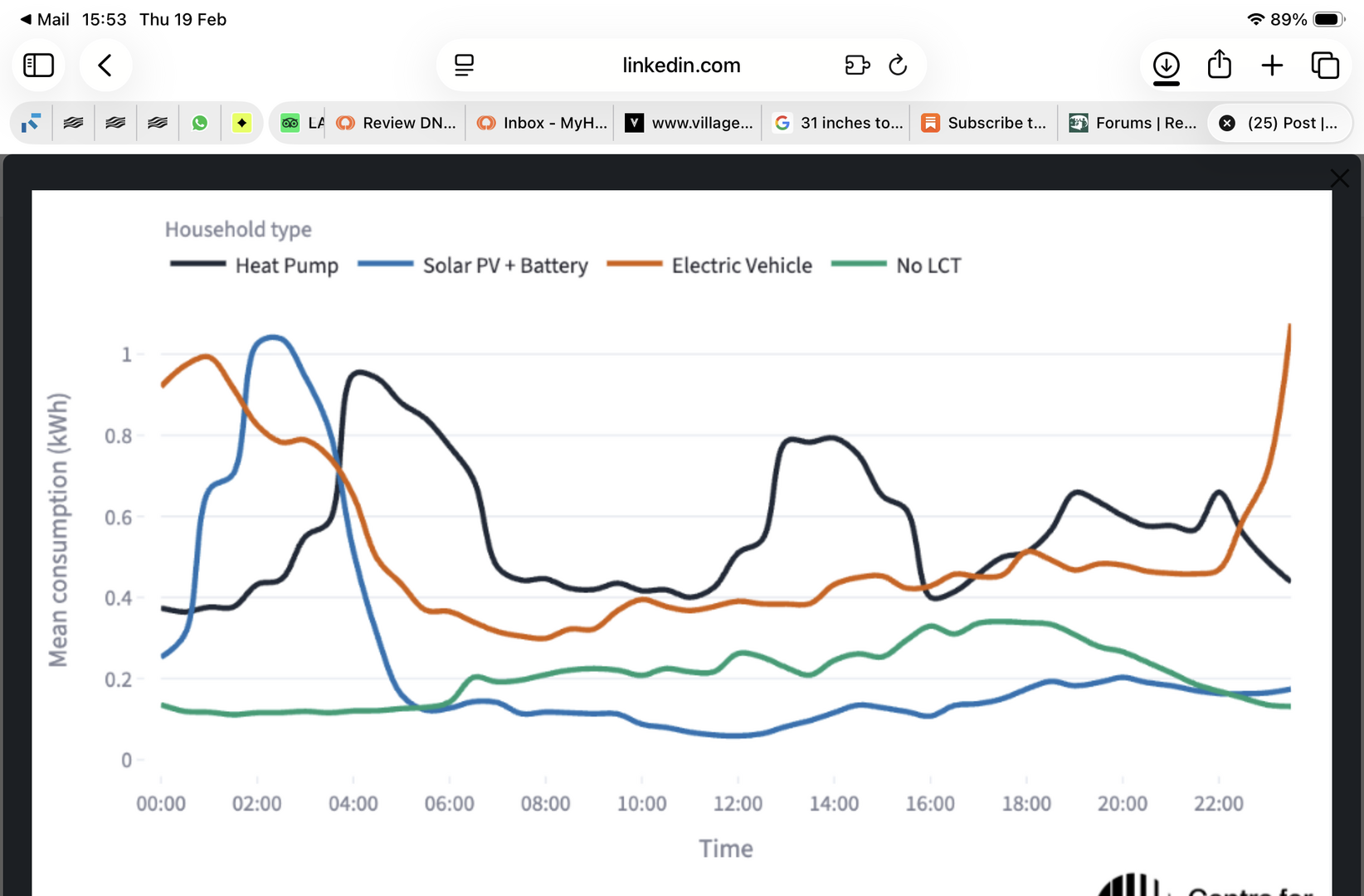
Thanks for sharing, and nice to see how the Octopus centre for net0 data shows a very differentiated consumption pattern in EV households, significantly shifted to overnight (we go off-radar during the day).
Now seriously, they comment that the cosy type of tariffs already changed demand. One way of thinking would be that, in case the grid is overloaded at specific times of day (considering commercial use), that demand can probably be shifted by adjusting the lower cost periods.
And of course there is the generation side, with increasing share of generation not being on demand and perhaps also CfD...
One interesting point is the inferred COP that they calculated, of around 3 to 3.4..
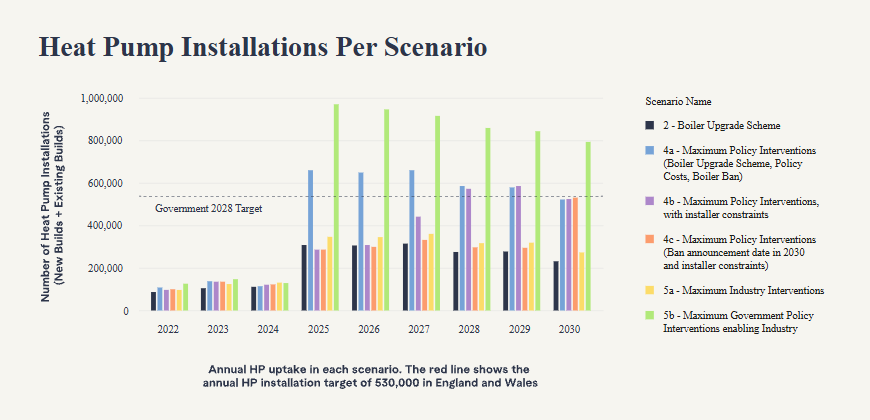
I came across a 2022 paper that expected 300k boilers gone with BUS in 2025. With our total by all schemes being 60k heatpumps installed in 2025, the grid usage pattern cannot have changed as expected..
So if we can infer anything from the past, this other factor (consumer decisions to take up low carbon technologies) may continue to be very difficult to estimate. Very strong inertial forces....
8kW Solis S6-EH1P8K-L-PLUS hybrid inverter; G99: 8kw export; 16kWh Seplos Fogstar battery; Ohme Home Pro EV charger; 100Amp head, HA lab on mini PC
Now, as to whether wholesale adoption of TOU tariffs would just shift the times of peak demand to different periods, I am not sure. My feeling is that, like me, some consumers might avail themselves of just the cheapest periods whilst others would not be able to do so due to financial or other restraints.
Should we end up with a more constant levelled out energy demand, this would surely help to reduce the NG’s problem of having to cater for short duration enormous peaks. These peaks (as @transparent will attest) are the dictator to infrastructure costs.
I understand that infrastructure costs are a considerable component in the price we pay for energy; TOU tariffs could and should help to reduce this cost.
I would like to have responded sooner to that nudge... ... but flu has intervened 😷
The questions and observations from @dr_dongle are on target and insightful.
Attempting to operate a heat-pump throughout the day by drawing on stored cheap-rate power is a very valid aspiration. As @batpred has noted elsewhere, this is financially viable by taking the partial DIY approach, using a self-assembled LiFePO₄ battery and hybrid inverter(s).
It becomes much more difficult to substantiate if you want to buy-in an off-the-shelf all-in-one battery/inverter combo.
A large part of the problem is the presently-available ToU tariffs.
These are being designed in response to two unstable concepts, neither of which is based on 'good science'
2: NESO, the Energy Systems Operator, recruited experienced staff who used to work for National Grid Electricity Transmission (NGET). They work within a whole-system national environment, on the assumption that the 275kV and 400kV Transmission Grid is the mechanism to supply electricity.
But that thinking is 'old', based on the concept of a few major generators with direct connections to the Transmission Grid.
That's no longer the case.
The majority of UK electricity is now generated (and stored) at the lower voltages of the regional Distribution Grids.
As a result of the bias in favour of a large high-capacity Transmission Network by NESO and Ofgem, most potential renewable energy generation companies are seeking a connection at as high a voltage as they can obtain. The companies and their (foreign) investors are attracted by the greater opportunities to make money, if not here, then by exporting to mainland Europe via marine interconnectors.
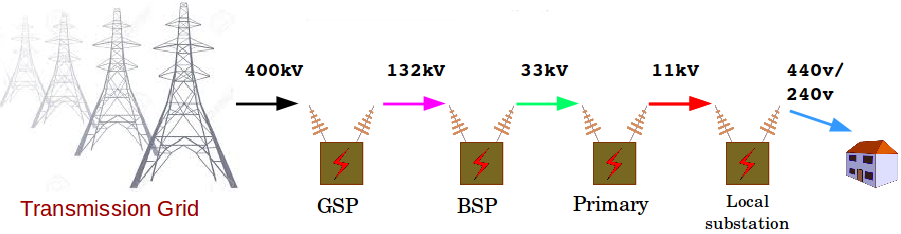
Consequently, large-scale energy-based planning applications are clustered around the Grid Supply Point (GSP) and Bulk Supply Point (BSP) locations.
There is no incentive for companies to place generation/storage sites close to where the electricity is actually needed. They know that Ofgem will approve the massive grid upgrades needed to move that electricity. It will be funded by higher bills for consumers.
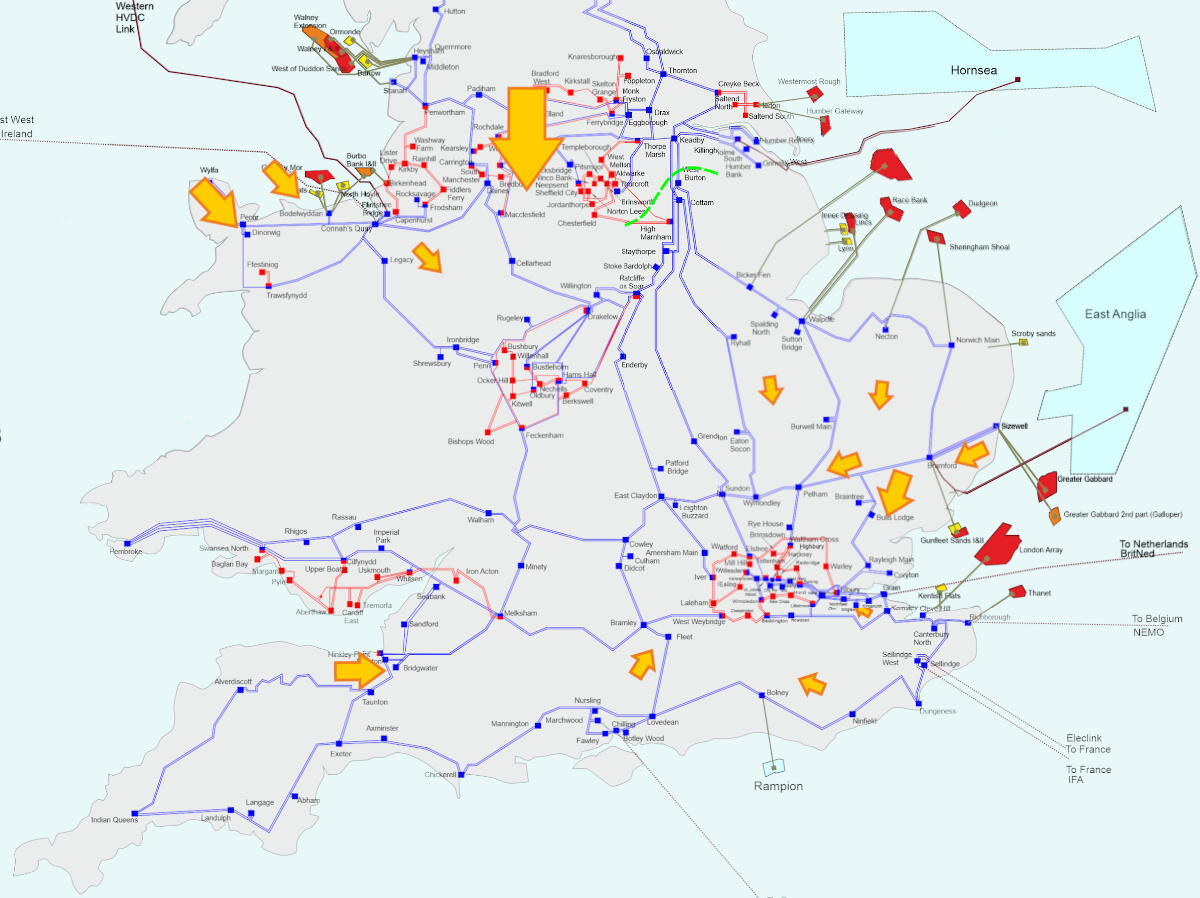
The size of those orange arrows represent the main electricity flows, depicting England, Wales and Scotland sending power to London and SE England, whose thirst for yet more energy is unfettered.
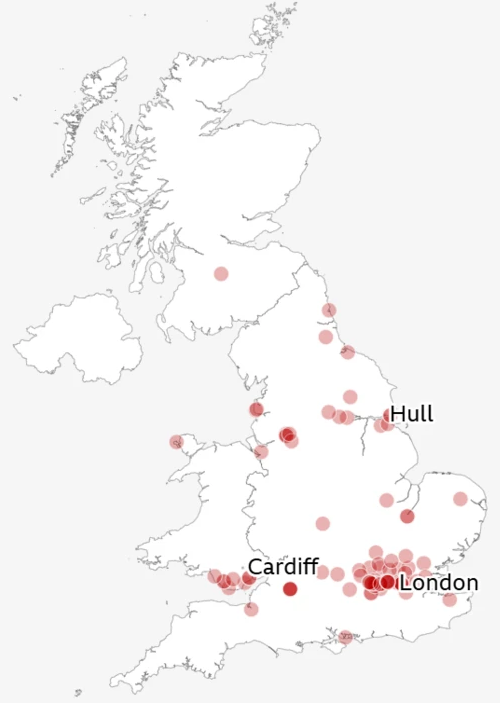
For example, here's a map showing the location of power-hungry data centres, as published by BBC Newsround in August'25.
However, this national approach to grid topology is flawed.
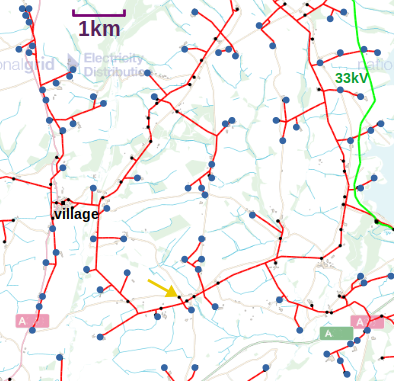
The majority of electricity cable-routes exist at the 11kV level. Those are the pole-mounted wires we see alongside B-roads and scattered across our rural countryside:
Every dot is a pole-mounted local sub-station.
I've highlighted with larger blue dots, those transformers which are supplied with split-phase, as opposed to 3-phase.
As we progress towards Net Zero, it's these 11kV routes which will come under thermal constraint due to installation of Low Carbon Technology. LCT is defined as EV charge points and heat-pumps.
Upgrading the 11kV level of the grid is financially crippling. Think "HS2 on steroids" and you'll get the idea!
And this is where we need ToU tariffs to time-slice demand on the rural cable routes.
The present implementation of ToU tariffs, based on national demand, only seems to be a 'good idea' if you're based in Westminster (DESNZ) or Canary Wharf (Ofgem).
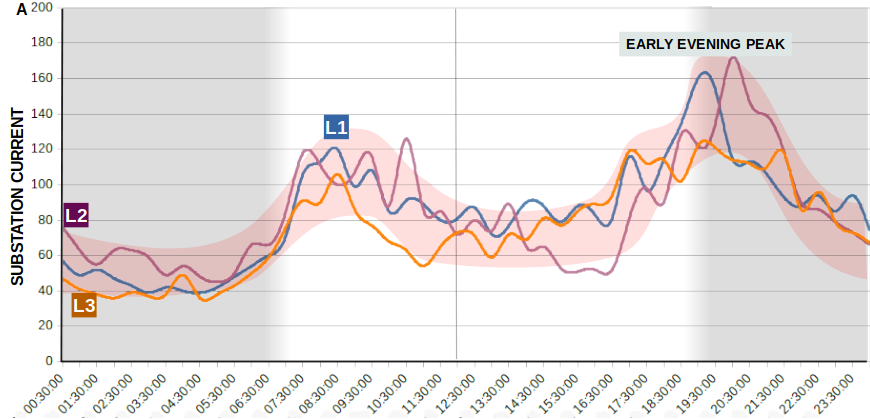
It's a very 'bad idea' if your household lives in energy poverty with a pre-payment meter. Those home-owners can't get a ToU tariff, so they use proportionally more electricity during the 4pm - 8pm window. There's no incentive for them to do otherwise, and hence they are major contributors to the classic Early Evening Demand Peak which @toodles referred to.
The above timeline is taken from a monitored substation serving around 200 homes on an estate with a higher-than-average number of households in energy poverty.
I'm unsure how much this helps the quest from @dr_dongle to operate his heat-pump from cheap-rate electricity, but I hope it provides a glimpse into the crazy way we currently create ToU tariffs.
The present implementation of ToU tariffs, based on national demand, only seems to be a 'good idea' if you're based in Westminster (DESNZ) or Canary Wharf (Ofgem).
.....
I'm unsure how much this helps the quest from @dr_dongle to operate his heat-pump from cheap-rate electricity, but I hope it provides a glimpse into the crazy way we currently create ToU tariffs.
I get the scientific argument however I would ask what is any government supposed to do given the real political pressures?
Nodal pricing was dropped, I think we can be certain, at least in part because of the political nightmare that would be created by 'postcode lottery pricing' (which is how it will surely be described). Im actually surprised it was ever considered because, if it were adopted, it would be ruthlessly exploited by opposing parties who would have a field day finding examples of poor, mostly white Caucasian, places with high prices, and rich, mostly black or immigrant, places with low prices (because both are bound to exist) and presenting these as if they were typical of what the policy creates. No amount of data showing that they were not typical would counter this. Those same parties, if they were to get into power, would then undo much of the work that the current Government is doing on electrification thus rendering the policy pointless anyway. Its a heads I win tails you lose scenario where there appears to be no realistic and sustainable political path to the situation you are arguing for.
Frankly its time this was recognised, and those who argue for it (quite possibly rightly in purely technical terms) come up with an alternative way to achieve similar aims but in a way that is politically realistic.
For the avoidance of doubt I'm not arguing for one side or the other, just pointing out that there are blindingly obvious political realities in play here. if those who propose 'solutions' were to take this into account perhaps they could come up with a policy that could be adopted and either achieves, or comes at least closer to achieving, the 'ideal'.
This post was modified 2 weeks ago 9 times by JamesPa
4kW peak of solar PV since 2011; EV and a 1930s house which has been partially renovated to improve its efficiency. 7kW Vaillant heat pump.
Im impressed by all your work on this. Triggered by the various comments Im now trying to make sure I understand the actual problem(s) better and hope you can help correct/add to my understanding.
From what you have previously said and say above the principal electrification issue is with the 11kV network. I believe you told us some months ago that, if it were load-levelled, it does (for the most part) have sufficient capacity to cope with electrification. Are both of these correct or only the first?
Consequently, large-scale energy-based planning applications are clustered around the Grid Supply Point (GSP) and Bulk Supply Point (BSP) locations.
There is no incentive for companies to place generation/storage sites close to where the electricity is actually needed.
Given that the principal issue is the 11kV network and given that generators have to connect somewhere: why is the above a problem? Is it because it triggers otherwise unnecessary upgrades in the higher voltage network or does it somehow exacerbate the 11kV problem (and if so how)? I guess my underlying question is - is this a separate issue to the 11kV one and if not how are they related given that they seem to concern different network levels? Would it even be realistic for them to connect at the 11kV level given the scale of the generation?
Finally how exactly would nodal pricing mitigate either of the above? Also if nodal pricing is responsive to capacity vs demand (which is presumably the idea) how is it guaranteed to be stable for long enough to be a basis for an investment case for generators?
This post was modified 2 weeks ago 8 times by JamesPa
4kW peak of solar PV since 2011; EV and a 1930s house which has been partially renovated to improve its efficiency. 7kW Vaillant heat pump.
Sorry to derail this thread ‘slightly?’ but back to the thread topic, Mr. Scrooge would like to know if anyreader has more information on the April 1st price reduction please. From many searches I have only been able to find that the Cosy rates will reduce by ~3.5 pence per unit. I wonder if this is a across the board reduction or if the reduction is based on the peak rate and that the lower cost rates will just reduce pro-rata please? Scroogilly Yours, Toodles.
Toodles, heats his home with cold draughts and cooks food with magnets.
Sorry to derail this thread ‘slightly?’ but back to the thread topic, Mr. Scrooge would like to know if anyreader has more information on the April 1st price reduction please. From many searches I have only been able to find that the Cosy rates will reduce by ~3.5 pence per unit. I wonder if this is a across the board reduction or if the reduction is based on the peak rate and that the lower cost rates will just reduce pro-rata please? Scroogilly Yours, Toodles.
i only know about Intelligent Octopus Go ToU, where according to Octopus Customer Services only the peak rate will be discounted. Might suggest a convention for their other ToUs, but I'm guessing tbh.
Mitsubishi Ecodan 11.2kW R32 ASHP; Ecodan DHW cylinder; UFH+rads
20x430W Jinko TOPCON Tiger Neo solar; Luxpower 6+4kW hybrid inverter; 20kWh Hanchu ESS LFP battery storage
PHEV; Zappi charger
1997 stone detached house with updated insulation. 140sqm, maintained at 20-22degC 24/7
I am always impressed with how you keep abreast of so many types of impact of electricity management policy on the real world of cabling and contracts. I
On the decision on regional electricity pricing and based on what I read at the time of that decision, I agree. And I wonder if it would not be possible to maintain similar pricing levels for dwellings in different regions but differentiate it for large users (so avoiding the headlines on consumer postcode lottery).
The majority of UK electricity is now generated (and stored) at the lower voltages of the regional Distribution Grids.
I did not have that idea, as I understand that most windfarms operate at 11 or 33kv but usually connect to at 132kv or higher, like this one near Blackpool. I would be surprised if any sizeable ones reach the bulk of the regions with large consumption like in the SE without going via 250kv or 400kv lines. But I would not know where to look..
Perhaps solar farms are lower scale and different.
I am also curious about the percentage of rural vs semi-rural vs urban consumers..
The present implementation of ToU tariffs, based on national demand, only seems to be a 'good idea' if you're based in Westminster (DESNZ) or Canary Wharf (Ofgem).
It's a very 'bad idea' if your household lives in energy poverty with a pre-payment meter. Those home-owners can't get a ToU tariff, so they use proportionally more electricity during the 4pm - 8pm window. There's no incentive for them to do otherwise, and hence they are major contributors to the classic Early Evening Demand Peak which @toodles referred to.
The above timeline is taken from a monitored substation serving around 200 homes on an estate with a higher-than-average number of households in energy poverty.
Yes, and it seems there are many other opportunities, according to recent research from the Centre for Net Zero, that also highlights:
Empirical data on the effectiveness of low-carbon technologies in alleviating fuel poverty is limited, due to low penetration rates by low-income households.
I am glad that there are incentives to export during peak, which can only help to smooth prices and reduce emissions.
Maybe extra cash could be made by taxing gas to fund another eco type of scheme to improve low carbon technology penetration rates?
8kW Solis S6-EH1P8K-L-PLUS hybrid inverter; G99: 8kw export; 16kWh Seplos Fogstar battery; Ohme Home Pro EV charger; 100Amp head, HA lab on mini PC
@toodles@skd Then there is not going to be much from this rate cut for renewable technology owners, looks like it. If the peak rates reduce by 10% we would see a small reduction in the winter at our home when our heat pump is on and the battery runs out by early evening. But, the proposed standing charges increase should negate that small reduction. This should bring down the payback period a tad, but still not complaining. These products should last many more years and we should see positive gains in the long run.
And I wonder if it would not be possible to maintain similar pricing levels for dwellings in different regions but differentiate it for large users (so avoiding the headlines on consumer postcode lottery).
I have often thought the same. In Italy (I am told) there is an element of pricing which is dependent on the supply capacity (basically you pay more for a higher capacity) Its fair and doesn't obviously discriminate against poor pensioners (which from a political perspective is a must I suspect). It does act as a disincentive to electrification however so would need to be well managed (perhaps two sets of charges depending on your level of electrification).
Well managed it could incentivise local load levelling. For example if I switch my kettle on during the cup final half time break, my heat pump and electric car charging could stop. If I switch my oven on, my car charging could stop and my heat pump optionally. No infrastructure is needed to manage this, just local intelligence limiting grid import. If I remember @transparent correctly and he did say that that the 11kV network is sufficient already for an electrified world if we load-level, then this perhaps could go a long way to solving our challenge at this level. The 'extra' charge for extra import capacity could be matched to the upgrade costs, so those who wont load-level pay for the priviledge.
I did not have that idea, as I understand that most windfarms operate at 11 or 33kv but usually connect to at 132kv or higher, like this one near Blackpool. I would be surprised if any sizeable ones reach the bulk of the regions with large consumption like in the SE without going via 250kv or 400kv lines. But I would not know where to look..
Me neither but land prices in the South East are very high so landowners are going to go for housing first and electricity generation only when housing is ruled out. That inevitably, I suspect, pushes generation some distance from consumption. Also we dont build hourse or such industry as we have in the windiest places! The electricity transport network therefore cant be dispensed with entirely, I feel sure.
Maybe extra cash could be made by taxing gas to fund another eco type of scheme to improve low carbon technology penetration rates?
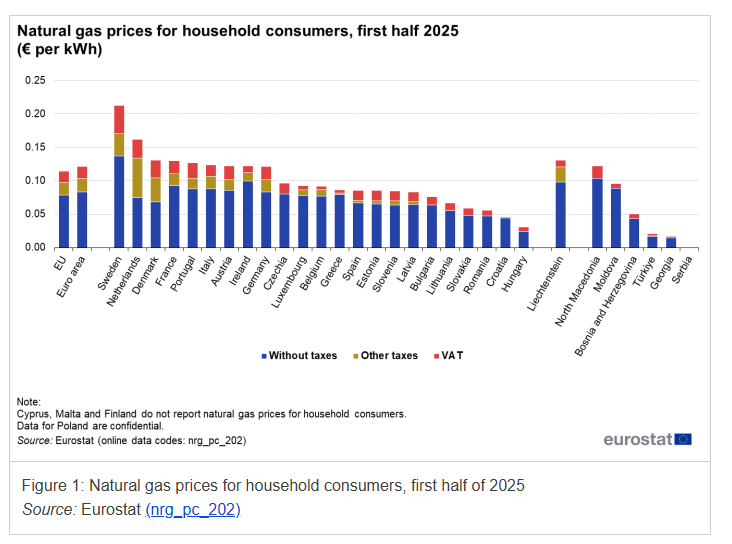
I suspect that taxing gas is a political no-go area. People rely it for their heating and, despite the fact that our gas price is amongst the lowest in Europe - see data from Eurostat below - deliberately raising it will immediately trigger pictures of freezing pensioners on the front page of the Daily Mail (other sensationalist political campaign publications are available).
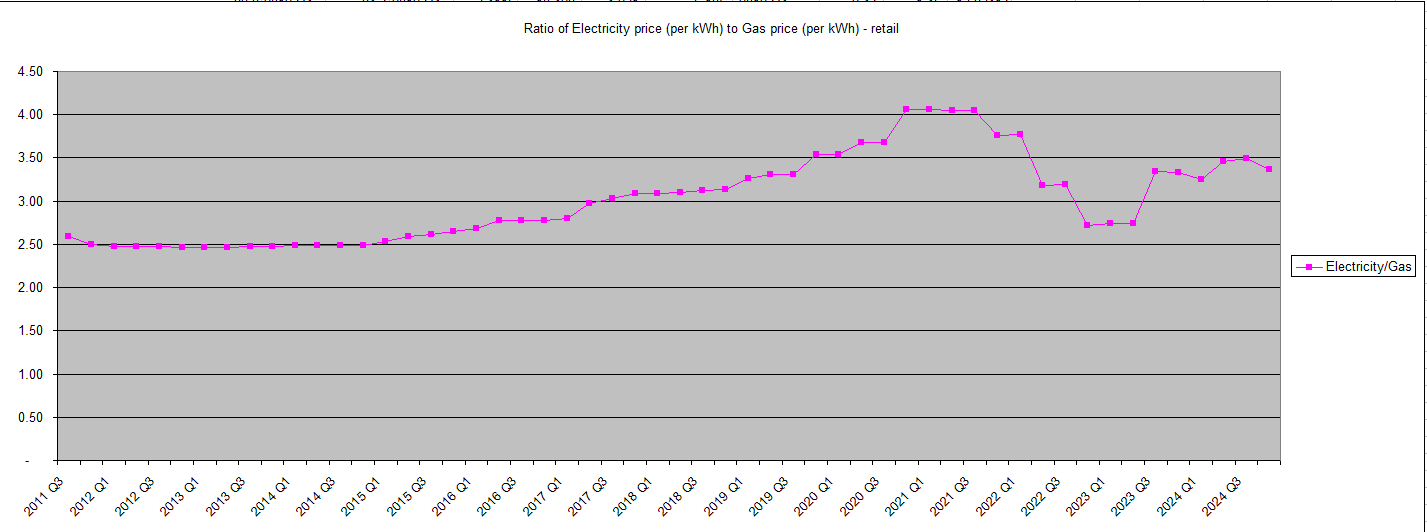
Perhaps it could be very gradually raised over a period of a decade, much like the stealth increase of the price of electricity relative to the price of gas over the period 2011-2021 (see plot below), but that depends on having a government with the same intent for a decade or more, which in turn depends on the voters.
For me its clear that the political dimension of energy pricing can't, IMHO, be ignored because it is so sensitive and currently has so much potential for political opportunism, not least because of the link to decarbonisation.
This post was modified 2 weeks ago 5 times by JamesPa
4kW peak of solar PV since 2011; EV and a 1930s house which has been partially renovated to improve its efficiency. 7kW Vaillant heat pump.
My apologies for slow responses. I seem to have found a strain of flu which wasn't well matched to the vaccine available last autumn. ☹️
Let's recognise that NESO isn't well placed to make decisions on the 90% of the electricity network which operates at 11kV. It isn't monitored, nor are the local substations which it supplies.
I have this information because:
I was part of the Ofgem-funded OpenLV Trial in 2018, for which 86 local substations were supplied with monitoring equipment. That's how I learned about phase imbalance, thermal constraints and how a DNO decides which hardware needs replacing/upgrading.
I've spoken with linesmen, network planners and area managers who work for DNOs. They tell me about voltage drops on long cable-runs, and where there is lack of resilience. But that knowledge is gathered over many years of attending onsite when there are outages, and taking LV readings to see what's happening at that moment in time. Those readings don't get logged so there's no data to recover and analyse.
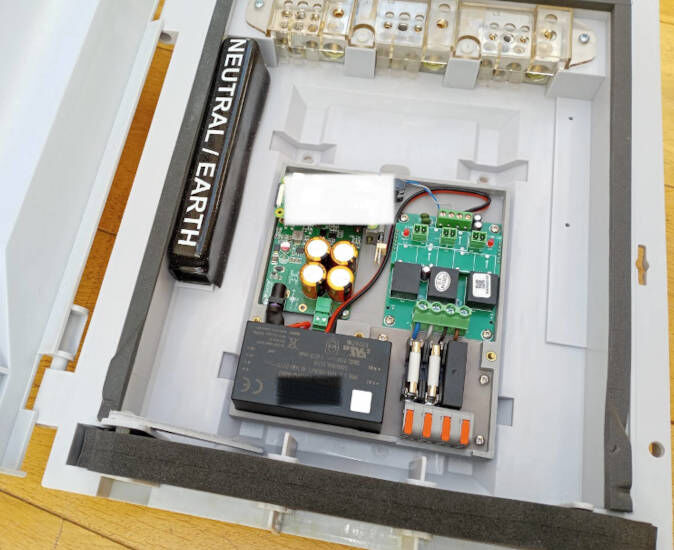
I've designed my own voltage monitors which can be placed on the LV supplies and send back data at minute intervals. The patterns obtained from comparing a number of different sets of monitor data allow me to deduce which voltage shifts are happening at 11kV or 33kV. I don't actually need monitors on the HV supplies.
For your interest, the next photo shows one (of three) possible designs for a 3-phase pole-mounted LV monitor.
It's housed in an ABC connection box. Aerial Bundled Cabling is replacing many of the older LV wiring, which used individually-suspended wires for each phase and neutral. The ABC boxes are connected using insulation displacement taps onto live cables, and allow overhead lines to be connected to a house.
Consequently, large-scale energy-based planning applications are clustered around the Grid Supply Point (GSP) and Bulk Supply Point (BSP) locations.
There is no incentive for companies to place generation/storage sites close to where the electricity is actually needed.
Given that the principal issue is the 11kV network and given that generators have to connect somewhere: why is the above a problem? Is it because it triggers otherwise unnecessary upgrades in the higher voltage network or does it somehow exacerbate the 11kV problem (and if so how)?
Connecting renewable generation/storage sites at the higher voltage levels is easy to assess for upgrades. There's data available for these routes and it's easy to check a map which shows cable routes which are already overloaded. The DNO simply declares that an upgrade is required, for which the DNUoS element in consumer bills must be increased. Ofgem agrees because there's no alternative being presented.
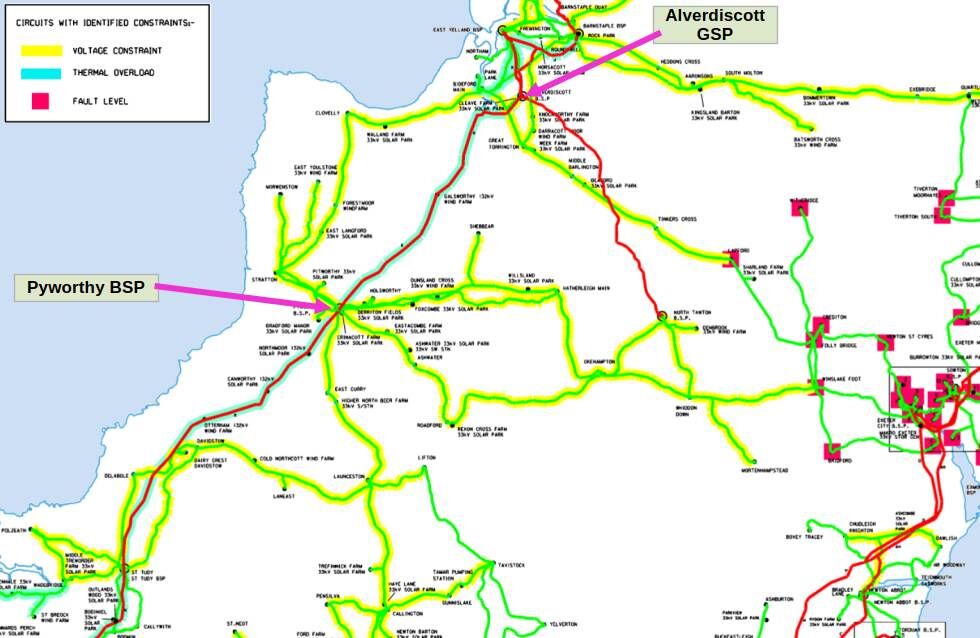
Here's a map of North Devon showing HV cable routes at 33kV (green) and 132kV (red) which are operating at or above capacity. The type of capacity constraint is shown by the colour of the highlight applied to that route.
About 20% of the labels in small black type are the names of towns which the distribution grid was originally constructed to serve. The other 80% are names of solar and wind generation sites, with most of them connected at 33kV.
Note how generation and storage sites are clustered around the Bulk Supply Point at Pyworthy, and the Grid Supply Point in the tiny hamlet of Alverdiscott.
Alverdiscott is the only GSP on this map. Indian Queens GSP (in the centre of Cornwall) is off the map to the SW, and Exeter Main is off to the East.
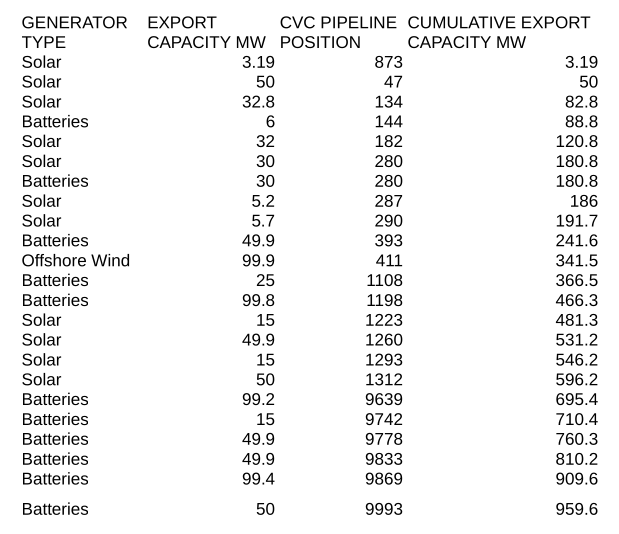
The 400kV transformers at Alverdiscott are rated 330MW in the supply (forwards) direction, and 240MW in the Reverse Power direction. Due to the amount of wind and solar generation in the area, the winter import (reverse power) level is peaking at -257MW. Yes, that's a minus sign!
Here's the accepted connection queue for Alverdiscott as it stood at the end of 2025:
I've not included the names of the companies, nor the location of the assets for which they've been granted an Offer to Connect.
The projected date for 'reinforcement work' on the 400kV Transmission Grid is December 2036.
Adding generation/storage assets to a grid level increases the voltage being carried by that cable.
Even if the intention is to export that excess generation to London & SE England, electricity doesn't work like that. A voltage rise on the 33kV supply gets reflected in a corresponding rise in the 11kV and LV levels.
I hope it's now becoming clearer why our electricity bills are increasing.
There's no regional energy plan in place to allow strategic decisions to be made. Companies wishing to add yet more generation simply refer to 'Government policy' to meet Net Zero, and apply pressure to ensure that their applications can't be rejected at the Planning stage.
The earliest that a Regional Energy Strategic Plan could be created is 2029, because NESO need until the end of 2028 to create the maps, governance and methodology on which such a plan could be built.
Perhaps it could be very gradually raised over a period of a decade, much like the stealth increase of the price of electricity relative to the price of gas over the period 2011-2021 (see plot below), but that depends on having a government with the same intent for a decade or more, which in turn depends on the voters.
Thanks, this graph does show us that that critical ratio that can accelerate or delay the transition is not moving in the right direction.
This from Octopus’s centre for net zero shows their load predictions (I think!) (...)
The one above about household consumption reminds me that consumption increases significantly with the introduction of a heatpump or EV. Households without low carbon technology use much less electricity.
Whoever runs the national and regional grids should have a view on:
whether more cables need to be deployed or not (and if much needs to be for 11kv)
whether the bottlenecks are the same for Cornwall were it seems grid outages are currently very frequent and this extrapolates for the regions where the bulk of domestic consumption happens (that I assume is in urban centres that do not suffer from those frequent outages)
Much is still very unclear. The UK grid governance seems far from being uniform.
But as I do not advise government, I do not need to know what is best.
Hopefully whoever is being heard when advising government is doing so based on solid data. Elected politicians would not be expected to do more than respond to the power outages in local areas and to the outcry in social media (as if decarbonisation goals are causing energy prices to soar). After all, very few elected politicians studied physics or maths and would be able to counter the arguments. It does not make sense to distrust the number crunchers whose main goal is to provide a basis for sound policy making.
I will try to do some more digging to help the debate..
8kW Solis S6-EH1P8K-L-PLUS hybrid inverter; G99: 8kw export; 16kWh Seplos Fogstar battery; Ohme Home Pro EV charger; 100Amp head, HA lab on mini PC