@jamespaamespa, thank you both @iaack so far I haven’t calculated this latent heat of fusion. Just the raising of the 180L of water temperature from 25C to 40C. It doesn’t seem insignificant. But please let me know if my maths is wrong.
Maths looks right to me, my only question about this calculation is whether its reasonable to assume that the whole 180l is reduced in temperature to 25C. The heat pump measures the temperature at the heat pump, ie just after its been cooled, I would guess that much of the water in the system might be warmer, possibly quite a lot warmer. A bit of maths on pump speed etc might help give an angle on this question but it might also be necessary to observe flow temp and state of defrost (or feel the radiators!). The min flow temp may not correspond with the end of defrost in which case the amount of water at a higher temp than the min could be even more than a calaculation based on pump speed might indicate.
My point above is, however, that the latent heat of fusion is already contained within the amount needed to reheat the water, because thats where the energy corresponding to the latent heat of fusion has come from. So to add it in would be double counting this amount. Its interesting to calculate it nevertheless to compare with the reheat energy, if only to allow us to ask the question - where does the rest go? This will also serve as a sense check and conservation of energy tends to do.
Depending on exactly what you are trying to work out so might adding in "the electrical energy to replace the 12 minutes when the HP is not adding heat energy to the system during the defrost."
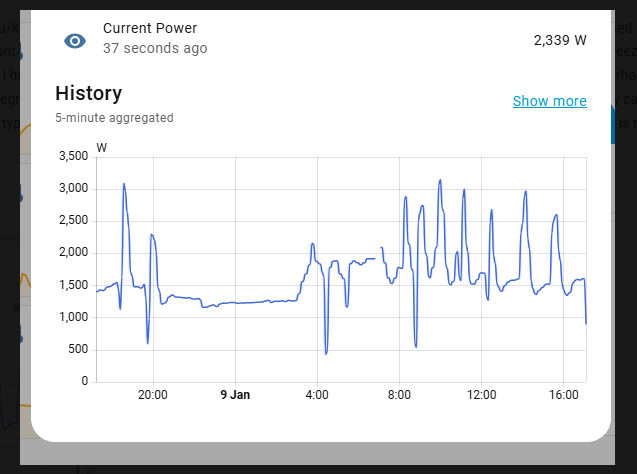
I think it might be easier (or perhaps a complementary sense check) to do an integration on power consumption during the defrost 'spike' which occurs immediately after defrost. I posted this diagram from mine (7kW Vaillant) earlier
An 'eyeball integration' of the spike (ignoring the dip) suggests about 0.25kWh. This will be largely the reheat energy I imagine. However that doesn't account for the fact that the consumption in the period after the spike may be higher than it would have been in the absence of defrost, but of course that is partially replacing the energy that was not put in during the dip in the cases where there is one. If you complete your calculation perhaps we can compare two ways of getting at the same question which may give us a view of the uncertainty!
Thats probably served to confuse rather than clarify in which case I apologise.
This post was modified 2 months ago 4 times by JamesPa
4kW peak of solar PV since 2011; EV and a 1930s house which has been partially renovated to improve its efficiency. 7kW Vaillant heat pump.
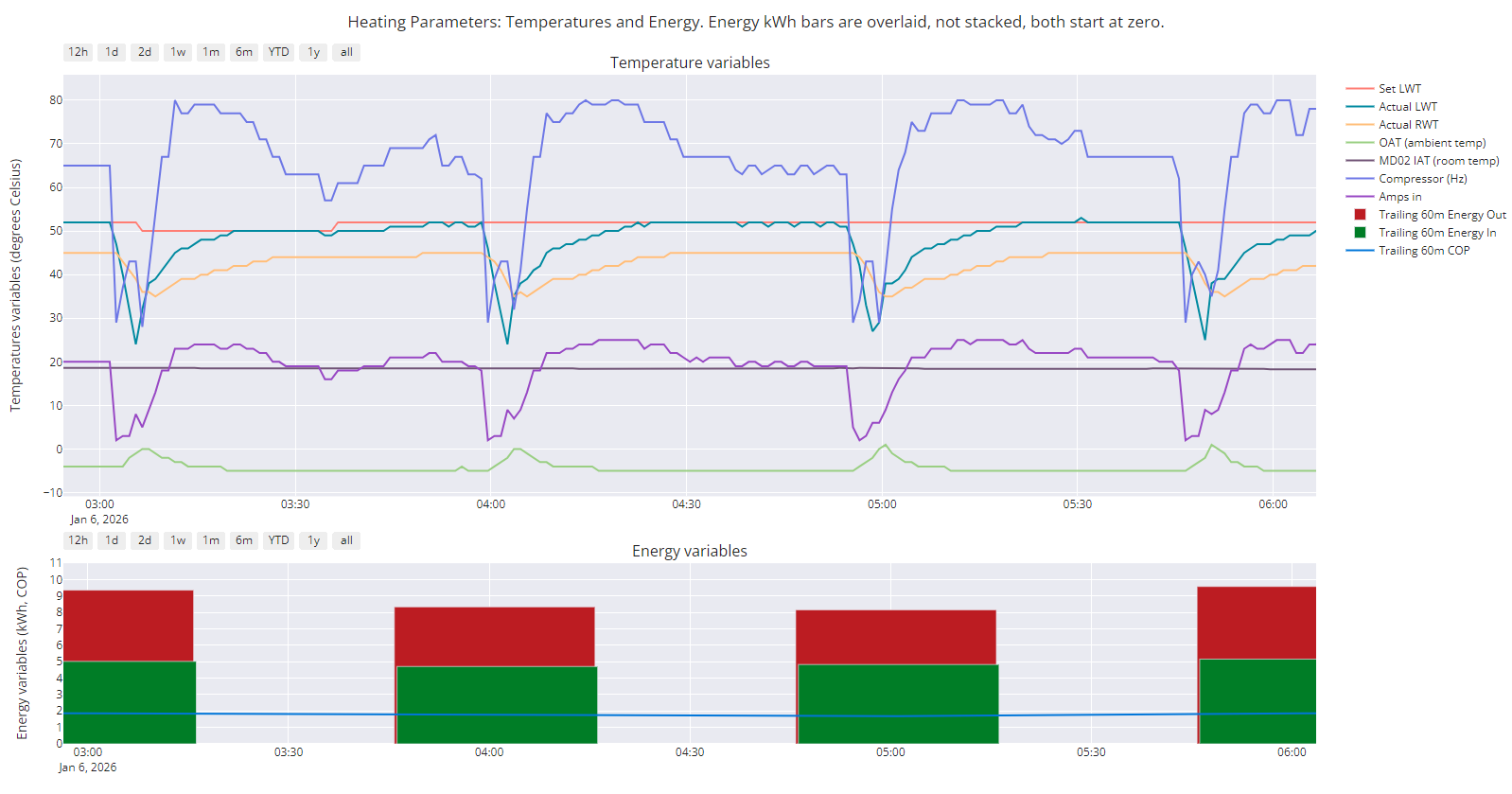
I'm also inclined to look into how a defrost is actually done. How much is just passive transfer of heat/energy (the coil simply becomes a radiator, and melts any ice that has formed on itself), and how much, if any, is done by the compressor, as extra work? My minute data shows the compressor certainly slows during the defrost, and then speeds up afterwards, but the value (in Hertz) is always positive (which sort of makes sense, given what follows below). From what I have read, a defrost cycle is is a just another context specific name for the heat pump switching to air conditioning/cooling mode, ie running as it would if cooling a building in the summer (which makes sense, it already has the set up to do that, why not use it rather than add another running mode?). Again, from what I have read, the actual flow in the compressor circuit is reversed (by valves, while the compressor still turns the same way), but how much extra heat is added by the compressor, over and above the transfer of heat from the circulating water from the house? There might be a clue in this chart (previously posted), in the amps in. They drop very low during a defrost, which suggests to me a defrost is mostly a passive transfer of heat:
Or perhaps I am talking through my hat?
Midea 14kW (for now...) ASHP heating both building and DHW
Ouch, your lower system volume is being seen here with big flow temperature drops. Our larger system volume results in only a ~7C drop in flow temp at 3C OAT and 11C drop at -6C OAT. Hopefully the 3 extra radiators you have identified as needed will help with this, also have you considered a volumiser (or bigger volumiser)?
I don’t think you can compare the two systems. Ours is entirely radiator system while yours appears to be under floor heating possibly with volumiser of some kind. A volumiser, depending on where it’s placed will mask a lot of performance as it blends and mixes before the temp sensors.
Our system is radiators, large ones and now with DIY fan systems (so fancoil like), and is straight open loop (no buffer/LLH/etc). So no blending or masking of anything, the figures/charts are simply what our system is doing. All of the electricity into the system and movements of thermal energy via the water in the system are monitored.
Your system does however show high delta T at minus temperatures - which was all I was interested in showing our -3 delta T image.
There is no ‘ouch’ in our defrosting it is simply operating within its capacity with no secondary pumps and no blending tanks or valves. Regarding capacity It is just a personal decision that I would like to extend the system at some point mainly to allow us to operate at lower temperatures.
All systems' dT will rise when increasing output. Your system in negative temperatures has a high dT (~9C) even before a defrost, while ours pre-defrost is a fairly typical ~5C.
Your flow temperature drops 18C, from 45C to 27C, during a defrost at -3C, while ours only drops ~11C at -3C OAT (only 61% of your system's drop).
My thoughts are I’d like to get back to the topic in question. As far as the recent posts has been, how much electrical energy is used in a defrost and what are all the elements that make up that energy. To that end it would appear there are 3 items unless someone knows of others?
1. the electrical energy used to reverse the flow in the compressor for defrosting purpose
2. the energy to replace the 12 minutes heating lost while the defrost took place and
3. the energy needed to reheat the 180 litres of water which has been chilled and sent around the heating system after the defrost.
I have some figures on this but interested if any views on other energy usage which might be relevant to this total.
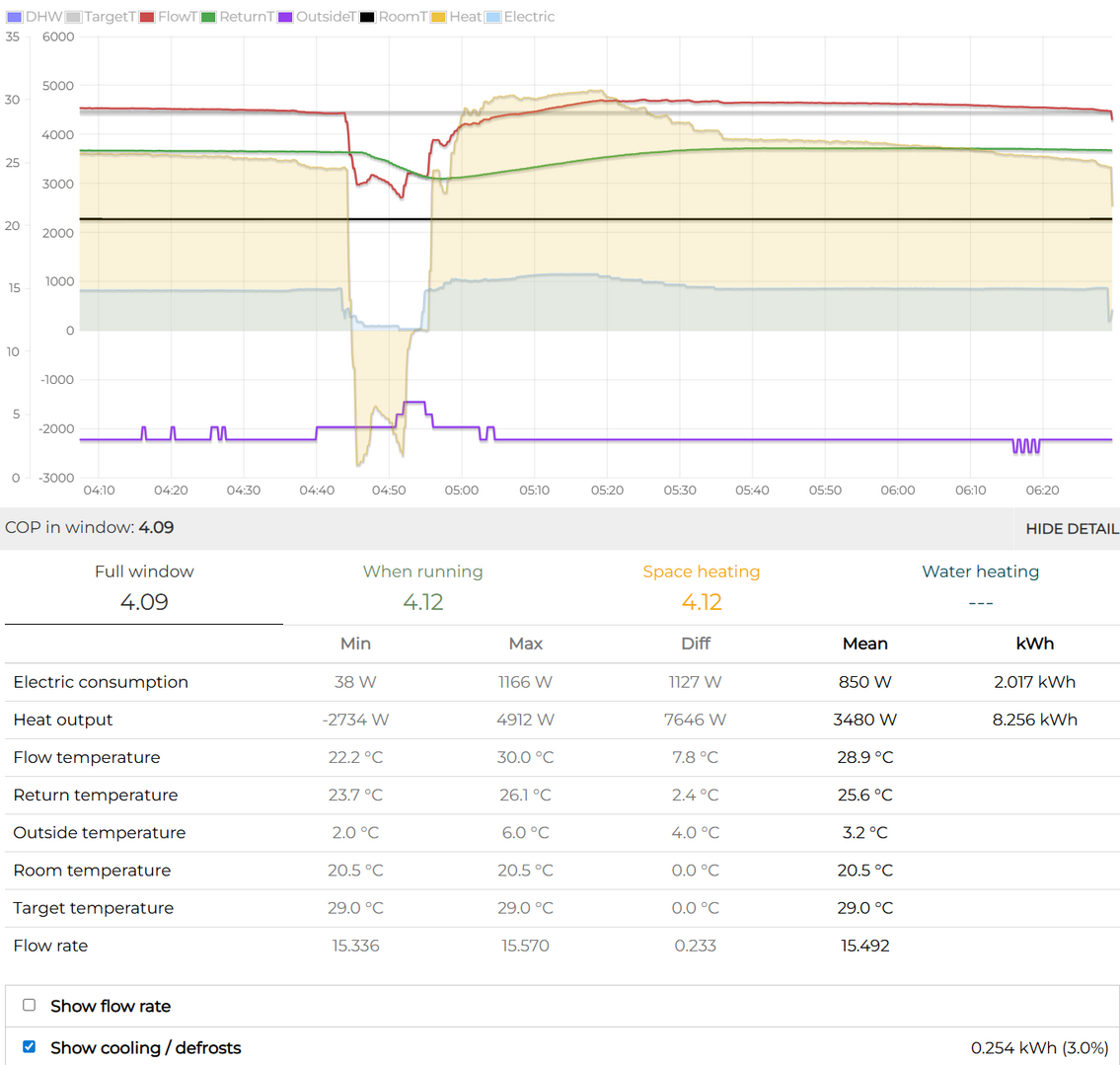
As we have an H4 boundary OEM level 3 monitoring setup all of the electricity used by the system (heat pump, water pump, controller, etc.) and all of water thermal energy flows (heating/defrost/cooling) are monitored. These data points are recorded every 60 seconds, providing a detailed record of what our system is doing 24/7. In the following charts the energy (input and output) and flow/return temperatures are from the OEM level 3 sensors, while the target flow temp, room temp/IAT and outside temp/OAT are from a device connected to the controller sold by @f1p on ebay (this reads values from the Mitsubishi controller and are the values used by the controller to control the heat pump).
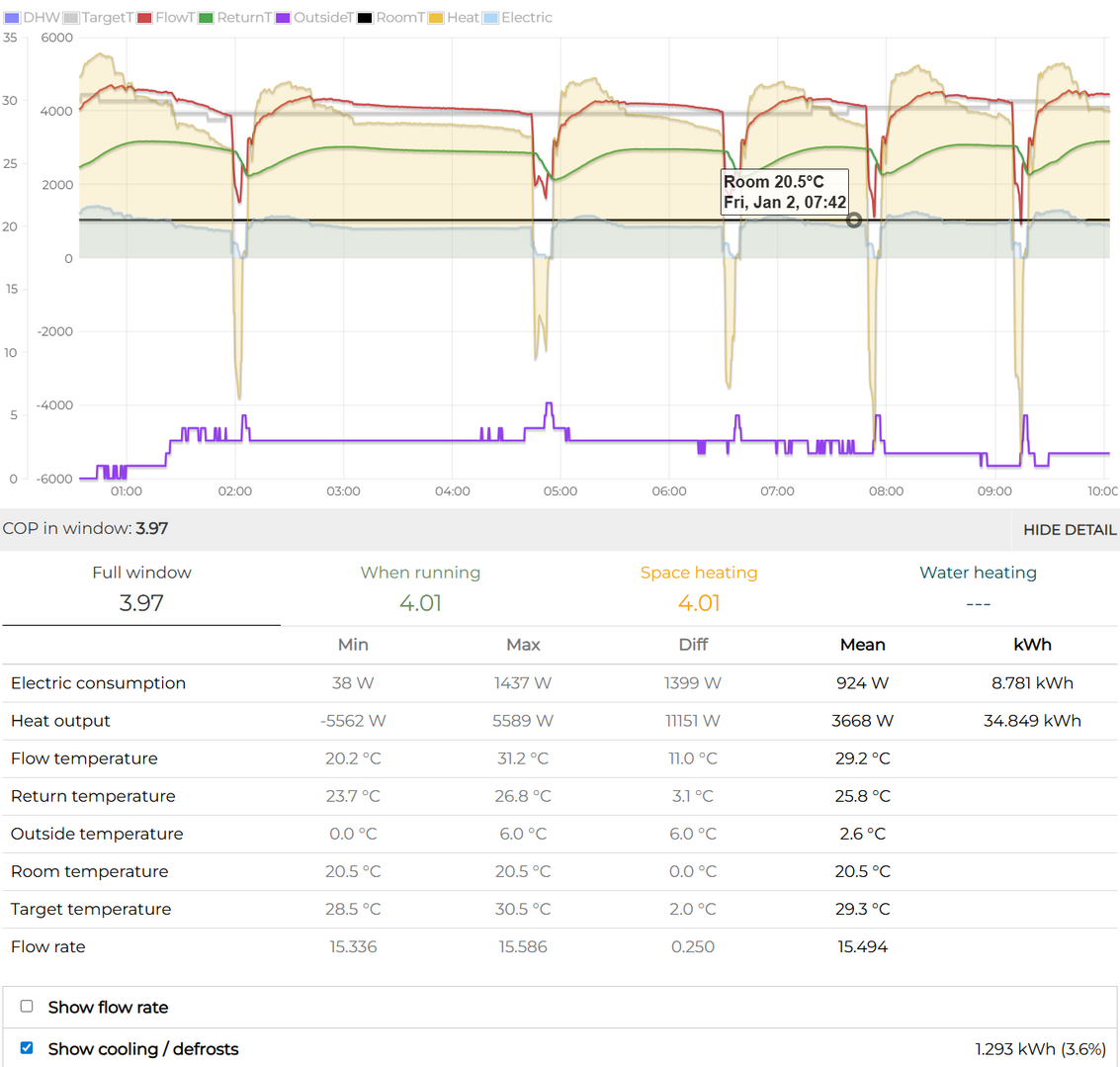
The following is a defrost cycle in lots of detail, it is at 3C OAT and lasts ~11 minutes, so I have used 11 minute units of time to make comparisons easy. The full cycle looks like this:
Zooming out further you can see that the IAT is maintained, indicating that the system is repeatedly replacing the energy lost to defrosts and not running a noticeable deficit.
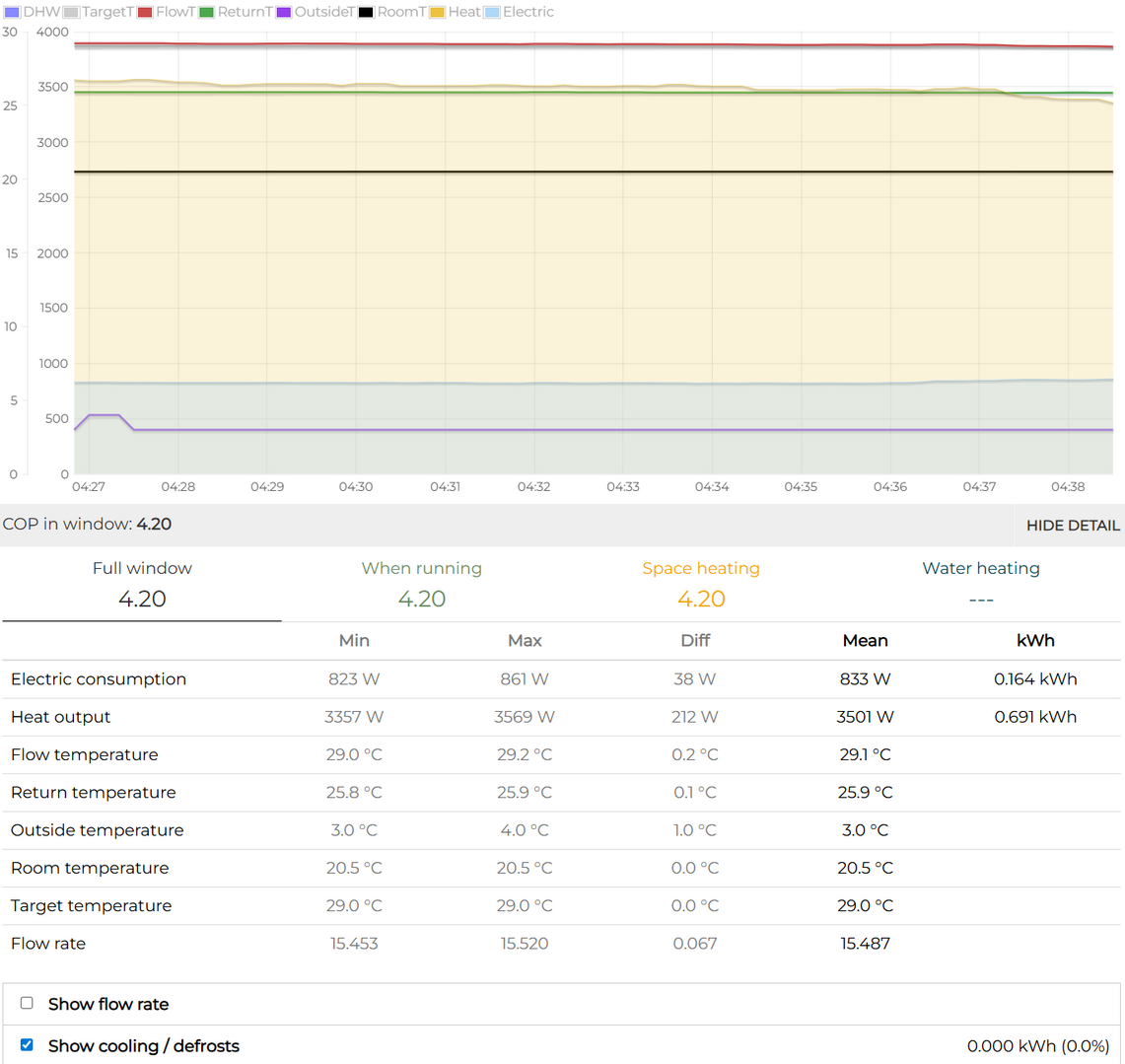
Also the defrost being considered (in the middle of the above) is after a period of continuous running and so the operation of the heat pump immediately prior to the defrost isn't effected by the previous defrost and can be used as a baseline. Below is prior to the defrost and representative of the consistent output in the ~1 hour prior to the defrost. In this 11 mins the system used 0.164 kWh of electricity to produce 0.691 kWh of heat, at a COP of 4.2:
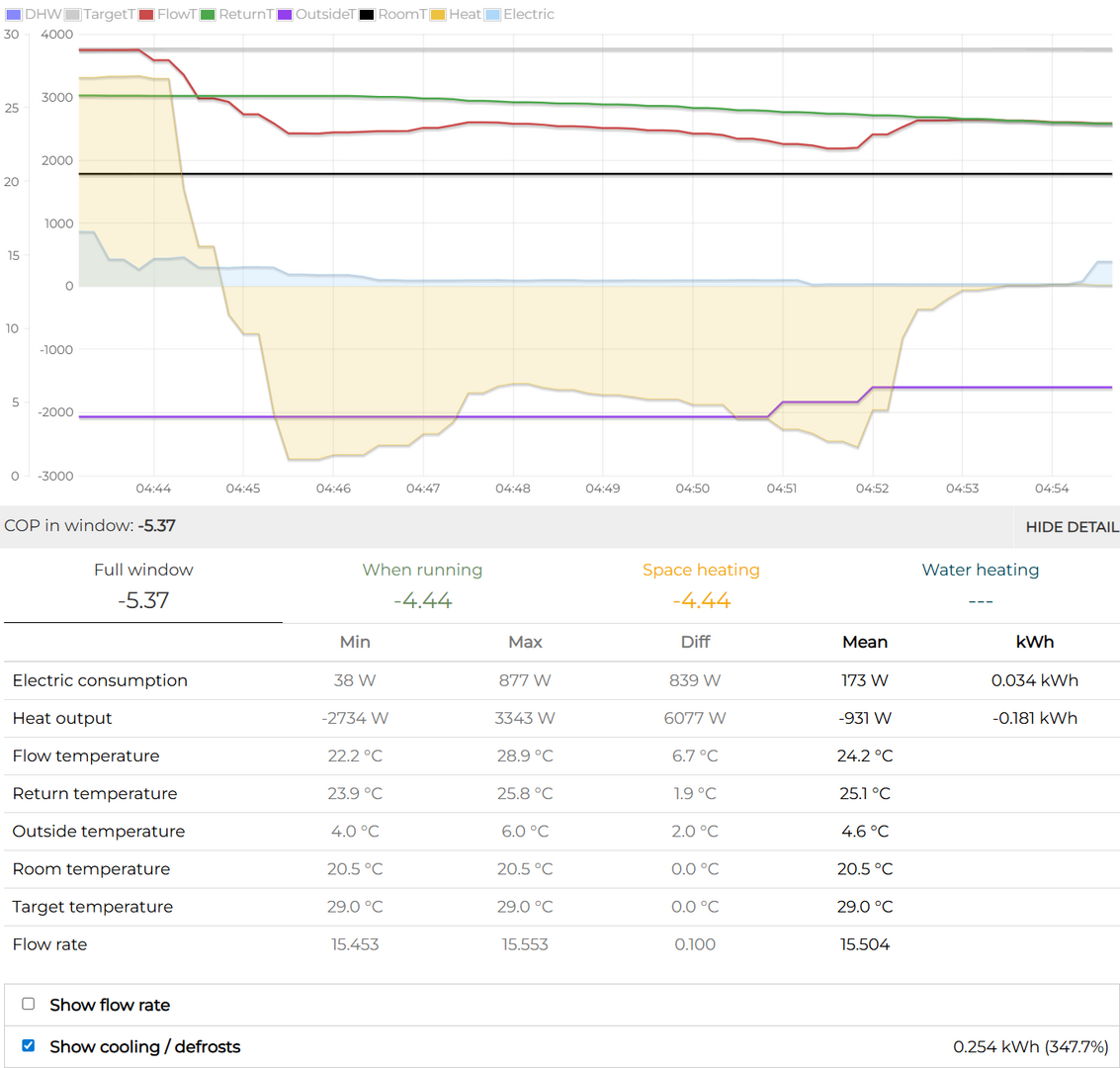
During the 11 mins of the defrost the system used 0.034kWh of electricity and 0.256 kWh of thermal energy is taken from the water to defrost the heat pump:
But the system saved 0.164 - 0.034 = 0.13 kWh of electricity when compared to pre-defrost. The total heat to replace is 0.691 + 0.256 = 0.947 kWh. I've been quite conservative here, as can be seen there is a thermal lag in the system and positive heat output continues for ~1.5 mins after the compressor starts its defrost cycle (the drop in electrical input is the start of the defrost), so only 0.691 + 0.181 = 0.872 kWh of heat actually needs to be replaced.
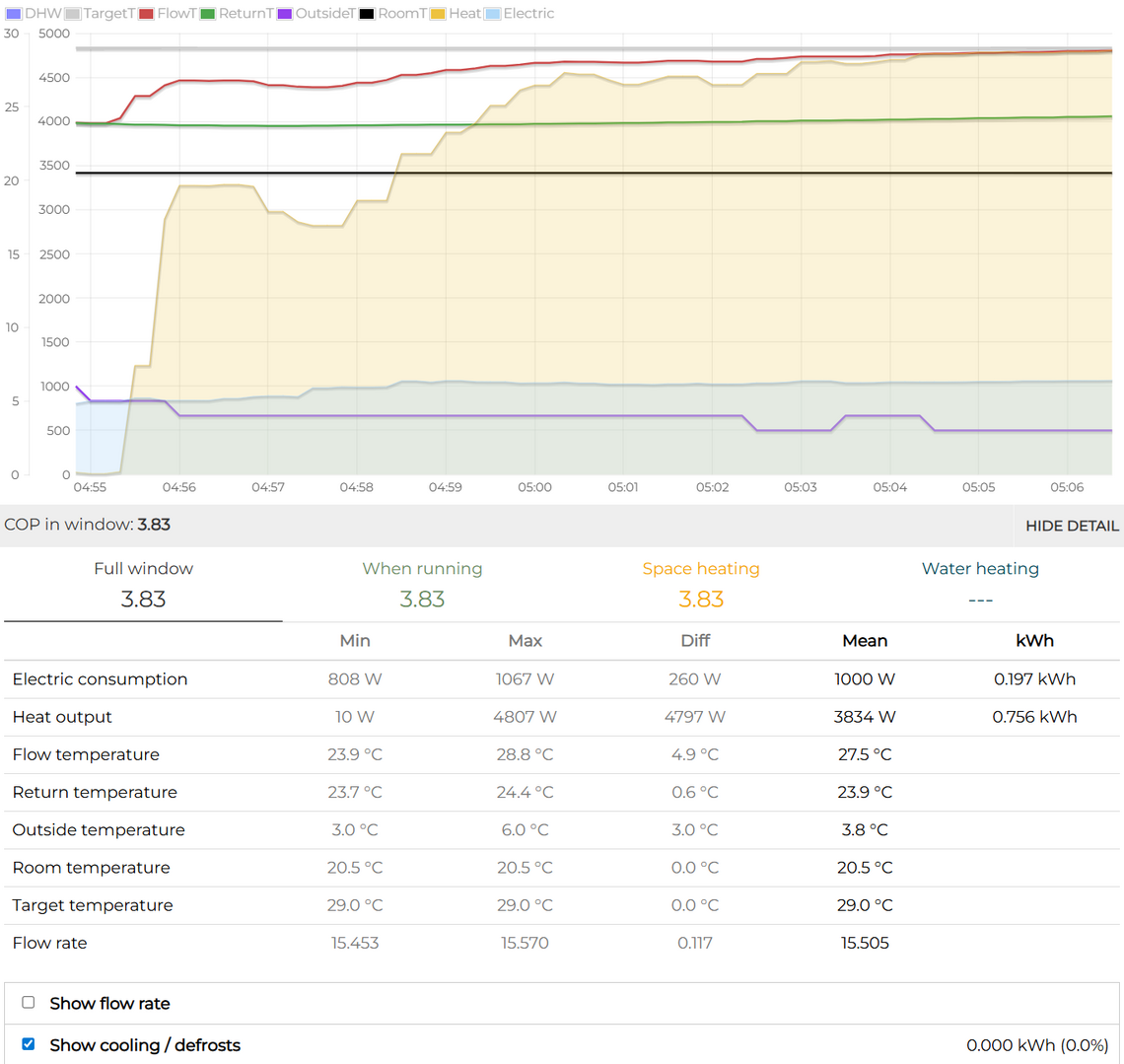
Post defrost the first 11 mins the system used 0.197 kWh to produce 0.756 kwh of heat, at a COP of 3.83.
That's 0.197 - 0.164 = 0.033 kWh more than pre-defrost (0.13 - 0.033 = 0.097 kWh remaining from the defrost period saving). And 0.756 - 0.691 = 0.065 kWh more than pre-defrost (0.947 - 0.065 = 0.882 kWh remaining to be restored).
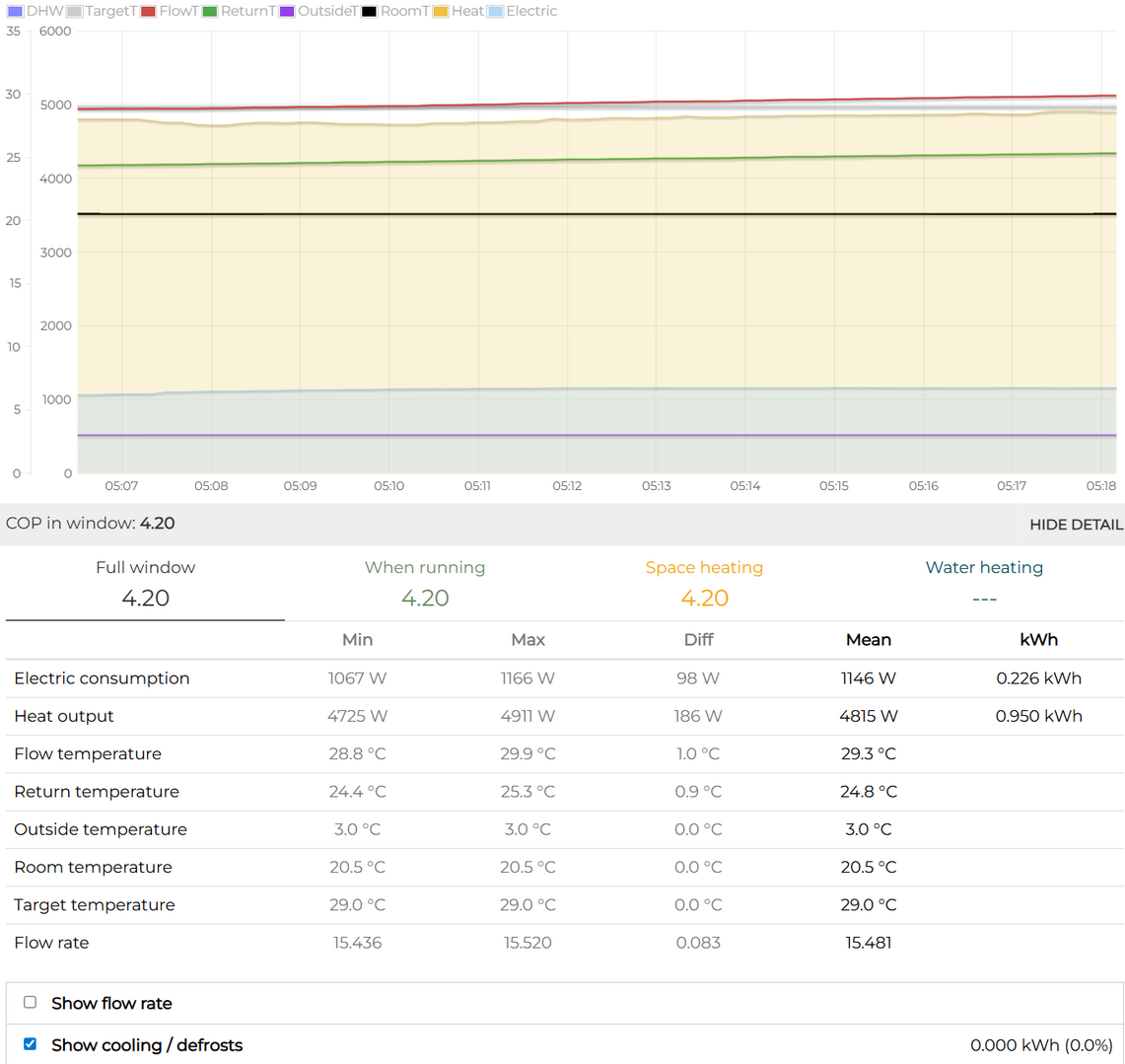
In the next 11 mins the system used 0.226 kWh to produce 0.950 kWh of heat, at a COP of 4.2.
That's 0.226 - 0.164 = 0.062 kWh more than pre-defrost (0.097 - 0.062 = 0.035 kWh remaining from defrost saving). And 0.950 - 0.691 = 0.259 kWh more than pre-defrost (0.882 - 0.259 = 0.623 kWh remaining to be restored).
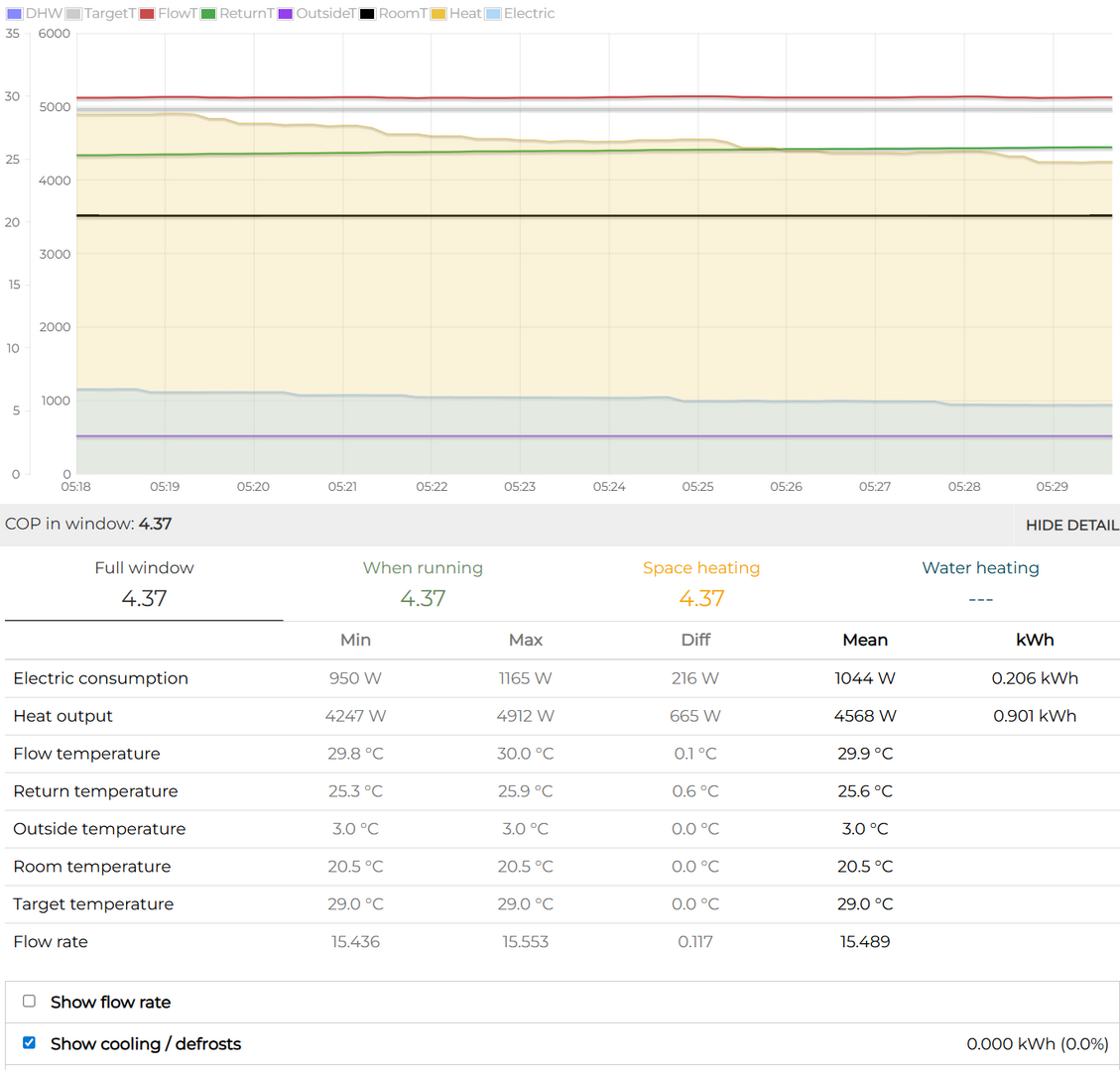
In the next 11 mins the system used 0.206 kWh to produce 0.901 kWh, at a COP of 4.37.
That's 0.206 - 0.164 = 0.042 kWh more than pre-defrost (0.062 - 0.042 = 0.020 kWh remaining). And 0.901 - 0.691 = 0.210 kWh more than pre-defrost (0.623 - 0.210 = 0.413 kWh remaining to be restored).
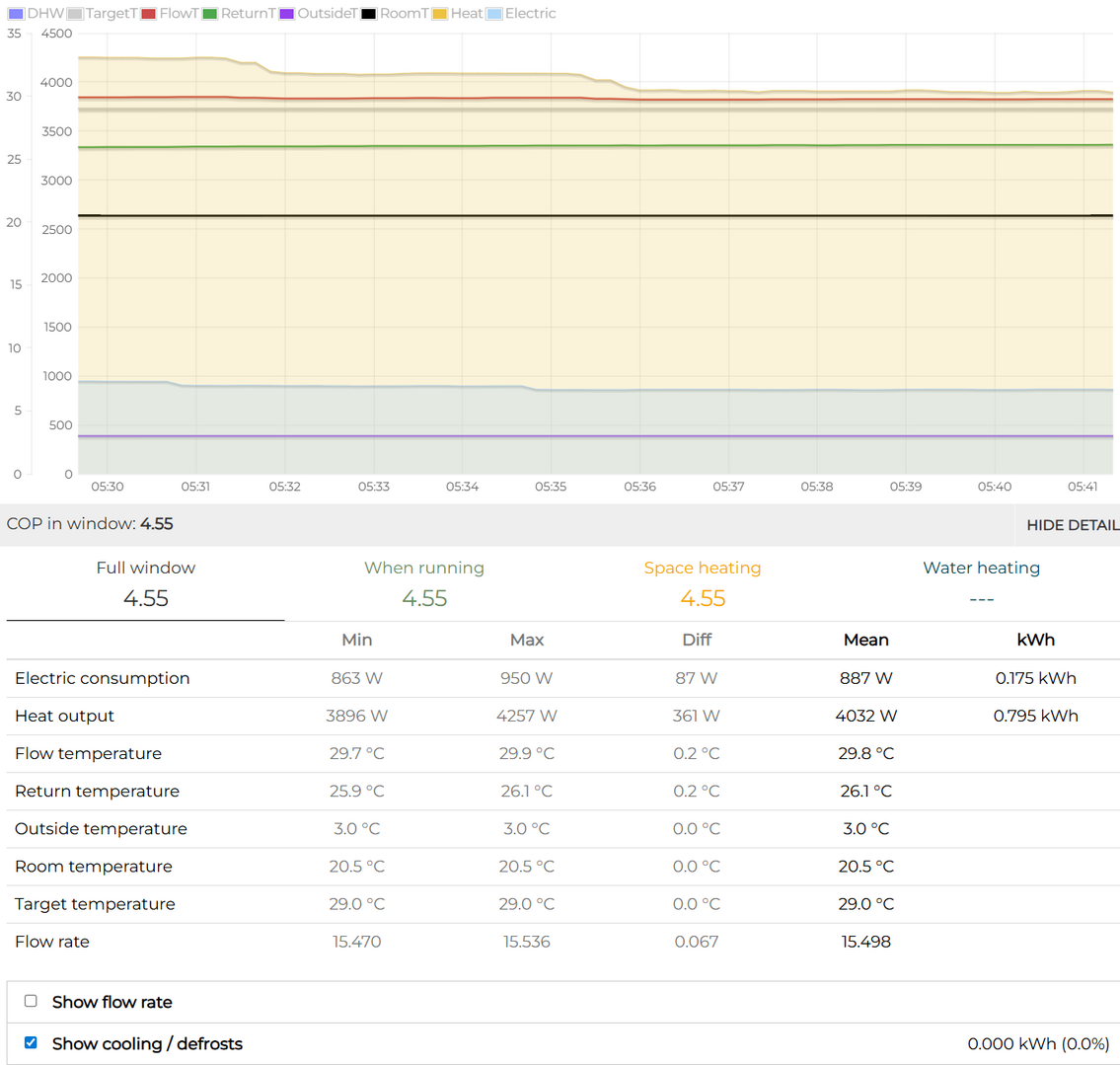
In the next 11 mins system used 0.175 kWh to produce 0.795 kWh, at a COP of 4.55.
That's 0.175 - 0.164 = 0.011 kWh more than pre-defrost (0.020 - 0.011 = 0.009 kWh remaining). And 0.795 - 0.691 = 0.104 kWh more than pre-defrost (0.413 - 0.104 = 0.309 kWh remaining to be restored).
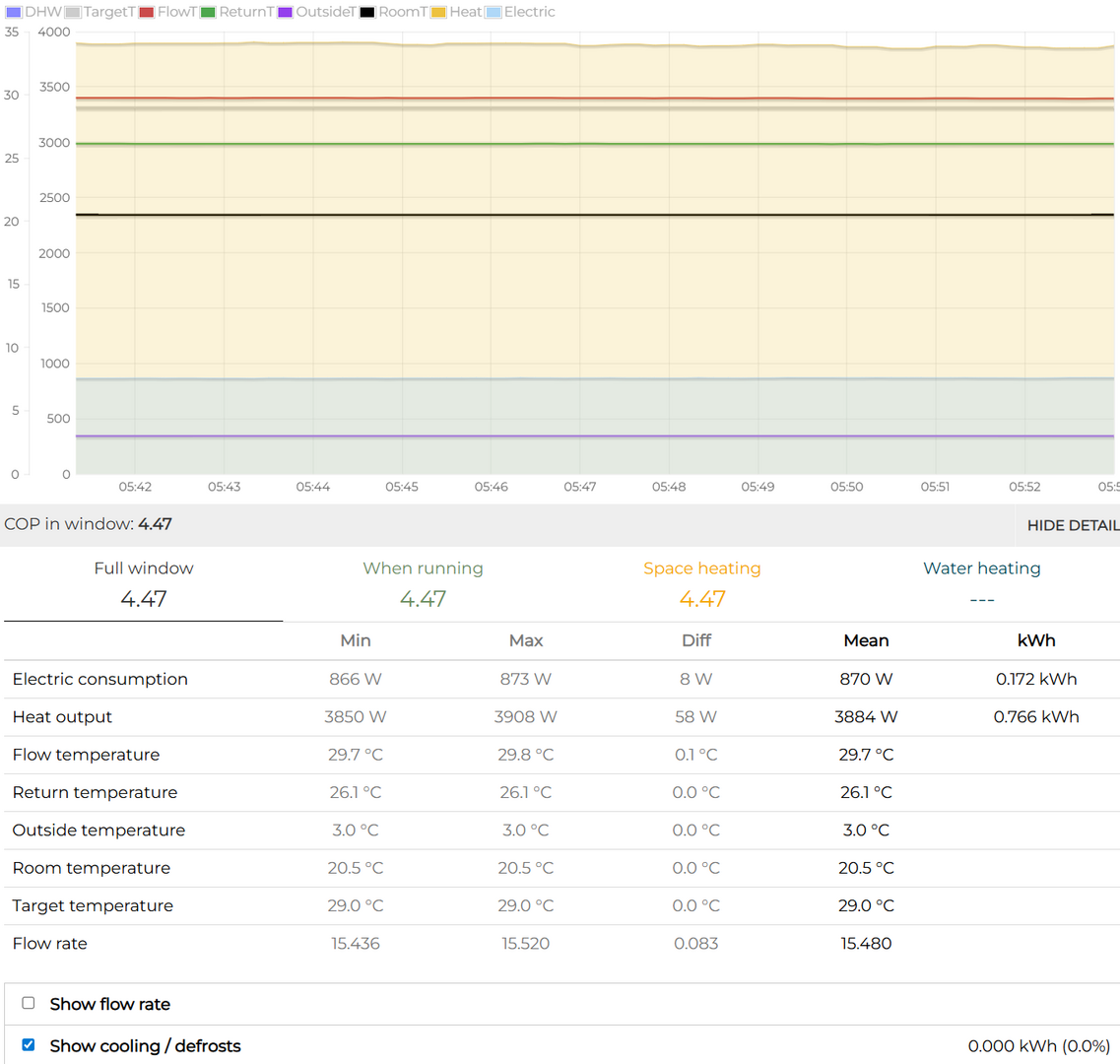
In the next 11 mins system used 0.172 kWh to produce 0.766 kWh, at a COP of 4.47.
That's 0.172 - 0.164 = 0.008 kWh more than pre-defrost (0.009 - 0.008 = 0.001 kWh remaining). And 0.766 - 0.691 = 0.075 kWh more than pre-defrost (0.309 - 0.075 = 0.234 kWh remaining to be restored).
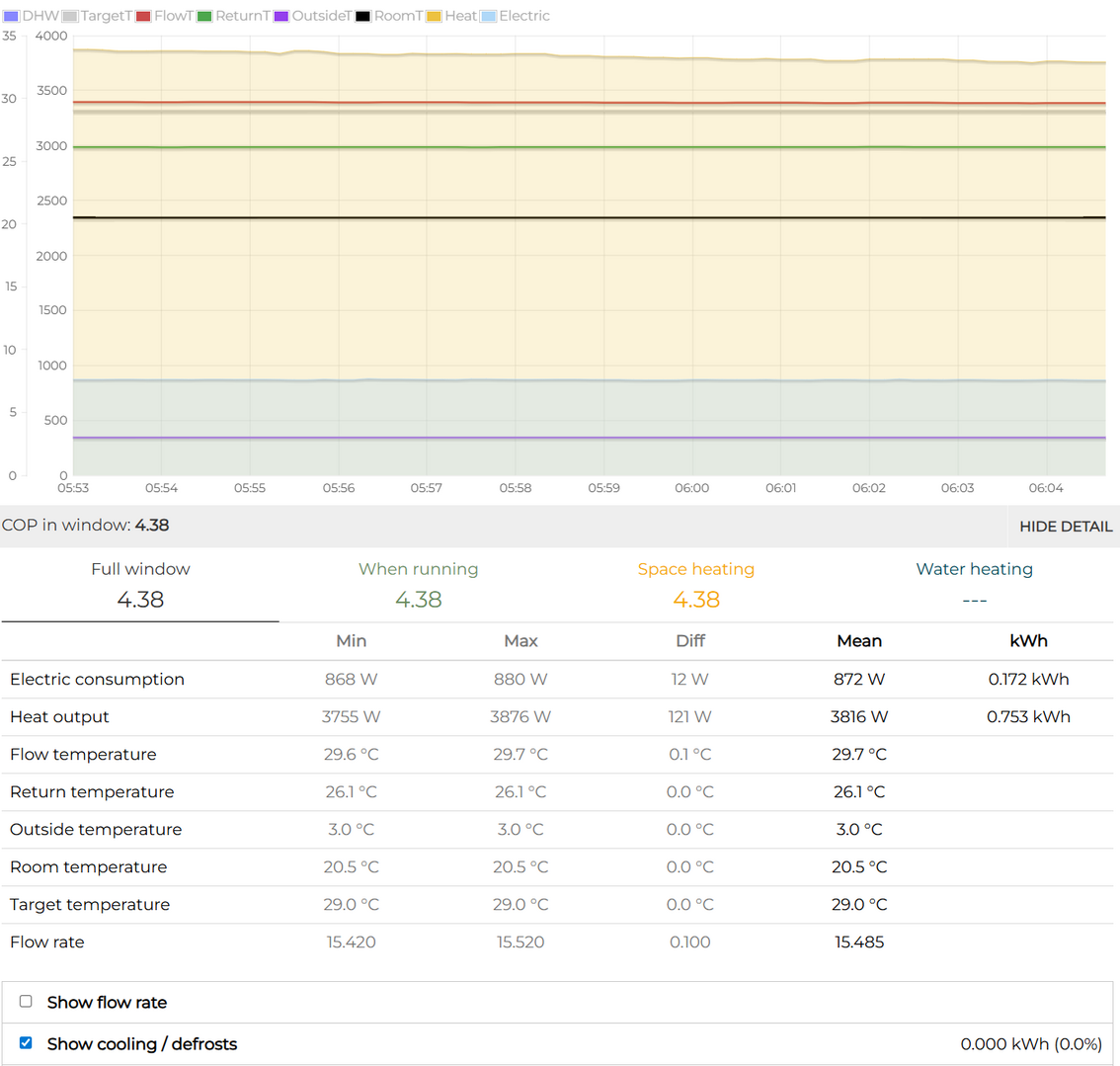
In the next 11 mins system used 0.172 kWh to produce 0.753 kWh, at a COP of 4.38.
That's 0.172 - 0.164 = 0.008 kWh more than pre-defrost (0.001 - 0.008 = -0.007 kWh remaining, so all of the savings during the defrost have been used at this point). And 0.753 - 0.691 = 0.062 kWh more than pre-defrost (0.234 - 0.062 = 0.172 kWh remaining to be restored).
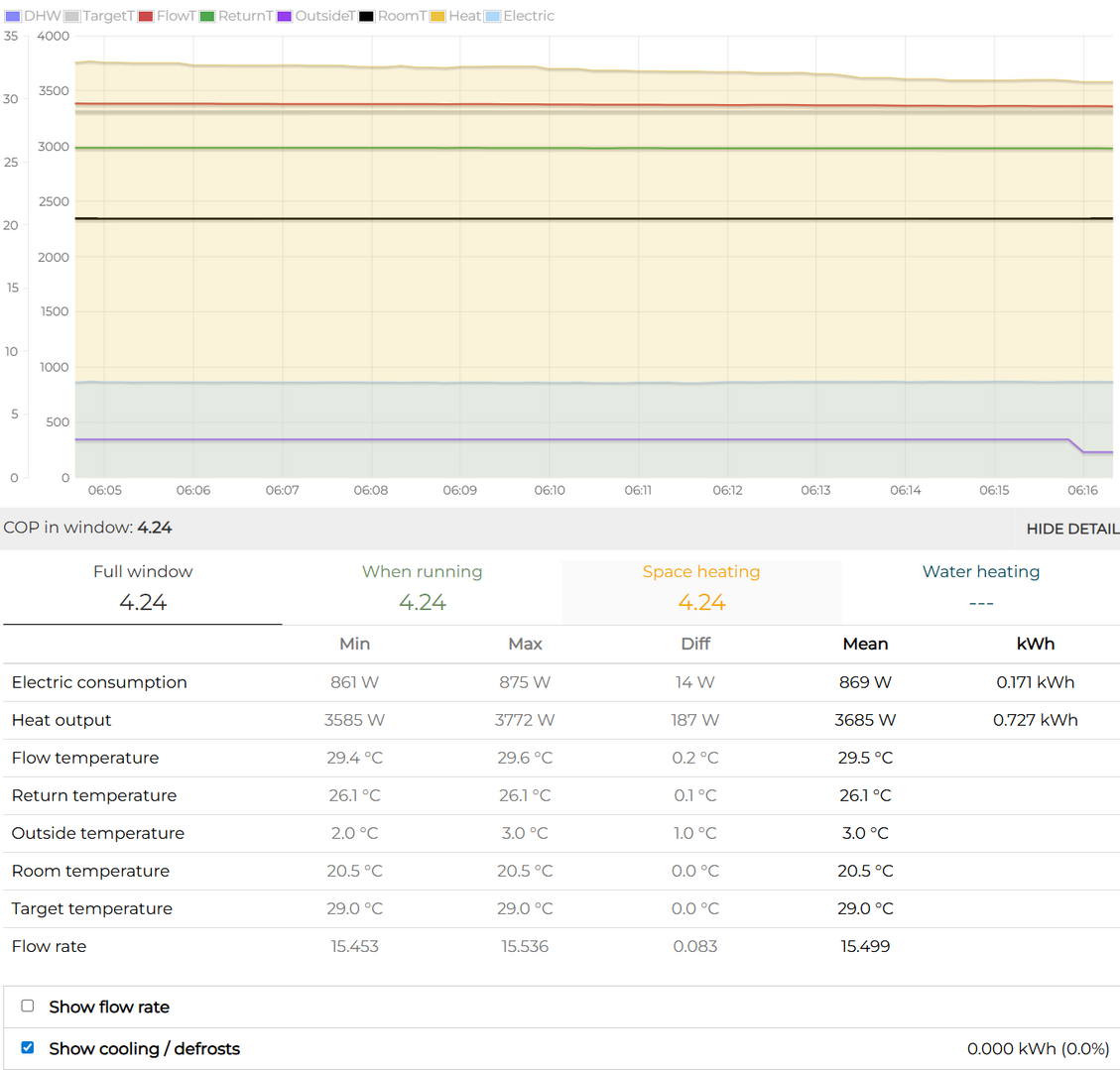
In the next 11 mins system used 0.171 kWh to produce 0.727 kWh, at a COP of 4.24.
That's 0.171 - 0.164 = 0.007 kWh more than pre-defrost (-0.007 - 0.007 = -0.014 kWh remaining). And 0.727 - 0.691 = 0.036 kWh more than pre-defrost (0.172 - 0.036 = 0.136 kWh remaining to be restored).
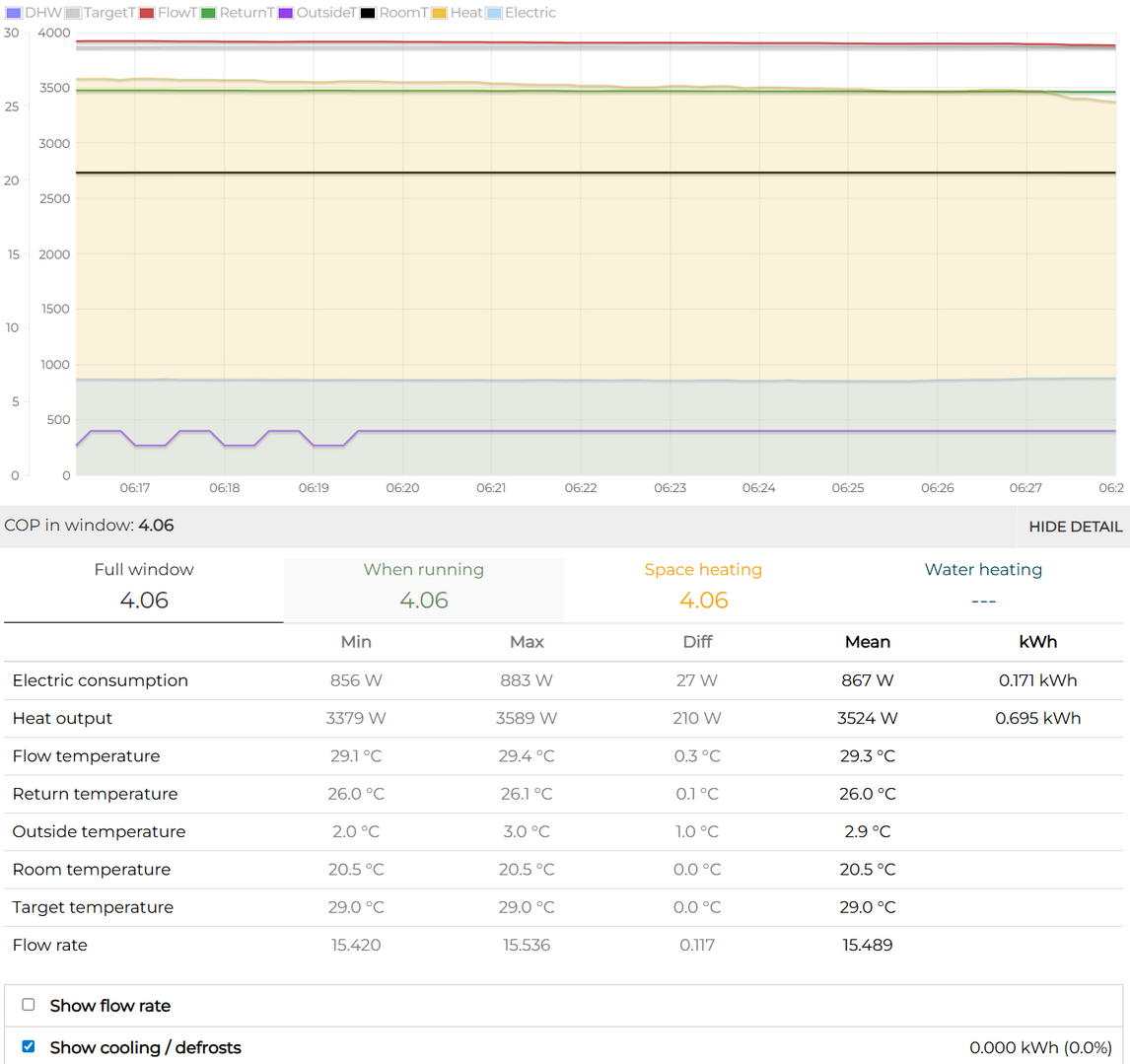
In the next 11 mins system used 0.171 kWh to produce 0.695 kWh, at a COP of 4.06.
That's 0.171 - 0.164 = 0.007 kWh more than pre-defrost (-0.014 - 0.007 = -0.021 kWh remaining). And 0.695 - 0.691 = 0.004 kWh more than pre-defrost (0.136 - 0.004 = 0.132 kWh remaining to be restored).
The next defrost starts one minute later, and the cycle repeats. So there is a tiny 0.132 kWh deficit, 2% of the total output between the defrost and the next one (with the less conservative value above the deficit is only 0.057 kWh). The defrost has caused just 0.021 kWh of extra electrical input, which I have to admit is less than I expected!
Could the flow temperature be lower if there were no defrosts? Almost certainly yes, but not much lower as the ~1 hour prior to the defrost that doesn't raise the IAT shows. But defrosts are a fact of life (well physics) and the above shows they are not terrible for electrical usage.
Hopefully that helps our collective understanding of defrosts. If there are any mistakes in the maths above please let me know!
Re defrost systems, i asked the engineer about these when the system was fitted. Viessmann have a two stage defrost, if the air temperature is above 0° the compressor stops and the fan pulls air through the pump to remove the build up of ice, this uses very little energy. If it is too cold for this to be effective the compressor then starts, and it pulls the warm water back into the pump radiator fins so defrosting the ice, this of course will use more energy. The first time it did this when i was stood next to it, it was very concerning, as when it reverses the hot water creates a cloud of water vapor for a few seconds, after which the defrosted water starts to run out of the bottom.
It is surprising how much water is produced,so when fitting it need access to a drain.
During the 11 mins of the defrost the system used 0.034kWh of electricity and 0.256 kWh of thermal energy is taken from the water to defrost the heat pump:
This appears to confirm what I hinted at earlier, the bulk if not all of the energy used for a defrost comes from the warmth (thermal energy) stored in the water in the radiator circuit. As I said a while back, during a defrost, your heat pump does in a way become a heat thief, though I suppose it could also and perhaps more accurately be said it had previously put heat in the bank, and was just making a withdrawal against earlier deposits.
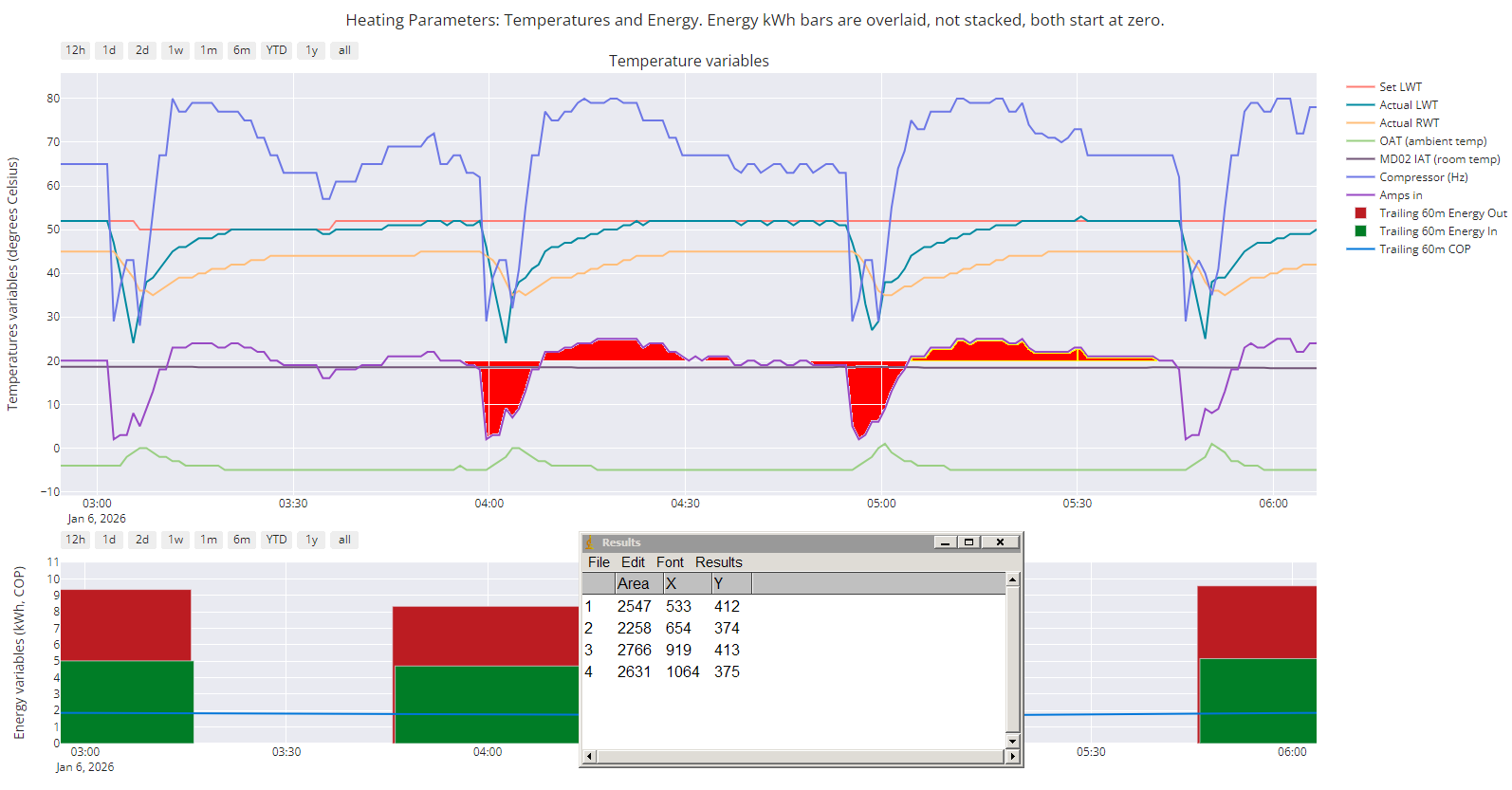
Another way of looking at this might be to use an 'area under the curve' approach. This can be done easily enough in ImageJ if one accepts pixel counts as the unit of measurement. Here I have filled in defrost - recovery - defrost - recovery from left to right, using '20' as the baseline, and then measured the areas in the same order:
It doesn't show values in kWh (and the areas are proxies for amps in), but in this example it suggests the post defrost recovery boost uses slightly less extra energy in than the energy in saved during the defrost. Quite how this squares with the conservation of energy, which must apply because the IAT stays stable, is beyond me. Perhaps I had the baseline in not quite the right place. But the overall conclusion, that defrosts are in reality not costly in terms of overall energy use remains the same. One might say their bark is worse than their bite. The COP is terrible, less than 2, but I think that is chiefly due to the OAT being around -5°C during the period shown.
I think that is a valid methodology and conclusion, no doubt @robs, @jamespa and very possibly others will soon correct me if I have got this wrong.
Re defrost systems, i asked the engineer about these when the system was fitted.
Thanks for this. It does seem Viessmann primarily use the heat (thermal energy) stored in the circulating water to achieve the defrost when extra energy is necessary, which is consistent with the above.
Midea 14kW (for now...) ASHP heating both building and DHW
I think that is a valid methodology and conclusion, no doubt @robs, @jamespa and very possibly others will soon correct me if I have got this wrong.
Area under graph is indeed a valid approach and the one I would use, the challenge is 'where do you draw the reference line'. The latent heat of fusion of water is 330kJ/kg, so one would hope that the energy use is not too far above (that/COP), otherwise the is a significant defrost inefficiency. Only observation of actuals can confirm that though, which is what you seem to be attempting to do.
4kW peak of solar PV since 2011; EV and a 1930s house which has been partially renovated to improve its efficiency. 7kW Vaillant heat pump.
@jamespa — thank you. I eyeballed the reference line, and it fell conveniently on the '20' grid line (convenient that is for doing the fills in ImageJ). I dare say the line doesn't need to move very far at all to get the areas above and below it to be equal.
Midea 14kW (for now...) ASHP heating both building and DHW
@jamespa — thank you. I eyeballed the reference line, and it fell conveniently on the '20' grid line (convenient that is for doing the fills in ImageJ). I dare say the line doesn't need to move very far at all to get the areas above and below it to be equal.
... and therein lies the problem. This is probably nearly as difficult as setback. The physics is simple, the engineering and measurement less so!
4kW peak of solar PV since 2011; EV and a 1930s house which has been partially renovated to improve its efficiency. 7kW Vaillant heat pump.
There is a detailed analysis of a defrost cycle for a Samsung heat pump here that may be of interest.
Samsung 12kW gen6 ASHP with 50L volumiser and all new large radiators. 7.2kWp solar (south facing), Tesla PW3 (13.5kW)
Solar generation completely offsets ASHP usage annually. We no longer burn ~1600L of kerosene annually.
There is a detailed analysis of a defrost cycle for a Samsung heat pump here that may be of interest.
Thanks for this. It certainly is detailed! And I think it generally confirms the idea that most of the energy used in a defrost comes from the heat contained within the circulating fluid in the emitter circuit. The only omission I can see is a direct measurement of energy in, so we can't compare energy in saved during the defrost with extra energy in used during the recovery, but energy out is there, and again it shows the negative flow, ie from the house to the heat pump.
Midea 14kW (for now...) ASHP heating both building and DHW
My thoughts are I’d like to get back to the topic in question. As far as the recent posts has been, how much electrical energy is used in a defrost and what are all the elements that make up that energy. To that end it would appear there are 3 items unless someone knows of others?
1. the electrical energy used to reverse the flow in the compressor for defrosting purpose
2. the energy to replace the 12 minutes heating lost while the defrost took place and
3. the energy needed to reheat the 180 litres of water which has been chilled and sent around the heating system after the defrost.
I have some figures on this but interested if any views on other energy usage which might be relevant to this total.
As we have an H4 boundary OEM level 3 monitoring setup all of the electricity used by the system (heat pump, water pump, controller, etc.) and all of water thermal energy flows (heating/defrost/cooling) are monitored. These data points are recorded every 60 seconds, providing a detailed record of what our system is doing 24/7. In the following charts the energy (input and output) and flow/return temperatures are from the OEM level 3 sensors, while the target flow temp, room temp/IAT and outside temp/OAT are from a device connected to the controller sold by @f1p on ebay (this reads values from the Mitsubishi controller and are the values used by the controller to control the heat pump).
The following is a defrost cycle in lots of detail, it is at 3C OAT and lasts ~11 minutes, so I have used 11 minute units of time to make comparisons easy. The full cycle looks like this:
@robs Your Heat Pump setup is quite exceptional. I can clearly see your heat pump is delivering the heat you require at a flow temperature of 29c when the outside ambient is as low as 3c. Likewise the detail of your monitoring setup is exemplary. Given more time I would love to understand it more.
In terms of this topic, you might be able to come up with a cost saving if you avoided a night of defrosts using something like a setback. I didn’t quite understand the data terms to make use of them. But with your understanding, Even your efficient system may benefit and it looks like the information is already there at your fingertips.
Regarding setbacks for general retrofit installations , it is clear that every heat pump installation is different. From our previous discussion your system operates at 10C lower flow temperature than my system and appears to have the latest tech - R290 Mitsubishi with its extra low minimum output.
Ours is a R32 heatpump by Mitsubishi with the installation designed at what might be seen by the whole industry as typical and ‘cautious’ RETROFIT installation for an old house with partial 10 mm microbore installed. It has been designed at what I believe is typical for retrofit at 45C flow temperature. I believe this is still standard practice for retrofits which means the vast majority of retrofit installations have a considerably higher consumption level than your fan coil radiator installation.
So in terms of energy saving I believe, as a Retrofit installation the defrost temperature zone is a particularly inefficient and costly period which becomes only more costly the colder the temperature gets. (In other words the true defrost burden should really reflect a mix of colder temperatures)
it’s worth emphasising and not to forget the energy saved in a setback is not just the defrost energy, there is also the actual running cost for the continually operated period at the colder temperature.
Finally there is the recovery process and getting the property up to 21c by a certain time of day. This was discussed earlier upthread and is very much down to the thermal properties if the external walls of the property. We have fully insulated the inside faces of all external walls, with a small exception of a brick fireplace. We have some internal brick walls which don’t cool down much in the setback period. Nonetheless we still have created a schedule which starts to reheat at either 4am or 6.30am depending on how cold the temp drop is.
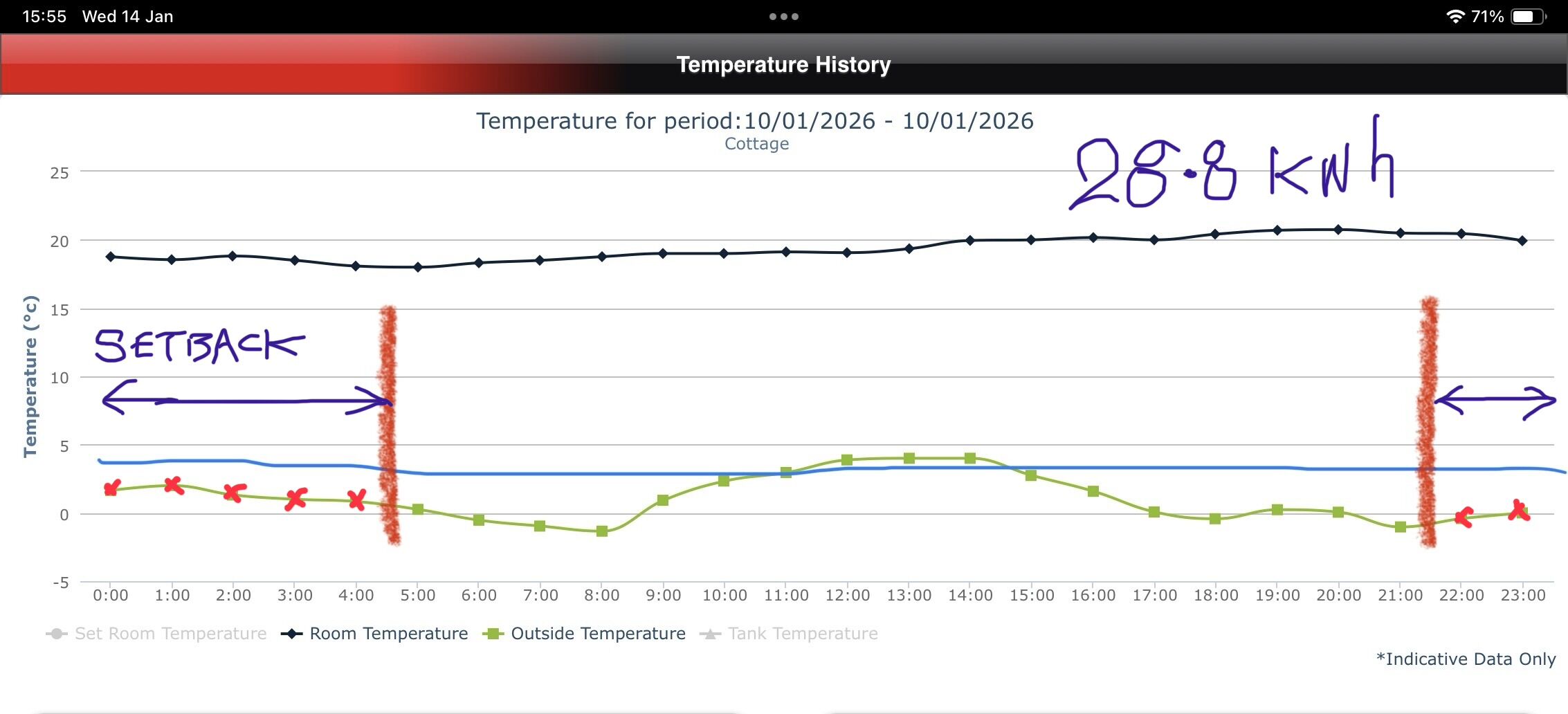
I’ve attached a 24 hour outside temperature chart and sketched a blue defrost line. Below this blue line the heat pump is operating within the defrost temperature zone. I have also marked the potential defrost hours in red, which fall within the setback period . The broad red lines show the extent of our setback period. On this particular day we would normally have been operating at 40c flow temperature. And our total consumption is 28.8C. I’m sure this will only have relevance to someone operating at at 40c or 45c.