
Notifications
Clear all
Joining the Renewable Heating Hub forums is completely free and only takes a minute. By registering you’ll be able to ask questions, join discussions, follow topics you’re interested in, bookmark useful threads and receive notifications when someone replies. When choosing your username, please note that it cannot be changed later, so we recommend avoiding brand or product names. Before registering, please take a moment to read the Forum Rules & Terms of Use so we can keep the community helpful, respectful and informative for everyone. Thanks for joining!
Air Source Heat Pumps (ASHPs)
110
Posts
12
Users
44
Reactions
12.3 K
Views

21/11/2025 9:52 pm
@jamespa some fair points. Personally we prefer how our native controls are operating our ASHP I think, and we may even be on track to make some savings, but certainly not much in it either way.
Me too, but I think we are in the minority. Most homeowners dont understand anything about heating, dont want to understand anything about heating and just want to be instantly warm when they turn it on. Most also probably believe that turning the heating off for 50% of the time halves the heating bill.
4kW peak of solar PV since 2011; EV and a 1930s house which has been partially renovated to improve its efficiency. 7kW Vaillant heat pump.

22/11/2025 8:56 am
@jamespa yes probably. That said I was one of those people a few years back. Probably up until around 6 months before we got our ASHP installed tbh. I also just assumed up until a few months ago that I must have IAT influence (it was your good self in fact who enlightened me otherwise!).
they dont know because the algorithm itself learns
Just revisiting this point, I actually think this is very possibly the reason. I remember contacting the homely when our outlet flow temp was overshooting. It was basicallly maxing out at 50°C for no logical reason and making our house far too warm- uncomfortably so (no Tou tarrif settings). Random times as well. They could only solve it by capping the max flow temp at 46°C, which then had the obvious consequence when it got really cold. In summary they had no idea what their own product was doing, which was perhaps slightly concerning.
1

Topic starter
22/11/2025 2:02 pm
@jamespa yes not sure whether you'd have to stick any probes/plugs anywhere. There seem to be a few integration options for Ecodans.
I've re-read your initial response regarding this, and I think the confusion arose because it refers to both Homely and Home Assistant within it, and I was thinking of Homely with regard to the more complex hardware set up.
I've been reading up on Home Assistant this morning and, given that I've purchased various Tapo smart plugs and temperature sensors recently, it looks like I'd potentially have a lot of Home Assistant compatible kit to make experimenting with it an interesting side-project (I can picture my wife weeping quietly if she ever reads that I've got another 'geek' project to focus my attention!)
I've got an old, unused Raspberry Pi 2 upstairs somewhere, a consequence of a previous geek project which presumably would enable an initial setup attempt. If not, then logically I'd buy a Home Assistant Green as a quicker way forward, but I can maybe save myself £115 or so by avoiding this. For now, I'd just want a central hub for the energy monitoring side of things in the house, rather than setting up loads of home automation, although I suspect that trying to learn how to navigate around Home Assistant might start me thinking about what else I could usefully do with it.
Thanks for the suggestion. Once I'd picked up on the fact that I was at crossed purposes about the two different things beginning with H, the suggestion made much more sense (so, my bad, basically!)
130m2 4 bed detached house in West Yorkshire
10kW Mitsubishi Ecodan R290 Heat Pump - Installed June 2025
6.3kWp PV, 5kW Sunsynk Inverter, 3 x 5.3kWh Sunsynk Batteries
MyEnergi Zappi Charger for 1 EV (Ioniq5) and 1 PHEV (Outlander)
User of Havenwise (Full control Jun-Dec 2025, DHW only from early Dec)
Subscriber to MelPump App data via CN105 Dongle Kit
1
22/11/2025 2:28 pm
@sheriff-fatman ah no worries...yes we are definitely done with homely. Home assistant is a different beast entirely.
I think the Pi 2 might come up a little bit short in terms of RAM? I just short-cutted and bought the HA green, partly because I didn't have anything I could recommission. It is good, and the built in energy dashboard is really decent and easy to use as well.
Topic starter
22/11/2025 2:36 pm
I can think of a few possible reasons why the manufacturers of third party controls in general might want to be obscure about what they actually do
- if they explain what they are doing then people like you and me will simply set up the native controls to do the same
- they arent targeting people who understand it, they are targeting people who just want things to work
- they change their algorithm
- they dont know because the algorithm itself learns
- marketing blurb is written by marketing people, who know hot to obfuscate even if the product they are selling is basically rubbish
- the product is basically rubbish, at least for the application for which they are selling it
I dont thing (6) applies to Homely, Havenwise or Adia, but it does IMHO apply to many other third party controls. IMHO the whole heating control industry has brainwashed us over decades into the false idea that microzoning in time and space is beneficial (or even possible in a real household), and ignored the simple truth that turning down the flow temperature on your gas boiler so that it actually condenses, as it was designed to do, was by far the best thing you could do.
I can't speak for the other systems beyond Havenwise, as it's the only one I'm familiar with. I suspect that Havenwise is capable of learning from individual system performance, but am not sure how much of this is recycled into tweaking the operation of them to fine-tune performance, as there would be a huge processing requirement to do so in this way across the portfolio of systems it runs. However, it is perhaps something they can do at a more global level as they collect data from systems of different sizes, manufacturers and across a variety of different homes.
One thing I do lack currently, is any comparative data from using the system in native WC mode and that is perhaps something that might be worth looking at a little later down the line. I switched Havenwise on from 'day 1' and, as @benson alluded to regarding Homely, it is a useful comfort blanket for a new heat pump user to have a 'set and forget' method of running beyond that which is left behind by an initial installer set up, of which there will be great variation in quality.
In my case, and I admit I'm not typical in this regard, the interest in the data and operation of the heat pump prompts me to want to understand things further, and there may be a logical point where its worth comparing the two approaches to see what my system does in native WC mode. Logically, I'd run this over a prolonged period, such as an entire heating season on each, so it may be a very 'long game' to reach any sort of conclusion on this, but I at least now have access to relevant data captures over which a review of this nature would be feasible.
I genuinely don't know what it would show, and I'm not implying that one approach is better than any other in the analysis I posted earlier. I'm approaching this more from the point of experiencing a very 'non-typical' usage profile, but one that is working well from an end-user perspective (i.e cost and comfort).
Ultimately, once a system is in place, it can provide clarity as to what the actual heat loss is within a property, relative to the guesswork, however sophisticated, that has taken place prior to this, and that is one aspect that I've now started to plot via the kWh produced vs average daily temperature data available from the system within MelPump. Beyond that, assuming that at any given temperature/period of time there is a known fixed kWh requirement from a system, the follow on question is how efficiently can this be delivered, and if there are multiple control options to achieve this, how differently do they perform overall.
For my own property at the very least, I'm interested in trying to figure out the answer over time.
130m2 4 bed detached house in West Yorkshire
10kW Mitsubishi Ecodan R290 Heat Pump - Installed June 2025
6.3kWp PV, 5kW Sunsynk Inverter, 3 x 5.3kWh Sunsynk Batteries
MyEnergi Zappi Charger for 1 EV (Ioniq5) and 1 PHEV (Outlander)
User of Havenwise (Full control Jun-Dec 2025, DHW only from early Dec)
Subscriber to MelPump App data via CN105 Dongle Kit
22/11/2025 3:22 pm
Logically, I'd run this over a prolonged period, such as an entire heating season on each, so it may be a very 'long game' to reach any sort of conclusion on this, but I at least now have access to relevant data captures over which a review of this nature would be feasible.
Indeed. That is what we are doing at the moment and this month has been the first full month that I can start to draw any comparisons. By 1st Nov 2024 our homely had its two weeks to make it's adjustments to the algorithms, and for that month [Nov 24] we used around 690kW for space heating.
So far for Nov 25 we have used 442kW and it seems to be to be a remarkably similar month in terms of weather profile, compared with this time last year. Mostly quite mild, but with some really cold days- in fact some of the coldest of the year. Therefore it looks like it is going to be very close in terms of cost/energy consumption. But....I have full control of my heating settings, it has been slightly more comfortable, and I also have control of whatever data I want to see.
I do think homely and havenwise are decent enough products, but for setups which include battery storage rather than using the actual house as thermal store and effectively overshooting during cheap periods, I don't think that there's any real money to be saved. Thus it boils down to whether you like the convenience of their particular app I guess. This is a big benefit in fairness, albeit again HA has a really good app and you can set up a dashboard to replicate similar controls/toggles. I wouldn't just want to rely on the physical control panel.
This post was modified 4 months ago by benson

22/11/2025 4:21 pm
@benson It will be interesting to see what Homely have in mind when they polled users about what other kit for solar and battery storage they might have or thinking of adding. Regards, Toodles.
Toodles, heats his home with cold draughts and cooks food with magnets.
22/11/2025 9:54 pm
@toodles oh yes I did get that email but didn't respond. If they somehow developed a way of having the best of both worlds, as our battery isn't quite enough to provide all of the kWs we need on very cold days outside of the cosy dips, that would be interesting...
Topic starter
22/11/2025 11:13 pm
Prior to doing any further updates on this thread, it's worth clarifying the situation with the conservatory saga which dominated the quotation process, as I've made reference to the fact that it got upgraded subsequent to the installation, which is the 'wrong order' than you'd ideally choose to do this.
The conservatory, even after upgrade, is still likely to be relevant to the overall CoP achievable in the house, but it's easier for a knowledgeable reader to form their own views if they can visualise it.
So just to recap, when we commenced the quotation process in February we had no idea that the conservatory would prove to be such a challenge. It was a 1997 extension added by the previous owners and had been connected to the wet heating system via pipework running through the floor of an upstairs bedroom off the radiator in there. It was controlled by a separate thermostat to the main house, which we subsequently discovered would have been a requirement of the building regs at the time, as was the fact that the external doors and windows remained in place when it was built to separate it from the main house.
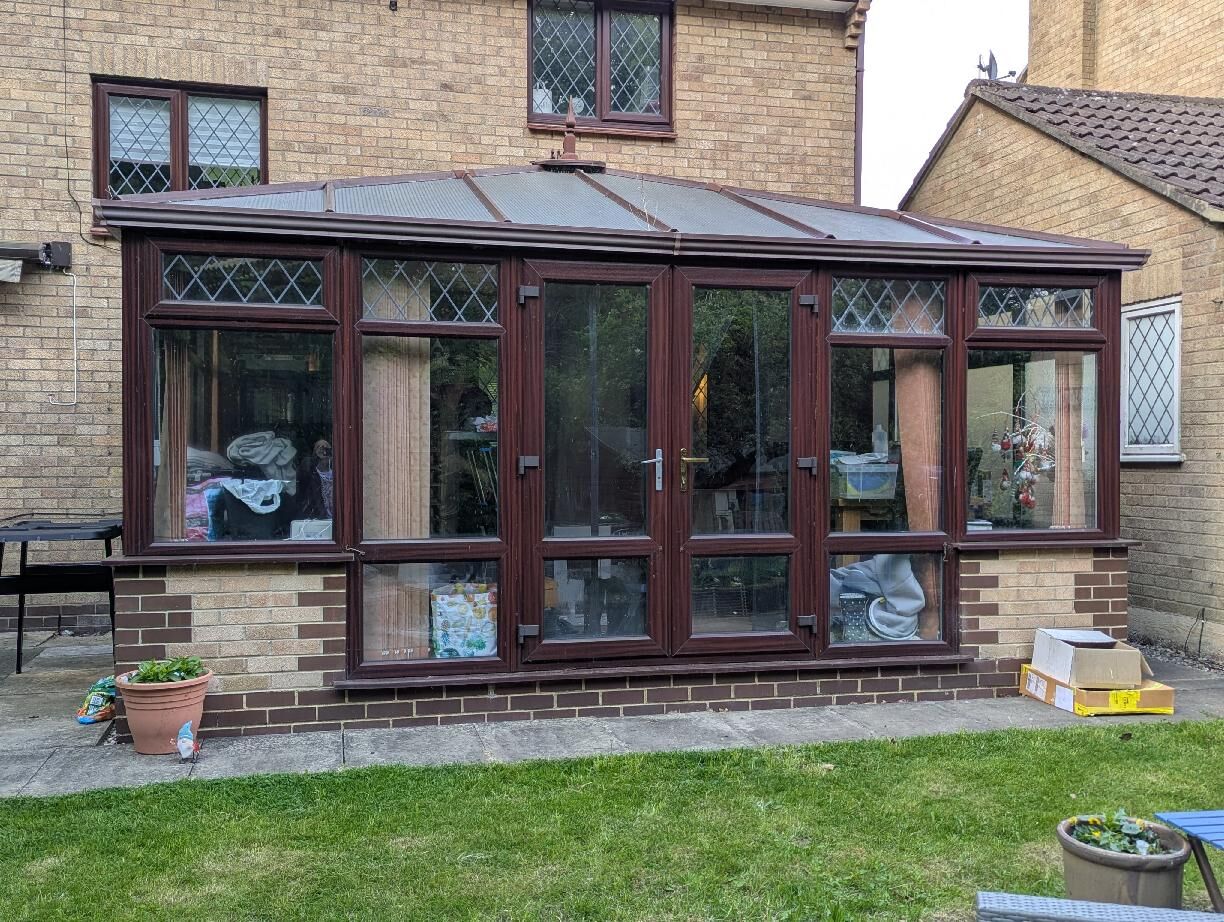
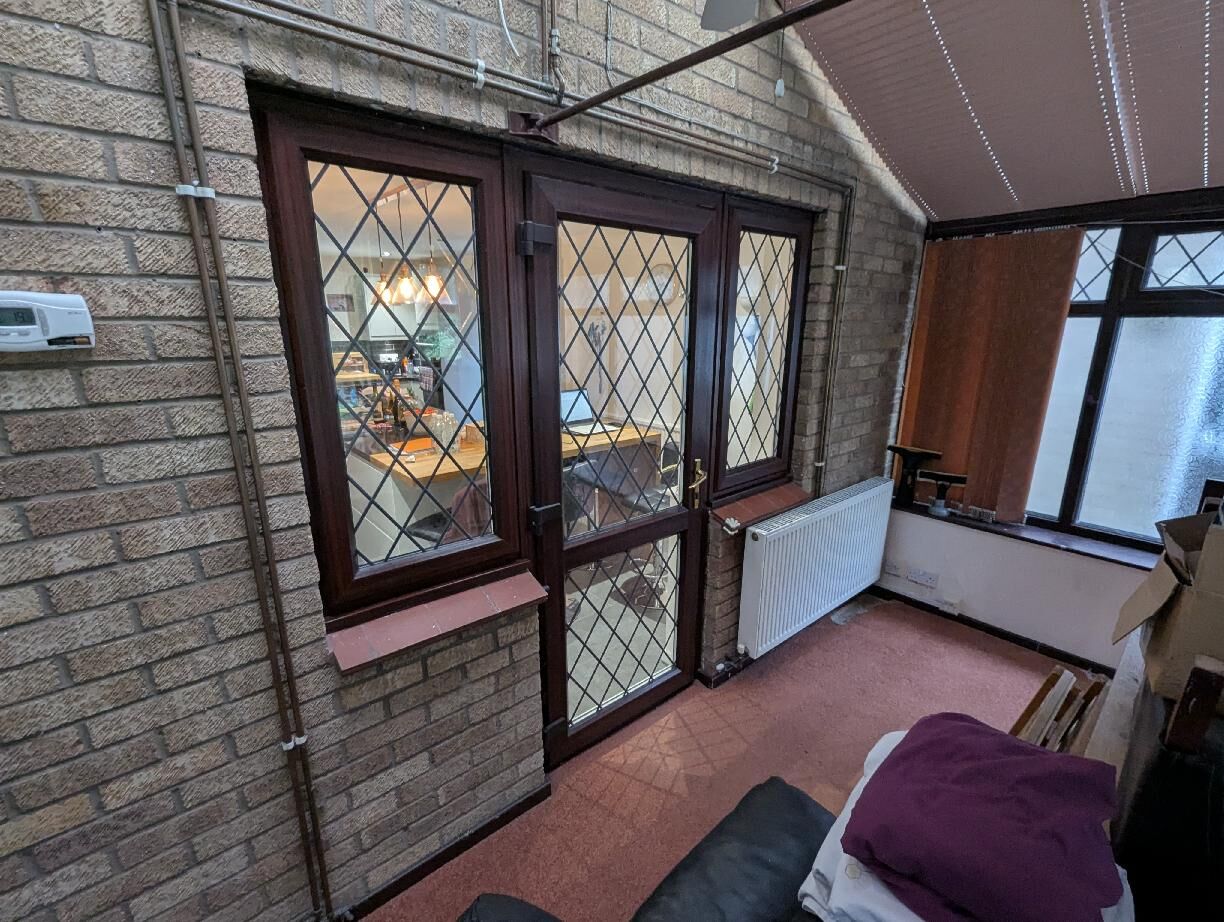
The above photos show the external and internal layout at the time (the internal pipework had been covered up prior to this, but we exposed it ahead of the work commencing).
During first heat loss survey, done by Octopus, the surveyor mentioned the conservatory as soon as he walked through the door. To his surprise, rather than exclude it, he calculated that the two radiators in there were recovering about 97% of the heat loss, and so was able to build it into his design.
Others, as we would subsequently discover, automatically ruled the conservatory out of consideration in the design and wanted to disconnect it, but this seemed counter-intuitive to do so, and then have to find an additional heating solution for that room alongside a new heat pump. We worked with various designs which included it, accepting that there would be a compromise on performance in doing so as the heat pump would have to work harder with the room included.
However, this also triggered us considering what to do about the conservatory longer-term, so as we were working on the heat pump quotations we started researching methods to improve the heat loss within that room. This very quickly ruled out any of the cheaper 'insulate an existing roof' propositions, as the size and existing structure wouldn't have supported the weight of such, so we moved on to looking at replacing doors, windows and roof. We learned from this that, if the job was done with appropriate building regs certification, we could properly convert the conservatory into an 'official' room within the house and lose the requirement for the external doors and windows to remain.
As suspected, the first couple of quotes we got for this work were prohibitive, but we then saw an advertisement for a local company offering a summer discount on work booked to commence within the next 4 weeks (essentially to cover one of their natural quiet periods). Naturally sceptical of such a 'deal' we got them to do a survey, and the quote received, which was several thousand pounds less than any of the others, along with the professionalism of the surveyor in answering queries nudged us into having to seriously consider it. After an evening of trawling Trustpilot and Facebook reviews, and doing due diligence on the company financials, we committed to the work on the final day of their summer offer, for an installation to commence approximately one month after the imminent heat pump installation date.
I had already done some calculations using the existing heat loss data to see what potential impact such a change would have on the outcome, and the conclusion was that amending the u-value figures in the relevant areas of the calculation would result in a heat loss reduction of, from memory, around 750W, which wasn't enough for us to need to size down from the 10kW Ecodan. The timing also allowed us to speak to the heat pump installation team to ask them to re-site the existing radiator under one of the external windows, as part of the wall on which it was sited was going to be removed. This was a relatively simple job for them and we only incurred an additional charge, at cost, for the new radiator, as this hadn't been originally factored as one requiring replacement. The photo below shows the conservatory on the weekend prior to the conservatory rebuild, after we'd cleared it out ahead of the job, with the re-sited radiator in place.

The conservatory rebuild was done over 4 days in late July, followed by re-flooring work and our own redecoration efforts, and it's fair to say that we are thrilled with the outcome. Having seen the extent to which the roof was insulated during construction it's easy to see where the improvement in ceiling heat loss will come from. The windows and new bi-fold door are still significantly glazed areas (just under 17m2 of glazing, as per the heat loss calculations) but the new double glazing will improve heat loss to some extent.
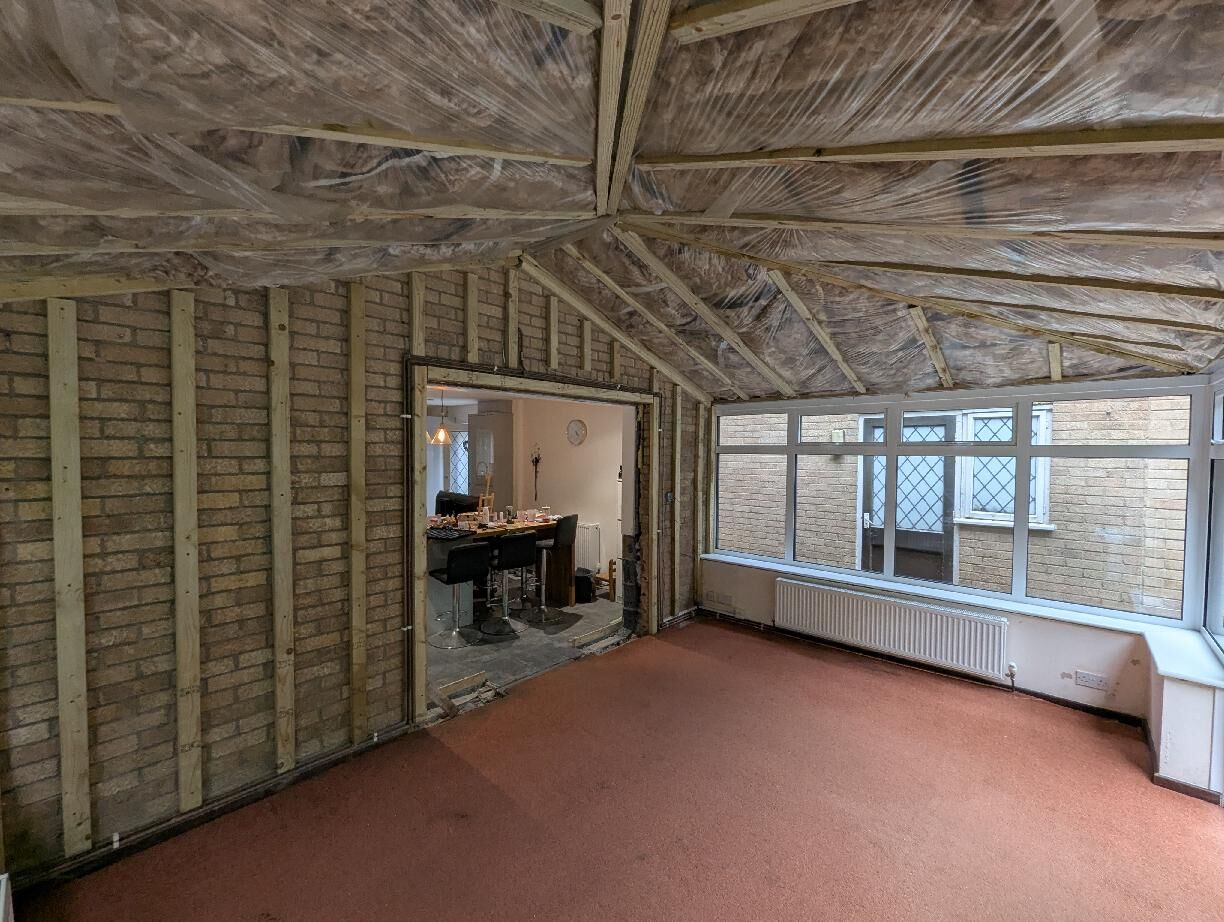
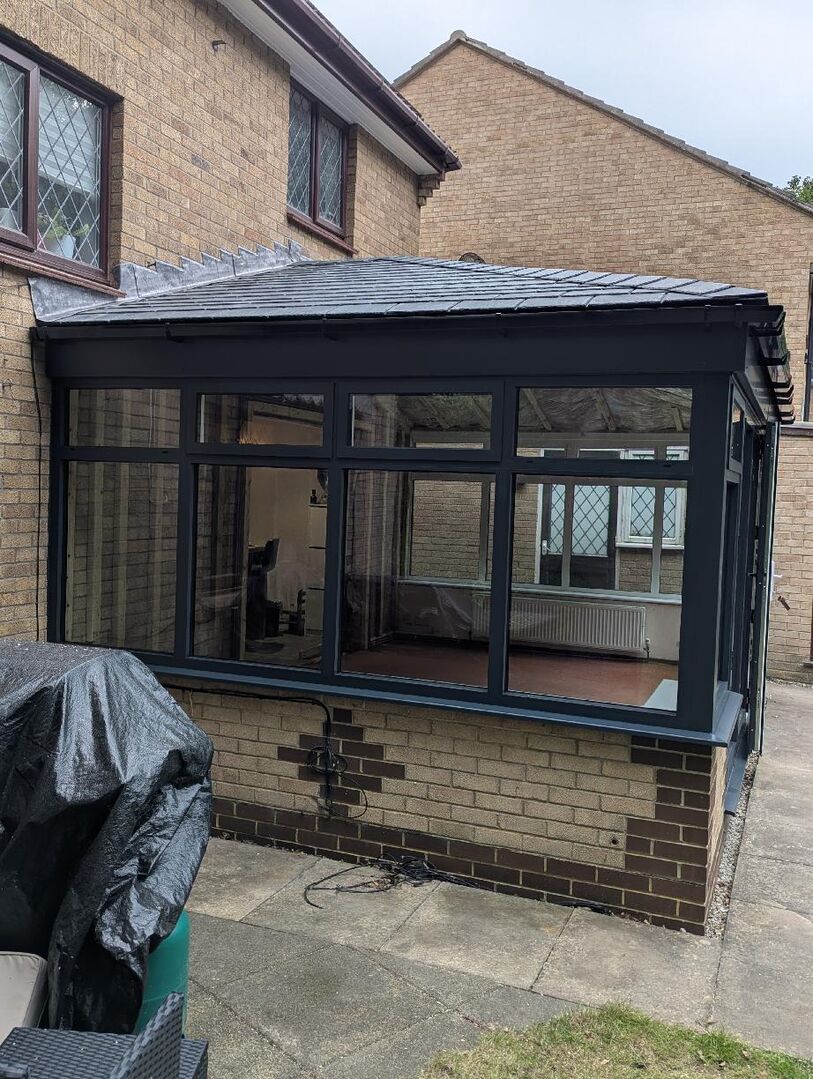
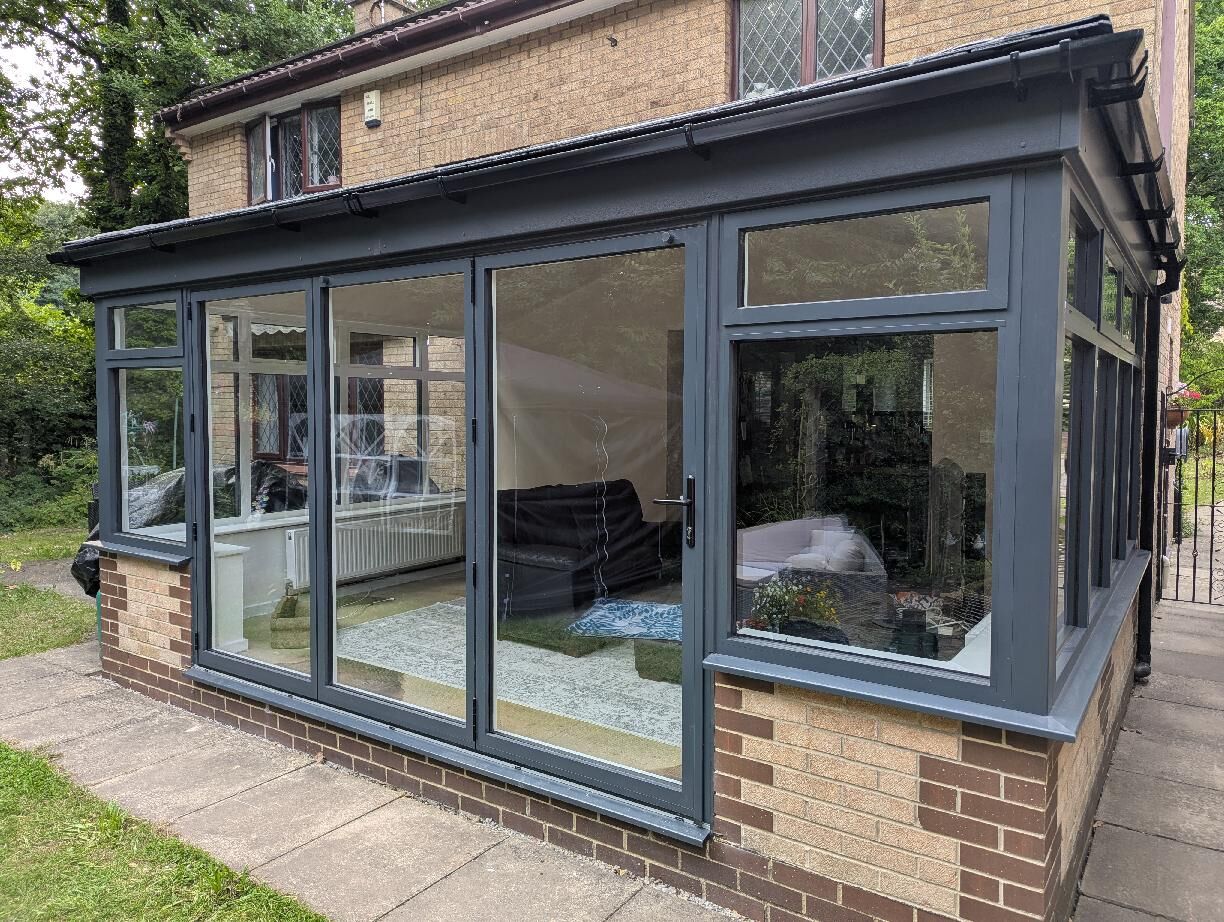
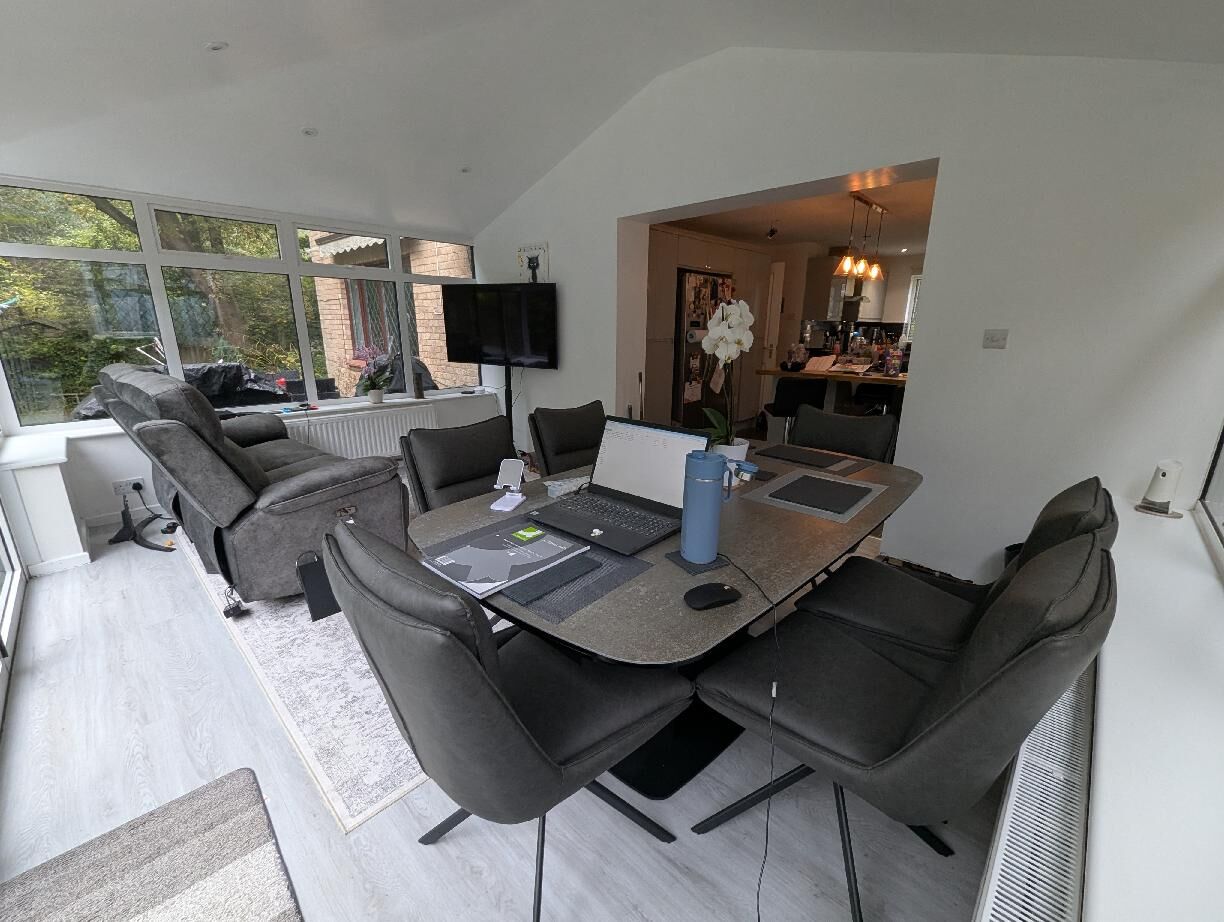
The big difference for us is that the room has immediately become one which the whole family, including the cat, now love to use and the conservatory area has gone from being an occasional room that we largely avoided in the extremes of winter and summer, to one which has become the de-facto dining area and a secondary TV room, so it's now a true full-time room. The only downside is that my Zwift indoor cycling setup has been banished from there into the garage, where motivation to go and use it in these temperatures is something of a challenge.
At the time of the installation we opted to leave the open area exposed by the removal of the doors and windows to see what it was like to live with, and we've subsequently concluded that it will stay that way. Similarly, we've kept the glazed areas uncovered to see how the room performed during winter without them, as the natural light that the room gets through them is a really appealing feature of the room, and we were reluctant to want to block it (the room itself can't be seen into by neighbours, so privacy isn't an issue). We're getting new blinds fitted in our living room this week, as part of a refurbishment of that room, and chances are we'll get the company we've chosen to quote for some form of roller blind solution for the conservatory.
From a heating perspective, it is easily reaching temperatures equivalent to the rest of the house, even in the current freezing outdoor temperatures. In the early morning it can be a degree lower than the adjacent kitchen area, but we're talking about it being 20°C when the kitchen is 21°C and it then catches up, presumably due to solar gain.
I thought it was worth giving a visual insight into this change as the updated conservatory area is likely still likely restricting what the achievable CoP from the heat pump will be, due to the significant glazed area within it. Installing blinds would no doubt improve that further, and it will be interesting to see if there's a noticeable change if and when that work takes place.
What's beyond doubt is that the room is now a much better proposition for a heat pump solution than it originally was. We never got to see what the heat pump would have done with the old one, as the two were only in place simultaneously for 4 weeks in June and July when no heating was required. The fact that we've been able to make such a significant change to that room has genuinely only come from considering the challenges presented by the heat pump quotation process. With hindsight, I'm extremely grateful to have been confronted with that dilemma, given how happy we are with the end result.

This post was modified 4 months ago 3 times by Sheriff Fatman
130m2 4 bed detached house in West Yorkshire
10kW Mitsubishi Ecodan R290 Heat Pump - Installed June 2025
6.3kWp PV, 5kW Sunsynk Inverter, 3 x 5.3kWh Sunsynk Batteries
MyEnergi Zappi Charger for 1 EV (Ioniq5) and 1 PHEV (Outlander)
User of Havenwise (Full control Jun-Dec 2025, DHW only from early Dec)
Subscriber to MelPump App data via CN105 Dongle Kit
1
23/11/2025 10:51 am
@sheriff-fatman looks very nice.
And good shout checking companies house. We did our due diligence (we thought) with our installers but I missed that the director of the company had a previous business linked to him. I am not sure how I missed it to be honest as I'm normally so retentive about checking these things. That company had gone into liquidation a few years back, owing £70,000 to plumbase (amongst various debts to other creditors)! Knowing what we know now, this is unsurprising.
All they'd then done is set up a new company with a very similar name, which as we all know happens rather frequently...
2

30/11/2025 9:18 pm
@sheriff-fatman

It's also worth highlighting that the decision to use the contractor we've chosen was greatly influenced by the personal interaction we had with him during his survey, so there's an additional value, in terms of likely conversion rate, available from doing face to face surveys.  However, relative to other quote processes I've gone through, the heat pump process requires a much more significant up-front investment from both customer and provider, which is only fully understood by the customer once they've seen what's involved in one of the surveys.
Wow... that's an amazing post for details. I chose on rapport with my fitters too.
On a much smaller scale I did what you did - 🐙, British Gas, and a local installer I found via Open Energy Monitor.
There's a long thread here somewhere whilst some here on the forum hand held me through my learning and thinking out loud. It really helped.
I went with Octopus in the end - also based on personal interaction with a tech lead who came to assess my cellar for the cylinder and bounced in like Tigger saying: "ask me anything". By this time I'd thoroughly geeked out on heat pumps and he didn't blink.
The local guy was amazing too - we definitely had rapport - he'd designed his own heat loss software during lockdown and he understood my house (a bungalow built into a hill so half of it is actually on the 1st floor over a big cellar) complexities. I had decided to go with Octopus by the time I found him so I cancelled the full survey so as not to waste his time. I didn't really like the heat pumps he was fitting either.
All in all, my Octopus team were superb, my entire system was changed (every rad in the house) and I'm happy with the Daikin which runs nicely at low flow temps. It wasn't super cheap or anything but I couldn't afford them now they do this turbo malarkey.
1
Topic starter
14/12/2025 12:40 am
I prepared this analysis for a post on another forum (a football one!) for some people curious about heat pumps, and then subsequently realised that it would provide a good general update on the economic realities of our system.
It's a simplified analysis, using the 'blended' rate from our Octopus bills for each month applied to the reported heat pump power usage for heating and DHW, but it's a decent general indicator. In reality, I should attribute a higher rate to the heat pump as the car charging should logically all be assumed to be done at the cheapest 7p rate, and this method assumes that all devices share the same rate, but the overall big picture conclusions on efficiency would remain the same.

There was minimal heating usage prior to September, so I've excluded the period before then, but those will have resulted in small YoY savings on DHW usage. Subsequent to that, we're currently looking at a circa 55% cost reduction in heating and DHW costs from 1st September to 12th December. Just under £223 in cash terms.
It's a like for like cost comparison, as it excludes the electricity standing charges but includes the gas standing charge in the comparative costs which we no longer pay after having the meter removed. There's also no payments for export factored into the figures. Arguably, there might have been a slight cost to us due to lower export potential, but the export is negligible at this time of year in any event.
This is from a system that appears to be relatively inefficient, in pure COP terms, but having studied this further over the last few weeks I'm content that the constraints are related to the specifics of our property, rather than any fundamental issues with the installation, and that may well be a topic for a future post. In short, I'm getting decent real-life cost savings from a system that is working as well as I could reasonable expect.
For the last couple of weeks I've had access to extensive system data via the MelPump app and, in particular, the data available via the dongle supplied by @f1p which I've also managed to feed into Home Assistant (the rapid learning curve associated with using HA for the first time has been a 'fun' project to get to grips with) and I'm rapidly improving my understanding of how the heat pump is functioning at any given point in time. In particular, I've gained an appreciation of how difficult it is, in reality, to get any meaningful output data from a heat pump, beyond those based on calculations using flow rate and delta T. Short of spending £700 or so to retrofit monitoring equipment on the flows, I now have access to real-time data reported by the heat pump to do these calculations, but it has been eye opening to realise that there's no way of actually having any metered measurement of this, and to realise that any reported COP figure from any system is a function of whatever calculation that app is doing behind the scenes, so they're all educated guesses of one form or another.
At least now, via generating my own calculations through emoncms (the Open Energy Monitor add-in) in HA, and seeing that they're largely aligned with what the heat pump itself is generating I've been able to improve my own understanding of the mathematics involved in generating these figures.
For most of the period in the analysis, and for the period prior to this, I've been running the entire system under Havenwise control, but since 5th December I've removed the heating operation from this and started using pure weather compensation for heating. Havenwise now only runs the DHW cycle, but it's something that's simple to switch on and off in the app for both heating and DHW independently. I don't have enough data as yet, but ultimately I'm interested in seeing what the real-life difference is between Havenwise control and weather compensation and I had no baseline data by which to compare it to. I'm now able to see the differences in much greater detail, including compressor frequency, power draw, etc so have a great platform to be able to review this over time.
So far, albeit, based on only around a week of usage, the big surprise of the change has been to see that the weather compensation control, driven by external temperature, has provided a noticeably more stable internal temperature than the Havenwise control, which is driven by an internal thermostat reading. It was helpful that the WC settings left behind by the installers were actually pretty reasonable (45°C flow at -7°C and 25°C flow at 20°C) and I had a good amount of actual flow rate data from the Havenwise control to be able to estimate the logical adjustments to this, so it has required minimal tweaking so far to produce heat in the comfortable range that I'm looking for. That in itself has been a worthwhile learning exercise.
I'll report back my findings at a later date. However, the intention of such isn't to imply any criticism of Havenwise as I think that overall the algorithms do a very good job. Ultimately, their target customer isn't one who's comfortable enough to run a system via weather compensation, and I'd imagine that such a customer represents a very small proportion of real-life heat pump users in the UK (and that's certainly the impression picked up from being in the Mitsubishi Air Pump user group on Facebook at this time of year). Where Havenwise can really make a positive difference is through the heat pump users who want the ease of an internal thermostat driven heating experience. In fairness, I've started my heat pump journey as one of those people and it's only via my inherent desire to want to obtain and analyse as much data as I can that I've developed enough confidence to want to step away from that 'comfort zone'. I doubt that many other typical users will likely want to follow in my footsteps in that regard.
130m2 4 bed detached house in West Yorkshire
10kW Mitsubishi Ecodan R290 Heat Pump - Installed June 2025
6.3kWp PV, 5kW Sunsynk Inverter, 3 x 5.3kWh Sunsynk Batteries
MyEnergi Zappi Charger for 1 EV (Ioniq5) and 1 PHEV (Outlander)
User of Havenwise (Full control Jun-Dec 2025, DHW only from early Dec)
Subscriber to MelPump App data via CN105 Dongle Kit
1

Latest Posts
-
RE: Octopus Cosy 12 Heat Pump Regret: Incredibly Loud, Poor Heating & Constant Hum - Help!
Balancing is a long process and its possible to mess th...
By JamesPa , 2 hours ago
-
RE: Daikin Altherma 3 LT compressor longevity question
Up to a point yes. However every heat pump (and every ...
By JamesPa , 3 hours ago
-
Thanks everyone for the help, Havenwise now diasbled. q...
By Boycey , 5 hours ago
-
RE: Advice needed after a successful "leftfield" experiment.....
@pauli Depending on whether you can get an EV tariff, I...
By ChandyKris , 6 hours ago
-
-
RE: New Build ASHP Defects - Looking for Advice, Support & Shared Experiences
Is that a single pair only? If so it may be part if th...
By JamesPa , 8 hours ago
-
RE: Solar Power Output – Let’s Compare Generation Figures
@technogeek I think you are correct, but, it didn’t inf...
By Papahuhu , 8 hours ago
-

@batpred, you’re quite right; it does work well. I don’...
By Majordennisbloodnok , 9 hours ago
-

@Mars at the time of writing heating oil is £1.28 / ltr...
By TechnoGeek , 9 hours ago
-
RE: Ecodan Cylinder Possible Weeping Around Thermostat Port
Update: Mitsubishi sent an engineer around. It was li...
By Gruff2001 , 12 hours ago
-
RE: A Smarter Smart Controller from Homely?
@benson Agreed. I believe the COP gains with homely, i...
By Papahuhu , 12 hours ago
-
RE: Samsung Gen 7 16kW Integrated unit Modbus monitoring
The setup for this is a Samsung Modbus card. Connected ...
By antonical , 14 hours ago
-

RE: Forum updates, announcements & issues
@davidalgarve, if the emails are more than roughly a mo...
By Mars , 14 hours ago
-
How to Find All Your Posts and Topics on the Forum – A Quick Guide
If you’ve ever posted something on the forum and then s...
By Mars , 14 hours ago
-
RE: If a heat pump can only heat DHW to 50C then what? Issue with 18KW Heliotherm heat pump
Sorry to hear that but I'm not surprised TBH. Stratifi...
By JamesPa , 15 hours ago
-
RE: Say hello and introduce yourself
@pt151 welcome to the forums, and looking forward to he...
By Mars , 1 day ago
-
RE: Setback savings - fact or fiction?
The answer was in two parts in my reply, the second par...
By RobS , 1 day ago
-
Samsung Gen 7 16kW Integrated unit Modbus monitoring
Looking for some assistance to get modbus monitoring wo...
By antonical , 1 day ago
-
Ecodan control return to Melpump from Havenwise trial. settings check
Hi, Just got control back after being on the hav...
By Boycey , 1 day ago
-
RE: Refrigerant R32, is it now banned in the EU from 1st Jan 2027 for monobloc ASHPs?
I wonder if heat pump manufacturers will tone these sit...
By JamesPa , 1 day ago
-
RE: Who’s Caved and Switched the Heating On Already?
@editor yesterday we used 12kW of electricity for heat,...
By Judith , 1 day ago
-
RE: Rate the quality of your heat pump design and installation
Loss assessments can be a very serious case of GIGO. I...
By JamesPa , 2 days ago
-
RE: Who's your electricity provider and what's your tariff?
@jamespa Just bizarre. This is our data. I really don't...
By antonical , 2 days ago
-
RE: Mitsubishi Ecodan 11.2kW review
I think you said its an 11.2kW model and your house is ...
By JamesPa , 2 days ago