
Notifications
Clear all
16/02/2026 2:54 pm
So, based on that observation, we'd need to know a lot more about the 'tables that you've found online',
what experimentation was done to create them, and who is publishing them.
I'm pretty sure I noticed they are not all the same, even with the same (LiFePO4) chemistry and conditions. I am sure there is a definitive table, but which one? That's why (along with the other things like it has to be a resting voltage) I decided not to use voltage as my primary way of determining SoC.
Midea 14kW (for now...) ASHP heating both building and DHW

16/02/2026 5:20 pm
You can not accurately determine state-of-charge of a LiFePO4 battery by voltage, with the exception of the so-called 'knees', that is, where the battery is near 100% (3.45V and above) or near empty (towards 2.5V). Everywhere else the voltage curve, no matter the state of charge, is essentially flat. The only reasonably reliable way to track state of charge over the entire range is to do Coulomb counting (using a shunt).
My blog where I write about all the systems in place and decisions made for my off-grid house at 63 degrees north in Finland.
16/02/2026 5:23 pm
Everywhere else the voltage curve, no matter the state of charge, is essentially flat.
Indeed. Another nail in the voltage-for-SoC coffin.
Midea 14kW (for now...) ASHP heating both building and DHW

Topic starter
16/02/2026 7:39 pm
Clearly one for @transparent but is your BMS Seplos? I would not expect much help from Solis.
Was Fogstar aware you were going to use a Solis? If so, are they not helping?
I bought a pre built battery and don't know which BMS it has. I did ask them if the battery would be compatible with the inverter before I ordered the battery but I haven't contacted them, I thought I would get a better answer here, which I am getting.
Perhaps at some point we have someone with a battery from the compatibility list that can get an answer from Solis
The Fogstar battery I bought has the option to use several different protocols. It was on the plyontech protocol when it arrived and the solar installer set the inverter to work with that. It was very straightforward, especially as the solar installer was interested to see a Fogstar battery and wanted to connect it up. There is a data cable between them and the inverter reads the SOC from the battery, I've no idea what other data they exchange as it has been seamless so far.
Topic starter
16/02/2026 8:55 pm
But an SoC of 13% is reasonable for cell voltages around 3.1v
...
So, based on that observation, we'd need to know a lot more about the 'tables that you've found online',
what experimentation was done to create them, and who is publishing them.
Thank you, it is good to know that the figures do in fact line up. The tables I found on line were on various battery suppliers website and although there was some difference between them I printed off a couple that seemed to be the most common figures I was finding. It wasn't at all scientific, I was trying to get an idea of how low would be sensible go. It would be interesting to hear what others do.
There is also a screen showing capacity, full and remaining capacity in Ah and that seems to match to the SOC%, although I guess they could all be calulated from one reading.
I've driven EV's since 2017 and try to take reasonable care of the battery so am aware of not leaving the battery at high or low SOC's but I do use them to their full potential at times and fully charge and discharge the battery on occasions where it is useful to do so. I work on the assumption that something else will make the car uneconomical to repair before the battery becomes degraded enough to cause an issue.
I'd like to treat the home battery the same so am trying to understand if discharging to 3.05-3.1V most nights is a good idea or not.
I have just read on the Fogstar website that the current battery 8000 cycle claim is with a 91% depth of discharge at 25° and 50A charge and discharge rate. I had alreay set the charge rate at 50A as that is more than enough to fully charge the battery in the 6 hour Octopus IOG cheap rate window. The sheet doesn't specify where the 9% margin should be but there's a warning light on the battery if it gets below 10% so that would seem like the place they would like it to stop discharging.
16/02/2026 9:20 pm
I've driven EV's since 2017 and try to take reasonable care of the battery so am aware of not leaving the battery at high or low SOC's but I do use them to their full potential at times and fully charge and discharge the battery on occasions where it is useful to do so. I work on the assumption that something else will make the car uneconomical to repair before the battery becomes degraded enough to cause an issue.
I'd like to treat the home battery the same so am trying to understand if discharging to 3.05-3.1V most nights is a good idea or not.
I have just read on the Fogstar website that the current battery 8000 cycle claim is with a 91% depth of discharge at 25° and 50A charge and discharge rate. I had alreay set the charge rate at 50A as that is more than enough to fully charge the battery in the 6 hour Octopus IOG cheap rate window. The sheet doesn't specify where the 9% margin should be but there's a warning light on the battery if it gets below 10% so that would seem like the place they would like it to stop discharging.
LiFePO4 (LFP) does not mind going to 100% and 0% state of charge. In practice, stay below 3.55V per cell at the top, and say 3.0V at the bottom. There is no capacity beyond those points. You don't have to go with the 80-20 'rule', that's for different chemistries such as NMC in a typical EV. Just don't keep the cell at a high voltage, they have to be allowed to settle.
There is a reason Tesla for example in their LFP vehicles recommends charging to 100% frequently: it's the only place where the balancer can work (you have to be in the knee of the curve in order to use voltage to determine which cells to balance), and the state of charge can be reset. Measuring a '90% state of charge' is practically impossible unless you have a very accurate coulomb measurement, and even then...
With LFP, even if you have 'only' 4000 cycles (the 8000 number typically puts the cut off at 70% remaining capacity, 4000 cycles makes that 80% of original capacity remaining) - if you do a full cycle every day, you have a life span of almost eleven years. Calendar aging will destroy them likely faster.
The one thing that kills LFP is temperature. Keep them at their optimal, 25C. Charging at 40C will half the cycle life.
This post was modified 3 days ago 2 times by upnorthandpersonal
My blog where I write about all the systems in place and decisions made for my off-grid house at 63 degrees north in Finland.
1
Topic starter
16/02/2026 9:49 pm
In practice, stay below 3.55V per cell at the top, and say 3.0V at the bottom.
So voltage is a reasonable way to determine what is too high and too low even if there is a small window inbetween?
16/02/2026 9:56 pm
So voltage is a reasonable way to determine what is too high and too low even if there is a small window inbetween?
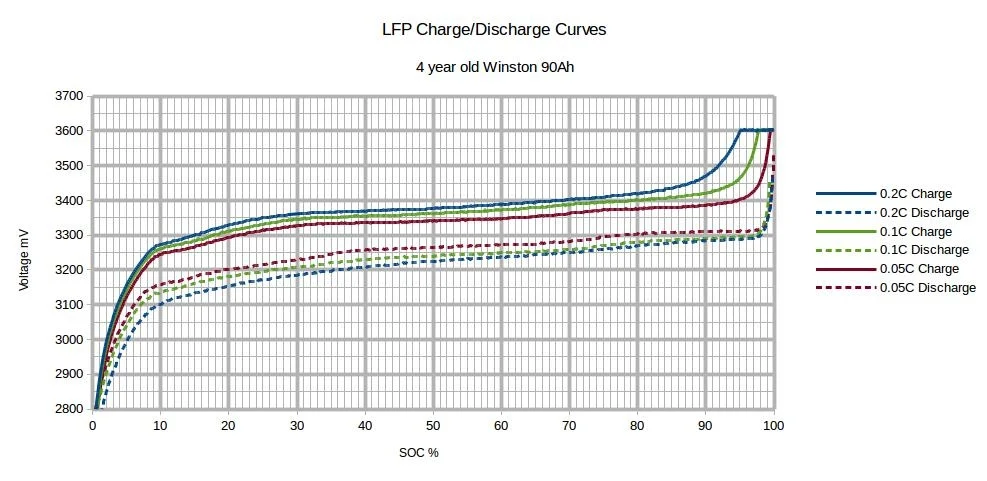
Check the image below for a typical charge/discharge curve at different rates for LFP. The 'middle' part is, for all intents and purposes, flat - you can not be accurate to measure that voltage, and it also depends on the charge/discharge rate. In addition, even at rest, it would just be 'more flat'.
In the knees of the curve however, you can see that small changes in state of charge lead to large voltage deltas. This is where voltage can be used to indicate state of charge (at least, you know you're 'almost full' or 'almost empty') but you still can't say for sure you're at '93%'. What you can say with certainty at this stage is that some cells are running ahead, and others are lagging - so the balancer knows what to do.
Note however that with this chemistry, you could get to 99.9% state of charge at 3.45V, when you allow the cell to absorb at that point (keeping the voltage at 3.45V and wait for the current to taper off). In other words, the only thing you can know is that above 3.45V you're pretty much full, but this could be in the high 80's or 99.9%, and you can't say for sure.
This post was modified 3 days ago by upnorthandpersonal
My blog where I write about all the systems in place and decisions made for my off-grid house at 63 degrees north in Finland.
1

16/02/2026 10:12 pm
I bought a pre built battery and don't know which BMS it has. I did ask them if the battery would be compatible with the inverter before I ordered the battery but I haven't contacted them, I thought I would get a better answer here, which I am getting.
I have a similar setup and know it has a seplos bms since I had to upgrade. If you look to add storage, you will need to know. This is as they need to be the same type - the inverter just connects to one that manages the others.
I had some odd situation with data about the battery not being shown on soliscloud. The troubleshooting highlighted the Solis team is overwhelmed and easily find excuses, particularly around compatibility and installation. So this can become a pain. And what Fogstar may have said is (at best) irrelevant to them. 🙂
Hopefully you have a different bms type, one that will be officially tested.
Anyway, as you see, there are plenty of people here with experience that are in the same boat..
8kW Solis S6-EH1P8K-L-PLUS hybrid inverter; G99: 8kw export; 16kWh Seplos Fogstar battery; Ohme Home Pro EV charger; 100Amp head, HA lab on mini PC

17/02/2026 3:09 pm
So voltage is a reasonable way to determine what is too high and too low even if there is a small window inbetween?
Yes.
And I generally agree with @upnorthandpersonal on this issue.
Here's a discharge curve which I've previously posted to this forum:
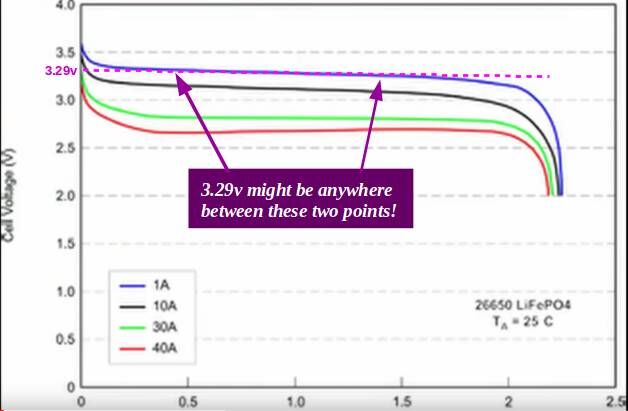
Let me point out that it's the Amps being transferred which causes the fluctuations we tend to see reported by an inverter, or by the App connected to a BMS.
My batteries have a relatively massive storage capacity (56kWh) which means the current tends to be very much lower than the system is specified to handle. It's rare that a battery would be charged or discharged at any more than ¼ of the current for which the BMS unit and cabling are rated. In these circumstances the voltages I see on the various connected meters are pretty stable.
Over the years I've learned enough about the way the batteries behave to know their SoC in the middle of the discharge curve just by noting the voltage.
But I also have a 5.5kWh battery set which I take to exhibitions and seminars.
That behaves quite differently. The current being drawn has a much larger effect on the voltages I read on the BMS App. I can't use my experiences with the larger battery set to tell me much about the SoC of the small one!
This post was modified 3 days ago by Transparent
Save energy... recycle electrons!
1
17/02/2026 4:57 pm
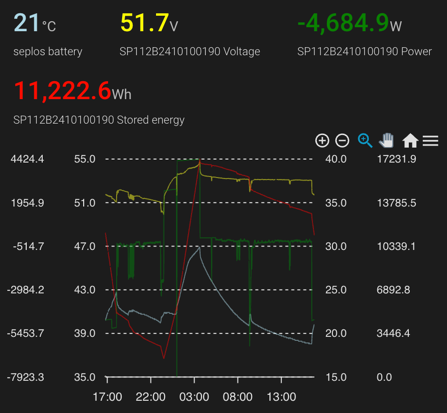
This is what my seplos is showing along the day. The readings are direct from the BMS.
So as expected, there are significant drops in voltage during discharge. Voltage recovers quickly after it stops discharging.
The soc is shown as Wh of this 16kWh battery.
The temperature increases significantly when charging, even if this is limited to max 100Amps. How many cycles could I expect from the 8,000 the battery could deliver?
8kW Solis S6-EH1P8K-L-PLUS hybrid inverter; G99: 8kw export; 16kWh Seplos Fogstar battery; Ohme Home Pro EV charger; 100Amp head, HA lab on mini PC
17/02/2026 5:39 pm
From your numbers (if I read them correctly, the graph is a bit small):
- You stop charging at 55V. If this is a 16s pack (which it should be) that means you stop at 3.437 V per cell. You also don't absorb there. This means that you won't charge to 100%, and your balancer can't do its job. You will lose capacity over time because of this (but you can recover this with balancing).
- Your temperature hits 30C. That's about the upper limit I ever use for my cells. Is there inadequate cooling? Are you sure this is cell temperature and not BMS temperature? If it's the BMS, you're fine. I highly doubt it's cell temperature actually: cells have a large thermal mass, and it takes quite long to heat 16 cells from 20C to 30C. There should be more than one temperature sensor in most batteries like this.
- The voltage drop is normal. Cells settle at 3.375V on their own. You're at 3.23V per cell under load. Especially since you're not fully charged, I consider this ok for now.
Personally, I would fully charge the pack (say, 3.5V to 3.55V per cell, 56V to 56.8V pack voltage). Can you monitor individual cells? Once you reach this voltage, you really want to check for cell imbalance (and also cell protection, maybe you won't reach this voltage at all because the BMS goes in protection when one cell goes too high). It would also be nice to be able to monitor the balancer. If you can't get to this voltage in one go, you definitely have an imbalance in which case you should gradually increase the voltage so the balancer can fix this without the BMS going in protection.
This post was modified 3 days ago by upnorthandpersonal
My blog where I write about all the systems in place and decisions made for my off-grid house at 63 degrees north in Finland.
1

Latest Posts
-
RE: Humidity, or lack thereof... is my heat pump making rooms drier?
I'd be happy with what you have (so would millions of o...
By Deltona , 12 minutes ago
-
RE: Testing new controls/monitoring for Midea Clone ASHP
@benson I see, I misunderstood obviously. So you set LW...
By Tasos , 29 minutes ago
-

This is absolutely standard for any sealed pressurised ...
By JamesPa , 10 hours ago
-
RE: Oversized 10.5kW Grant Aerona Heat Pump on Microbore Pipes and Undersized Rads
@uknick TBH if I were taking the floor up ...
By JamesPa , 10 hours ago
-
RE: What determines the SOC of a battery?
@batpred Your BMS parameters will be the same as m...
By Bash , 11 hours ago
-
RE: Getting ready for export with a BESS
I would have not got it if it was that tight
By Batpred , 12 hours ago
-
RE: Setback savings - fact or fiction?
I also need to correct something I said by mistake earl...
By cathodeRay , 12 hours ago
-
RE: Electricity price predictions
@judith Thanks for sharing, and nice to see how the ...
By Batpred , 12 hours ago
-
RE: Need help maximising COP of 3.5kW Valiant Aerotherm heat pump
@judith thanks Judith. Confirmation appreciated. The ...
By DavidB , 15 hours ago
-
RE: Recommended home battery inverters + regulatory matters - help requested
That makes sense. I thought better to comment in this t...
By Batpred , 15 hours ago
-
Bosch CS5800i 7kW replacing Greenstar Junior 28i
My heat pump journey began a couple of years ago when I...
By Slartibartfast , 15 hours ago
-
RE: How to control DHW with Honeywell EvoHome on Trianco ActiveAir 5 kW ASHP
The last photo is defrost for sure (or cooling, but pre...
By JamesPa , 17 hours ago
-
RE: Plug and play solar. Thoughts?
Essentially, this just needed legislation. In Germany t...
By Batpred , 17 hours ago
-
RE: A Smarter Smart Controller from Homely?
@toodles Intentional opening of any warranty “can of wo...
By Papahuhu , 19 hours ago
-
RE: Safety update; RCBOs supplying inverters or storage batteries
Thanks @transparent Thankyou for your advic...
By Bash , 20 hours ago
-
RE: Air source heat pump roll call – what heat pump brand and model do you have?
Forum Handle: Odd_LionManufacturer: SamsungModel: Samsu...
By Odd_Lion , 20 hours ago
-
RE: Configuring third party dongle for Ecodan local control
Well, it was mentioned before in the early pos...
By F1p , 1 day ago
-
RE: DIY solar upgrade - Considering adding more panels
I know this is a bit old, but it made me wonder what co...
By Batpred , 2 days ago
-

RE: New Vaillant aroTherm Plus in black - When will it come to the UK?
@majordennisbloodnok Daikin, take note! (In fact, I hav...
By Toodles , 2 days ago
-
RE: Midea ASHP – how to set weather compensation
@mk4 — good work! First, I agree, no evidence of cycl...
By cathodeRay , 2 days ago
-
RE: Solis inverters S6-EH1P: pros and cons and battery options
I don't know about Solis inverters. It isn't a featur...
By Transparent , 2 days ago
-
Daikin Altherma 3 H HT - Freeze Prevention Threshold
Hi. We have an Altherma 3 HT (18kW I think) which, now ...
By RICHARDF5033 , 2 days ago
-
RE: Passiv Smart Thermostat - Help & Forum Support
@petch We are not yet compatible with the R290 from Gra...
By Will H , 2 days ago