Joining the Renewable Heating Hub forums is completely free and only takes a minute. By registering you’ll be able to ask questions, join discussions, follow topics you’re interested in, bookmark useful threads and receive notifications when someone replies. Non-registered members also do not have access to our AI features. When choosing your username, please note that it cannot be changed later, so we recommend avoiding brand or product names. Before registering, please take a moment to read the Forum Rules & Terms of Use so we can keep the community helpful, respectful and informative for everyone. Thanks for joining!
Solis inverters S6-EH1P: pros and cons and battery options
With the octopus intelligent flux (as I have EV), so far they did not insist to control the car charging - but I wonder if they will in future.
Possible, but unlikely, I think. Flux is currently purely for solar PV and battery, whilst Go is purely for EVs. Rather than join them together to insist on controlling both, I would expect a new tariff to be dreamt up precisely for targeting both together and to run alongside Flux and Go. Based on past performance I’d wxpect Octopus to provide more choice rather than risk alienating existing customers.
To be clear, at the moment I have INTELLI-FIX-12M-25-08-29 that gives me 6 hours of 7p/kwh for 12 months. This would require me to link the charger to them, unless they can link directly to the car (which is the case..).
So far, this has not made getting my EV charger to work any worse. And I am almost done fine tuning my lab HA so it can reign on the EV charger.. 😍
8kW Solis S6-EH1P8K-L-PLUS hybrid inverter; G99: 8kW export; 16kWh Seplos Fogstar battery; Ohme Home Pro EV charger; Vaillant Arotherm Pro 7kW; 100Amp head, HA lab on mini PC
With the octopus intelligent flux (as I have EV), so far they did not insist to control the car charging - but I wonder if they will in future.
Possible, but unlikely, I think. Flux is currently purely for solar PV and battery, whilst Go is purely for EVs. Rather than join them together to insist on controlling both, I would expect a new tariff to be dreamt up precisely for targeting both together and to run alongside Flux and Go. Based on past performance I’d wxpect Octopus to provide more choice rather than risk alienating existing customers.
To be clear, at the moment I have INTELLI-FIX-12M-25-08-29 that gives me 6 hours of 7p/kwh for 12 months. This would require me to link the charger to them, unless they can link directly to the car (which is the case..).
So far, this has not made getting my EV charger to work any worse. And I am almost done fine tuning my lab HA so it can reign on the EV charger.. 😍
@batpred, I think you may be getting a couple of wires slightly crossed.
INTELLI-FIX-12M is, as you already know, the Octopus code for Intelligent Octopus Go, fixed for 12 months. This is a tariff that allows Octopus to control your EV charging in exchange for a particularly good off-peak rate. That control of your EV’s charging can be done either at the wallbox or by the car itself, hence why you mention the distinction. All this is not news to you, I know.
@drei, however, is talking about a different tariff - Octopus Intelligent Flux - where the deal is the same as for your tariff, but for controlling the home battery, not the EV. The agreement still means that, to get the best rates, you relinquish control to Octopus, exactly as you do with your car, and in the case of @drei’s home battery and PV, the inverter manufacturer - GivEnergy - has code to support this tariff quite strictly, to the extent of stopping the homeowner from fiddling with the configuration if they are on the Intelligent Flux tariff.
What you wrote suggests to me that you didn’t appreciate the distinction between Flux and Go. If that’s not the case and I’ve over-clarified, I apologise.
105 m2 bungalow in South East England
Mitsubishi Ecodan 8.5 kW air source heat pump
18 x 360W solar panels
1 x 6 kW GroWatt battery and SPH5000 inverter
1 x Myenergi Zappi
1 x VW ID3
Raised beds for home-grown veg and chickens for eggs
"Semper in excretia; sumus solum profundum variat"
To be honest, when I spoke with Octopus I spoke about the EV import tariff and also the export tariff for pv/battery so I got the names a bit mixed up.
Regarding the import tariff, if Octopus will want to control the car charging, this is not anything they tried so far. Ohme apparently has a very different way to be setup for that tariff. But as Octopus confirmed they are happy not having control of the charger, so am I!
No need to apologise, some of these tariffs may intend to work differently from the way they actually work in practice. The tariffs would theoretically require a lot of integrations with a wide variety of hardware and a lot of use cases to be considered.
Just one example, if I charge the car elsewhere, I absolutely do not expect octopus to interfere with it... So would they need car location? As I doubt the car manufacturer received my authorisation to disclose the car location, in fact they would probably hesitate to get involved with the associated liability... what if the car is stolen, could there be a claim that it was related to disclosure of the location via octopus?
8kW Solis S6-EH1P8K-L-PLUS hybrid inverter; G99: 8kW export; 16kWh Seplos Fogstar battery; Ohme Home Pro EV charger; Vaillant Arotherm Pro 7kW; 100Amp head, HA lab on mini PC
Just one example, if I charge the car elsewhere, I absolutely do not expect octopus to interfere with it... So would they need car location?
Interesting question. To be frank, since I have no intention of relinquishing control of my car’s charging to Octopus, I haven’t looked into the workings of IOG all that deeply. Your earlier post was the first time I’d been told Octopus were happy dealing directly with the car and not the wallbox, but since it made apparent sense I took it at face value. With the point you’ve just made, I start wondering if Octopus may later contact you wanting some control of the wallbox to comply with the “intelligent” part of the tariff.
All that said, this is a bit of a distraction from the central topic of inverters, so I’ll step back a bit here.
105 m2 bungalow in South East England
Mitsubishi Ecodan 8.5 kW air source heat pump
18 x 360W solar panels
1 x 6 kW GroWatt battery and SPH5000 inverter
1 x Myenergi Zappi
1 x VW ID3
Raised beds for home-grown veg and chickens for eggs
"Semper in excretia; sumus solum profundum variat"
I am now considering adding a second battery to my setup.
The Solis has a RS485 Port Connection. They say "if a 3rd party external device or controller needs to communicate with the inverter, the RS485 port can be used. Modbus RTU protocol is supported by Solis inverters."
Perhaps this can be used to communicate with a second BMS, I will try to find out.
8kW Solis S6-EH1P8K-L-PLUS hybrid inverter; G99: 8kW export; 16kWh Seplos Fogstar battery; Ohme Home Pro EV charger; Vaillant Arotherm Pro 7kW; 100Amp head, HA lab on mini PC
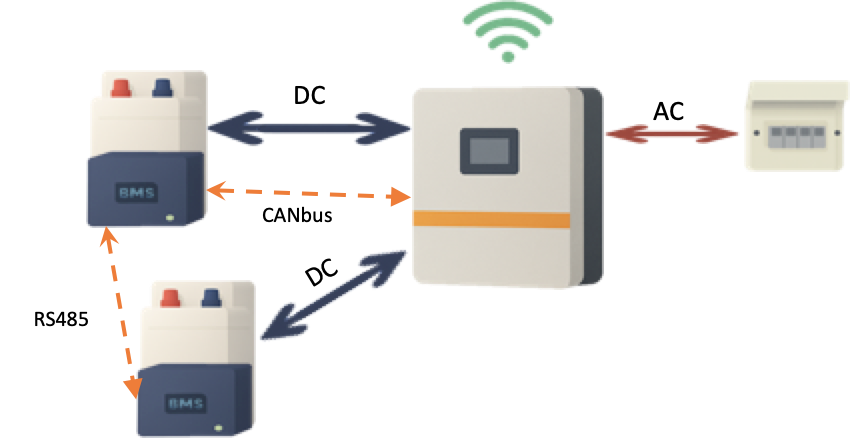
In the diagram below, I describe my understanding of the comms connections involved in a standard setup, where there are several batteries (I love diagrams but no matter how detailed, they would never be really right. still, they can help.. ).
This assumes that the BMSs on each battery can be made to work together (one way to do this is to ensure they are all the same BMS model, with the same firmware installed).
I did not consider which batteries are supported when buying my Solis inverter. Now that I realised that Seplos not being supported can cause issues, I need to explore alternatives.
As Solis menus imply the inverter is only meant to work with one BMS from one battery manufacturer, one question is why would the daisy chaining of BMS comms not work with other BMS models?
8kW Solis S6-EH1P8K-L-PLUS hybrid inverter; G99: 8kW export; 16kWh Seplos Fogstar battery; Ohme Home Pro EV charger; Vaillant Arotherm Pro 7kW; 100Amp head, HA lab on mini PC
I did not consider which batteries are supported when buying my Solis inverter. Now that I realised that Seplos not being supported can cause issues, I need to explore alternatives.
Solis confirmed that the S6 works with a single battery (pack) via CANbus. So the BMS connected via CANbus needs "to take care" of any communication related to daisychaining of additional batteries.
Yes, communication from the inverter to a BMS expected to use CANbus. For that you can use inverter CAN port only.
RS485 port can be used for the third party communication only.
The above seem to be used extensively in South Africa and in the US.
There are other aspects to consider (beyond all the batteries having the same BMS model):
the firmware on those needs to be specifically designed to work with others in master slave configuration
the connections on the battery casing need to be compatible,
suitable comms cables, etc.
The Solis inverter will only connect to one of the BMS. That specific BMS needs to implement a comms protocol to the extent required (like Pylontech).
This PV software site has a lot of information on batteries and inverters, including information on integration of SEPLOS with Home Assistant and Node Red.
This post was modified 10 months ago 2 times by Batpred
8kW Solis S6-EH1P8K-L-PLUS hybrid inverter; G99: 8kW export; 16kWh Seplos Fogstar battery; Ohme Home Pro EV charger; Vaillant Arotherm Pro 7kW; 100Amp head, HA lab on mini PC
@batpred I started reading this thread thinking I would be reading about you configuring predbat based on your user name. 🤣
is there any reason you’ve not looked at predbat? As it seems to do everything that you want the AI to do.
🤣
Well, I never managed to get the HA solis "sensors" properly configured on HA´s batpred, (I tried to leverage the solis Modbus integration). That and a little mistake with HA that required me to rebuild it.. It never stops..
At the moment, since I have an EV tariff and no export/solar, I do not even need Solis AI!
8kW Solis S6-EH1P8K-L-PLUS hybrid inverter; G99: 8kW export; 16kWh Seplos Fogstar battery; Ohme Home Pro EV charger; Vaillant Arotherm Pro 7kW; 100Amp head, HA lab on mini PC
... the battery that could have cost me £1000 can be worked by Solis AI to get a yearly return of return of £87..
Actually I am now finding that the return can be significantly higher, even if a battery cannot be easily purchased for £1000. With the current peak export rates, a powerful inverter can get you a decent return, with very simple programming.
So no need for Solis AI, everything can run locally! 🙂
- export when the grid does not need much power, and so the export rate is low
- shutdown during grid failures. While some systems could continue to work and use PV power, this is the exception
What I found so far with Solis AI is that, even if it can maximise profit, when I last used it, I saw a few problems:
- support engineers were not very confident, they seemed to associate config problems with it
- the operation of the Solis AI system is not auditable
- it is unclear whether typical comms issues can "confuse" it
- the user interface is not yet well integrated into the app and browser
8kW Solis S6-EH1P8K-L-PLUS hybrid inverter; G99: 8kW export; 16kWh Seplos Fogstar battery; Ohme Home Pro EV charger; Vaillant Arotherm Pro 7kW; 100Amp head, HA lab on mini PC
I hear some cases of apparent misconfiguration of inverters, where the end user would expect no import during some hours, like during the day but they see it.
Even if an inverter cannot adjust to the consumption of a house instantly, the lag can be minimal, unless an EV charger or similar suddenly adds 8kw. In our case, imports are not measurable. So this unavoidable lag does not explain an import of 100w, not with a modern inverter.
I had a look at the Octopus charges. Essentially we only expect to buy electricity at night and this is what we see. The Solis and battery ensures the only cost we have during the day is the import standing charge (there´s no export standing charge).
And if all the solar inverter based systems were upgraded to primarily export when the fossil fuel generators need to "fill the gap", the transition would become a lot less painful. Not everybody can make lifestyle changes to help..
8kW Solis S6-EH1P8K-L-PLUS hybrid inverter; G99: 8kW export; 16kWh Seplos Fogstar battery; Ohme Home Pro EV charger; Vaillant Arotherm Pro 7kW; 100Amp head, HA lab on mini PC
@johnnyb who has a three phasic solis s6 inverter and is seeing some import while the Solis is running off the battery
I wonder if it is how you are measuring things in your three phase supply. It may not matter that you export in three phases and consume more and so import a bit at the same time on one of the phases.
Essentially you probably have a shared neutral and three live cables going onto the inverter. Perhaps the inverter produces power evenly on the three phases?
But I think the meter will offset, it so your supplier will charge you 0? So the electrical considerations may not impact the cost side
I am curious if your CT clamp covers three live cables and so three readings of imports are considered?
@transparent has experience with the meter side of this for sure!
8kW Solis S6-EH1P8K-L-PLUS hybrid inverter; G99: 8kW export; 16kWh Seplos Fogstar battery; Ohme Home Pro EV charger; Vaillant Arotherm Pro 7kW; 100Amp head, HA lab on mini PC