
Notifications
Clear all

Topic starter
25/11/2025 5:08 pm
Im now looking again at batteries because recent changes in tarifs (which are no surprise and I suspect are the direction of travel) have altered the equation. I have grid tied solar and I am looking at grid tied AC coupled batteries. Ideally I would want islanding to be possible to cover power cuts and 3.6kW output maybe a bit more
At this stage I am trying to get my mind around the regs. As I understand it
a) even if the battery inverter is set so that it does not discharge when this would lead to export, I still need G99, which will need to specify both inverters, because the DNO assumes it might export. This might limit the max output of the battery inverter even though its not intended to export
b) If the inverter does support islanding, there must be a suitable cut out device |(presbetween the supply and any part of the internal wiring that will be energised during a power cut, to ensure that nothing is fed back to the grid in this circumstance
Have I got this correct? Im not trying to 'design' the system, just understand so I am an informed customer!
Also, has anyone looked seriously at sodium ion batteries. They seem to be obtainable and are, at least prima facie (but who knows what happens under the hood), more ethical in production and lower fire risk.
Sorry to ask simple questions, Im starting on a new learning curve here!
This topic was modified 2 months ago 3 times by JamesPa
4kW peak of solar PV since 2011; EV and a 1930s house which has been partially renovated to improve its efficiency. 7kW Vaillant heat pump.

25/11/2025 9:50 pm
a) even if the battery inverter is set so that it does not discharge when this would lead to export, I still need G99, which will need to specify both inverters, because the DNO assumes it might export. This might limit the max output of the battery inverter even though its not intended to export
I have just been through this. I had an electrician connect a battery to an inverter to my consumer unit (and I had previously had the CU replaced to improve safety).
I am not familiar with combined battery+inverter, my preference was to have a set that works, I chose low voltage lifepo4 as I understood it was the best value. I made the mistake to get a battery kit, there are now ready made 16kwh batteries starting at £1000.
I chose a solis hybrid inverter that provides 4ms switch from power failure, essentially it is fast enough that no device notices it. I did some tests. I switched the consumer unit off, all ok, the inverter made a few clicks and all continued as normal. I then switched it back to grid, again no issues, no flicking, as the inverter kept handling the load with the battery. It took some time to defer to use grid power. I think these timings are mandatory for approval.
I was not planning to export, but when I contacted my DNO (UK Power Networks) to let them know I had an inverter, they said they did not need to know unless I would be exporting. They "offered" 5kw export and said "just fill in the details in the initial G99 form as if G98". In short, right now I have an export MPAN.. for 8kw.. All without any MCS overhead.
As I underspent, we are now considering investing the spare funds and getting PV a bit earlier than we thought.
The regs may be a bit more restrictive than what UKPN allows.. So it may depend on what your DNO says and it may depend on your local grid as well.
b) If the inverter does support islanding, there must be a suitable cut out device |(presbetween the supply and any part of the internal wiring that will be energised during a power cut, to ensure that nothing is fed back to the grid in this circumstance
Have I got this correct? Im not trying to 'design' the system, just understand so I am an informed customer!
Officially you may, and there is apparently only one brand of inverter in the list that does not require a separate device.
@transparent kindly provided an explanation of the oscillators the inverters have to support islanding, etc.
Still, my experience was that UKPN was happy to accept the Solis G100 capability. I contacted them after the system was up and running (I always made sure it was set to not export). When filling in the G99 commissioning form, provided the inverter is type approved, much of it does not need to be tested on your installation. it is "out of the box". Very little work involved, it seemed. They were very helpful.
Also, has anyone looked seriously at sodium ion batteries. They seem to be obtainable and are, at least prima facie (but who knows what happens under the hood), more ethical in production and lower fire risk.
That may be a longer route.. If you search for sodium, some suggestions were made, but I think nobody ordered it, or if they did, I do not recall a report of the experience.
This post was modified 2 months ago by Batpred
8kW Solis S6-EH1P8K-L-PLUS hybrid inverter; G99: 8kw export; 16kWh Seplos Fogstar battery; Ohme Home Pro EV charger; 100Amp head, HA lab on mini PC

25/11/2025 9:57 pm
G99 needed for ac coupled battery. DNO will assume it can export unless it is type tested G100 and installed how the DNO likes to be export proof. Limiting export via software settings is not considered inherently safe or reliable.
PV inverter + battery inverter together count as combined generation capacity.
If you want it to power the house during a grid outage, it must have a certified anti-islanding mechanism. Must comply with Engineering Recommendation G98/G99 and ENA anti-islanding requirements.
Sodium ion batteries are heavy, LFP cells are now so cheap the shipping is the majority of the price. So sodium has to "compete" against that. Sodium is dirt cheap, but you'll never avoid the weight. The temp tolerance is moot in domestic storage application where its being constantly cycled. They have lower power density and a wider, annoying, voltage range, which means inverters will need to change for them.
25/11/2025 10:09 pm
To make clear, my Solis inverter has anti islanding. But because it has a couple of separate ports that it can serve independently from the grid, those can continue to work based on PV or battery. So only the grid port looses power to prevent islanding.
8kW Solis S6-EH1P8K-L-PLUS hybrid inverter; G99: 8kw export; 16kWh Seplos Fogstar battery; Ohme Home Pro EV charger; 100Amp head, HA lab on mini PC

25/11/2025 10:27 pm
Hi It well worth getting the G99 as it opens up "options"
I have the give energy AIO and "gateway" and yes i to had to get a G99 giving me 9.64kw export.
the AIO can discharge at 6kw which works for us.
the Gateway will go into "island Mode" if the grid is down all Automatically.
also when the AIO is support the home any solar will continue to charge or run the house, without the need for the grid.
A 2 box solution, just works ! and is tidy !
I see the Powerwall 3 can do a higher discharge and they do an equivalent to a "gateway"
Regarding Sodium I think in a year that be more options but your need more space for the same capacity.
I to will expand my storage with sodium when it more of a option..
25/11/2025 10:54 pm
@batpred The EPS output can be tricky to do to current regs. The old "rcd socket for type 2 only!" doesn't really cut it anymore.
25/11/2025 11:44 pm
@batpred The EPS output can be tricky to do to current regs. The old "rcd socket for type 2 only!" doesn't really cut it anymore.
I have the export MPAN, what are you talking about?
This is how it is working, before exporting..
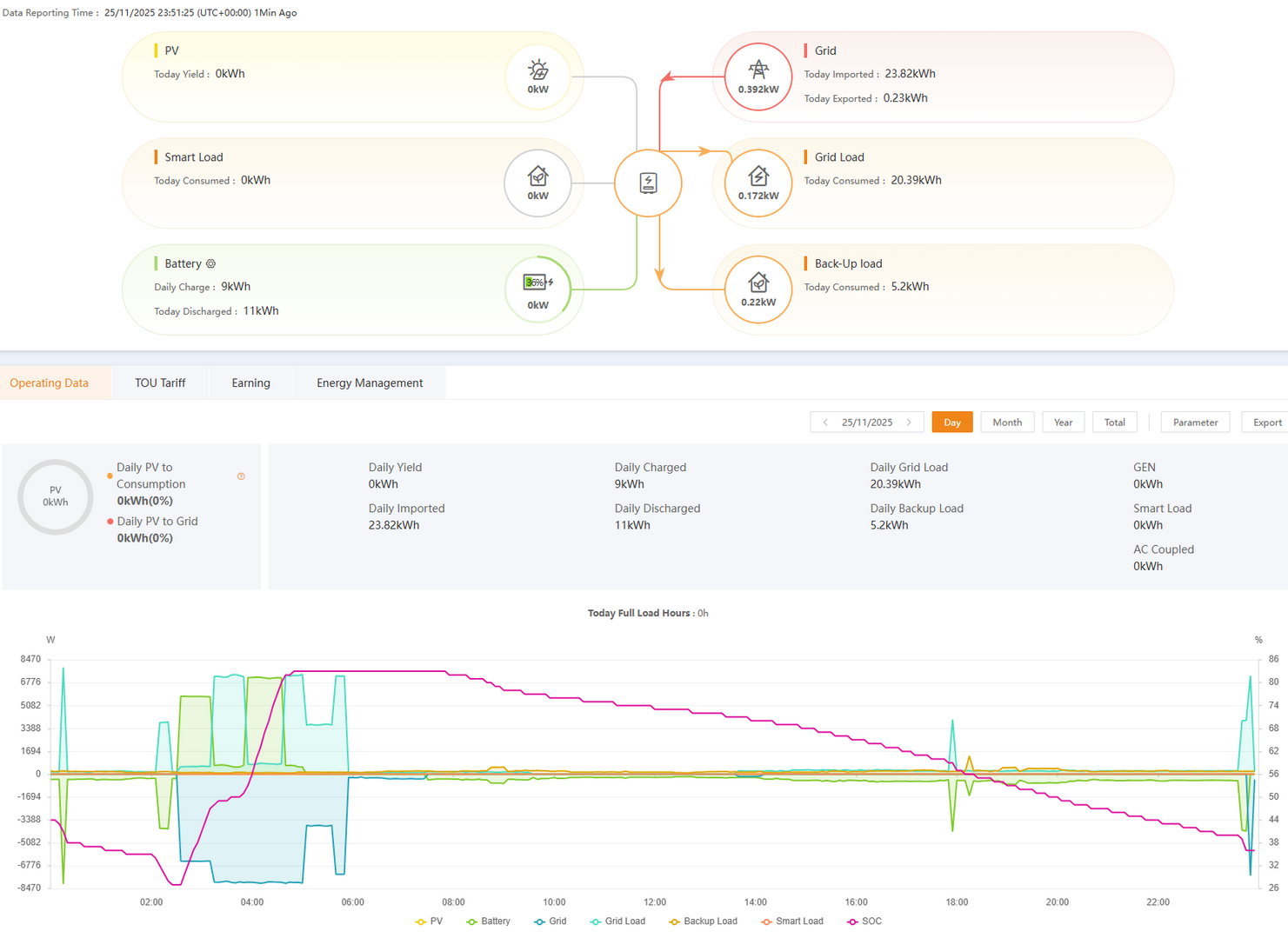
This post was modified 2 months ago by Batpred
8kW Solis S6-EH1P8K-L-PLUS hybrid inverter; G99: 8kw export; 16kWh Seplos Fogstar battery; Ohme Home Pro EV charger; 100Amp head, HA lab on mini PC
25/11/2025 11:47 pm
Regarding Sodium I think in a year that be more options but your need more space for the same capacity.
I to will expand my storage with sodium when it more of a option..
I am curious... which inverter would you go with for sodium batteries?
This post was modified 2 months ago by Batpred
8kW Solis S6-EH1P8K-L-PLUS hybrid inverter; G99: 8kw export; 16kWh Seplos Fogstar battery; Ohme Home Pro EV charger; 100Amp head, HA lab on mini PC
04/12/2025 5:50 pm
I have the give energy AIO and "gateway" and yes i to had to get a G99 giving me 9.64kw export.
We submitted our papers for SEG, so hopefully we will soon unleash our inverter with export. Keen to see what Solis AI can do with that.
@rob-heatpump-bob I am curious if your DNO accept 9.64kW on a single phase circuit?
8kW Solis S6-EH1P8K-L-PLUS hybrid inverter; G99: 8kw export; 16kWh Seplos Fogstar battery; Ohme Home Pro EV charger; 100Amp head, HA lab on mini PC
17/01/2026 10:38 am
The octopus export is now working, with the non mcs non flexiorb process.
There was some delay as they are asking for a building control certificate and the electricians firm that I used to replace the consumer unit has not been notifying this type of work. niceic needs that done before issuing the certificate.
8kW Solis S6-EH1P8K-L-PLUS hybrid inverter; G99: 8kw export; 16kWh Seplos Fogstar battery; Ohme Home Pro EV charger; 100Amp head, HA lab on mini PC
1

23/01/2026 11:43 pm
Just reading this with interest. We have recently (over a year) got approval from the DNO for 10KW export we requested no export. But they also set a limit of a 10KW inverter this is the issue for us. We had long debates around the technology having moved on and the inverters etc. all being ENA certified for G99 and G100. The islanding debate was also painful. The new generation of hybrid inverters handle all of this automatically faster than you can blink. We built a G98 POC it is a large property with a number of outbuilding. 6.5kWp of Solar a 32kWH battery and a Sunsynk Acure 3.6 Inverter. Initially configured with some local outbuilding loads on the load port and grid connected to the outbuilding incomer. It has been truly amazing. G98 so little hassle for the POC. Now we need to scale up but are limited to a 10KW inverter. We requested a 16kW inverter with G100 enabled at whatever the level the DNO wanted. Their answer was to ignore all of the technology and simply limit the inverter to 10KW with 10KW export.
The site will consume all of the solar and stored energy there will be little if any potential to export. Very frustrating. As our plan was to essentially put the main property on the load port entirely. Use the grid port for TOU charging/EV etc. 10KW doesn't allow us to do that. We tested the inverter grid fail response etc. during one of our many power cuts the grid port on the inverter was dead instantly and would not reconnect until the grid returned and was stable ~60secs before switching the grid port back on. Zero export settings. Testing for the last few months and nothing has crept out of the property.
Does anyone have any advice to get the inverter size we need approved with export limit etc. We don't even have an export MPAN!
Any advice appreciated.
Cheers
1
Topic starter
24/01/2026 1:57 pm
There is something here about generation with export limitation which I think makes it clear that it should be possible subject to having the right equipment. From some discussions occurring in another thread it appears that the interpretation of the regs may be a little flexible, varying between manufacturers and DNOs
4kW peak of solar PV since 2011; EV and a 1930s house which has been partially renovated to improve its efficiency. 7kW Vaillant heat pump.
Page 1 / 2
Next

Latest Posts
-
RE: If a heat pump can only heat DHW to 50C then what? Issue with 18KW Heliotherm heat pump
Hi, Nothing yet. I've asked customer to measure flow...
By errmm , 5 hours ago
-
RE: High Temp Heat Pumps for fast warm-up of house
I don't know exactly how long it takes to heat up (and ...
By JamesPa , 7 hours ago
-
RE: Need help maximising COP of 3.5kW Valiant Aerotherm heat pump
OK. What Im seeing looks fairly normal TBH: 1 start ...
By JamesPa , 7 hours ago
-
RE: Vaillant Tech Support Flagged Low DT: UFH Return Cold, Suspected Zero Flow
@editor thanks for the tips which I will try before cal...
By DavidB , 9 hours ago
-
RE: Daikin 6kw setup with Dixell controller
@jamespa Many thanks for your reply, a very detailed an...
By CraigH , 9 hours ago
-
RE: Exploring the role of alternative clean heating solutions - Government Consultation
Despite reservations, I found some time to respond to t...
By Rusty , 9 hours ago
-

RE: New Vaillant aroTherm Plus in black - When will it come to the UK?
@crankplus, nope, still not, and I've followed up with ...
By Mars , 9 hours ago
-
RE: Octopus Cosy Heat Pump Owners & Discussion Thread
@agentgeorge Probably, but temperature change at -10 ha...
By AndrewJ , 10 hours ago
-
RE: External wall insulation - your experience
To be clear, my experience was very positive. The journ...
By Batpred , 12 hours ago
-

@foxesfan Re: ‘Servicing’ as @editor has covered in his...
By Toodles , 12 hours ago
-
RE: A Smarter Smart Controller from Homely?
@benson No idea why mine doesn’t work, all I see on ...
By Papahuhu , 13 hours ago
-
RE: Battery sizing - How low can you go!
It seems I am seeing something similar to what you do, ...
By Batpred , 14 hours ago
-
RE: Gaslighting in the heat pump industry – has anyone else experienced this?
Don’t know if this is relevant to this thread, but my A...
By Gruff2001 , 14 hours ago
-
RE: Bosch CS5800i 5kW - Experience So Far
@majordennisbloodnok While getting Home Assistant runni...
By Steelbadger , 1 day ago
-
RE: MCS - BS EN 12831-1:2017 – Heat Loss Survey
Since May 2025 it no longer a requirement in England to...
By JamesPa , 1 day ago
-
RE: Air source heat pump roll call – what heat pump brand and model do you have?
Forum Handel @jancold Manufacturer: Daikin Model: E...
By Jancold , 1 day ago
-
RE: Octopus Cosy 12 Heat Pump Regret: Incredibly Loud, Poor Heating & Constant Hum - Help!
@harriworld it was roughly 3am for an hour as that’s ...
By L2jad , 1 day ago
-
RE: Hoped for improvements not being realised on my Mitsubishi heat pump
I have been wondering that myself. The fact is that, ...
By JamesPa , 1 day ago
-

RE: Filtering Tap Water – Share Your Setup for Cleaner, Better-Tasting Water
I remember when I was in my early 20s I was introduced ...
By Majordennisbloodnok , 2 days ago
-

RE: Setback savings - fact or fiction?
But if it is recorded an an integer, which it seems it ...
By cathodeRay , 2 days ago