

Notifications
Clear all
Joining the Renewable Heating Hub forums is completely free and only takes a minute. By registering you’ll be able to ask questions, join discussions, follow topics you’re interested in, bookmark useful threads and receive notifications when someone replies. Non-registered members also do not have access to our AI features. When choosing your username, please note that it cannot be changed later, so we recommend avoiding brand or product names. Before registering, please take a moment to read the Forum Rules & Terms of Use so we can keep the community helpful, respectful and informative for everyone. Thanks for joining!

09/01/2025 4:03 pm
h, we're both right about how the ASHP would be supported from a Sunsynk inverter, but we've made different initial assumptions
Hi @transparent , that's all good then. Yes, I'm not changing wiring or adding a backup power distribution board (having recently done a major refurbishment) and we're in a city, all power distribution is underground and power cuts rare and short.
This is the diagram approved by the DNO (no surprises where I got the original, thank you 🙂) - I was stymied by not being able to PM you for the OpenDraw file without first posting.

End 1980's terrace in Southern England
NIBE 12kW air source heat pump
2 solar water panels
1 x Ohme ePod
1 x VW ID Buzz

09/01/2025 4:41 pm
I would happily send you ODT files of my diagrams for you to dissect and amend.
The more graphics we have on this forum, the easier it is for others to understand.
You will note that I keep a graphics library of 200+ PNG/JPEG images from which I can quickly build an appropriate diagram.
It's not as slick as I'd like, but at least the software is free...
... and therefore anyone else can replicate the style.
You will occasionally find my graphics on other 'official' sites and in government leaflets.
Provided that no one is trying to gain an income by their use, then that's fine by me.
Save energy... recycle electrons!

Topic starter
09/01/2025 5:15 pm
@bontwoody , thank you. I'm looking to do a similar off-peak storage (ASHP, but no Solar PV) and was interested to compare your figures with my calculations. Could I just check? - your December off-peak usage is 550kWh, presumably this supports about 150kWh of charging your 5kWh battery once every day (assuming the PV is not charging it) - does that mean your normal off-peak December consumption is 400kWh (i.e. 400/756 = 52%)?
Yes thats right, although I dont totally use all my battery capacity and its closer to 4.5 kWh charging rather than 5kWh per night
I think what Im seeing is that depending on the cost of the battery and usage, its doesnt aways make financial sense to try and cover 100% of your daily usage for all days of the year. That said extending my current battery pack is quite expensive at £2500 for an extra 5kWh and the calculation will alter with something like the Fogstar 15.5 kWh battery at a similar price.
hope thats helpful
House-3 bed partial stone bungalow, 5kW Samsung Gen 6 ASHP (Self install)
6.9 kWp of PV
10kWh DC coupled battery
Blog: https://thegreeningofrosecottage.weebly.com/
Heatpump Stats: http://heatpumpmonitor.org/system/view?id=60
Topic starter
03/04/2025 2:47 pm
So just for completeness here is may last update on this topic regarding the cost effectiveness of adding another 5kWh to my battery module.
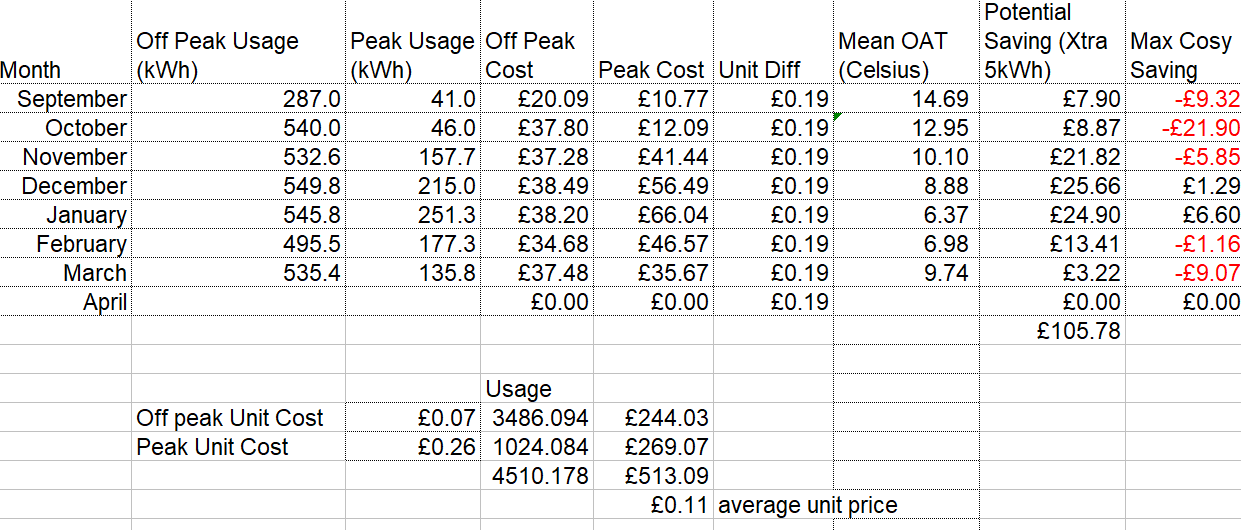
Between September and March the additional 5kWh battery would have saved about £105. Given I was quoted £2500 to install one it would not make financial sense to do so.
Switching from Octopus Intelligent Go to Cosy would only have saved a small amount in December and January, the rest of the time it would have been more expensive.
Overall throughout the period I paid an average of 11p per kWh.
House-3 bed partial stone bungalow, 5kW Samsung Gen 6 ASHP (Self install)
6.9 kWp of PV
10kWh DC coupled battery
Blog: https://thegreeningofrosecottage.weebly.com/
Heatpump Stats: http://heatpumpmonitor.org/system/view?id=60
1


01/05/2025 11:17 am
@bontwoody I am just looking into adding another 6.5 kWh battery to our system. We were on Octopus Cosy after we installed the heat pump towards end of January, and I see that we have nearly cycled 2.5 to 3 times each day for the battery. I switched to Octopus Go towards the middle of April, and now we cycle about 0.5 times a day. We have had a fantastic April with respect to solar production that has topped up the battery and taken care of base load plus HP usage. Even otherwise, I would assume staying on the Go tariff would reduce cycling than Cosy I would assume.
We have a decent solar array, but due to trees and neighbouring houses, in the winter we don't produce enough to top up the battery enough during the day. Even though we hardly touched the grid during the peak times and paid only 14 pence on average per kWh we imported on Cosy, I wonder whether adding another battery to the system would prolong the life of the battery. Not sure how BMS works and whether they deplete one battery fully before using the other, or would it equally distribute the load. If it's the latter, I assume we might not cycle so much during peak winter and could problong the battery life by 5 years.
This would also mean the EV charging would be on cheaper Octopus Go than slightly more expensive Octopus Cosy during the peak winter months. Maybe, I am being overoptimistic,
16 * 435 watts PV
13 kWh Growatt battery
1 EV - Mercedes EQB
6 kW Aira Heat Pump
Bosch Induction Hob
Pod Point Solo 3 charger
Topic starter
01/05/2025 2:53 pm
@chandykris We seem to have similarly sized systems and yes I found Go to be a better choice than cosy with a couple of minor months difference.
I really cant make the financial case for adding another battery though, even though I agree it should prolong the life of the battery system. I have set mine so that I dont get to zero or 100% so Im hoping that will help me. As to whether it depletes one battery first I cant honestly say but others will no doubt know the answer @transparent ?
House-3 bed partial stone bungalow, 5kW Samsung Gen 6 ASHP (Self install)
6.9 kWp of PV
10kWh DC coupled battery
Blog: https://thegreeningofrosecottage.weebly.com/
Heatpump Stats: http://heatpumpmonitor.org/system/view?id=60
1
02/05/2025 6:34 am
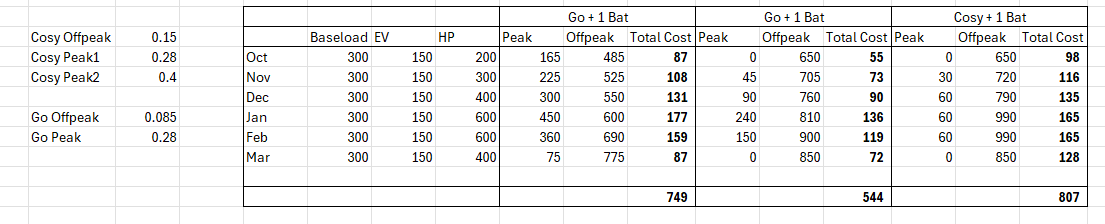
@bontwoody I watched a video on Tim & Kat's Green Walk's YouTube channel yesterday on this same topic. Tim has a detailed spreadsheet to help calculate the returns. Having plugged in my numbers into a similar model, I can see that during the months of November to March, I could save a bit by staying on Octopus Go and adding another 6.5 kWh battery. Probably about 10% RoI as there's no VAT, and Tim also talks about reduced strain on the battery and longer life. Another thing he mentions is battery degradation over time and having spare capacity once the batteries start to lose capacity. So, I have pressed the button to add another battery to our set-up.
16 * 435 watts PV
13 kWh Growatt battery
1 EV - Mercedes EQB
6 kW Aira Heat Pump
Bosch Induction Hob
Pod Point Solo 3 charger
Topic starter
02/05/2025 7:24 am
@chandykris Thats a fair point and something Ive considered. I do keep one eye on ebay for any reduced price battery packs 🙂
Can you post the figures and spreadsheet on this thread for posterity, I would be interested in seeing them.
House-3 bed partial stone bungalow, 5kW Samsung Gen 6 ASHP (Self install)
6.9 kWp of PV
10kWh DC coupled battery
Blog: https://thegreeningofrosecottage.weebly.com/
Heatpump Stats: http://heatpumpmonitor.org/system/view?id=60

02/05/2025 9:56 am
16 * 435 watts PV
13 kWh Growatt battery
1 EV - Mercedes EQB
6 kW Aira Heat Pump
Bosch Induction Hob
Pod Point Solo 3 charger
07/05/2025 10:34 am
As to whether it depletes one battery first I cant honestly say but others will no doubt know the answer
My own experience with connecting four batteries to three hybrid inverters shows that the most significant factor is the resistance of the cabling.
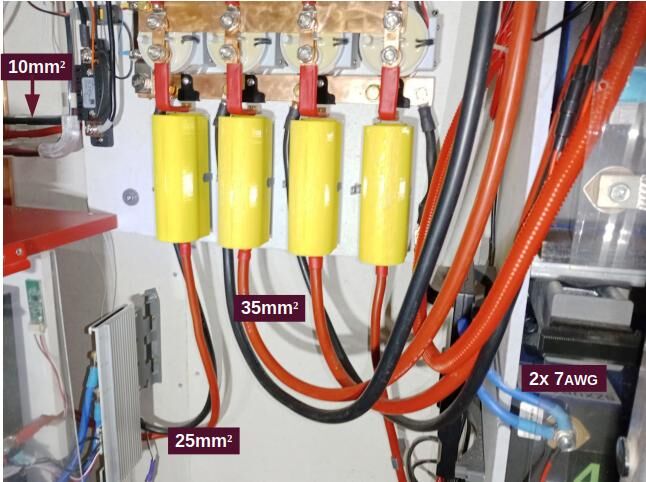
I've deliberately been using wires with different cross-sectional areas, and of different lengths.
I've also tried using different torque on the bolts which which I clamp the cable ends.
Every fraction of an ohm makes a difference,
and the more so when high currents need to flow.
A poorly installed battery connection might have ¼Ω additional resistance when compared to the adjacent battery.
If the inverter wants to pass 20A charge current to the two batteries (10A to each) that small resistance is the equivalent of a 2.5v voltage drop.
Unsurprisingly, the batteries cannot possibly share the current equally!
Save energy... recycle electrons!
1
12/05/2025 1:43 pm
The second 6.5 kWh Growatt battery was installed today. The process was straightforward. The GBLI6532 model has been discontinued by Growatt, but the installer managed to source one of the last seven remaining in stock from a wholesaler.
Now that we have 13 kWh storage, I would assume except for peak winter heating months, we should just be using off-peak power for the house base load and the heat pump.
The installer did mention that Growatt has another model (AXE), that's modular at 5 kWh increments, which can be added to the same inverter if needed. But, that would require a BMS module as well. So, glad we managed to add a second 6.5 kWh battery of the same model. But, good to know for the future. If these batteries start to deplete in capacity, we have an alternative to add without having to change the inverters too.
16 * 435 watts PV
13 kWh Growatt battery
1 EV - Mercedes EQB
6 kW Aira Heat Pump
Bosch Induction Hob
Pod Point Solo 3 charger

06/02/2026 4:49 pm
I was never able to provide an adequate answer to those posts about a SunSynk inverter 'deciding' to recharge a Fogstar battery from the grid when its SoC reduced to 14%.
- Where was the 14% being measured: the BMS in the Fogstar battery, the front-panel LCD on the inverter, or the SunSynk App?
- Was the 14% measurement being noted whilst that grid-charge had just started? Coz the charge-current would distort the measurement.
- What parameter on the SunSynk inverter was determining that it should initiate an immediate recharge from the grid?
- Can the level of that parameter be changed, or the parameter disabled?
- Did it matter whether the user had coupled the battery and inverter with a data-lead?
There were just too many variables left unqualified by the two respondents.
My general overview is that a user needs to check out what possible benefit is obtained by linking the battery and the inverter.
If it's merely allow the inverter's App to display the cell voltages delivered by the BMS, then that's no more than a convenience.
But if the battery and inverter are exchanging commands between them, then what are those doing?I've spent hours reading Modbus commands in documents from (Chinese) manufacturers, and they rarely apply the international Modbus standards.
So I'd be very wary of hooking up a data lead just because a manufacturer claims some sort of 'compatibility'.
It seems I am seeing something similar to what you do, but with a Solis inverter (using CAN). It seems the inverter starts charging the battery even when the SOC is above the configured minimum SOC. Perhaps the inverter is doing this based on voltage.
Potentially this would also happen using RS 485 and modbus, that seems to be an alternative on the Solis. Solis has not clarified what the battery model/comms options mean. They suggested to follow the battery SOP (which I am guessing means standard operating procedure). But of course nothing is specific to any particular inverter in the configuration information in the Seplos manual.
It also raises questions about what is meant by compatibility.
8kW Solis S6-EH1P8K-L-PLUS hybrid inverter; G99: 8kW export; 16kWh Seplos Fogstar battery; Ohme Home Pro EV charger; Vaillant Arotherm Pro 7kW; 100Amp head, HA lab on mini PC
Page 5 / 5
Prev

SPONSORS
Degrees of Separation

Latest Posts
-

RE: Heat pump branding. Clever, contemporary… or a bit too much?
I think Heat Geek have done an amazing job on their bra...
By Tomtheheatingengineer , 5 hours ago
-
RE: HeatGeek vs Octopus surveys: puzzling disparity - any ideas why?
I have just had 3 heat loss surveys, one by heat geek o...
By David , 5 hours ago
-
RE: Heat Geek Zero Disrupt: Are We Sleepwalking Into Another Race to the Bottom?
I think that's the key question. After all inverter uni...
By Prunus , 7 hours ago
-
RE: battery storage without solar
As of October 1st they need specific qualifications to ...
By EtchedPixels , 8 hours ago
-
RE: How should the Boiler Upgrade Scheme be reformed?
A unit which uses water to transfer the heat/chill from...
By Temperature_Gradient , 8 hours ago
-
RE: Renewables & Heat Pumps in the News
With regards to the BUS grant raid, I gave it more thou...
By ASHP-BOBBA , 8 hours ago
-
RE: Why are ASHP installs so expensive?
The whole system seems to work on the basis of...
By ian33a , 9 hours ago
-
RE: Missing flow temperature in Heat Geek proposal
Good plan. If you can get half hourly meter readings a...
By JamesPa , 14 hours ago
-
RE: Heat Pumps Without Grants: Would You Have Installed One & Will You Now?
@editor Most certainly. The heat pump was an ideal s...
By Abernyte , 14 hours ago
-
Although regulations may well vary from country to coun...
By Majordennisbloodnok , 15 hours ago
-
RE: Does anyone have experience of a smart water meter?
Yep I caught our slow leak from a £100 bill rise 8)
By EtchedPixels , 15 hours ago
-
RE: Do You Need a Buffer Tank or Low Loss Header for Underfloor Heating in a Large Property?
@jamespa in some cases, failing the Turing test might b...
By GrahamF , 18 hours ago
-
RE: Passiv Smart Thermostat - Help & Forum Support
@energystoragetech The heat capacity of some...
By JamesPa , 20 hours ago
-
RE: tepeo ZEB UK Support & Info Thread
Sorry you are correct, I was remembering figures from t...
By JamesPa , 1 day ago




SPONSORS

