
Notifications
Clear all
Electricity, Tariffs, Monitoring & Providers
9
Posts
3
Users
3
Reactions
347
Views

Topic starter
17/12/2025 10:18 am
Canvasing for opinions/ideas on which tariff people think could work best for us.
Our situation:
- We have x1 EV, which I estimate we ush about 1200kwh a year from home charging on (free charging at work). There is a chance we lose the free home charging though, which would mean home charging goes up to about 3600kwh p/year
- We are about to replace our gas boiler with a heat pump. Our gas demand for the year was c.16k kwh, so I expect our HP energy usage to be around 3800 kwh
- Cooking is all electric, so gas will be capped after install
- Non ev/heating usage in the home is around 4000 kwh p/year
- We try to load shift dishwasher, washing machine and dryer to the evening
- We are currently on Octopus Go and have an average £ p/kwh over the last year of £.215. I'd estimate our non-ev use to be about £.255
- When temperatures aren't too low (c.10c), I think that 90%+ of our heating+DHW needs can be met overnight. We have UFH with concrete floors and good-not-great insulation
- We have no battery storage or solar
- The odds of me convincing my wife to load shift anything other than things listed above (in particular cooking kids' tea) outside of 4-7pm is 0%
- When I ran a simulation of our current/historic usage on agile, it suggested we'd make a 5% saving.
I'm thinking by adding a HP we may be best going onto agile and use havenwise to optimise and then having our EV charger +appliances still set to run overnight, but manually adjust it on exceptional days - maybe introduce a bit of automation to cap/alert on high/low pricing.
However, part of me thinks that given we can get most heating need from off-peak periods on mild days, we might be better just going for an ev tariff. Also makes life simpler. When I run the numbers I struggle to see how a solar and/or battery storage solution adds up £ wise for us.
What would you do in my situation?
Particularly interested to hear from anyone with an ev+heat pump but no solar battery and people using havenwise with agile, as I'm very finger in the air on what to expect my heat pump's p/kwh to end up being.

17/12/2025 12:34 pm
Hi, @2stacksterry, and welcome to the forum. Although you've asked one question, there are several others linked in here and a few assumptions you've made that could do with a bit of challenging or testing. As a result, my answer might not be quite as quick or clear cut as you might hope.
Firstly, some easy stuff. Your dishwasher and washing machine are likely already very efficient and so load shifting them, whilst an easy thing to do, will have a miniscule impact. The dryer is more important, but you're shifting it anyway so no worries. As for trying to load-shift other family activities, I'd strongly suggest you don't do it unless it's really easy to do; the whole point is that things fit round your family life, not the other way round.
Your calculations of 4000kWh per year for non EV/heating stuff equate to just under 11kWh per day which is pretty much in line with most of us. A daily consumption of around 10kWh per day is the normal rule of thumb used and mine tends to fluctuate between about 7kWh and 12kWh. In comparison, my daily averages for heat pump and EV are about 14.5 and 8.75 respectively. In your position, I'd up your heat pump estimate until you get a better one from a proper heat loss calculation.
Now for the slightly more involved stuff.
Trying to run a heat pump in a load-shifting way is not great on your wallet or health. In order to do what you're suggesting, you'd end up with a hot house during the night (and therefore quite probably have worse sleep as a result) and a house that gets too cold during the day to a point where it's at its coldest during the evening when you're most likely to want to relax somewhere cosy. It'll also mean your heat pump has to operate hard to bring the temperature back up again before turning off completely, and that's analagous to a boy racer accelerating hard as the traffic lights turn green only to get to the next red light quicker and have to come to a standstill again. Far better to operate the heat pump low and slow 24x7 or at most have a minor heat setback of a couple of degrees overnight. None of that fits in with the idea of shifting load to a cheap tariff time. I'll add further that most of your heat pump requirements are for the colder half of the year when your home will lose more heat and your heat pump will have to work harder with catching up on heat losses.
Havenwise, Homely and other similar services certainly have the potential for running your heat pump more efficiently but they are not a magic bullet. Most of their claimed savings are actually based around taking a good installation that's been configured badly and making it run low and slow with weather compensation, which you can do yourself anyway. They do have the potential for extra savings around time of use tariffs - and those savings may well exceed the cost of the service - but are not on the kind of scale to warrant your changing your tariff strategy overall. In short, I'd ignore them for your initial calculations and only start thinking of them as a tweak once you've got a system up and running already.
When you charge your EV is easy to choose, but time-shifting any other significant load is largely impractical unless you have a home battery. If you have to consume electricity during the peak periods (7-10am and 4-7pm for Agile), the last thing you want is to be buying your leccy at those times.
In your situation, I'd rejig your calculations assuming your heat pump is expending closer to 23-24kWh per day for half the year for heating and about 2.5-3 kWh per day for the whole year for DHW. I'd assume your heat pump needs to run constantly for heating and therefore cannot be significantly offset and I'd assume (unless you've several teenagers that feel the need to shower every day and use the whole tank in the process) all your DHW consumption CAN be offset.
As for tariffs, I would avoid Agile without a home battery to allow some time shifting. It's precisely because I have a battery that I can store charge to get me through the expensive periods and therefore bring my average import price down significantly that Agile makes sense for me. And in your situation with only the EV capable of being time-shifted, I'd say an EV-specific tariff is far more sensible.
Nonetheless, if you rehash your calculations as I suggested, you may find solar PV and/or battery may start to make financial sense instead. It still won't work for everyone - @jamespa is a good example - but for quite a few of us it does.
105 m2 bungalow in South East England
Mitsubishi Ecodan 8.5 kW air source heat pump
18 x 360W solar panels
1 x 6 kW GroWatt battery and SPH5000 inverter
1 x Myenergi Zappi
1 x VW ID3
Raised beds for home-grown veg and chickens for eggs
"Semper in excretia; sumus solum profundum variat"
Topic starter
17/12/2025 2:47 pm
Thanks for the response Major. I have an old 'proper' heatloss done based off building plans that we have not yet executed. As you suggest, it has expected usage higher than I have estimated, at 5000kwh. I'm interested that you think a paper assessment of total load trumps real-world gas usage data. Why is that? Energy=energy and if assumptions around boiler and heat pump efficiencies are true, why would my method be less accurate for total usage?
Dishwasher and washing machine running overnight currently is no bother to us. The only real change in behaviour is pressing a button to delay starts and sometimes running the dishwasher on a half load where we would otherwise leave it until its full. The washing machine never runs at half loads! (2 kids under 3)
I think I agree with you on treating the optimisers as a tweak. Unfortunately that requires patience - a virtue I don't often have the patience for!
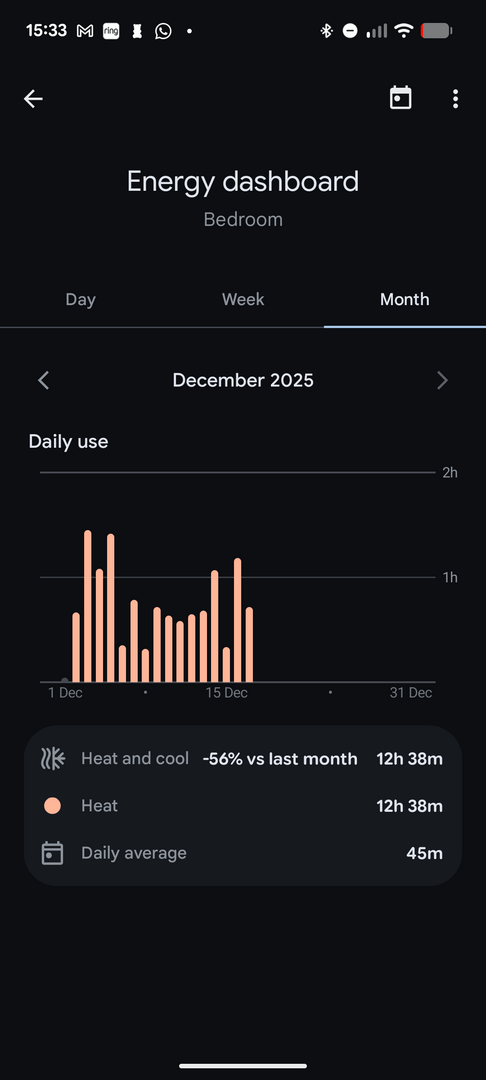
I also agree that comfort is the most important thing. My wife keeps me in check on that and an extra few quid on the direct debit is worth it to keep everyone comfortable. However..... We already have our house set to fixed temps (18c 24/7 upstairs, 20c downstairs with a 18.5c setback overnight). Our UFH throughout downstairs - with 100mm centres - also already runs at 30c* flow based off a mixer pre-manifold. Experience from the last 2 winters tells me on all but the coldest days (I'd estimate <30 days a year), the downstairs will generally heat up in the morning from 5am, the heating will overshoot it's 20c target and go to c.21c and not fall back below 20c without any additional energy until after we've gone to bed. The upstairs radiators have been on for an average of 45 mins a day over the last 30 days although flow to them is a guess as my current boiler doesn't give a readout. I'd guess 45c (I manually turn up once a fortnight for legionella). Basically, what I'm trying to say is that I suspect I could run a HP efficiently without being 24/7 - to the point where most usage could be offpeak - and tariff savings might trump SCOP savings and comfort wouldn't suffer.
Final thing - interested that you say avoid Agile if no battery. I would have saved c£110 over the last year if I was on Agile vs OG with no behaviour change (agreed savings would have been a bit less if I was on IOG, but that's a long story). Is there something else I'm missing? I'm not particularly risk averse...
Topic starter
17/12/2025 2:52 pm
Asterisk explanation:
* I am skeptical of whether the pre-manifold mixer really is getting UFH flow temp to 30c. It feels warm once the screed is heated up, but I expect a 30c emitter to be cold/mild to touch. In leiu of anything concrete though (other than my insulated subfloor), I'm going to assume it is doing what it says on't tin.
17/12/2025 3:21 pm
Thanks for the response Major. I have an old 'proper' heatloss done based off building plans that we have not yet executed. As you suggest, it has expected usage higher than I have estimated, at 5000kwh. I'm interested that you think a paper assessment of total load trumps real-world gas usage data. Why is that? Energy=energy and if assumptions around boiler and heat pump efficiencies are true, why would my method be less accurate for total usage?
...
Actually, I don't; I would go with real world usage over theoretical every time. However, in the absence of any heat loss calculation guesstimates when I wrote what I did I could see your annual gas usage was about the same as my home's calculated heat loss and so I preferred my measured heat pump usage over your (as it seemed at the time) finger in the air estimate.
I would also point out that 16k kWh gas vs 3.8k kWh heat pump consumption is a ratio of about 4.2. If I had to go for a rule of thumb for heat pump performance over a whole year (energy in vs energy out, which is precisely what a SCoP value is), I'd want to err more towards a figure of 3 than 4; it's far better to overbudget than underbudget. Now your follow-up suggests an expected heat pump consumption of 5k kWh annually, that makes much better sense (3 x 5 = 15 which roughly equals 16k boiler figure).
...
Dishwasher and washing machine running overnight currently is no bother to us. The only real change in behaviour is pressing a button to delay starts and sometimes running the dishwasher on a half load where we would otherwise leave it until its full. The washing machine never runs at half loads! (2 kids under 3)
I think I agree with you on treating the optimisers as a tweak. Unfortunately that requires patience - a virtue I don't often have the patience for!
I also agree that comfort is the most important thing. My wife keeps me in check on that and an extra few quid on the direct debit is worth it to keep everyone comfortable.
...
All sounds pretty reasonable to me.
...
However..... We already have our house set to fixed temps (18c 24/7 upstairs, 20c downstairs with a 18.5c setback overnight). Our UFH throughout downstairs - with 100mm centres - also already runs at 30c* flow based off a mixer pre-manifold. Experience from the last 2 winters tells me on all but the coldest days (I'd estimate <30 days a year), the downstairs will generally heat up in the morning from 5am, the heating will overshoot it's 20c target and go to c.21c and not fall back below 20c without any additional energy until after we've gone to bed. The upstairs radiators have been on for an average of 45 mins a day over the last 30 days although flow to them is a guess as my current boiler doesn't give a readout. I'd guess 45c (I manually turn up once a fortnight for legionella). Basically, what I'm trying to say is that I suspect I could run a HP efficiently without being 24/7 - to the point where most usage could be offpeak - and tariff savings might trump SCOP savings and comfort wouldn't suffer.
...
To be frank, we've had plenty of discussions here on the forum about savings from setbacks and setforwards with no significant consistent outcome. In that light, I would be surprised if what you're suggesting were true but I'm also well aware that each home is different and the characteristics of yours may yet fall outside what we've seen to date. No experiments you try once the heat pump is in will be irreversible so I'd suggest you simply try it and see. I'll also say that since you're running your boiler with rather heat pump friendly flow temperatures already, you're in a better situation than most for making predictions about your home with a heat pump installed.
...
Final thing - interested that you say avoid Agile if no battery. I would have saved c£110 over the last year if I was on Agile vs OG with no behaviour change (agreed savings would have been a bit less if I was on IOG, but that's a long story). Is there something else I'm missing? I'm not particularly risk averse...
No, you're not missing anything; I am. The car in and of itself is a battery. I suspect that, if you separated out your energy consumption and time of use costs, you'd see that your non-EV outgoings would've been slightly more expensive over the last year with Agile but more than offset by the significant savings on the energy piled into the EV.
My point is that since I'm on Agile import, I know full well how expensive the peak times get. It can be quite alarming when the price per kWh hits the capped amount of £1, but knowing all our usage is coming from the battery that was filled up at perhaps a quarter of that is a big relief. You can, of course, avoid peak times with your EV, so all your predictions hang on whether you really can do some time-shifting of usage on your heat pump as you are hoping to. If not, your bills on the really cold days could be quite eye watering; the maximum I've seen in my time with a heat pump happened on 16th December 2022 when I saw a day's consumption hit 62.5 kWh (about 2.6kWh per hour, or a potential maximum of £7.80 for the three hour stretch between 4pm and 7pm if charged at the maximum allowed rate).
All that said, with Octopus you can swap between rates something like once a month so it costs relatively little to try out a few scenarios before settling on your preferred one.
105 m2 bungalow in South East England
Mitsubishi Ecodan 8.5 kW air source heat pump
18 x 360W solar panels
1 x 6 kW GroWatt battery and SPH5000 inverter
1 x Myenergi Zappi
1 x VW ID3
Raised beds for home-grown veg and chickens for eggs
"Semper in excretia; sumus solum profundum variat"
Topic starter
17/12/2025 3:57 pm
I've assumed a boiler efficiency of 85% and heat pump scop of 380% to get to an overall 4.2 multiplier. Too harsh on the boiler maybe given flow temps? But it's on its last legs so would be surprised if it's running too much more efficiently. Appreciate that it is wise to consider the effects of a less efficient install.
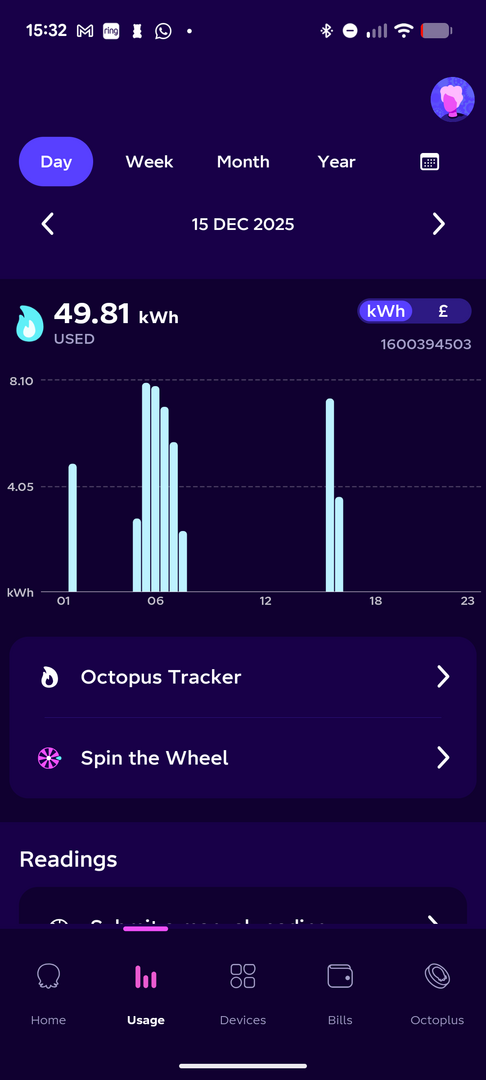
Screenshots show my most recent days usage of gas plus how often my upstairs has been calling for heat in December. DHW run is currently once a day, 2.30-3.30pm, but really could be done anytime of day.
"Try it and see" - you've given me confidence to do this. Will report back ok the outcomes.
17/12/2025 5:18 pm
Eventually, all the figures are up for considerable leeway until more accurately narrowed down by independent means. You're quite right that the boiler could be as inefficient as that and the heat pump may end up as efficient as that kind of SCoP. The only thing I'd urge is to err on the side of the minimum realistic savings for investigative purposes and then risk being pleasantly surprised.
The only thing I would personally not see as negotiable is the need for checking and double checking the quotes not just for cost but for the installers' ability to justify each design choice. In particular:
- The heat loss calculation must be carried out properly and the results made available to you.
- The heat emitters must be verified to be compatible with the ideal flow temperatures for a heat pump, and suited to the rooms they're in. Your preparation here will have been invaluable.
- The heat pump must be appropriately sized for the house and available heat emitters. You've probably already seen on the forum that too big is almost as bad as too small.
- View with serious suspicion anyone who tries to insist on a buffer tank in the design. Pound to a penny, it's not needed and will reduce efficiency.
I know I'm banging a drum that's been hit many a time before here, but if you want to see that 3.8 SCoP, this is the best chance of doing so.
105 m2 bungalow in South East England
Mitsubishi Ecodan 8.5 kW air source heat pump
18 x 360W solar panels
1 x 6 kW GroWatt battery and SPH5000 inverter
1 x Myenergi Zappi
1 x VW ID3
Raised beds for home-grown veg and chickens for eggs
"Semper in excretia; sumus solum profundum variat"
1
Topic starter
17/12/2025 5:36 pm
Thanks for the tips.
The engineer booked to do my (next) heatloss is heatgeek elite and has various systems on open monitor with an average scop >4.
The original heatloss I went through in early 2023 was precisely to get emitters sized correctly before I went through a major refurb where the aim was to be heat pump ready at the end.
Our boiler is giving up unexpectedly early. I hadn't anticipated needing to do this for another few years. Maybe given political climate I'll be glad of doing this sooner than planned.
You've probably already seen on the forum that too big is almost as bad as too small.
To be honest, this is one of my main concerns. Instinct tells me my downstairs ufh, at 100m centred pipes, is currently oversized Vs rads upstairs. As previously mentioned though I'm skeptical of the true flow temp being 30c and I know the flow rate is faster than I'd get off a hp without any boost, so hoping this levels the field by reducing energy going in.

17/12/2025 10:51 pm
Agree with @majordennisbloodnok on the setbacks. We have a heat pump, EV, solar and battery storage. Our Aira heat pump was installed in January, and in our home it just doesn't help with load shifting. Our house is at 20.5 degrees all the time, and if I try and reduce by 1 degree at night from 9 pm to 12:30 am (we are on Octopus Go), any savings from the setback seems to be lost when the house has to work harder to come up to temperature. Not having to argue with my Mrs and teenage child on why the house is too warm in the early mornings is an added bonus!
Battery storage has been immensely useful though. We were on Octopus cosy initially when we installed the heat pump. But, then we doubled the battery capacity in the summer. So, Octopus Go is the best tariff all year around. Now we are averaging about 12 p per kWh during a relatively cold November and kind of mild but also odd very cold days in December. I predict around 15 p per kWh average for January and February, then go back to 8.5 p from March to October.
This post was modified 3 months ago by ChandyKris
16 * 435 watts PV
13 kWh Growatt battery
1 EV - Mercedes EQB
6 kW Aira Heat Pump
2

Latest Posts
-

RE: Heat Pump vs New Gas Boiler for Inherited House - Worth the Extra Cost?
@fretless6, where are you based? I might be able to con...
By Mars , 9 minutes ago
-

RE: Underfloor Heating Installation Issues with Heat Pump
I'm going to install Thermacome ACOSI+ radiant ceiling....
By bobflux , 50 minutes ago
-
Issue with a Grant Air Source Heat Pump & Tado Smart Thermostat
Hi all I'm having some trouble with a Grant ASHP and ...
By Renewables345 , 2 hours ago
-
RE: Testing new controls/monitoring for Midea Clone ASHP
Now seems a good time to summarise the costs and effici...
By benson , 2 hours ago
-
RE: Tell us about your Solar (PV) setup
@mk4 Charge to 100%, discharge down to 10%.
By bobflux , 3 hours ago
-
RE: Daikin Altherma 3 LT compressor longevity question
This mess is intriguing: I wonder if this represent...
By bobflux , 5 hours ago
-
RE: Connecting Growatt SPH5000 over wired ethernet rather than wireless
The simplest wired option is usually the Growatt Ethern...
By Jonatan , 9 hours ago
-
RE: Peak Energy Products V therm 16kW unit heat pump not reaching flow temperature
ASHPs do have a minimum compressor speed. The minimum h...
By bobflux , 16 hours ago
-

RE: Electricity price predictions
@jamespa And it seems some of the nasty public cloud...
By Batpred , 16 hours ago
-

RE: Jokes and fun posts about heat pumps and renewables
Technology is rapidly advancing. BBC News reported th...
By Transparent , 19 hours ago
-
What matters for flow and pressure drop is internal dia...
By bobflux , 20 hours ago
-

RE: Do Fridges and Freezers have COP ratings?
@editor Thank you all for your replies and submitted in...
By Toodles , 22 hours ago
-

I know and yes. The secondary deltaT wont necessaril...
By JamesPa , 1 day ago
-
RE: Designing heating system with air to water heat pump in France, near Lyon
Just love the way you put it! 🤣
By Batpred , 2 days ago
-
RE: Safety update; RCBOs supplying inverters or storage batteries
Thank you for sharing. So it seems that your Schneid...
By Batpred , 2 days ago
-
RE: Forum updates, announcements & issues
@upnorthandpersonal thanks for the thoughtful, consider...
By Mars , 2 days ago
-
RE: Solar Power Output – Let’s Compare Generation Figures
@mk4 All 21 panels have their own Enphase IQ7a microinv...
By Toodles , 2 days ago
-
RE: Setback savings - fact or fiction?
Great, so you have proven that MELCloud is consistently...
By RobS , 3 days ago
-
RE: Mitsu PUHZ120Y 'Outdoor Temp 'error?
Thanks David & James It almos...
By DavidAlgarve , 3 days ago
-
RE: Surge protection devices SPDs
@trebor12345 - your original Topic about the right type...
By Transparent , 3 days ago
-
RE: Help needed with Samsung AE120RXYDEG
@tomf I’ve been sent this from a service engineer at Sa...
By Mars , 3 days ago
-
RE: Buying large amp bidirectional RCD and RCBO
Yes... I went through this particular headache and ende...
By bobflux , 4 days ago
-
O-oh! Let's take this as an opportunity to 'pass the ...
By Transparent , 4 days ago


