Demand sites, such as data centres, would no longer be required to contribute towards grid upgrade costs unless their predicted usage triggered a high-cost threshold.
Generation sites would no longer be required to pay any contribution towards reinforcement/upgrade of voltage levels above the one to which they connect. So if the generation site outputs 33kV, it doesn't pay anything towards the required upgrades at 132kV or the 400kV Transmission Grid.
All those grid upgrades for which Demand Sites and Generators would no longer be contributing anything would still go ahead, but the money would come from increased TUoS and DUoS payments, which are part of our consumer bills.
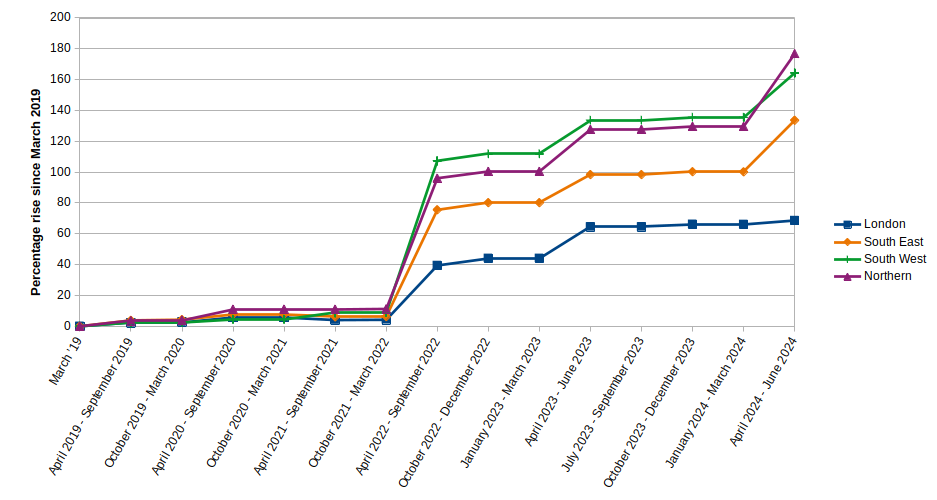
You can easily see the consequences of that decision reflected in the Standing Charge increases for Q2 of 2022:
I would certainly start with the presumption that bulk users of energy (whatever they produce) should pay the full infrastructure costs of their demand.
Demand sites, such as data centres, would no longer be required to contribute towards grid upgrade costs unless their predicted usage triggered a high-cost threshold.
Generation sites would be required to pay any contribution towards reinforcement/upgrade of voltage levels above the one to which they connect. So if the generation site outputs 33kV, it doesn't pay anything towards the required upgrades at 132kV or the 400kV Transmission Grid.
OK thanks, so following a decision (under the previous Government) neither steel production sites in Merthyr Tidfil, nor data centres in Harlow, need to pay for upgrade costs unless they 'trigger a high-cost threshold'.
However generation sites do.
Is this a reasonable policy?
Reasoned answers, considering the multi-dimensional nature of the problem, bearing in mind that somebody has to pay, and taking into account the complaints about the effect of high energy costs on business, on a postcard please!
This post was modified 6 days ago 2 times by JamesPa
4kW peak of solar PV since 2011; EV and a 1930s house which has been partially renovated to improve its efficiency. 7kW Vaillant heat pump.
In effect 'we' are being asked to generate enough zero-carbon electricity to power two countries.
One is Great Britain, and the other is a collection of data-centres being rapidly built in order to satisfy government policy.
I agree with questioning why large consumers should have their connection subsidised by the previous grid users.
But viewing data centre demand as being very unique feels unfair. The same type of separate treatment could be argued for manufacturing, etc.
As I understand that data centres pay business rates, etc, so they make a positive difference at a local level. Surely much higher than farming, etc. And they also tend to require guarantees of low carbon electricity, etc with positive effects on investments in new generation.
8kW Solis S6-EH1P8K-L-PLUS hybrid inverter; G99: 8kw export; 16kWh Seplos Fogstar battery; Ohme Home Pro EV charger; 100Amp head, HA lab on mini PC
In effect 'we' are being asked to generate enough zero-carbon electricity to power two countries.
One is Great Britain, and the other is a collection of data-centres being rapidly built in order to satisfy government policy.
I agree with questioning why large consumers should have their connection subsidised by the previous grid users.
But viewing data centre demand as being very unique feels unfair. The same type of separate treatment could be argued for manufacturing, etc.
As I understand that data centres pay business rates, etc, so they make a positive difference at a local level. Surely much higher than farming, etc. And they also tend to require guarantees of low carbon electricity, etc with positive effects on investments in new generation.
Exactly my point!
In fact it seems, from what @transparent now says, that (following a decision made under the previous government) the generators pay the immediate cost of infrastructure upgrades.
Obviously this gets passed onto consumers (as it must) but surely this encourages generators to place capacity in locations where either there is high demand or the level of upgrade required is relatively low, which is surely a good thing. Previously @transparent has said that there is no such encouragement and has also said that generators want to connect at the highest voltage possible yet is now saying "So if the generation site outputs 33kV, it doesn't pay anything towards the required upgrades at 132kV or the 400kV Transmission Grid", which seemingly encourages them to connect at whatever level can best accept the load, surely again good?
If nothing else this shows that this is a complex question and throwing out random criticisms of the current policy is really not helpful or even justified without looking at the alternatives (because somebody has to pay) , the complexity involved and the system and charging as a whole.
I repeat: reasoned answers, considering the multi-dimensional nature of the problem, bearing in mind that somebody has to pay, and taking into account the complaints about the effect of high energy costs on business, on a postcard please!
4kW peak of solar PV since 2011; EV and a 1930s house which has been partially renovated to improve its efficiency. 7kW Vaillant heat pump.
Prior to the Ofgem SCR of May'22 Generation Companies were required to contribute towards all grid upgrades required as a consequence of them being given an Offer to Connect. That wasn't restricted to the voltage level at which their connection would be made.
The change was wanted by DESNZ in order to incentivise more companies to seek a grid connection for generation from renewable sources. That rapid acceleration resulted in the connections queue rising to 800GW, which is why NESO had to undertake the Connections Reform process in May'25.
There is now no incentive for a company to build generation close to where there will be demand.
DNOs and NGET will assess the infrastructure required to move the electricity, and then apply to Ofgem for a rise in the DUoS and TUoS portions of our bills.
Most renewable generation is now being connected in an area where there is no benefit for local consumers.
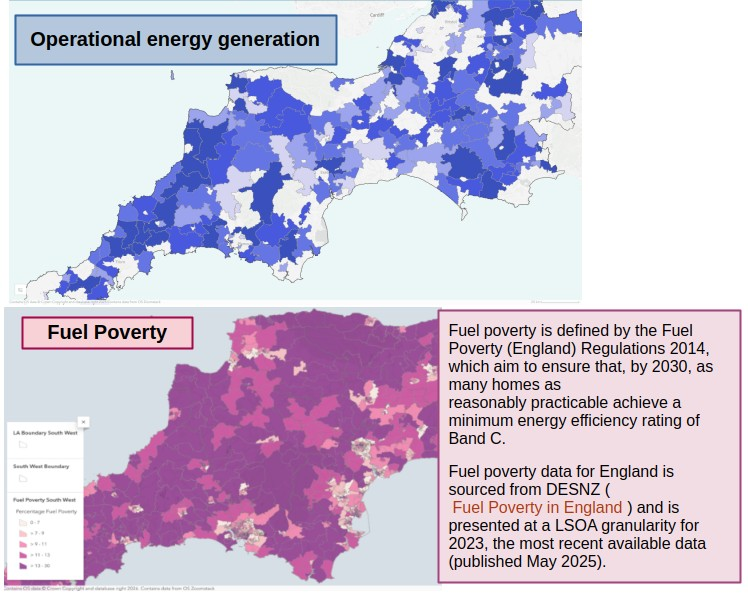
Here's a (NESO) map showing the Operational Generation in the West Country, for example, and the same area showing households in fuel poverty.
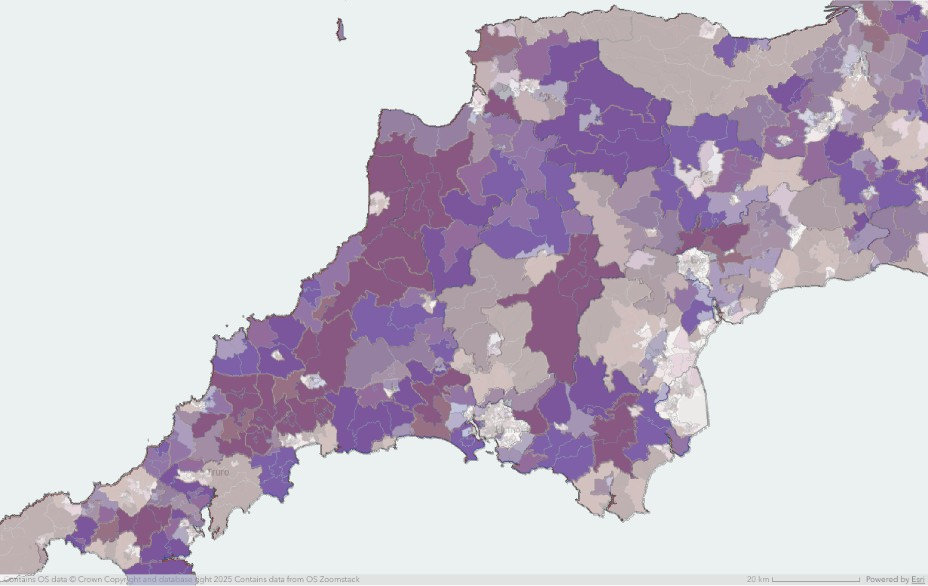
Let me change the colour range of Fuel Poverty from purples to reds, and then overlay those two maps.
Thus the more intense the purple colour, the greater is the contrast between (renewables) generation and poverty:
The large dark purple area on the east side of Dartmoor is a data error by NESO, which you can ignore. Yes, it's possible to fill the National Park with solar panels, but there's no grid infrastructure to connect to! 🤔
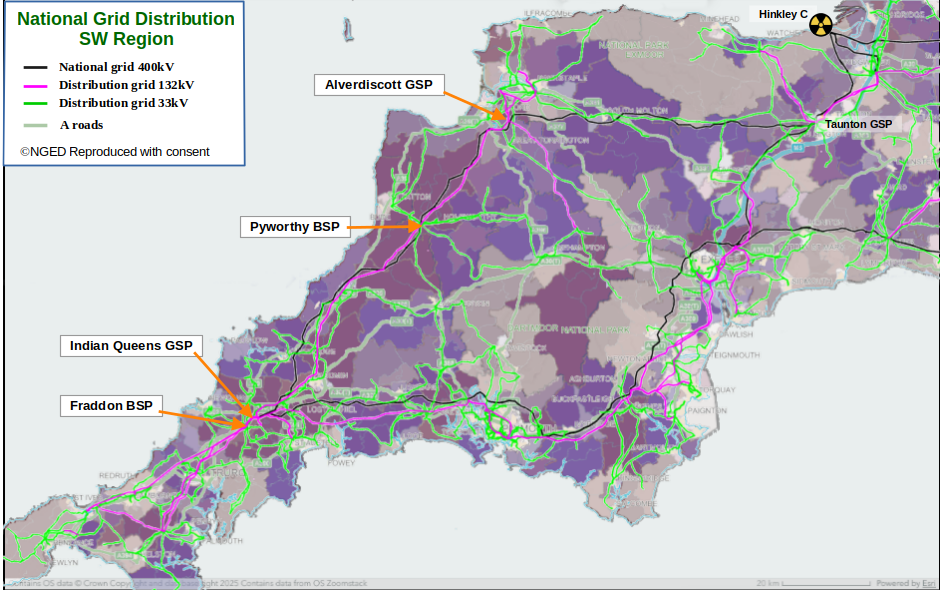
I can now overlay that composite map with the electricity grid (33kV and above) to demonstrate how most generation companies have sought connections along the corridor connecting Indian Queens in Cornwall to Alverdiscott in North Devon.
A week ago here, I posted data showing the oversupply of electricity which affects the Grid Supply Point at Alverdiscott.
They have temporarily suspended that NSIP Application with the Planning Inspectorate whilst they reconsider the viability timescales.
If those generation companies weren't having the grid infrastructure upgrades 'subsidised' from consumer bills, then they wouldn't be targeting the West Country with yet more generation & BESS. They are building in Cornwall and Devon because it puts yet more pressure on the government to bring forward massive upgrades of the 400kV Transmission Grid in the region.
From the viewpoint of the local population, their energy assets are being plundered by foreign-owned investment companies, for which they are required to pay ever greater bills to fund the infrastructure enhancements.
That's why they end up in Energy Poverty.
This post was modified 5 days ago 8 times by Transparent
Prior to the Ofgem SCR of May'22 Generation Companies were required to contribute towards all grid upgrades required as a consequence of them being given an Offer to Connect. That wasn't restricted to the voltage level at which their connection would be made.
The change was wanted by DESNZ in order to incentivise more companies to seek a grid connection for generation from renewable sources. That rapid acceleration resulted in the connections queue rising to 800GW, which is why NESO had to undertake the Connections Reform process in May'25.
There is now no incentive for a company to build generation close to where there will be demand.
DNOs and NGET will assess the infrastructure required to move the electricity, and then apply to Ofgem for a rise in the DUoS and TUoS portions of our bills.
Most renewable generation is now being connected in an area where there is no benefit for local consumers.
Thank you, this really helped me make sense of what is happening to the grid.
Clearly some low carbon generators like wind, nuclear and PV (to some extent) cannot produce near consumption centres but are restricted to some locations. It makes sense that they would not have to pay as much as a gas generator did and so the "common pot" of grid management would facilitate it.
And if I understand it correctly, on the demand side this also seems to be the case (they do not have to pay proportionate infra costs to connect).
For new demand like from data centres, it is odd that it was not incentivised to move closer to generation using differentiated pricing (short term political tactics aside!).
The conclusion in any case seems to be that more could be done to constrain the rise of the DUoS and TUoS portions of our bills.
I repeat: reasoned answers, considering the multi-dimensional nature of the problem, bearing in mind that somebody has to pay, and taking into account the complaints about the effect of high energy costs on business, on a postcard please!
Fair enough, hope I was reasoned enough... 🙂
And I try to keep some consolation that, as these are justified by the need to fund capital investments, those bill components will come down after this massive transformation. As the rules could be adjusted once 95% of our electricity is from carbon free sources...
From the viewpoint of the local population, their energy assets are being plundered by foreign-owned investment companies, for which they are required to pay ever greater bills to fund the infrastructure enhancements.
That's why they end up in Energy Poverty.
I understand these grid security in a post fossil fuel world are not easy arguments to make, and they will be lost on anyone in any kind of Poverty. I have no insight nor data on whether the ´22 decision that DESZN wanted was influenced by foreign companies.
But blaming foreigners money when our economy manages so much money for foreigners, and how much of "our money" is away on tax havens is tricky to reconcile. In my view, that is the background that leads to our ambivalent stance when our neighbours are getting close to implement a "made in Europe" policy.
This post was modified 5 days ago 4 times by Batpred
8kW Solis S6-EH1P8K-L-PLUS hybrid inverter; G99: 8kw export; 16kWh Seplos Fogstar battery; Ohme Home Pro EV charger; 100Amp head, HA lab on mini PC
I repeat: reasoned answers, considering the multi-dimensional nature of the problem, bearing in mind that somebody has to pay, and taking into account the complaints about the effect of high energy costs on business, on a postcard please!
Fair enough, hope I was reasoned enough...
And I try to keep some consolation that, as these are justified by the need to fund capital investments, those bill components will come down after this massive transformation. As the rules could be adjusted once 95% of our electricity is from carbon free sources
You were, the comment was meant for people who complain without bothering to take into account the enormous complexity, or propose a solution. This seems to be commonplace these days and really does absolutely nothing to move things foward.
For new demand like from data centres, it is odd that it was not incentivised to move closer to generation using differentiated pricing (short term political tactics aside!).
Data centres sometimes have to be close to their customers if the response is time critical. There are, apparently, a fair few data centres around London serving the City including the ones I mentioned earlier. I suspect adding 10ms to the response time because a few extra hops are needed makes a difference to City types (and yes I am being serious).
I do wonder about nodal pricing for businesses over a certain size/consumption. That would defeat the 'postcode lottery = freezing pensioner' objection and might push some business into areas where power is plentiful.
For new demand like from data centres, it is odd that it was not incentivised to move closer to generation using differentiated pricing (short term political tactics aside!).
Data centres sometimes have to be close to their customers if the response is time critical. There are, apparently, a fair few data centres around London serving the City including the ones I mentioned earlier. I suspect adding 10ms to the response time because a few extra hops are needed makes a difference to City types (and yes I am being serious).
I do wonder about nodal pricing for businesses over a certain size/consumption. That would defeat the 'postcode lottery = freezing pensioner' objection and might push some business into areas where power is plentiful.
I am fully aware that for some use cases and workloads, the response is time critical. When I worked in that area, ns were already being hotly discussed. If money is no object to the customer, of course everything will be critical.
But as an example, when an AI model is being trained or tested, this does not need to be done next to a user (but it may need to be done within a country signing up to ECHR). Once the model is right, it can be instantiated/migrated close to the user.
Nodal pricing for large consumers would make a difference when planning investments. For D/C already approved, it may be too late to change.
Yes, but that still means other customers are paying for the bulk of the cost of the infra upgrades related to the capacity that new consumer needs.
On the occasions I have needed a new (small scale) commercial electricity supply I have had to pay a fairly substantial connection charge. I don't know how that is calculated, I think back to the nearest grid connection point in the road. Quite how you would allocate the costs of the 400kV infrastructure to individual connections eludes me, it could work out that some poor person ordering at the wrong time has to pay millions whereas everyone else before and after pays nothing. I think there does come a point where shared infrastructure is just that.
4kW peak of solar PV since 2011; EV and a 1930s house which has been partially renovated to improve its efficiency. 7kW Vaillant heat pump.
Data centres sometimes have to be close to their customers if the response is time critical. There are, apparently, a fair few data centres around London serving the City including the ones I mentioned earlier. I suspect adding 10ms to the response time because a few extra hops are needed makes a difference to City types (and yes I am being serious).
An additional reason for so many data centres is because for "the cloud" which these data centres support, to be 100% robust, they must have a large amount of duplication contained within them. You can have regions of data centres, each region containing multiple data centres in different geographical areas.
A client who maybe hosting a database or website with Amazon for example, will have their data distributed across many data centres. If one or two data centres are destroyed, you as a client of Amazon will not have any interruptions to your website or loss of data.
However as has been realised, each data centre can consume large amounts of energy which is further exaggerated by the need for cloud robustness, service duplication and hence more data centres doing practically the same thing.
Regards
5 Bedroom House in Cambridgeshire, double glazing, 300mm loft insulation and cavity wall insulation
Design temperature 21C @ OAT -2C = 10.2Kw heat loss, deltaT = 8 degrees
Bivalent system containing:
12Kw Samsung High Temperature Quiet (Gen 6) heat pump
26Kw Grant Blue Flame Oil Boiler
4.1Kw Solar Panel Array
34Kwh GivEnergy Stackable Battery System
Yes, but that still means other customers are paying for the bulk of the cost of the infra upgrades related to the capacity that new consumer needs.
On the occasions I have needed a new (small scale) commercial electricity supply I have had to pay a fairly substantial connection charge. I don't know how that is calculated, I think back to the nearest grid connection point in the road. Quite how you would allocate the costs of the 400kV infrastructure to individual connections eludes me, it could work out that some poor person ordering at the wrong time has to pay millions whereas everyone else before and after pays nothing. I think there does come a point where shared infrastructure is just that.
In a very simplified way, the way I understood it, whenever there was a connection that customer would pay part of the cost of the common pipe they were connecting to. This would ensure that when that "pipe" needs upgrading, the money is available for it..
I have been to the public consultation for one of these data centres. They are planning their dedicated substation for it. I am not sure if they get 250kv in, but that substation delivers 11kv onto the d/c.
If they would build it in Scotland, that substation would be built there. But essentially they pay the same wherever they build. With a lot of the new production being in the north of GB, the 400kv grid surely needs more upgrades if these huge new data centres are built in the south east instead of in Scotland.
8kW Solis S6-EH1P8K-L-PLUS hybrid inverter; G99: 8kw export; 16kWh Seplos Fogstar battery; Ohme Home Pro EV charger; 100Amp head, HA lab on mini PC