

Notifications
Clear all
Joining the Renewable Heating Hub forums is completely free and only takes a minute. By registering you’ll be able to ask questions, join discussions, follow topics you’re interested in, bookmark useful threads and receive notifications when someone replies. Non-registered members also do not have access to our AI features. When choosing your username, please note that it cannot be changed later, so we recommend avoiding brand or product names. Before registering, please take a moment to read the Forum Rules & Terms of Use so we can keep the community helpful, respectful and informative for everyone. Thanks for joining!

Topic starter
07/07/2026 1:30 pm
I have a Solar/battery system with an approved G99 export limit of 3.68kW. I know that would/could be covered by a G98 but the installer and I were hoping for a lot more given the 10kW of panels installed. I experience an issue during summer where the export causes my voltage to spike over 254V and causes a PE fault with my Hypervolt charger: essentially I cannot charge my car at home during the day in summer. The DNO did come out and put a voltage meter on the supply and agreed it was spiking over the limit. This might normally be resolved by adjusting the transformer tap to reduce the voltage to the house but unfortunately the transformer is a fair distance away from the house and making changes would potentially negatively impact other households in the area so they can't do that. I did get a follow up call to say they would change the cable to my house to reduce the resistance and hopefully resolve the problem that way; they also said there is no timetable for the work but I shouldn't expect it to be done any time soon.
That was last September and I've heard nothing since. Not charging at home during the day isn't really an issue and neither is the G99 limit as I can mostly manage clipping to keep it to a minimum. If I was to contact the DNO to find out what was happening, could they use it as a prompt to revisit the G99 limit and reduce it further? In some respects that also would resolve the problem if it was reduced to zero but would be a serious blow as even that small amount has allowed me to achieve a £0 energy bill in the last year.
On a related note, is it possible to ask the DNO to relook at the G99 and increase the export allowance, again without them saying no and also reducing the current allowance?
Basically, I don't want to rock the boat in respect to my export but it would be good to get the issue with the charger/supply cable resolved.
This topic was modified 3 months ago by AndrewJ

07/07/2026 11:38 pm
To answer your question, I'm not sure they can reduce your offer and anyway, you are allowed 3.68kW of export under G98 so you can always revert to that.
Have you asked if switching to another phase may help. It may be that solar in your vicinity is not evenly spread across all 3 phases, and switching to another phase may improve your over-voltage events. @tim441 had similar voltage spikes and switching phases helped, see here:
Samsung 12kW gen6 ASHP with 50L volumiser and large radiators. 7.2kWp solar (south facing), Tesla PW3 (13.5kW). Net Zero

08/07/2026 12:04 am
If you try and revise it they can definitely offer you less not more and this does happen. I don't believe they can withdraw an existing one however.
More likely the DNO has decided it involves spending actual money and effort to fix. The charitable interpretation is that this takes time and planning, the less charitable one is that they are hoping you'll go away and they can leave it in limbo forever. I wouldn't rule out that it's on a piece of paper somewhere or buried in the system and they've completely forgotten about it either.
I would rattle cages, ask why it's not been done yet, offer to write to my MP and the like 8)

08/07/2026 8:46 am
I have updated the overvoltage thread mentioned by @old_scientist to add further information on undervoltage
Listed Grade 2 building with large modern extension.
LG Therma V 16kw ASHP
Underfloor heating + Rads
8.7kw pv solar
3 x 8.2kw GivEnergy batteries
1 x GivEnergy Gen1 hybrid 5.0kw inverter
Manual changeover EPS
MG4 EV

Topic starter
08/07/2026 9:15 am
I did read that thread with some interest. My inverter isn’t faulting, just the EV charger. There is plenty of solar in this area which is probably the reason for the low allowance. I’m sure I’ve read somewhere that they can offer <3.68kWh on a G99 which would seem to preclude re-applying under G98 for the 3.68kWh even if that is a legal allowance.
it would be useful to get it resolved as Octopus seem to be moving their customers towards a wider spread of charging times with Intelligent Go. I.e. making more use of renewables during the day when there is surplus and offering incentives to do so.
1
08/07/2026 11:24 am
I did read that thread with some interest. My inverter isn’t faulting, just the EV charger. There is plenty of solar in this area which is probably the reason for the low allowance. I’m sure I’ve read somewhere that they can offer <3.68kWh on a G99 which would seem to preclude re-applying under G98 for the 3.68kWh even if that is a legal allowance.
it would be useful to get it resolved as Octopus seem to be moving their customers towards a wider spread of charging times with Intelligent Go. I.e. making more use of renewables during the day when there is surplus and offering incentives to do so.
Correct, when you apply under G99 the DNO will make you an offer, which you can choose to accept, or not. This offer can be literally anything, and it can certainly be less than 3.68kW.
If you do not like the G99 offer, you can always fall back to G98, which is install (upto 3.68kW) and notify - no permission required so I do not believe they can refuse this.
I had 3.68kW export under G98, applied for a PW3 and additional solar under G99 and was initially offered 1kW export limit, so less than my existing 3.68kW under G98. The DNO (NG) were very helpful in explaining their process. They use a spreadsheet to calculate the voltage change for each export limit, and gradually reduce the export until the voltage remains within their prescribed tolerances. The guy explained that when they entered 11kW it exceeded tolerances, so they reduce to 10, 9, 8... right down to 1kW for my line before it was in tolerance, hence the 1kW offer I received. Of course all this is a desktop exercise without actually measuring stuff, but that's the process they use to make their offers under G99.
I would certainly want to get it resolved as I do not think it will be long before export rates during daytime solar excess fall off a cliff, making use or storage near mandatory. It may be that one of the other phases has far more capacity to cope with your generation/export, which would be beneficial to you as well as the grid as the phases would be better balanced. If all the phases are over-voltage, they probably need to tap the substation down to a lower voltage. I would keep pushing them to record voltages, and if they remain outside of limits, push them to address that as they are required to maintain those limits.
This post was modified 3 months ago by Old_Scientist
Samsung 12kW gen6 ASHP with 50L volumiser and large radiators. 7.2kWp solar (south facing), Tesla PW3 (13.5kW). Net Zero

08/07/2026 7:32 pm
did read that thread with some interest. My inverter isn’t faulting, just the EV charger. There is plenty of solar in this area which is probably the reason for the low allowance. I’m sure I’ve read somewhere that they can offer <3.68kWh on a G99 which would seem to preclude re-applying under G98 for the 3.68kWh even if that is a legal allowance.
OK. But the issue of your EV charger tripping out, and @tim441 seeing his inverter cease to export are related.
Having 'plenty of solar in the area' means that those solar inverters raise the grid voltage when they export.
Any LCT appliance like an EV charger, or another G98/G99 certified inverter should respond to a sustained over-voltage by detaching itself from the grid.
Secondly, there is another concept which needs airing in order for us to understand what is happening with your EV charger.
a: We're going to assume that this is a single-phase charger, and that the 254v you mention is being measured by electronics within the charger, and between phase and neutral.
That's not a great location to be sensing line voltage!
It's affected by the current being drawn by the charger itself.
Have you cross-checked that 254v against what is present on a 13A socket close to the consumer unit?
b: EV chargers and other high-current single-phase devices like electric showers will create phase imbalance at the local substation.
This timeline shows a single charger operating from a local substation from 00:30 - 04:30 (Octopus Go).
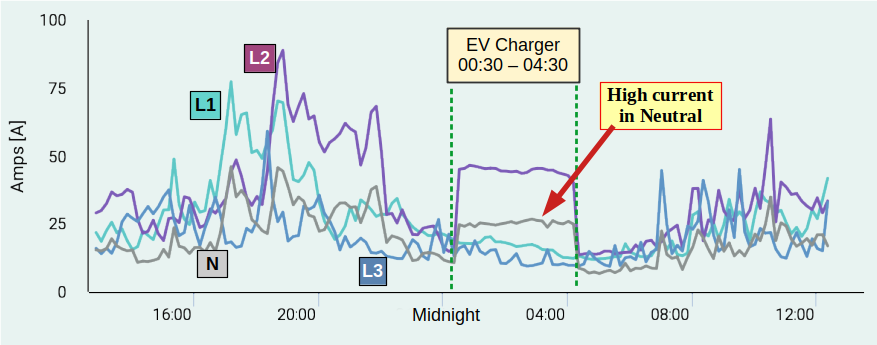
Whenever there is phase imbalance, current flows in the Neutral conductor.
That Neutral current moves its voltage away from zero.
If you now measure the voltage between Live and Neutral for all three phases, they will be different. The voltage you sample will also vary according to the distance between you and the substation transformer.
We have no idea how many other EV chargers and showers are simultaneously drawing 32A+ on what phases, and at what distance from the substation. Nor does your DNO know because they are not permitted to access data from individual Smart Meters. They receive aggregated data, and that doesn't show what phases are being adversely affected because a Smart Meter can't know what phase it's connected to anyway.
Due to there being so many unknowns, I think it unusual that the designer/manufacturer of an EV charger would set such a small over-voltage as 254v as the threshold to initiate it tripping out.
On the other topic I stated that the ENA are proposing a nationwide voltage reduction on LV supplies.
However, this won't be applied by changing taps at each local substation transformer. There are 550,000 of them!
Rather, it will be adjustments to the 11kV supply from the Primary Substation which is moved downwards. The LV feeds to homes will fall by the same ratio.
We shouldn't be expecting a DNO to change taps at a local substation in the meantime.
This post was modified 3 months ago by Transparent
Save energy... recycle electrons!
08/07/2026 7:47 pm
"We shouldn't be expecting a DNO to change taps at a local substation in the meantime. "
They've taken enough of our money to do it, if it's out of the permitted range they should be doing it and if not they need dragging through every inconvenience and annoyance until they jump.
It's attitudes like that which get nothing done in this country.

08/07/2026 8:04 pm
They've taken enough of our money to do it, if it's out of the permitted range
It's unlikely that the voltages are outside the envelopes specified in Sect.27 of the ESQCR
I think @andrewj is giving us a reading which is being measured at his EV charger. It might even be shown on an App, rather than a physical meter on the charger unit itself.
The accuracy of that measurement must comply with the Measuring Instruments Regulations (SI 2016/1153). An EV Charger is almost certainly going to be Class-B which requires plus/minus 1% accuracy.
There's no way a charger should be disconnecting due to measurement of 254v for a max parameter defined as 253v. That's expecting a level of accuracy greater than the unit is certified for.
The DNO will monitor the voltage using a 10-minute rolling average. See what I wrote about this here just last week.
Small spikes will make little difference to the calculation.
Save energy... recycle electrons!

08/07/2026 8:07 pm
Due to there being so many unknowns, I think it unusual that the designer/manufacturer of an EV charger would set such a small over-voltage as 254v as the threshold to initiate it tripping out.
My charger was quite picky about the lower threshold. I contacted Ohme and they set it as low as G99 allows. I have not seen it tripping on the higher limit but that could be just due to us generally only charging overnight.. The exception being when IOG decides to give us an extra period @3.5p/kwh
8kW Solis S6-EH1P8K-L-PLUS hybrid inverter; G99: 8kW export; 16kWh Seplos Fogstar battery; Ohme Home Pro EV charger; Vaillant Arotherm Pro 7kW; 100Amp head, HA lab on mini PC
08/07/2026 9:33 pm
My charger was quite picky about the lower threshold. I contacted Ohme and they set it as low as G99 allows.
The lowest point in the low-volts disconnect range is 186v.
That's 20% below the statutory Declared Voltage of 230v.
There are time-frames between 216.4v and 186v when an inverter or storage battery must react because it recognises the Low-Volts as being sustained, rather than momentary.
This is a large subject area. I can't provide sufficiently extensive explanations within the confines of a Forum.
Save energy... recycle electrons!
Topic starter
08/07/2026 10:01 pm
The EV charger doesn’t tell me voltage levels, just goes red when a PE fault is detected. This happens a lot at the moment during the day when it’s very sunny - I’m assuming that there is a mix of different facing panels and differing allowances. Never happens in the morning, evening or overnight. The inverter stats show voltages peaking over 256v actually but I don’t know how it is measuring it or where; when the DNO attached a voltage meter for a week they were seeing the same sort of spiking. They have made no adjustments for it - too far from the substation and it would impact other homes too much - but as I said, I did get a call to say they wouldn’t upgrade the cable to my house at some point.
Page 1 / 3
Next
SPONSORS
Degrees of Separation

Latest Posts
-

RE: How quickly would you want/expect heat recovery to take from setback?
I have no idea how the control loop works with the Cosy...
By AndrewJ , 4 hours ago
-
RE: How should the Boiler Upgrade Scheme be reformed?
Not quite, regular A2W heat-pumps need a load of extra ...
By Temperature_Gradient , 19 hours ago
-
RE: Heat Geek installations: share your experiences
one thing i learnt from reading people’s comments and e...
By Batpred , 21 hours ago
-
RE: Cooling/heating with one unit
"The way we use A2A on a cheap overnight EV tariff is t...
By mrkfm , 23 hours ago
-
RE: Do I add Air Con or MVHR to existing A2W ASHP?
We have ‘signed on the dotted line’ today for a Panason...
By Toodles , 23 hours ago
-
RE: Heat pump branding. Clever, contemporary… or a bit too much?
...or it was there and was lost thanks to laziness and ...
By Majordennisbloodnok , 24 hours ago
-
@bobflux Thank you for your response. I am trying to ...
By RonV. , 24 hours ago
-
This post is about how I successfully configured a buff...
By Tony.Stolz , 1 day ago
-
The installer visited yesterday and suggested the noise...
By JamesChatz , 1 day ago
-
RE: HeatGeek vs Octopus surveys: puzzling disparity - any ideas why?
Your house sounds a lot like mine. 2 surveyors each sp...
By JamesPa , 1 day ago
-
RE: Heat Geek Zero Disrupt: Are We Sleepwalking Into Another Race to the Bottom?
Thats true only if you do the wrong experiment. Done c...
By JamesPa , 1 day ago
-
RE: battery storage without solar
As of October 1st they need specific qualifications to ...
By EtchedPixels , 2 days ago
-
RE: Renewables & Heat Pumps in the News
With regards to the BUS grant raid, I gave it more thou...
By ASHP-BOBBA , 2 days ago
-
RE: Why are ASHP installs so expensive?
The whole system seems to work on the basis of...
By ian33a , 2 days ago






SPONSORS