

Notifications
Clear all
Joining the Renewable Heating Hub forums is completely free and only takes a minute. By registering you’ll be able to ask questions, join discussions, follow topics you’re interested in, bookmark useful threads and receive notifications when someone replies. Non-registered members also do not have access to our AI features. When choosing your username, please note that it cannot be changed later, so we recommend avoiding brand or product names. Before registering, please take a moment to read the Forum Rules & Terms of Use so we can keep the community helpful, respectful and informative for everyone. Thanks for joining!


Topic starter
13/01/2022 10:13 pm
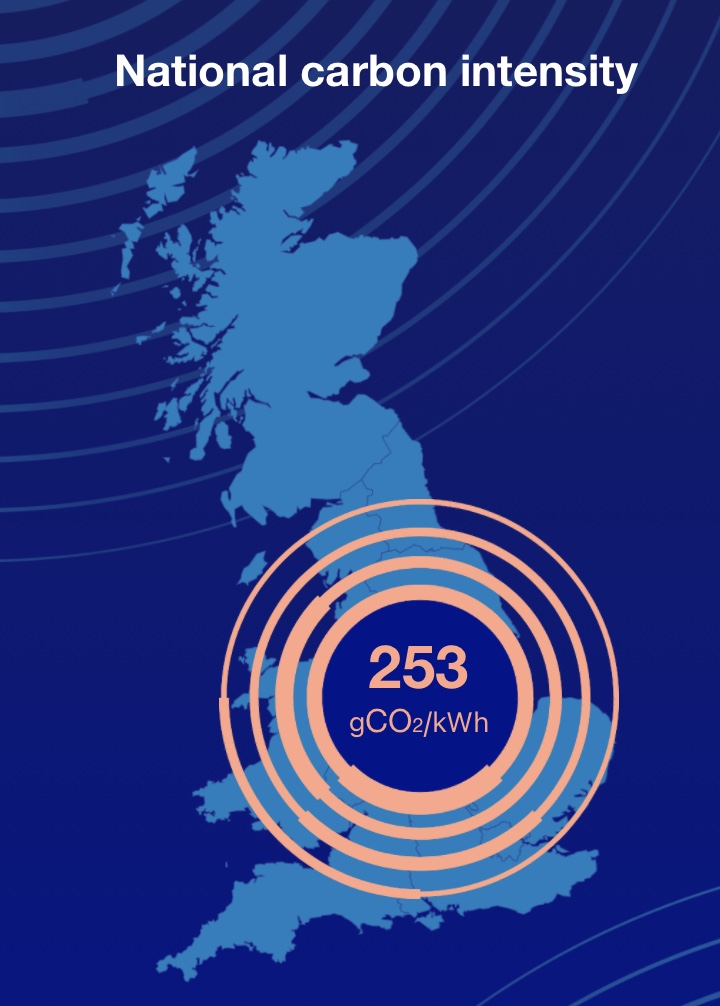
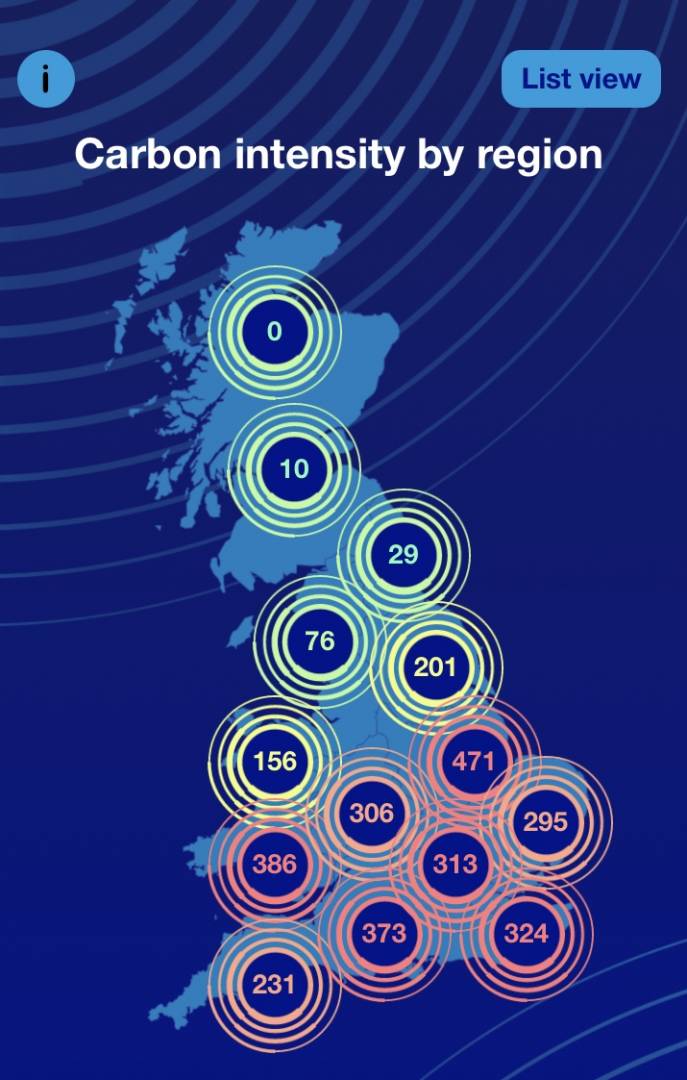
@julianc, I think that electrification has to be the end goal, and I completely get your point about burning HVO (or any other biofuel) for home heating, but the supply of green energy remains an issue I can’t my head around. Yes, the UK has done an amazing job to get more renewable energy in play, but look at the attached charts from the grid for today.
Scotland - amazing. Wind and hydro delivering all their electricity. NE and NW of England - good. Rest of England and Wales is really, really poor, and this unfortunately is the norm since I’ve started to look at this data this year. It’s all gas and import. Today’s CO2 emissions for electricity production (which our heat pump would be using) far exceed what the HVO is emitting.
HVO is not a long-term solution, but it’s fulfilling a low carbon heating role for us this winter. And I think each household needs to figure out what it’s comfortable with and what works.
As you and Derek and others have stated, the objective is to use less energy… that’s our personal goal for 2022. We’re better than ever waiting for solar production to be high to do tasks that are electricity intensive, and the HVO has helped with that because all solar goes to home electric use, not the heat pump, when it’s cold outside. We’re better at not having lights on where we aren’t.
🔥 Britain’s Heat Pump Shitshow
How Installing a Heating System Became a National Nervous Breakdown
Free UK shipping.
📗 Heat Pumps Explained
A Jargon-Free Guide for Homeowners
Rewritten and updated for 2027
📘 From Zero to Heat Pump Hero
🛠️ Bodge Buster
New to heat pumps?
Take the Heat Pump Fundamentals course and use INTRO50 at checkout for 50% off.
2

13/01/2022 10:16 pm
...
I do not see how HVO helps this compared to full electric solution.
...
It's clear that HVO contains carbon and that burning it will release that back into the atmosphere. However, given its starting point is oil from a recent crop, and that even then it's only recycling that which has already been wasted, it's not unreasonable to regard it as carbon neutral; the crop fixes the carbon, the crop is used for culinary purposes, the waste is burned and releases the carbon back into the atmosphere.
The gold standard for resolving the global environmental problem we're facing is any form of energy production that doesn't release carbon; in effect, any carbon sink. However, we have very little time to fix the problem and we run the very real risk of doing nothing for fear of not picking the perfect solution. HVO, amongst other biofuels, represents a significant improvement in its carbon footprint compared with fossil fuels. If that buys us all time to put in place long term solutions it'll be serving its purpose.
The starting point is vegetable oil and hydrogen plus a lot of heat energy. So i think that it could only be considered carbon neutral if the hydrogen is produced from something like electrolysis of water using carbon neutral electricity, not if it’s steamed out of oil. Then to be picky, the processing would also need to be green, and the delivery tankers fuelled by HVO (which I believe they might be).
Not knocking it, it may well be a possible interim solution, I would just like to see clarity.
2

13/01/2022 10:20 pm
I'd just like to correct a misconception everyone here seems to have. The UK has in fact reduced it's power use massively over the last decade or so. Down from 357TWh in 2005 (60m people) to 287TWh in 2020 (67m people). We have over 10% more people and used 20% less power in total terms. Along side this the UK used large amounts of coal, which has also been phased out.
This is what surprises me when people say the grid can't handle more use. Of course it can, it literally did 10 years ago.
4

13/01/2022 10:52 pm
@editor I’ve downloaded the app to track carbon intensity. It is particularly poor at the moment. The low record is 39g CO2 / kWh. Oil is 245g CO2 / kWh. The 306g CO2 / kWh for current generation doesn’t take into account the COP of the ASHP whereas oil is just a 1 for 1 I think
Daikin Altherma 3H HT 12kWh ASHP with Mixergy h/w cylinder; 4kW solar PV with Solic 200 electric diverter; Honda e and Volvo EX30 Ultra Twin Performance electric vehicles with Myenergi Zappi mk1 & Ohme chargers


13/01/2022 11:46 pm
I'd just like to correct a misconception everyone here seems to have. The UK has in fact reduced it's power use massively over the last decade or so. Down from 357TWh in 2005 (60m people) to 287TWh in 2020 (67m people). We have over 10% more people and used 20% less power in total terms. Along side this the UK used large amounts of coal, which has also been phased out.
This is what surprises me when people say the grid can't handle more use. Of course it can, it literally did 10 years ago.
Hi Batalto,
I'm afraid it's not quite as simple as that. In the area where I live, 5GW of coal fired generating capacity has been shutdown over the past few years, so the grid in our area is probably under utilize now. So areas where renewable generation is being connected will probably need to be strengthened to cope with the extra capacity.
Electrical distribution systems are designed using a diversification factor, which assumes that not everyone will switch everything on at the same time and hence overloading the circuits. If everyone in an area were to charge an EV or battery storage, plus run a heat pump, all during a 4 hour period at night, I imagine it may cause problems if the local circuits are not strengthened.
I also suspect that much of the load reduction over the years, was due to the closure of heavy industry rather than domestic consumers using less.
14/01/2022 8:56 am
@editor I’ve downloaded the app to track carbon intensity. It is particularly poor at the moment. The low record is 39g CO2 / kWh. Oil is 245g CO2 / kWh. The 306g CO2 / kWh for current generation doesn’t take into account the COP of the ASHP whereas oil is just a 1 for 1 I think
Hi Julian,
To get everything in context, could you clarify on which date the low record of 39g CO2/kWh occurred?
Topic starter
14/01/2022 8:58 am
Hi Julian,
To get everything in context, could you clarify on which date the low record of 39g CO2/kWh occurred?
January 3, 2022
🔥 Britain’s Heat Pump Shitshow
How Installing a Heating System Became a National Nervous Breakdown
Free UK shipping.
📗 Heat Pumps Explained
A Jargon-Free Guide for Homeowners
Rewritten and updated for 2027
📘 From Zero to Heat Pump Hero
🛠️ Bodge Buster
New to heat pumps?
Take the Heat Pump Fundamentals course and use INTRO50 at checkout for 50% off.

Topic starter
14/01/2022 9:04 am
@editor I’ve downloaded the app to track carbon intensity. It is particularly poor at the moment. The low record is 39g CO2 / kWh. Oil is 245g CO2 / kWh. The 306g CO2 / kWh for current generation doesn’t take into account the COP of the ASHP whereas oil is just a 1 for 1 I think
To address COP, the data I’ve used for our property is on compressor consumption - the actual amount of electricity we drew from the grid to run the heat pump - so our calculations were relatively straightforward by just multiplying by the amount of CO2 created to generate electricity on that day, so we’re comparing HVO directly to electricity.
🔥 Britain’s Heat Pump Shitshow
How Installing a Heating System Became a National Nervous Breakdown
Free UK shipping.
📗 Heat Pumps Explained
A Jargon-Free Guide for Homeowners
Rewritten and updated for 2027
📘 From Zero to Heat Pump Hero
🛠️ Bodge Buster
New to heat pumps?
Take the Heat Pump Fundamentals course and use INTRO50 at checkout for 50% off.
2
Topic starter
14/01/2022 9:06 am
@derek-m, you’re welcome. The 39g is a terrific number, but the rest of January - 13 days - has been extremely poor with the electricity grid producing upwards of 200g/kWh.
🔥 Britain’s Heat Pump Shitshow
How Installing a Heating System Became a National Nervous Breakdown
Free UK shipping.
📗 Heat Pumps Explained
A Jargon-Free Guide for Homeowners
Rewritten and updated for 2027
📘 From Zero to Heat Pump Hero
🛠️ Bodge Buster
New to heat pumps?
Take the Heat Pump Fundamentals course and use INTRO50 at checkout for 50% off.
2
14/01/2022 9:08 am
Topic starter
14/01/2022 9:13 am
Today is another intensive day. 302g/kWh as a UK average. For the first time I truly understand the argument for nuclear energy. Interestingly, I think the Chinese had a successful fusion test earlier this year.
🔥 Britain’s Heat Pump Shitshow
How Installing a Heating System Became a National Nervous Breakdown
Free UK shipping.
📗 Heat Pumps Explained
A Jargon-Free Guide for Homeowners
Rewritten and updated for 2027
📘 From Zero to Heat Pump Hero
🛠️ Bodge Buster
New to heat pumps?
Take the Heat Pump Fundamentals course and use INTRO50 at checkout for 50% off.

SPONSORS

Degrees of Separation
Latest Posts
-

RE: New Build 3 Phase or 1Phase
Not so. 1: It's now the case that the Service Fuse wi...
By Transparent , 4 hours ago
-
RE: How will removing the standing charge on gas bills benefit heat pumps?
I think it has an enormous impact on air/air users. The...
By EtchedPixels , 11 hours ago
-
@editor Ouch, sorry to re start the tick. I had assume...
By DavidB , 1 day ago
-
RE: Say hello and introduce yourself
@e-a-west as the good Major said, welcome to the forums...
By Mars , 1 day ago
-
RE: How much of your renewable and home setup would still work if the internet went down?
Yes I actually have a copy of a tool that whenever a ce...
By EtchedPixels , 2 days ago
-
RE: Indevolt Batteries UK Support & Info Thread
@editor Hi, To resolve this, please tap on the A...
By Indevolt Tech , 2 days ago
-
RE: Double or Triple Glazed Windows?
Posted by: @singlespeed With 9 years repairing windo...
By Rob of York , 3 days ago
-
@transparent we’re still running a secure version of PH...
By Mars , 3 days ago
-
RE: How quickly would you want/expect heat recovery to take from setback?
Much longer than that here. The heating isn't even on. ...
By bobflux , 3 days ago
-
RE: Passiv Smart Thermostat - Help & Forum Support
Obviously the weather is changeable but there's a defin...
By Singlespeed , 3 days ago
-
RE: The Changing Jet Stream Could Challenge UK Air Source Heat Pumps
@rob-of-york I must admit that when we had a Daikin hea...
By Toodles , 3 days ago
-
RE: Forum updates, announcements & issues
Get the Renewable Heating Hub heads-up on WhatsApp. I...
By Mars , 3 days ago
-
RE: Safety study for plug in batteries out to tender - looks like Q3 2027 at best before legal
@editor I pointed out to the one of the Fuse execs that...
By dansus , 3 days ago
-
RE: 15kw pump for 225m2 1990's house - over kill?
@seaviews As well as loft insulation, there are othe...
By Rob of York , 4 days ago





SPONSORS