
Notifications
Clear all

Topic starter
18/02/2026 5:52 pm
Hi @jamespaThanks for posting the photos which are very useful. You are asking the right questions!
Without knowing exactly how the Honeywell is wired/connected its difficult for me to tell how best to disable it. Can you tell anything from the wiring around? Others, eg someone with one of the Honeywell devices, may well have a better idea.
The final picture is your weather compensation curve. This changes the temperature of the water that the heat pump produces to feed the radiators according to the outside temperature. With the current settings its likely you are paying 30% -50% more for your heating than you need to and are less comfortable than you could be. Dont panic though, it can be changed and we will provide help.
Before you start changing anything I recommend you read this introduction to heat pumps which explains some of the key concepts. You need to forget everything you learned about running a boiler (much of which was wrong even for boilers!) and think instead 'low and slow' - on 24x7 at a very low level, just enough to keep the house warm. The weather compensation is key to this.
If you read the introduction and tell us something about how the Honeywell is connected we can talk you through the key steps. If you do this your house should be more comfortable and your heating bills lower.
Thanks for the reply. I have read through the info and posts again. I am ignoring the Honeywell at the moment. I have activated the AT compensation and moved the curve so to be around 35C FT @ 0C which ranges from 25C FT @ 20C to 50C FT @ -30C (40C FT @ -10C). I'll try this for a few days to see. I've attached pics. I think that I was looking for 'unicorn dust'. I just spiked the DHW for a shower!
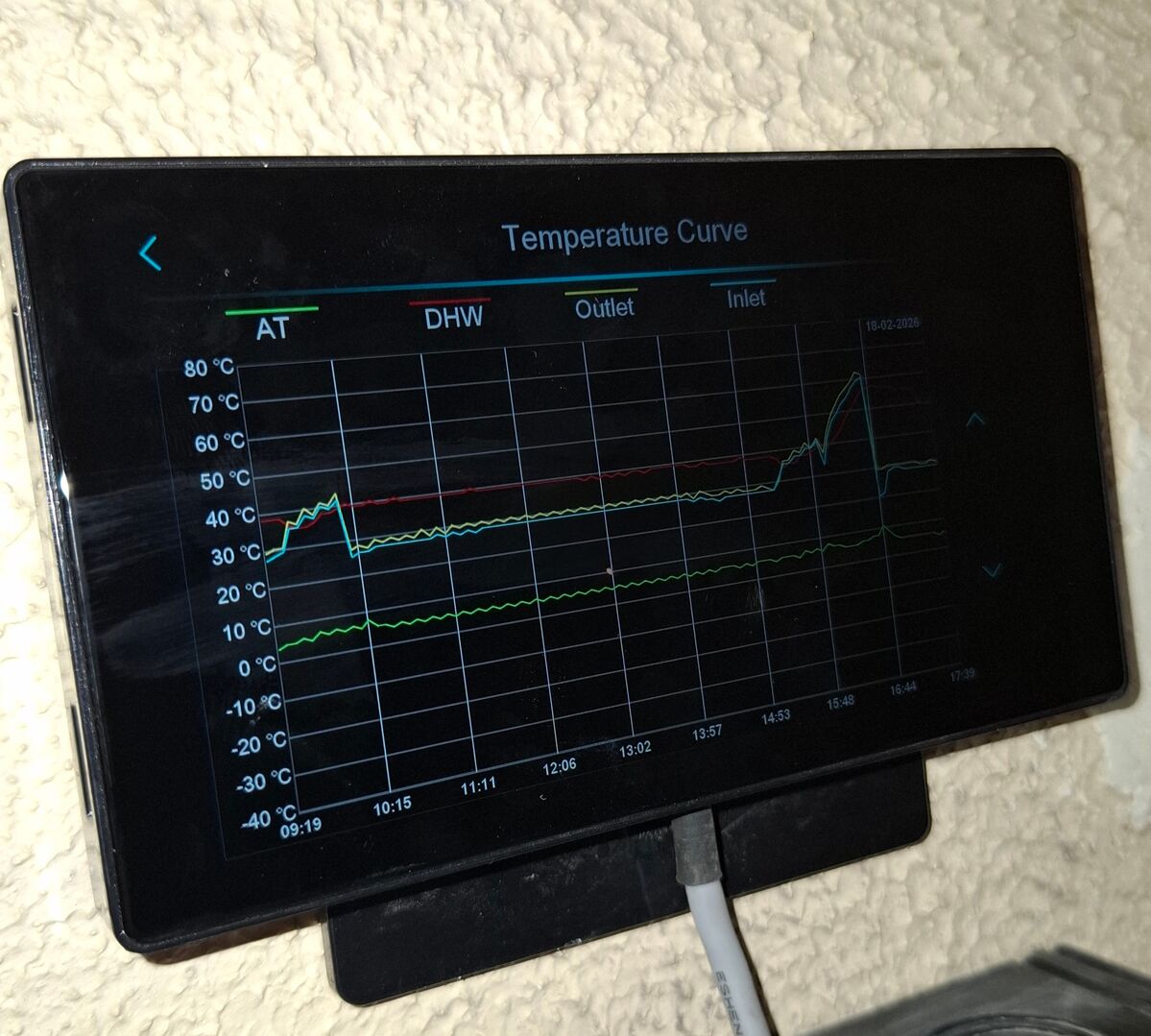
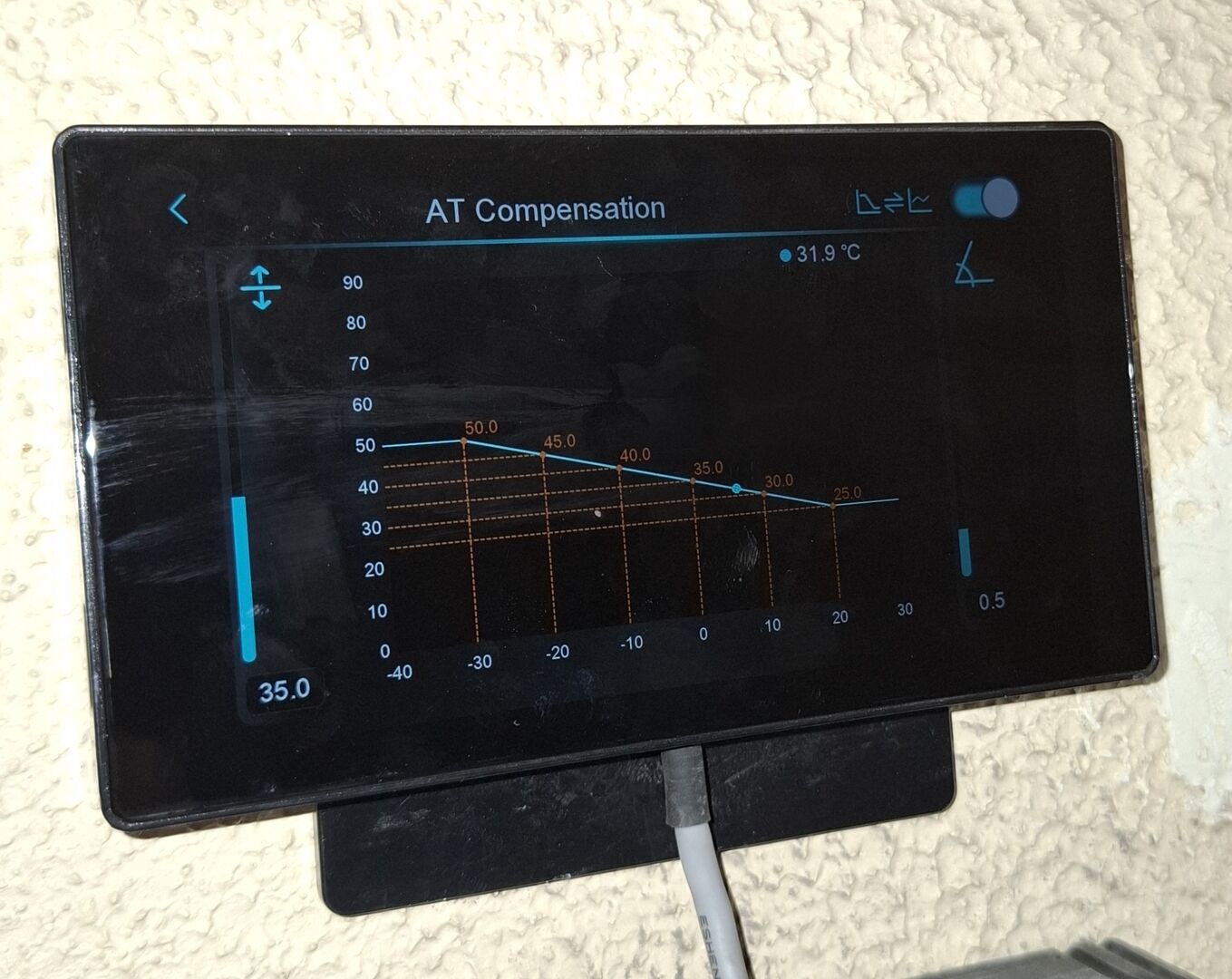
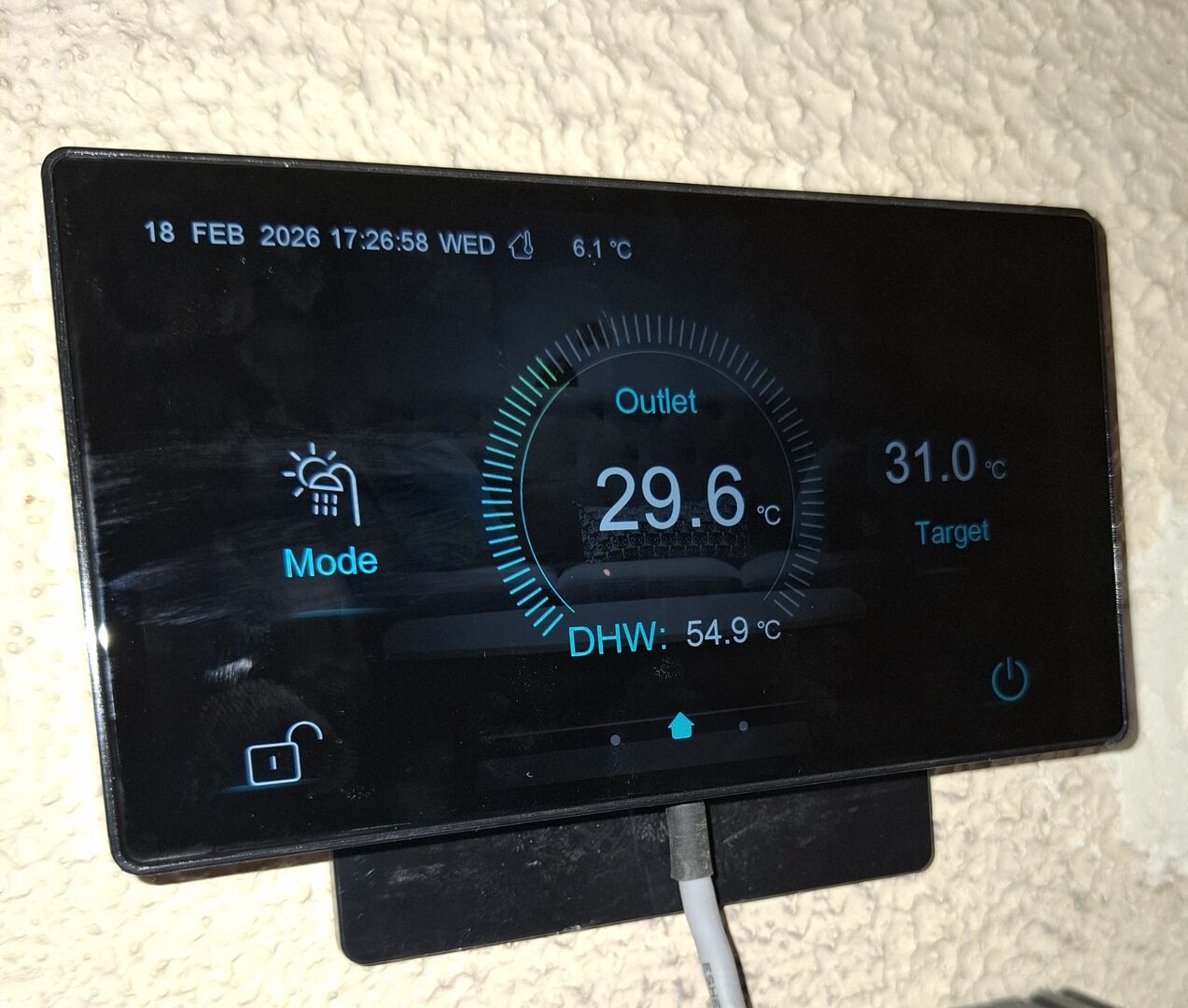

18/02/2026 7:47 pm
. I think that I was looking for 'unicorn dust'.
Not if you are systematic and patient.
The high OAT end is logically something like 20 at 20, or more practically something like 25-27 @ 16 or thereabouts. At this level it's fairly self regulating. So that leaves only the low oat end. Start at the design ft if there is one or if not 35 for ufh or 45 for rads at design oat (or do a linear extrapolation of that to a lower oat if you wish Then turn it up ir down as appropriate, once a day no more frequently. Once the house is getting close to the right temperature (go by feel) start trimming radiator lsvs if there are major discrepancies.
Fortunately rad balancing doesn't have to be particularly accurate because rooms share heat. Adjusting the WC curve is basically one parameter up or down, same as a thermostat.
This really is much more difficult to describe than to do, so long as you are patient.
This post was modified 1 day ago by JamesPa
4kW peak of solar PV since 2011; EV and a 1930s house which has been partially renovated to improve its efficiency. 7kW Vaillant heat pump.
1
Topic starter
19/02/2026 12:24 pm
Hi @jamespa , Thanks for the reply - cautionary tale re adjustment.. I think that I was looking for 'unicorn dust'.
Not if you are systematic and patient.
The high OAT end is logically something like 20 at 20, or more practically something like 25-27 @ 16 or thereabouts. At this level it's fairly self regulating. So that leaves only the low oat end. Start at the design ft if there is one or if not 35 for ufh or 45 for rads at design oat (or do a linear extrapolation of that to a lower oat if you wish Then turn it up ir down as appropriate, once a day no more frequently. Once the house is getting close to the right temperature (go by feel) start trimming radiator lsvs if there are major discrepancies.
Fortunately rad balancing doesn't have to be particularly accurate because rooms share heat. Adjusting the WC curve is basically one parameter up or down, same as a thermostat.
This really is much more difficult to describe than to do, so long as you are patient.
AT curve centred around 35C as per last post. Late evening not quite enough comfort for the missus, so I altered AT curve to 37C. At approx 4 ish am, both of us downstairs - synchronised loo system - complaining how warm it was so I quickly altered AT curve back to 35C - fabulous this morning when we got up properly. Anyways I attach some pics of the temp traces of the system showing the Flow and Return (oulet and Inlet) temps. You can clearly see the lines around 4 ish pre alteration, then a little reset downwards? then settle at reduced values. i checked again when I got up and noticed another slightly larger reset? before returning to the previous temps. With the second blip, you can see the Flow and return temps appear to separate to about 5C apart (Usually around 2.5 max) before returning to normal readings. I thought that it might be something to do with defrost but with the larger dip the AT(outside) actually rise upwards at the same time. Any thoughts?
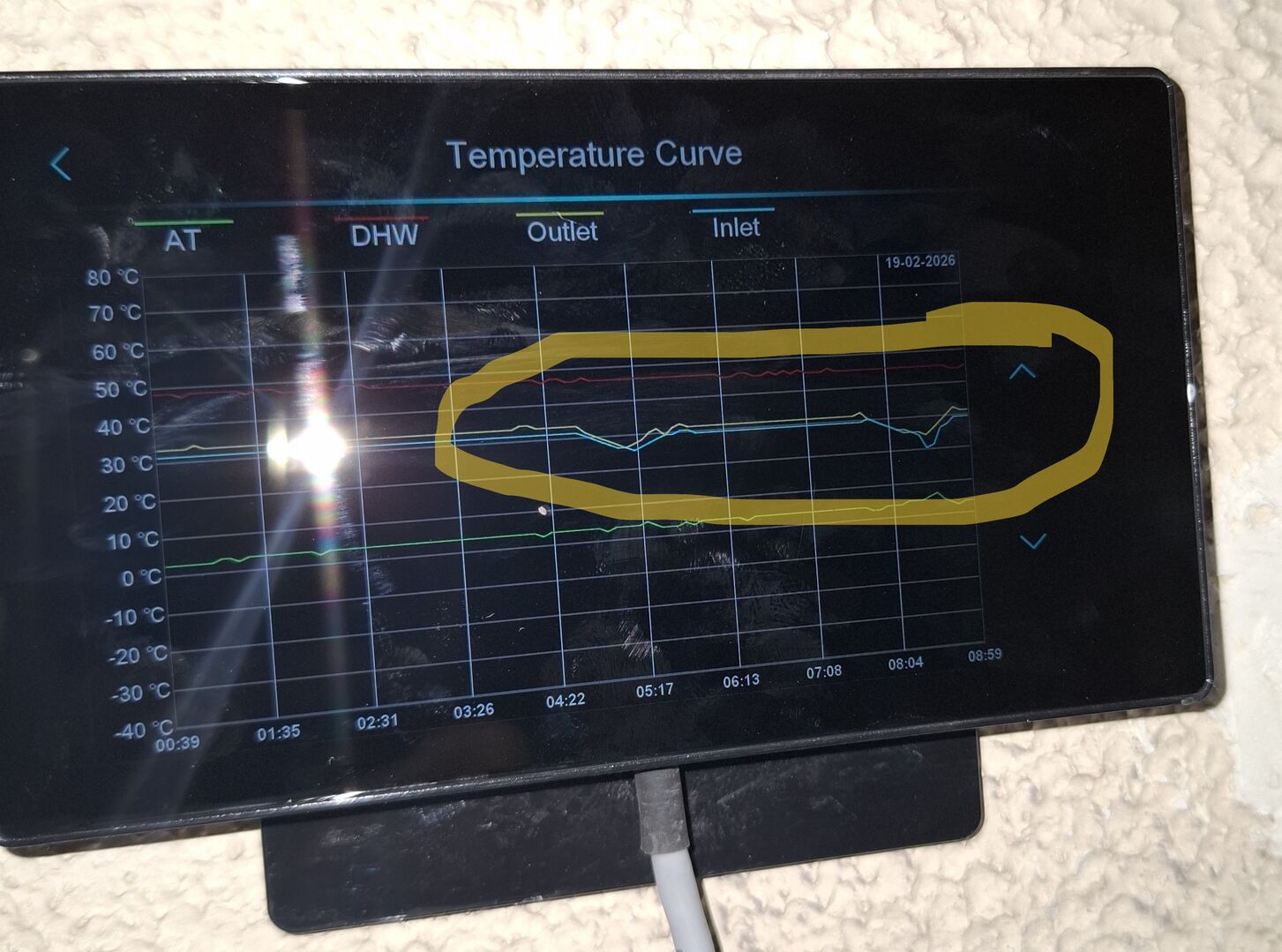
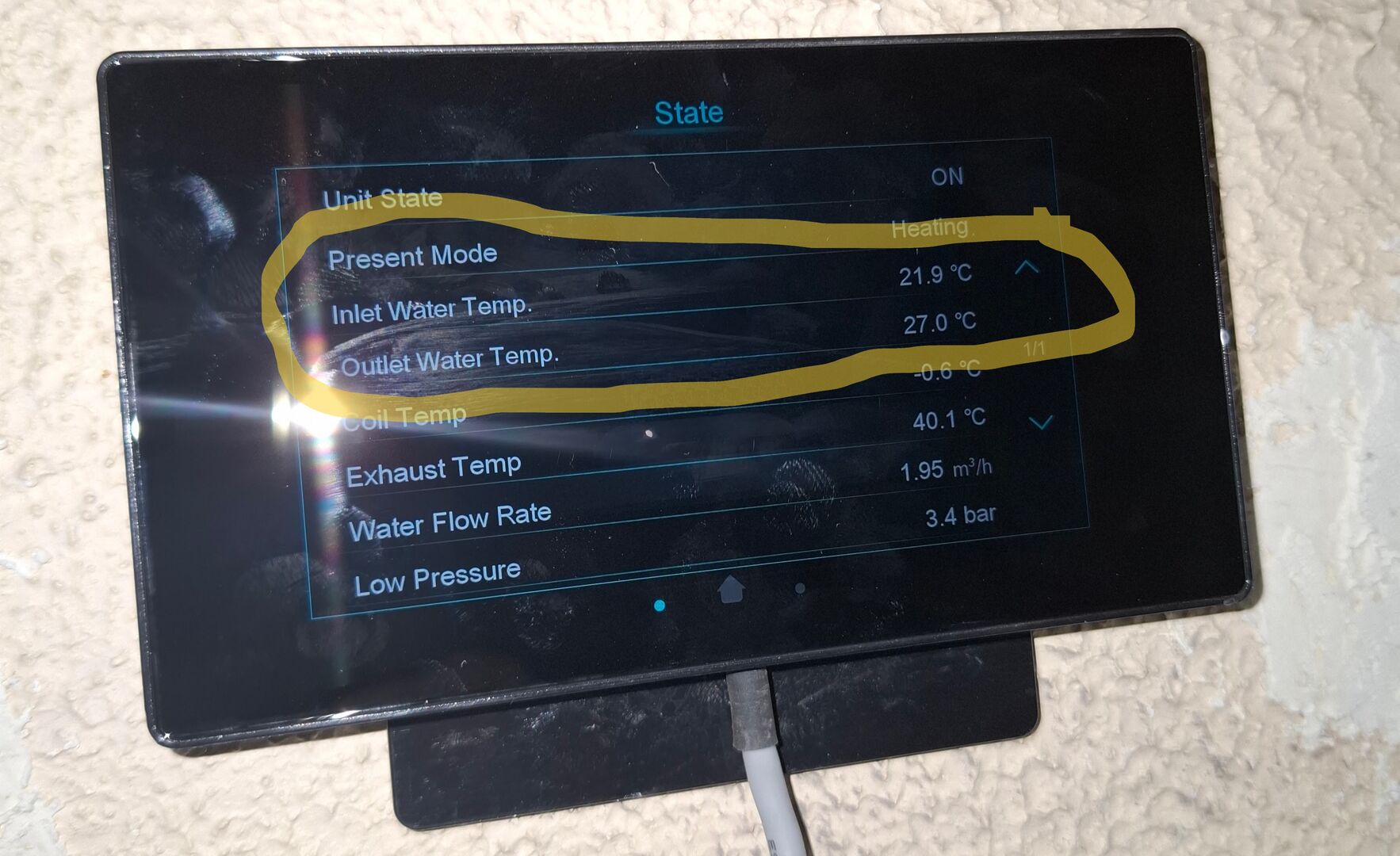
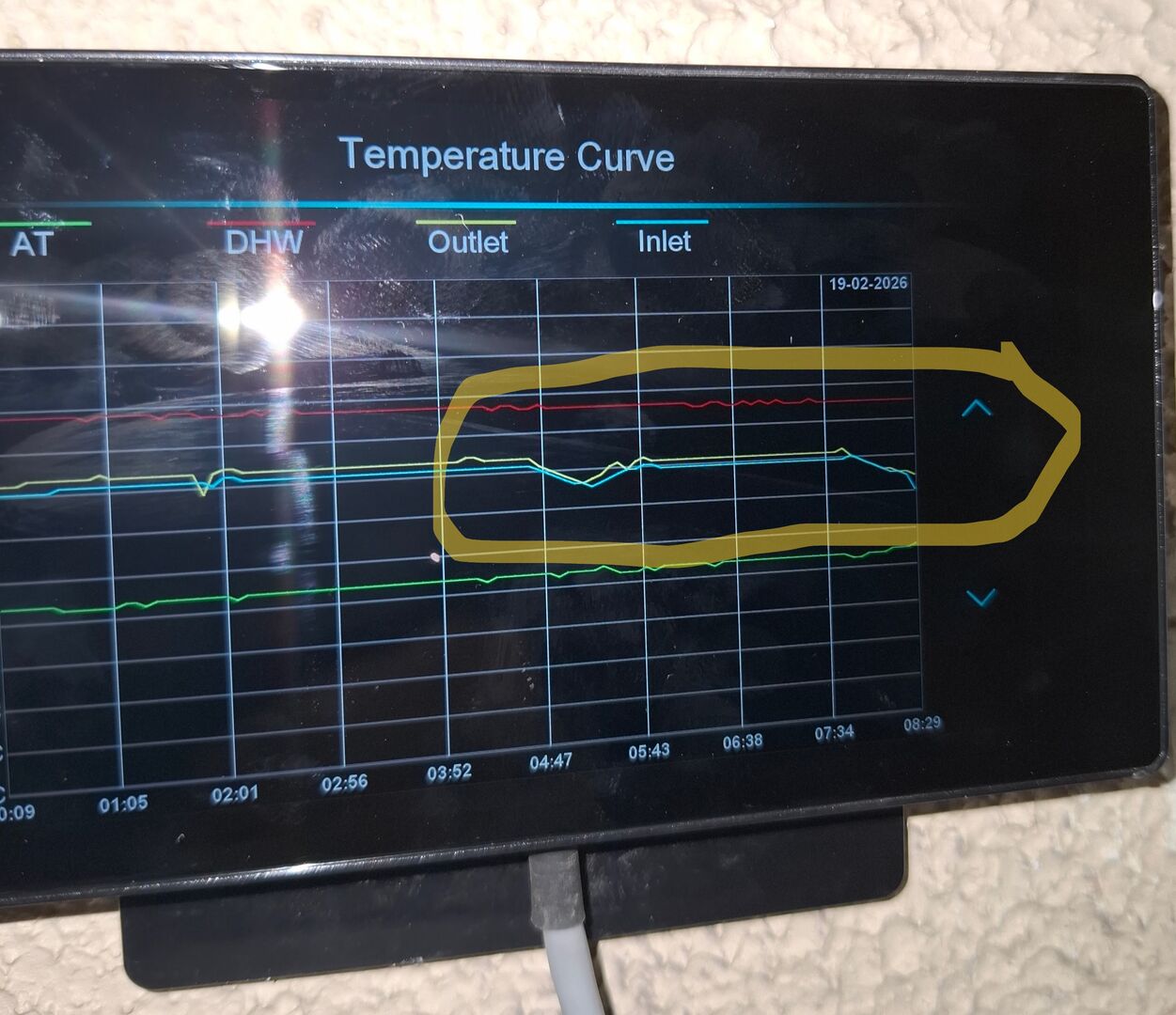
would be appreciated
This post was modified 15 hours ago by giganto
19/02/2026 2:12 pm
The last photo is defrost for sure (or cooling, but presumably not at this time of year). You can tell because flow < return.Once you get close to the right curve I would go for one adjustment every 2 days or even longer, and make smaller changes. Houses take a very long time to stabilise so adjusting too much too frequently just leads to oscilllation.
4kW peak of solar PV since 2011; EV and a 1930s house which has been partially renovated to improve its efficiency. 7kW Vaillant heat pump.
2
Page 2 / 2
Prev

Latest Posts
-

RE: Humidity, or lack thereof... is my heat pump making rooms drier?
Actually, it’s better for wooden furniture – or at leas...
By Majordennisbloodnok , 4 hours ago
-
This is absolutely standard for any sealed pressurised ...
By JamesPa , 6 hours ago
-
RE: Oversized 10.5kW Grant Aerona Heat Pump on Microbore Pipes and Undersized Rads
@uknick TBH if I were taking the floor up ...
By JamesPa , 6 hours ago
-
RE: What determines the SOC of a battery?
@batpred Your BMS parameters will be the same as m...
By Bash , 7 hours ago
-

RE: Getting ready for export with a BESS
I would have not got it if it was that tight
By Batpred , 8 hours ago
-
RE: Setback savings - fact or fiction?
I also need to correct something I said by mistake earl...
By cathodeRay , 8 hours ago
-
RE: Electricity price predictions
@judith Thanks for sharing, and nice to see how the ...
By Batpred , 9 hours ago
-
RE: Testing new controls/monitoring for Midea Clone ASHP
@tasos the OAT is incorporated into the control logic. ...
By benson , 10 hours ago
-
RE: Need help maximising COP of 3.5kW Valiant Aerotherm heat pump
@judith thanks Judith. Confirmation appreciated. The ...
By DavidB , 11 hours ago
-
RE: Recommended home battery inverters + regulatory matters - help requested
That makes sense. I thought better to comment in this t...
By Batpred , 12 hours ago
-
Bosch CS5800i 7kW replacing Greenstar Junior 28i
My heat pump journey began a couple of years ago when I...
By Slartibartfast , 12 hours ago
-
RE: How to control DHW with Honeywell EvoHome on Trianco ActiveAir 5 kW ASHP
The last photo is defrost for sure (or cooling, but pre...
By JamesPa , 13 hours ago
-
RE: Plug and play solar. Thoughts?
Essentially, this just needed legislation. In Germany t...
By Batpred , 14 hours ago
-
RE: A Smarter Smart Controller from Homely?
@toodles Intentional opening of any warranty “can of wo...
By Papahuhu , 15 hours ago
-
RE: Safety update; RCBOs supplying inverters or storage batteries
Thanks @transparent Thankyou for your advic...
By Bash , 16 hours ago
-
RE: Air source heat pump roll call – what heat pump brand and model do you have?
Forum Handle: Odd_LionManufacturer: SamsungModel: Samsu...
By Odd_Lion , 17 hours ago
-
RE: Configuring third party dongle for Ecodan local control
Well, it was mentioned before in the early pos...
By F1p , 1 day ago
-
RE: DIY solar upgrade - Considering adding more panels
I know this is a bit old, but it made me wonder what co...
By Batpred , 1 day ago
-

RE: New Vaillant aroTherm Plus in black - When will it come to the UK?
@majordennisbloodnok Daikin, take note! (In fact, I hav...
By Toodles , 1 day ago
-
RE: Midea ASHP – how to set weather compensation
@mk4 — good work! First, I agree, no evidence of cycl...
By cathodeRay , 1 day ago
-

RE: Solis inverters S6-EH1P: pros and cons and battery options
I don't know about Solis inverters. It isn't a featur...
By Transparent , 1 day ago
-
Daikin Altherma 3 H HT - Freeze Prevention Threshold
Hi. We have an Altherma 3 HT (18kW I think) which, now ...
By RICHARDF5033 , 2 days ago
-
RE: Passiv Smart Thermostat - Help & Forum Support
@petch We are not yet compatible with the R290 from Gra...
By Will H , 2 days ago


