

Notifications
Clear all
Joining the Renewable Heating Hub forums is completely free and only takes a minute. By registering you’ll be able to ask questions, join discussions, follow topics you’re interested in, bookmark useful threads and receive notifications when someone replies. Non-registered members also do not have access to our AI features. When choosing your username, please note that it cannot be changed later, so we recommend avoiding brand or product names. Before registering, please take a moment to read the Forum Rules & Terms of Use so we can keep the community helpful, respectful and informative for everyone. Thanks for joining!

11/03/2022 2:54 pm
@derek-m that would make it 3kw then - so the same as most other inverters.
If you wanted something beefier I might suggest the GoodWe GW5000S-BP - HERE - That will do maximum output of 5kw - £1,700
Then you could get a MASON Kit (or two) - HERE - $1000 + shipping, lets say $1200 (£900) for two of them - This is a box with battery system to hold the cells
and the cells - HERE - 32 cells for £4000 delivered
That's 30kwh of battery storage at a maximum discharge of 5kw for £6,600 + Install costs (£1,000)
Yes there is a small amount of DIY in making up the battery kits with the cells, but beyond that you are getting double the capacity for less money. If I was starting again I would 100% go down this route as almost all LiFePo4 batteries are the same inside; they are all just tarted up with branding.
2


11/03/2022 3:48 pm
@batalto, so when you say DIY, did you just buy all your components and assemble the batteries, and then hired someone to wire it all in?
🔥 Britain’s Heat Pump Shitshow
How Installing a Heating System Became a National Nervous Breakdown
Free UK shipping.
📗 Heat Pumps Explained
A Jargon-Free Guide for Homeowners
Rewritten and updated for 2027
📘 From Zero to Heat Pump Hero
🛠️ Bodge Buster
New to heat pumps?
Take the Heat Pump Fundamentals course and use INTRO50 at checkout for 50% off.

11/03/2022 3:56 pm
@derek-m that would make it 3kw then - so the same as most other inverters.
If you wanted something beefier I might suggest the GoodWe GW5000S-BP - HERE - That will do maximum output of 5kw - £1,700
Then you could get a MASON Kit (or two) - HERE - $1000 + shipping, lets say $1200 (£900) for two of them - This is a box with battery system to hold the cells
and the cells - HERE - 32 cells for £4000 delivered
That's 30kwh of battery storage at a maximum discharge of 5kw for £6,600 + Install costs (£1,000)
Yes there is a small amount of DIY in making up the battery kits with the cells, but beyond that you are getting double the capacity for less money. If I was starting again I would 100% go down this route as almost all LiFePo4 batteries are the same inside; they are all just tarted up with branding.
How big physically would the above be? Just trying to visualise where I could put it all.
2
11/03/2022 4:02 pm
@editor I actually bought ready assembled batteries - Pylontechs. However, as I said, if I were in your position, knowing what I know now, I would build a battery. All you'll get in a LiFePo4 battery is the same components in a different case - Sunny boy stated LiFePo4 HERE. You'll get double or triple the battery capacity for the same spend. I don't think I've ever heard anyone complain they had too much spare battery capacity. Given you've stated you want it for blackouts, the more, the better.
Seplos sell completed batteries, or you can buy the cases and the cells separately and follow the guide to assemble them yourself - YouTube guide HERE
I bought the inverter and batteries just got my solar guy to wire them in when he was installing. However, I will say this, you can do the batteries yourself easily. The inverter I'd leave to a professional, but the batteries are just plug and play. When I doubled my storage I just added them myself and updated the inverter settings.
One other thing to note - they are heavy, really heavy. So make sure you've got a good spot on the floor somewhere near the inverter and preferably on the ground floor...

11/03/2022 4:05 pm
@kev-m Inverter is an inverter - so pop it on the wall. The batteries are 440 x 750 x 270 and you've probably stack two on top of each other or place them facing upwards.
You obviously need the batteries next to the inverter - so you'd need a cupboard sized space and you'd put the batteries on the floor.
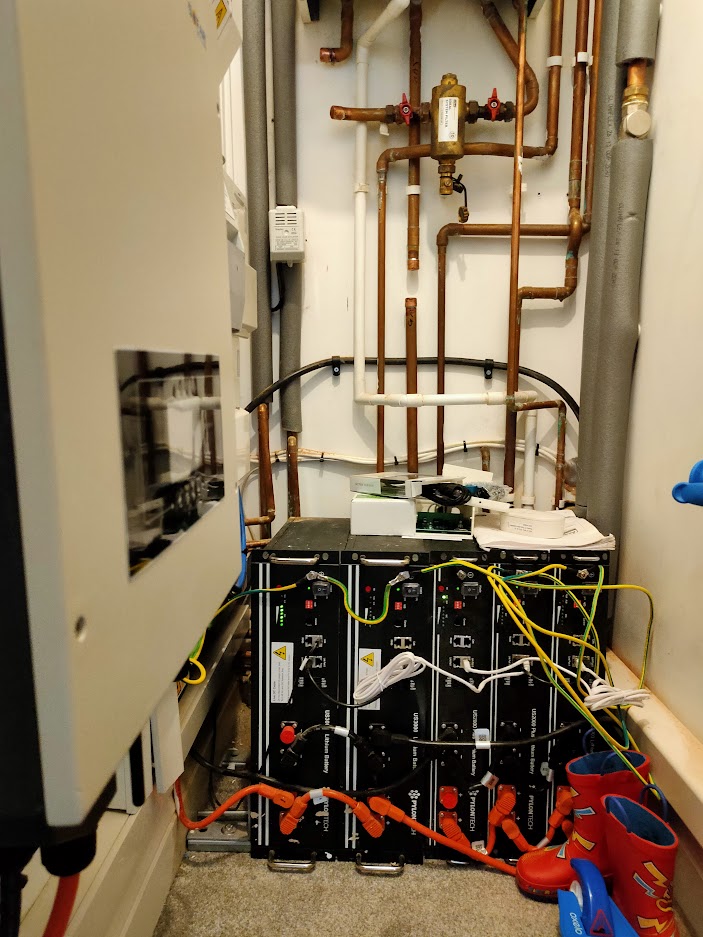
This is my battery setup - I've since tidied up those earth leads
2
11/03/2022 4:15 pm
@batalto, good tip about the weight. It we put them on the floor of our open garage would that work? They wouldn't get any direct rain or water. But the air might be damp/humid.
🔥 Britain’s Heat Pump Shitshow
How Installing a Heating System Became a National Nervous Breakdown
Free UK shipping.
📗 Heat Pumps Explained
A Jargon-Free Guide for Homeowners
Rewritten and updated for 2027
📘 From Zero to Heat Pump Hero
🛠️ Bodge Buster
New to heat pumps?
Take the Heat Pump Fundamentals course and use INTRO50 at checkout for 50% off.
11/03/2022 4:20 pm
@editor what do you mean by "open garage"? In the end, its electrical equipment, so the usual things apply. Dry to keep them dry and as they are batteries don't let them get really cold.
11/03/2022 4:23 pm
There's no door on the garage. It would be set back in the far corner – all our PV equipment is housed there so it is dry, but batteries can be fussy and delicate with temperature changes.They wouldn't get wet.
🔥 Britain’s Heat Pump Shitshow
How Installing a Heating System Became a National Nervous Breakdown
Free UK shipping.
📗 Heat Pumps Explained
A Jargon-Free Guide for Homeowners
Rewritten and updated for 2027
📘 From Zero to Heat Pump Hero
🛠️ Bodge Buster
New to heat pumps?
Take the Heat Pump Fundamentals course and use INTRO50 at checkout for 50% off.
11/03/2022 4:37 pm
@editor most batteries have some kind of low temperature cut out which stops them working. Its part of the BMS. You'd have to check what that is if its out in the open. What temperature does it get down to where you are?
11/03/2022 5:01 pm
@batalto, it'll drop to single figures in Dec/Jan. Current 9.9C.
🔥 Britain’s Heat Pump Shitshow
How Installing a Heating System Became a National Nervous Breakdown
Free UK shipping.
📗 Heat Pumps Explained
A Jargon-Free Guide for Homeowners
Rewritten and updated for 2027
📘 From Zero to Heat Pump Hero
🛠️ Bodge Buster
New to heat pumps?
Take the Heat Pump Fundamentals course and use INTRO50 at checkout for 50% off.
11/03/2022 5:04 pm
@editor doesn't seem a great place for a battery system - they don't like the cold and if they get too cold the battery management system will shut them down to protect them.
2

11/03/2022 5:46 pm
@derek-m that would make it 3kw then - so the same as most other inverters.
If you wanted something beefier I might suggest the GoodWe GW5000S-BP - HERE - That will do maximum output of 5kw - £1,700
Then you could get a MASON Kit (or two) - HERE - $1000 + shipping, lets say $1200 (£900) for two of them - This is a box with battery system to hold the cells
and the cells - HERE - 32 cells for £4000 delivered
That's 30kwh of battery storage at a maximum discharge of 5kw for £6,600 + Install costs (£1,000)
Yes there is a small amount of DIY in making up the battery kits with the cells, but beyond that you are getting double the capacity for less money. If I was starting again I would 100% go down this route as almost all LiFePo4 batteries are the same inside; they are all just tarted up with branding.
Hi Batalto,
I obviously did not make myself clear. During a power cut it would be possible to supply selected equipment (not the full house) using what SMA describe as a Secure Power Supply via an Emergency Power Outlet, which is isolated from the main electrical circuits and the grid supply. The inverter is also disconnect from the grid supply and the main electrical circuits. It does not state clearly, but it may be possible to maintain a connection to a solar PV system and hence use any available solar power.
On loss of grid supply it would be necessary to enable the system by operating a switch, and then switch back to normal supply when the grid power has been restored.
There are three sizes of Sunny Boy Storage systems available, with maximum output power of 3680W, 5000W and 6000W, and I believe that batteries of capacity up to 24kWh can be connected.
Whilst I have an SMA inverter, that was supplied with my solar PV system, and has worked perfectly for the past 10 years, I have no actual involvement with SMA or any of its distributors. My original post was in answer to Mars, who was having difficulty finding any installer who could provide a system that would continue to operate during a power cut. Also to answer, I think it was, Ken's query about a limited power supply to certain equipment during a power cut.

SPONSORS
Degrees of Separation

Latest Posts
-

RE: Review your electricity provider
@singlespeed I am with octopus and if a large credit...
By Batpred , 3 minutes ago
-
RE: Cooling/heating with one unit
Long term, it may be more cost effective to get an A2A ...
By Rob of York , 52 minutes ago
-
The video in the link mentions a direction arrow, which...
By Singlespeed , 13 hours ago
-
RE: Renewables & Heat Pumps in the News
Posted by: @editor I think we should make that approa...
By Rob of York , 21 hours ago
-
RE: Does anyone have experience of a smart water meter?
My neighbour received an email from Anglian Water sayin...
By AndrewJ , 22 hours ago
-
RE: Jokes and fun posts about heat pumps and renewables
Well the military is well known for going green, isn't ...
By Majordennisbloodnok , 24 hours ago
-
RE: Why are ASHP installs so expensive?
I've ripped out over 11kw of storage and panel heaters ...
By Singlespeed , 1 day ago
-
RE: Safety study for plug in batteries out to tender - looks like Q3 2027 at best before legal
I think it may depend how much of the world is on fire ...
By EtchedPixels , 1 day ago
-
RE: Air-to-Air Heat Pumps & Air Conditioning: UK Heating and Cooling Q&A
I hope it's not the same people who make the awful TV s...
By EtchedPixels , 1 day ago
-
RE: Replacing Storage Heaters with a Heat Pump in a Stone Cottage
I found some interesting data about the price of heat p...
By Rob of York , 2 days ago
-
RE: PV and battery long payback - sense check query
Thanks for all the comments. I finally got to the bott...
By DavidB , 2 days ago
-
RE: Indevolt Batteries UK Support & Info Thread
People following this thread who are hoping that plug i...
By JamesPa , 2 days ago
-
RE: Passiv Smart Thermostat - Help & Forum Support
By Singlespeed , 3 days ago
-
RE: Help me keep the faith with my air source heat pump installation
just had Vaillant over to service the HP and asked abou...
By AdamK , 3 days ago





SPONSORS

