
Notifications
Clear all
Safety, Regulations, Tools, Plumbing & DIY Installations
86
Posts
13
Users
13
Reactions
2,929
Views

23/12/2025 10:19 am
Whilst we're talking about blinds, does anyone have any good and practical ideas for some roller blinds to cope with glazing that goes up into the eaves?
We also have angle-topped bay windows and have decided not to bother with any coverings on the top windows as they are high and there is no privacy issue as we are not overlooked.
I retrofitted Zemismart Matter-compatible motors on our kitchen window blinds. They connect via wifi not Thread and have been reliable, although occasionally one seems to lose wifi connection until the router is rebooted. The physical backup in this case is that each motor comes with a remote control which always works even if the wifi connection is playing up.
Mitsubishi Zubadan 14kW with Mixergy 210l DHW in 220m2 barn property. 24 solar panels = 9kWp with GivEnergy 5.0kW Hybrid inverter and 19kWh GivE batteries. Jaga Strada fan-assisted rads throughout. Landvac vacuum glazing/triple glazed windows.

Topic starter
23/12/2025 10:51 am
Whilst we're talking about blinds, does anyone have any good and practical ideas for some roller blinds to cope with glazing that goes up into the eaves?
We also have angle-topped bay windows and have decided not to bother with any coverings on the top windows as they are high and there is no privacy issue as we are not overlooked.
I retrofitted Zemismart Matter-compatible motors on our kitchen window blinds. They connect via wifi not Thread and have been reliable, although occasionally one seems to lose wifi connection until the router is rebooted. The physical backup in this case is that each motor comes with a remote control which always works even if the wifi connection is playing up.
Thanks, @downfield. I'll take a look at the Zemismart motors.
We're also not overlooked at all, but our preference for some kind of blind in those eaves is for shade during the morning on sunny days. Our sitting room is double-vaulted so the picture I posted was only for half the back wall, and that wall faces only just South of East (E by S in the original "boxing the compass" terminology) so gets full sun in the summer up until about 1pm.
105 m2 bungalow in South East England
Mitsubishi Ecodan 8.5 kW air source heat pump
18 x 360W solar panels
1 x 6 kW GroWatt battery and SPH5000 inverter
1 x Myenergi Zappi
1 x VW ID3
Raised beds for home-grown veg and chickens for eggs
"Semper in excretia; sumus solum profundum variat"

23/12/2025 12:00 pm
@majordennisbloodnok I am considering increasing my battery from 5 to 10kW, I’ll ask the installer if when you do that the time take to charge both batteries is 2x one, or the charger is configurable to charge both at 3kW/h
My current battery takes about 2h to go from 10-100%, so would need at least 3.3kWh charge rate to replenish both batteries in the 3h Cosy cheap rate window.

23/12/2025 12:24 pm
I’ll ask the installer if when you do that the time take to charge both batteries is 2x one, or the charger is configurable to charge both at 3kW/h
If you've got the same sort of inverter arrangement as described by @majordennisbloodnok here earlier,
then adding to the battery capacity will simply split the available charge-current across more cells.
The underlying concept is this:
A: If you want to store more energy, and hence have it available to use over a longer period of time, then add battery(ies)
B: If you need to run more appliances from the energy you've stored in your battery, then add inverter(s).
Your situation is a sub-class of that second 'rule':
To recharge storage batteries faster, then you need more inverter(s).
Inverters don't configure themselves according to the capacity of your storage.
They don't even need to 'know' what storage space you've got connected.
The charge limit/speed of the inverter is constrained by the physical electronics inside it.
If you'd like more clarification, then please ask again.
The basic concepts are more important than the inverter model numbers!
This post was modified 2 months ago by Transparent
Save energy... recycle electrons!

23/12/2025 1:42 pm
@majordennisbloodnok I am considering increasing my battery from 5 to 10kW, I’ll ask the installer if when you do that the time take to charge both batteries is 2x one, or the charger is configurable to charge both at 3kW/h
My current battery takes about 2h to go from 10-100%, so would need at least 3.3kWh charge rate to replenish both batteries in the 3h Cosy cheap rate window.
Assuming none of this contradicts anything that @transparent said in his more technical reply, I've had practical experience of this.
At installation in 2022, I ordered 2 x 5.32kWh Sunsynk batteries with the PV installation. Only 1 of them was available on installation day, so I had to wait a few weeks for the 2nd one to be added. When that one was added, the installer was able to double the amps (or something along those lines) that the system could accept via 2 batteries within the inverter settings, so the charging time remained the same overall as 2 batteries were being charged at a faster rate than 1 (from memory, I think one of the settings was increased from 20A to 40A somewhere).
Recently, I've had a 3rd battery added at no cost, but I don't think that I was able to get the same incremental rate of increase, either due to the capacity of the inverter (5kW) or due to the maximum charge that could be taken from the grid.
So my practical experience is that from 5kWh to 10kWh storage, it is potentially feasible to see the same overall charge time, but this doesn't necessarily extend indefinitely with further capacity.
Hopefully that's enough info for the technical experts to figure out what the relevant constraints at play are in this.
This post was modified 2 months ago 2 times by Sheriff Fatman
130m2 4 bed detached house in West Yorkshire
10kW Mitsubishi Ecodan R290 Heat Pump - Installed June 2025
6.3kWp PV, 5kW Sunsynk Inverter, 3 x 5.3kWh Sunsynk Batteries
MyEnergi Zappi Charger for 1 EV (Ioniq5) and 1 PHEV (Outlander)
User of Havenwise (Full control Jun-Dec 2025, DHW only from early Dec)
Subscriber to MelPump App data via CN105 Dongle Kit
23/12/2025 2:17 pm
At installation in 2022, I ordered 2 x 5.32kWh Sunsynk batteries with the PV installation. Only 1 of them was available on installation day, so I had to wait a few weeks for the 2nd one to be added. When that one was added, the installer was able to double the amps (or something along those lines) that the system could accept via 2 batteries within the inverter settings, so the charging time remained the same overall as 2 batteries were being charged at a faster rate than 1 (from memory, I think one of the settings was increased from 20A to 40A somewhere).
That makes sense to me,
although we don't know what the inverter's capability was.
The nominal charge current for a SunSynk 5.32kWh battery is 50A (100A peak).
That is dictated by the specification of the BMS unit inside it.
A typical solar/hybrid inverter for home use would be a 5kW model.
For a LiFePO₄ battery operating at 52v, the inverter would be capable of charge/discharge at around 100A.
5000 watts / 52v = 96A
That would exceed the charge current permitted for the single 5.32kWh storage battery, so the installer configured the inverter to deliver less than 50A (the BMS rating).
When the second battery is added in parallel, the charge current can be shared between them.
There will be slightly different levels of resistance in the wires and connectors for the two batteries, and the current won't be shared exactly 50:50
For that reason an installer is unlikely to risk setting the inverter charge current to be as much as 100A.
80A or 90A would be a typical compromise.
Adding a third battery wouldn't allow the inverter to be configured to charge at an even higher current.
It's then already set close to the maximum permitted.
The constraints here are mainly due to buying batteries in units of 5.32kWh.
Each has to be operated within the specification of their internal BMS units.
If, as an alternative approach, you were to buy a single 15kWh battery, then it would most likely have a 100A BMS.
Optimal expansion of a battery storage installation is obtained by buying batteries and inverters where the current-handling rating of each is the same.
Thus a 5Kw inverter and a 15kWh battery would both have a nominal 100A charge/discharge level...
... and the 15kWh battery being discharged at the maximum 100A (5kW) would therefore last 3-hours.
This post was modified 2 months ago by Transparent
Save energy... recycle electrons!
1
Topic starter
24/12/2025 12:08 pm
OK, one final question before Christmas, but not expecting answers until well after 25th....
Imagine a blind the shape of an isosceles triangle on a roller that's spring-loaded. Imagine that, to pull the blind out, you pull on a cord attached to the point of the triangle and then (since it's manual) secure it to a cleat of some sort.
Does anyone know of an electric motor solution that would do away with the cleat and do the pulling on that cord electrically? I can't believe the roller blind industry don't have such a device, but I can't for the life of me find something.
105 m2 bungalow in South East England
Mitsubishi Ecodan 8.5 kW air source heat pump
18 x 360W solar panels
1 x 6 kW GroWatt battery and SPH5000 inverter
1 x Myenergi Zappi
1 x VW ID3
Raised beds for home-grown veg and chickens for eggs
"Semper in excretia; sumus solum profundum variat"
24/12/2025 12:31 pm
@majordennisbloodnok Well - I'll go first with a silly idea.
If you have a pulley at the top and attach a heavy weight to the cord, then you could put a regular blind motor in the bottom spool and as the motor unwound the blind it would be pulled up by the weight.
This has the advantage that the motor is concealed, but the disadvantage that you have a sizeable weight in view. Unless the weight could run in a tube at the side - like the old sash window arrangement where the weights were concealed.
Mitsubishi Zubadan 14kW with Mixergy 210l DHW in 220m2 barn property. 24 solar panels = 9kWp with GivEnergy 5.0kW Hybrid inverter and 19kWh GivE batteries. Jaga Strada fan-assisted rads throughout. Landvac vacuum glazing/triple glazed windows.
24/12/2025 12:32 pm
Does anyone know of an electric motor solution that would do away with the cleat and do the pulling on that cord electrically?
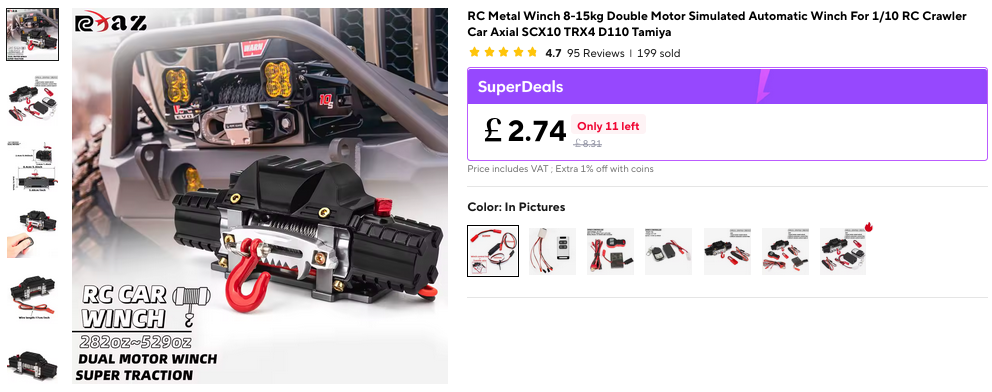
Lots of Land Rovers used to have a 12v electric winch bolted to the front of the chassis.
Your problem would be to stop it pulling the entire blind off the window!
Fortuitously, there's a model of such an electric winch available from AliExpress.
It's intended for use on radio-control models, and has a remote control.
This post was modified 2 months ago by Transparent
Save energy... recycle electrons!
Topic starter
24/12/2025 12:49 pm
Not a silly idea, @downfield, but not quite what I'm looking for. Interestingly, whilst I couldn't get away with a 4x4 winch (scaled down or otherwise) on the window frame, @transparent's post is very close to the thing I'm after. I just want to find something like that but already designed for blinds. The closest I've seen is a Zemismart motor for Roman blinds, but it doesn't include the actual bit that would pull the cord; just the motor for turning it. On the plus side, though, it does have a maximum and minimum setting allowing for fairly precise height configuration. On the downside, it's a Tuya app which signals a whole world of pain integrating it into anything else.
105 m2 bungalow in South East England
Mitsubishi Ecodan 8.5 kW air source heat pump
18 x 360W solar panels
1 x 6 kW GroWatt battery and SPH5000 inverter
1 x Myenergi Zappi
1 x VW ID3
Raised beds for home-grown veg and chickens for eggs
"Semper in excretia; sumus solum profundum variat"
24/12/2025 1:17 pm
I put this question into Perplexity (AI search) and got some good ideas
" suggest motors for blinds fitted to triangular windows"
Mitsubishi Zubadan 14kW with Mixergy 210l DHW in 220m2 barn property. 24 solar panels = 9kWp with GivEnergy 5.0kW Hybrid inverter and 19kWh GivE batteries. Jaga Strada fan-assisted rads throughout. Landvac vacuum glazing/triple glazed windows.

24/12/2025 2:05 pm
You can get blinds which live inside DGUs, maybe that is an option.

Latest Posts
-

RE: Daikin Altherma 3 LT compressor longevity question
This mess is intriguing: I wonder if this represent...
By bobflux , 20 minutes ago
-
RE: Say hello and introduce yourself
Hi. I'm Mike. Thank you for letting me join. My partn...
By Fretless6 , 2 hours ago
-
RE: Connecting Growatt SPH5000 over wired ethernet rather than wireless
The simplest wired option is usually the Growatt Ethern...
By Jonatan , 5 hours ago
-
RE: Peak Energy Products V therm 16kW unit heat pump not reaching flow temperature
ASHPs do have a minimum compressor speed. The minimum h...
By bobflux , 11 hours ago
-

RE: Electricity price predictions
@jamespa And it seems some of the nasty public cloud...
By Batpred , 12 hours ago
-
RE: Tell us about your Solar (PV) setup
Location: near Lyon, France 12kWp on the roof, 2x Sol...
By bobflux , 12 hours ago
-
RE: Jokes and fun posts about heat pumps and renewables
Technology is rapidly advancing. BBC News reported th...
By Transparent , 15 hours ago
-
What matters for flow and pressure drop is internal dia...
By bobflux , 16 hours ago
-

RE: Do Fridges and Freezers have COP ratings?
@editor Thank you all for your replies and submitted in...
By Toodles , 18 hours ago
-
I know and yes. The secondary deltaT wont necessaril...
By JamesPa , 22 hours ago
-
RE: Designing heating system with air to water heat pump in France, near Lyon
Just love the way you put it! 🤣
By Batpred , 2 days ago
-
RE: Safety update; RCBOs supplying inverters or storage batteries
Thank you for sharing. So it seems that your Schneid...
By Batpred , 2 days ago
-

RE: Forum updates, announcements & issues
@upnorthandpersonal thanks for the thoughtful, consider...
By Mars , 2 days ago
-
RE: Solar Power Output – Let’s Compare Generation Figures
@mk4 All 21 panels have their own Enphase IQ7a microinv...
By Toodles , 2 days ago
-
RE: Setback savings - fact or fiction?
Great, so you have proven that MELCloud is consistently...
By RobS , 3 days ago
-
RE: Mitsu PUHZ120Y 'Outdoor Temp 'error?
Thanks David & James It almos...
By DavidAlgarve , 3 days ago
-
RE: Surge protection devices SPDs
@trebor12345 - your original Topic about the right type...
By Transparent , 3 days ago
-
RE: Help needed with Samsung AE120RXYDEG
@tomf I’ve been sent this from a service engineer at Sa...
By Mars , 3 days ago
-
RE: Buying large amp bidirectional RCD and RCBO
Yes... I went through this particular headache and ende...
By bobflux , 4 days ago
-
O-oh! Let's take this as an opportunity to 'pass the ...
By Transparent , 4 days ago
-
RE: Homely setup on daikin heat pump
@craigh I refer to our somewhat elevated temperature of...
By Toodles , 4 days ago
-
RE: Air source heat pump roll call – what heat pump brand and model do you have?
My turn, this describes the future installation, only t...
By bobflux , 4 days ago