

Notifications
Clear all
Joining the Renewable Heating Hub forums is completely free and only takes a minute. By registering you’ll be able to ask questions, join discussions, follow topics you’re interested in, bookmark useful threads and receive notifications when someone replies. Non-registered members also do not have access to our AI features. When choosing your username, please note that it cannot be changed later, so we recommend avoiding brand or product names. Before registering, please take a moment to read the Forum Rules & Terms of Use so we can keep the community helpful, respectful and informative for everyone. Thanks for joining!
Ground Source Heat Pump (GSHPs)
75
Posts
9
Users
31
Reactions
25.8 K
Views


15/03/2026 9:48 pm
@phowardstutterheim, now that this thread has been reawakened, what happened with your system?
This post was modified 7 months ago by Mars
🔥 Britain’s Heat Pump Shitshow
How Installing a Heating System Became a National Nervous Breakdown
Free UK shipping.
📗 Heat Pumps Explained
A Jargon-Free Guide for Homeowners
Rewritten and updated for 2027
📘 From Zero to Heat Pump Hero
🛠️ Bodge Buster
New to heat pumps?
Take the Heat Pump Fundamentals course and use INTRO50 at checkout for 50% off.

Topic starter
15/03/2026 11:47 pm
The corrosion problem was never resolved. I filed a lawsuit against the maintenance company for failure to prevent corrosion and compensation for damages, but my legal firm and I could find no expert witnesses, likely partly due to self-protection within the industry, and partly due to the difficulty of proving internal damage, likely reduction in efficiency and in useful life of the heat pump and ancillary equipment, without dismantling and virtually destroying the pump in the process. Corrosion is a topic that no one in the industry is willing to acknowledge or address. The case was ongoing for nearly three years and finally had to be abandoned. After replacing various corroded parts as well as a Sorbox filter, the system continued to function. Vaillant Germany apologised, as did Vaillant UK, and promised in writing that parts would always be readily available in the UK, but I have no way of knowing if this is the case or not.
1

16/03/2026 1:46 pm
The corrosion problem was never resolved.
Here's an excellent explanation.
I filed a lawsuit against the maintenance company for failure to prevent corrosion and compensation for damages
If you have non barrier PEX underfloor heating, it is the most likely culprit as it is permeable to oxygen.
The maintenance company can't do anything about it.
Whoever decided to install non barrier PEX in a heating circuit bears responsibility, but it's probably too late to sue them.
A little bit of oxygen (ie, the amount in the initial filling water) is OK. It'll react and form oxides, and if you add inhibitor these also contain oxygen scavengers. Then you get no corrosion unless you have oxygen ingress via non barrier PEX, refilling after leaks, or other stuff like local low pressure sucking in air through the vents.
I also have a non barrier PEX underfloor heating system which was installed in the 1980's, so I looked into it in great detail. It seems like corrosion is a neglected and relatively not well understood subject (by installers) but all the info you need is actually available, for example in DIN VDI 2035.
Dirt separators like the "sorbox filter" will remove some sludge but this treats the symptom, not the cause.
When water contains a lot of oxygen, the only way to avoid corrosion is to 1) not have any steel component in the installation and 2) the heat exchanger should be stainless steel welded, or stainless steel with EPDM seals, not stainless brazed with copper (see above link for why) and 3) monitor pH and adjust if necessary.
...which is why I'm on a quest for a non cast iron body circulator that does not cost an arm and a kidney 🤣
Topic starter
16/03/2026 3:55 pm
The UFH system was installed at the same time as the GSHP, and it was supplied by Nu-Heat. Nu-Heat utilized its signature Fastflo® PE-RT tube for its hydronic systems. This tubing is a 5-layer high-density polyethylene pipe designed specifically for durability and flexibility in water-based floor heating. The Fastflo® tube used in these systems included an oxygen diffusion barrier to protect the heating system's metal components from corrosion. So no, it was not the UFH, it was maintenance, and I have lab results to prove it.
1

16/03/2026 4:35 pm
What happened then? What do the lab results show?
Topic starter
16/03/2026 10:50 pm
No corrosion inhibitors detected in system fluid. No frost protection detected. Low pH.
17/03/2026 10:14 am
Yeah if you have acidic pH it's going to be bad.
I'm baffled at the size of these metal flakes, they're huge! This doesn't look like the usual sludge from oxidized iron at all! What the hell happened? Where does this stuff even come from? What kind of metal is ut? You have a lot of aluminium radiators?
This post was modified 7 months ago 2 times by bobflux
Topic starter
17/03/2026 11:07 am
We have no radiators. The sludge comes from inside the Heat Pump and ancillary equipment. We would have had to pay a lot to have these particles analysed but a corrosion expert said that they are clearly metal as well as rubber. Identifying the precise source of internal corrosion would be impossible without opening the system and looking at all the metal parts, which means effectively tearing it apart, hence our dilemma in providing sufficient evidence.
We were told by experts, including at Vaillant, which we consulted on multiple occasions and who were very reluctant to respond to our questions, that most of the corrosion accumulates in the rubber hoses inside the heat pump because the hoses do not have an oxygen barrier and are a common place for the accumulation of corrosion. The buffer cylinder may be corroded/damaged by corrosion on the hot water side. The condenser may be damaged / full of corroded particles
We were told that, “If the condenser fills with corroded particles, then it would potentially affect efficiency due to poorer heat transfer, this could cause issues with the operation, this will only become known once the heat pump started faulting, flushing may help in some very rare cases but generally does not solve the problem, systems are always recommended to be flushed and chemically treated upon install, a suitable filter is also recommended." While, over a two-year period, we found various people within the GSHP industry who were willing to discuss these issues after a lot of repeated correspondence, what we were unable to do was find an expert witness who would testify that:
- The brine side of the heat pump may be damaged
- The efficiency of the system may be compromised (COP)
- The life expectancy of the system may be compromised (20 years+)
Further, we thoroughly investigated the training and guidance provided by the GSHPA and the MCS at the time, and there was no reference anywhere to corrosion prevention, nor were certified installers required to have certification or training in basic heating and plumbing which, of course, covers corrosion prevention as an ABC. This may no longer be the case as we drew a lot of attention to this problem when we were investigating the causes and consequences of corrosion in heat pumps and attempting to take action against the maintenance company. At the end of the day, the maintenance company was trained according to standards of the day and was probably largely unaware of both corrosion and the means to prevent it. They are certainly aware now.

17/03/2026 12:33 pm
You can get an idea of what these shavings are:
They're not rusty, so not steel. You can always try with a magnet.
Crush it with some pliers to check if it's rock / mineral or metal.
Heat it with a blowtorch:
- Melts : aluminium
- Burns while melting: thermoplastic
- Burns while not melting: most likely rubber
- Does not melt: stainless steel
Honestly this looks like someone in the factory dumped a bin of metal shavings or other detritus into a pipe and you got the equipment delivered with the crap inside.
Are these shavings present on:
- Both sides of the heat pump?
- Only one side, which one?
This post was modified 7 months ago 3 times by bobflux
1
17/03/2026 12:46 pm
We were told by experts, including at Vaillant, which we consulted on multiple occasions and who were very reluctant to respond to our questions, that most of the corrosion accumulates in the rubber hoses inside the heat pump because the hoses do not have an oxygen barrier and are a common place for the accumulation of corrosion.
Bullshit.
Rubber hoses do let in some oxygen, but that oxygen will travel in the circuit to corrode iron somewhere else. Just because some O2 enters in the hose doesn't mean it will "attract" sludge or particles into the hoses.
When I took out the 40 year old rubber hoses from my installation, they were absolutely okay. I mean, the rubber had gotten a little bit stiffer than new, and the inside was painted by brown sludge, but there wasn't a single particle in there. All the corrosion flakes were at places where flow slows down so they can settle (bottom of the buffer tank, radiators, etc) and of course in the heat pump exchanger since this has small cross section and acts as a filter.
FYI I drew a sample from my heating water
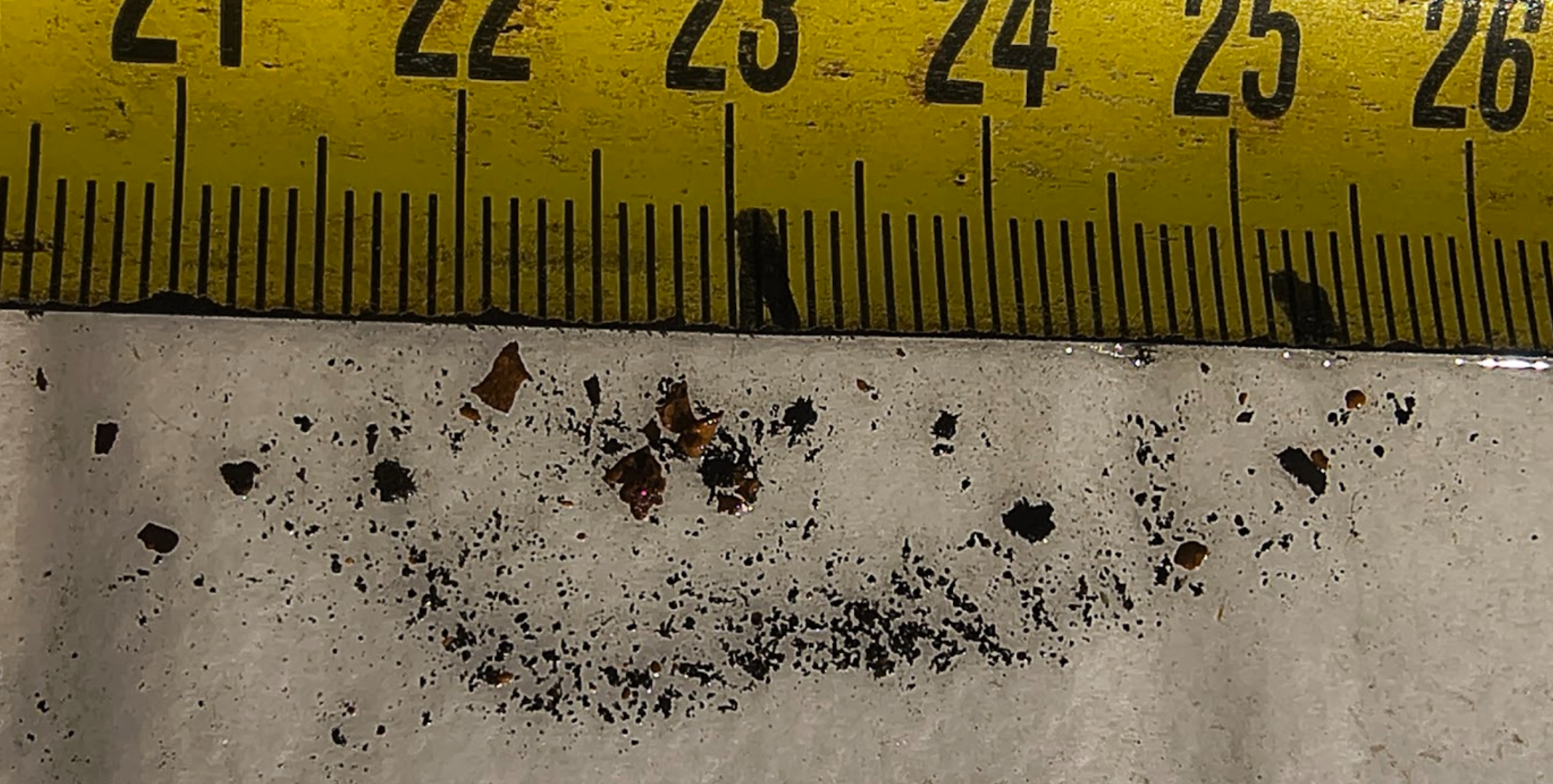
This is the kind of particles you'd expect from cast iron or steel corroded by oxygen. Scale in cm and mm. Unfortunately the cell phone camera can't tell the difference between rust (brown flakes) and magnetite (black particles) but it is clearly visible.
Completely different from yours. I bet it's not corrosion and this stuff was probably already inside when you got the equipment.
This post was modified 7 months ago by bobflux
2
Topic starter
18/03/2026 9:43 am
In your comment, you are both confident and rude, which translates into arrogant. Your knowledge appears to be based on a single sample of a 40-year-old system, which is hardly an apt comparison. Thus, in my opinion, your comment is both arrogant and ignorant.
SPONSORS

Degrees of Separation

Latest Posts
-

RE: Heat pump branding. Clever, contemporary… or a bit too much?
I think Heat Geek have done an amazing job on their bra...
By Tomtheheatingengineer , 9 hours ago
-
RE: HeatGeek vs Octopus surveys: puzzling disparity - any ideas why?
I have just had 3 heat loss surveys, one by heat geek o...
By David , 9 hours ago
-
RE: Heat Geek Zero Disrupt: Are We Sleepwalking Into Another Race to the Bottom?
I think that's the key question. After all inverter uni...
By Prunus , 11 hours ago
-
RE: battery storage without solar
As of October 1st they need specific qualifications to ...
By EtchedPixels , 11 hours ago
-
RE: How should the Boiler Upgrade Scheme be reformed?
A unit which uses water to transfer the heat/chill from...
By Temperature_Gradient , 12 hours ago
-
RE: Renewables & Heat Pumps in the News
With regards to the BUS grant raid, I gave it more thou...
By ASHP-BOBBA , 12 hours ago
-
RE: Why are ASHP installs so expensive?
The whole system seems to work on the basis of...
By ian33a , 13 hours ago
-
RE: Missing flow temperature in Heat Geek proposal
Good plan. If you can get half hourly meter readings a...
By JamesPa , 18 hours ago
-
RE: Heat Pumps Without Grants: Would You Have Installed One & Will You Now?
@editor Most certainly. The heat pump was an ideal s...
By Abernyte , 18 hours ago
-
Although regulations may well vary from country to coun...
By Majordennisbloodnok , 18 hours ago
-
RE: Does anyone have experience of a smart water meter?
Yep I caught our slow leak from a £100 bill rise 8)
By EtchedPixels , 18 hours ago
-
RE: Do You Need a Buffer Tank or Low Loss Header for Underfloor Heating in a Large Property?
@jamespa in some cases, failing the Turing test might b...
By GrahamF , 22 hours ago
-
RE: Passiv Smart Thermostat - Help & Forum Support
@energystoragetech The heat capacity of some...
By JamesPa , 23 hours ago
-
RE: tepeo ZEB UK Support & Info Thread
Sorry you are correct, I was remembering figures from t...
By JamesPa , 1 day ago




SPONSORS

