

Notifications
Clear all
Joining the Renewable Heating Hub forums is completely free and only takes a minute. By registering you’ll be able to ask questions, join discussions, follow topics you’re interested in, bookmark useful threads and receive notifications when someone replies. Non-registered members also do not have access to our AI features. When choosing your username, please note that it cannot be changed later, so we recommend avoiding brand or product names. Before registering, please take a moment to read the Forum Rules & Terms of Use so we can keep the community helpful, respectful and informative for everyone. Thanks for joining!

21/09/2026 8:03 am
Frankly I still don't understand why our electricity is so expensive. Still, that fact that other European countries don't have such a big difference between gas and electricity suggests it's down to policy and not engineering constraints.
It is a politically motivated myth that our electricity prices are vastly more expensive than the EU. We are certainly amongst the more expensive (#6 out of 40), but not dissimilar to other large countries in the west of the continent; Germany, Ireland and Austria are all more expensive. Even France, with its abundant nuclear power, is only 20% less expensive.
Our gas prices on the other hand are somewhat cheaper than our large neighbours, for example we are nearly 40% cheaper than France.
Taken together that makes a big difference to gas/electricity ratio.
Here is a good representation of both, figures from Eurostat which is the EU statistics body. There are some insights here as to the differences.
This post was modified 1 month ago 5 times by JamesPa
4kW peak of solar PV since 2011; EV and a 1930s house which has been partially renovated to improve its efficiency. 7kW Vaillant heat pump.
1

21/09/2026 2:53 pm
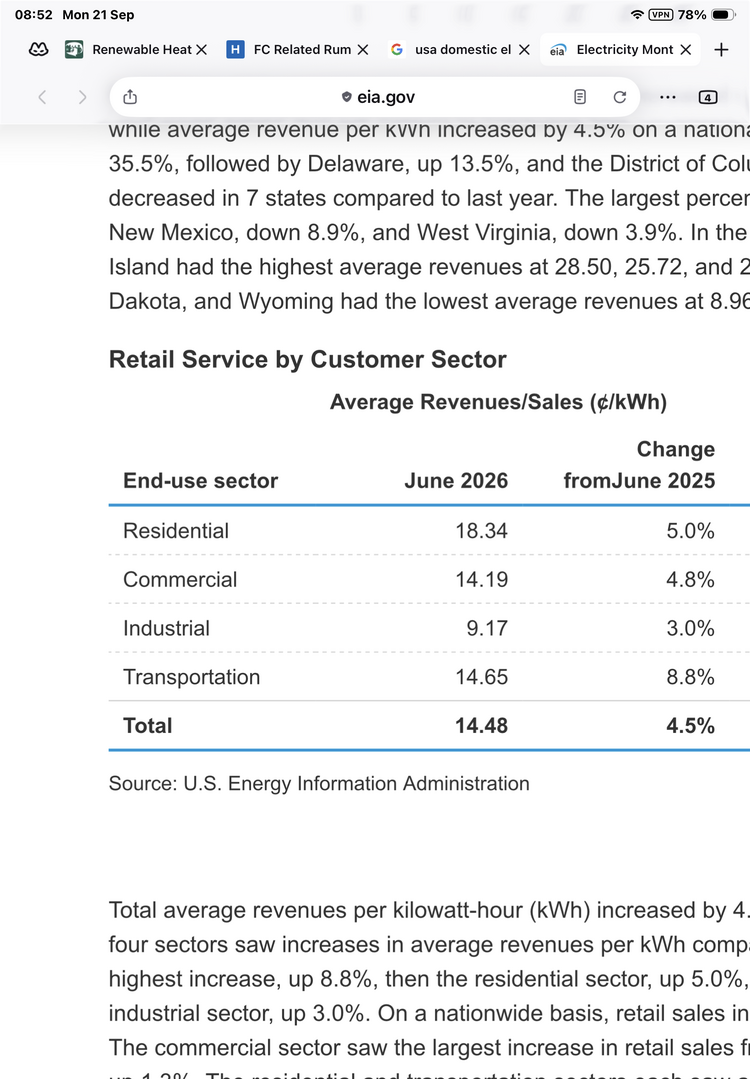
And then you look at US electricity prices and weep.
3.68kw FiT AC coupled pv
5 kw of DC coupled pv
14 kWhr of battery
3kw A2A ASHP
5 kw Vaillant ASHP heating UFH & Thermal store

22/09/2026 11:20 am
Looking at it another way, do we think heat pump installers are making massive profits? I don't think so. If they were, surely it wouldn't be so hard to find them? They'd all be piling onto the training courses, getting MCS certified, and pushing heat pumps at you wherever you go.
Like solar installers these days. Everyone is pushing solar now, presumably because there are high margins in it. I don't see the same for heat pumps, so presumably the margins -- and therefore the quotes -- aren't excessive.
Another thing for the "list of costs" is the capitalised cost of all the equipment and training that goes into running a heat pump installer vs a gas boiler installer.
ASHP: Mitsubishi Ecodan 8.5kW
PV: 5.2kWp
Battery: 8.2kWh

Topic starter
22/09/2026 4:58 pm
Posted by: @springswood
I confess to becoming a little triggered by mention of dunkelflaute. It's not as worrying as it at first seems. This is explained a lot better then I could on the YouTube channel of Prof Gio here The Genius Trap of "What if the wind doesn't blow". And he is a professor, of control engineering at Imperial College.
There is good material in that YouTube video; however, nearly all of the points made address how we can deal with a shortfall of output from renewables over a time period which is measured in hours up to a day rather than a week or more. At times 12:50 and 17:50 in the video there is mention of a longer duration being economically very expensive to solve.
At 21:40 the video talks about aggregating the output of many renewable generators being like coin flips where statistics, specifically the law of large numbers dictates that the number of heads or tails will be very close to the average. Unfortunately, unlike coin flips, renewable generators do not behave independently in the statistical meaning of the word. This completely undermines the argument - it is incorrect and simple does not apply in this case. Rather, the weather in the UK is highly dependent across one part of the country to another. It is easily possible under high pressure conditions to get very little wind generation from a very large number of wind generators all at the same time. We can see this unfortunate reality in the recorded outputs. See https://www.energydashboard.co.uk/historical for the 90 day period starting 1st Oct 2025 and look at the total solar and wind output for Oct 12th to 17th 2025.
It is not impossible to develop technology to address the supply issues caused by this type of weather pattern; however, it is expensive to do so. Demand response is not a comprehensive answer over this time frame, for example reducing the state of charge of EV batteries in the evening to smooth out peak demand is achievable and starting to happen provided that they are charged again over night, but doing the same over a 3-4 day period before recharging is perhaps a stretch. Building sufficient pumped hydro or compressed gas systems to handle this type of supply issue is expensive and the number of sites suitable for the former is limited in the UK.
I particularly liked the bit in the video about Brandolini's law and how much more explanation it takes to fully rebuff a simple falsity. (The point above about statistical independence is one of those).
2


24/09/2026 11:08 am
Brandolini's law and how much more explanation it takes to fully rebuff a simple falsity
This just might need a rebuttal (possibly marginally more civilised that a rebuff) of its own. Though the original source is not clear, the idea has been flying around the world around for centuries, with alleged sources ranging from Mark Twain to Winston Churchill, while those who would determine the origin are still putting their boots on. The earliest published reference to the idea is probably from Jonathan Swift in 1710, when Brandolini wasn't even a twinkle in his great great grandparent's eyes: "Falsehood flies, and the Truth comes limping after it". See the various possible sources/quotes here.
Midea 14kW (for now...) ASHP heating both building and DHW


25/09/2026 11:43 am
On the subject of pricing of UK heat pumps, I filmed one of the most interesting podcast episodes we’ve done this year with JT Stewart (he's the lead chair of the US Heat Pump Summit), looking at heat pumps from an American perspective.
The cost of US installations genuinely surprised me, particularly when you consider that their market is dominated by air-to-air systems. I don’t want to give too much away before the episode is released, but it’s remarkable how widely costs vary and how different the American sales process can be from what we experience in the UK.
The transatlantic comparison was absolutely fascinating. Episode drops on Wednesday.
🔥 Britain’s Heat Pump Shitshow
How Installing a Heating System Became a National Nervous Breakdown
Free UK shipping.
📗 Heat Pumps Explained
A Jargon-Free Guide for Homeowners
Rewritten and updated for 2027
📘 From Zero to Heat Pump Hero
🛠️ Bodge Buster
New to heat pumps?
Take the Heat Pump Fundamentals course and use INTRO50 at checkout for 50% off.
Topic starter
25/09/2026 3:47 pm
I look forward to watching the podcast.
The comparison with our neighbours in Europe is an interesting one. There is an excellent article here:
https://heatpumpswatch.org/heat-pump-installation-costs-germany-vs-europe/
The UK is far from the most expensive.
I hope our Govt. doesn't take a lead from their German counterparts and require that all heat pumps over 4.2kW are able to be throttled back to that level by the grid operator to avoid overloads...

25/09/2026 6:42 pm
Looking at it another way, do we think heat pump installers are making massive profits? I don't think so. If they were, surely it wouldn't be so hard to find them? They'd all be piling onto the training courses, getting MCS certified, and pushing heat pumps at you wherever you go.
Like solar installers these days. Everyone is pushing solar now, presumably because there are high margins in it. I don't see the same for heat pumps, so presumably the margins -- and therefore the quotes -- aren't excessive.
It is clearly difficult to say, there must be cases where good work and efficient sales processes are leading to good return, which is not a bad thing.
And yes, solar installs must be a lot more profitable, given the equipment cost dropped significantly.
This post was modified 1 month ago 2 times by Batpred
8kW Solis S6-EH1P8K-L-PLUS hybrid inverter; G99: 8kW export; 16kWh Seplos Fogstar battery; Ohme Home Pro EV charger; Vaillant Arotherm Pro 7kW; 100Amp head, HA lab on mini PC
Topic starter
12/10/2026 9:02 am
The Evaluation of the Boiler Upgrade Scheme: 2026 Final Report makes for interesting reading, see:
It covered installations through to the end of March 2025 of which there were 49,136
There are some interesting takeaways about the demographics of the people receiving the BUS grant.
55% are in detached houses
52% have 4 or 5+ bedrooms
56% had a gross annual income of over £52,000
35% self reported that they would have likely done the upgrade anyway without the BUS grant (20% at the same time or quicker and 15% slower). Modelling produced a lower percentage of 26% of the upgrades that would not have taken place without the BUS grant.
So more than half of the BUS grant funding is going to higher rate tax payers, people who live in detached homes with 4 or more bedrooms, and over a quarter is going to people who would have done the upgrade anyway, but are nevertheless very pleased to receive a large subsidy from public funds (taxpayers money).
There is no analysis of the level of subsidy that would have been sufficient for each upgrade to take place. However, the self reported percentage of installs that would not have gone ahead without the BUS grant went from 69% to 79% when grant increased from £5000 to £7500.
Assuming that 20% would have done the upgrade anyway without the grant, then the cost in terms of productive use of public money is around £9375 per additional heat pump installed.
It is arguable that the majority of funds are going to the reasonably wealthy with their own sizable detached homes.
NESTA suggested that the BUS grant should be tapered away over time giving as an example £5000 in 2028, £3750 in 2029/30 and £2500 in 2031-33, before stopping in 2034. There are suggestions in the media today that reductions in the grant are in the pipeline due to Treasury pressure on Govt. department spending.
2
12/10/2026 10:29 am
Not sure that's fair, the BUS isn't designed for low-income households so I'm not sure I'd expect them to receive them? There are other schemes designed for lower-income households to reduce bills and promote cheaper and/or more efficient heating systems, like ECO grants. I'm not surprised it didn't achieve something it wasn't designed to do.
This post was modified 3 weeks ago by scrchngwsl
ASHP: Mitsubishi Ecodan 8.5kW
PV: 5.2kWp
Battery: 8.2kWh

12/10/2026 10:46 am
NESTA suggested that the BUS grant should be tapered away over time giving as an example £5000 in 2028, £3750 in 2029/30 and £2500 in 2031-33, before stopping in 2034. There are suggestions in the media today that reductions in the grant are in the pipeline due to Treasury pressure on Govt. department spending.
I'd seen a reference to that on my google feed - citing the need to fund defence instead. It's a reasonable statement and I can see why it has been mentioned as a possibility.
It does have strong parallels with what happened in the solar industry ten or so years ago - a lot of businesses were formed with the best of intentions and at large expense, only to have the generous feed in tariff removed - and a lot of companies soon went bust afterwards. While it's not a good business proposition for invest heavily on the back of fickle Government policy, it happens rather too often and the fall out can be significant.
Escaped to the country : central Devon - 280 sqm converted mill - 4KW Solar - 15 KWh Battery - UFH - Vaillant Arotherm V2 Plus 12KW (soon!)
12/10/2026 1:32 pm
@rob-of-york I think the most revealing question here is whether BUS is making heat pumps accessible to people who otherwise couldn’t make the switch or mainly making an expensive purchase more attractive to people already reasonably well placed to proceed. Those aren’t quite the same achievement and I think that your post gets to the heart of why we need to look beyond installation totals when judging what the public money is buying. I agree.
One distinction I’d make on the income figures, though, is that £52,000 refers to gross household income, not an individual’s salary, so it doesn’t establish that the recipients are higher rate taxpayers. A couple earning £27,000 each would fall into that category, and the report itself gives £54,740 as the median gross household income for owner occupiers in England and Wales. That doesn’t necessarily make the affordability question disappear, but it makes me cautious about describing the recipients as predominantly wealthy on that evidence alone. Similarly, the separate percentages for detached houses, bedroom numbers and income don’t tell us that a majority of recipients meet all three descriptions.
The more persuasive concern for me is that a grant can be available to everyone in principle while remaining inaccessible to many in practice, because you still need to find whatever sits between the grant and the quotation. Someone with savings can bridge that gap, whereas someone without them may never get as far as even commissioning a survey; especially with some installers now charging as much as £400 for that heat loss survey. Looking only at those who completed an installation therefore tells us relatively little about the households who liked the idea but couldn’t get through the financial front door.
On the "would have happened anyway" point, I think the modelling figure has been reversed in one sentence... the evaluation estimates that 74% of installations would not have happened without BUS during the period studied, leaving approximately 26% that would. I’d also distinguish that modelled result from the survey respondents who said they would eventually have proceeded but more slowly, because bringing an installation forward isn’t necessarily buying nothing. There is still a legitimate question about whether a smaller grant would have been sufficient, but "I would have done it eventually" and "the subsidy made no difference" aren’t interchangeable IMO.
Where I think the report offers a more useful steer on targeting is its comparison between self-builds and retrofits. Using the survey definition that includes installations being brought forward, it reports 48% additionality for self builds against 81% for retrofits. To me that is a stronger starting point for reviewing how funding is allocated than simply counting bedrooms because it starts to distinguish projects where the grant is more likely to change the decision from projects where the heating system might already be part of a funded building programme. It isn’t a case for automatically excluding every self builder, but it does suggest that a uniform grant isn’t necessarily doing the same amount of useful work in every situation.
There’s also an interesting 'tension' in the larger property figures. I think what looks questionable from a distribution of funding perspective can look more defensible from a carbon perspective. The evaluation projects around 2.5 million tonnes of lifetime emissions savings, close to the original 2.6 million tonne expectation despite fewer installations than anticipated partly because the homes had higher heat demand and more oil and coal systems were replaced than expected. Those are modelled savings rather than measured lifetime outcomes, but I feel that that they complicate the argument that supporting a larger detached house is inherently poor value.
Where I’m much more firmly with you is that the grant cannot become a permanent substitute for addressing installation costs, and by many accounts the grant may be gone by the next budget announcement. However, tapering support only makes sense to me if there is a credible plan for reducing the amount the homeowner still has to find. If the quotation stays the same and the grant falls by £2,500, the installation hasn’t become cheaper... the customer has simply been handed another £2,500 of it. If the grant is axed in its entirety, that bill is even higher. My concern is that reducing the grant without reducing that underlying cost could/will actually strengthen the pattern you’re questioning, because the people most likely to withdraw would be those with the least financial room to manoeuvre.
That brings me back to the subject of this thread. I want clearer quotations, less duplicated work and a more competent installer base capable of delivering good systems efficiently, rather than a choice between expensive bespoke projects and cheaper installations with important work omitted. Equally so, I've seen some quotes recently with insane amounts charged for labour for standard-ish installs.
🔥 Britain’s Heat Pump Shitshow
How Installing a Heating System Became a National Nervous Breakdown
Free UK shipping.
📗 Heat Pumps Explained
A Jargon-Free Guide for Homeowners
Rewritten and updated for 2027
📘 From Zero to Heat Pump Hero
🛠️ Bodge Buster
New to heat pumps?
Take the Heat Pump Fundamentals course and use INTRO50 at checkout for 50% off.
2

SPONSORS

Degrees of Separation
Latest Posts
-

RE: Aerotherm and weather compensation
@jamespa I replied yesterday with detailed readings whi...
By DavidB , 40 minutes ago
-
RE: Octopussy cosy 6 experience
@paultheheating Unless things have changed more recentl...
By Toodles , 16 hours ago
-
RE: Boiler Upgrade Scheme funding reduced by circa £750 million in 2026 budget
Sorry I thought and meant to put 'may' in, but the diff...
By JamesPa , 19 hours ago
-
The alternative would be to move some productive energy...
By EtchedPixels , 20 hours ago
-
RE: Marvel Heating liquidation
@editor This is an important point. each winter, you...
By davidnolan22 , 21 hours ago
-
RE: Adding data centre electricity costs to domestic energy bills?
Potentially the largest data centre hub in Europe and t...
By Jeff , 1 day ago
-
RE: Solar Power Output – Let’s Compare Generation Figures
Very nice. we’ve been super soggy here, but rather m...
By Papahuhu , 2 days ago
-
RE: DIY powerflushing tutorial
Interesting! I toyed with the idea too. But I installed...
By bobflux , 2 days ago
-
RE: 15kw pump for 225m2 1990's house - over kill?
@seaviews Agree with the others on sequence: loft first...
By mk1234 , 2 days ago
-
RE: The Changing Jet Stream Could Challenge UK Air Source Heat Pumps
@etchedpixels Agreed, just a thought for others. I am...
By Watcher , 3 days ago
-
RE: Vaillant ecoTEC Plus - Flow Temp and Set Up
Heating been on for 4 weeks now, continuous. It's 6C o...
By trebor12345 , 4 days ago
-
Coming back on subject... A shortened version of the ...
By Transparent , 4 days ago
-
RE: Say hello and introduce yourself
Perhaps it is time for an update on ‘our’ project. We h...
By Toodles , 4 days ago
-
RE: Free app: run the immersion / heat pump from Growatt battery & solar surplus – no Home Assistant
Please bear in mind, everyone, that in order to use thi...
By Majordennisbloodnok , 6 days ago


SPONSORS
