

Notifications
Clear all
Joining the Renewable Heating Hub forums is completely free and only takes a minute. By registering you’ll be able to ask questions, join discussions, follow topics you’re interested in, bookmark useful threads and receive notifications when someone replies. Non-registered members also do not have access to our AI features. When choosing your username, please note that it cannot be changed later, so we recommend avoiding brand or product names. Before registering, please take a moment to read the Forum Rules & Terms of Use so we can keep the community helpful, respectful and informative for everyone. Thanks for joining!

Topic starter
17/09/2026 10:50 am
Last week the government published the heat pump deployment figures through to June 2026:
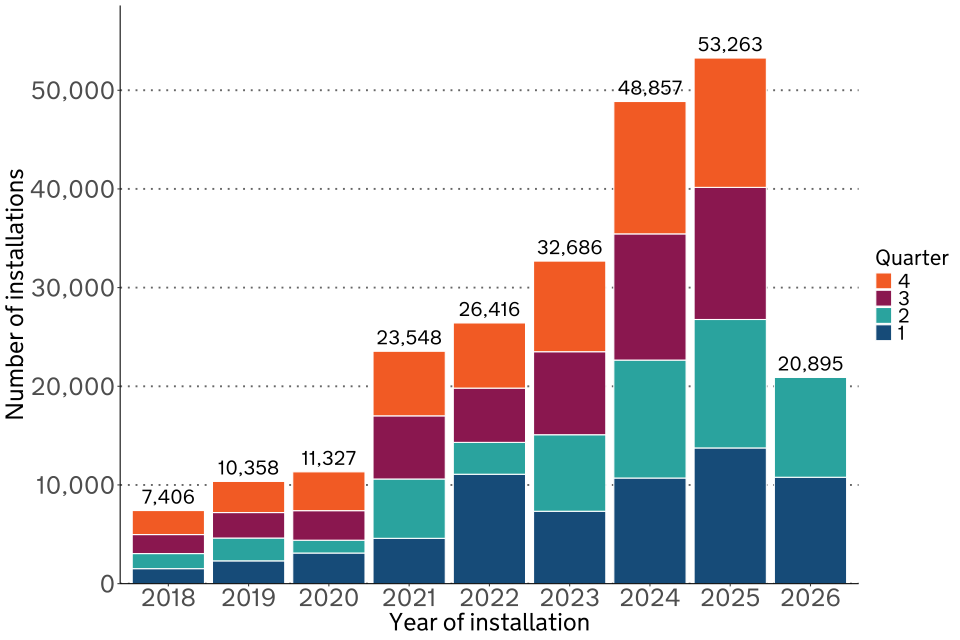
Figures for the first half of 2026 show a significant slowing in the rate of installs, which will presumably fall further as the ECO4 scheme continues to wind down.
Where does the heat pump market go from here? How does it continue to build momentum?
This topic was modified 3 weeks ago by Old_Scientist
Samsung 12kW gen6 ASHP with 50L volumiser and large radiators. 7.2kWp solar (south facing), Tesla PW3 (13.5kW). Net Zero

17/09/2026 11:24 am
Where does the heat pump market go from here? How does it continue to build momentum?
Personally I don't think it can until it reinvents itself completely. Currently it's designed like a bespoke tailoring service with every install requiring a master tailor.and a vast lead time, not a mass market produt (with product options that together cover most cases) where the vast majority of installs require only your local plumber.
Octopus and heat geek are both pushing in significant ways on the right buttons but it is going to be slow without determined top- down redesign, which would almost certainly need to be a government initiative because the current industry would perceive the type of redesign needed as a threat.
With only 2.5 years to the next election there is insufficient time to complete this in the current term of government.
4kW peak of solar PV since 2011; EV and a 1930s house which has been partially renovated to improve its efficiency. 7kW Vaillant heat pump.
Topic starter
17/09/2026 11:43 am
The ‘Warm Homes Plan’ was subsequently published in January 2026, which included details of the government’s aim to achieve 450,000 heat pump installations per year by 2030.
I have to say, on current evidence the above does seem like a pipe dream (sorry, couldn't resist!) and completely unachievable (going from current 50k per year to 450k per year in 4 years). Looks more likely the industry may consolidate at a base of around 50k installs per year whilst it figures out how to grow from there.
Samsung 12kW gen6 ASHP with 50L volumiser and large radiators. 7.2kWp solar (south facing), Tesla PW3 (13.5kW). Net Zero
17/09/2026 12:08 pm
The ‘Warm Homes Plan’ was subsequently published in January 2026, which included details of the government’s aim to achieve 450,000 heat pump installations per year by 2030.
I have to say, on current evidence the above does seem like a pipe dream (sorry, couldn't resist!) and completely unachievable (going from current 50k per year to 450k per year in 4 years). Looks more likely the industry may consolidate at a base of around 50k installs per year whilst it figures out how to grow from there.
IMHO its not unachievable, but it wont be achieved with a linear evolution of the current industry set up. And I personally don't assume that the industry wants to grow, it may be perfectly happy where it is thank you and certainly may not want to take a risk that its monopoly is disrupted in the hope that growing the market rapidly will in fact bring benefits to all. Just look at the resistance to plug in solar if you want to see how it reacts to any proposed change in the status quo.
Government probably wont yet have the evidence to force the industry shake up that is needed, but the figures tell me that it must be puzzling over it, as Government clearly genuinely intends to transition to take place.
Government does have the evidence in respect of quality which is why it is consulting on stripping existing bodies of there responsibilities for consumer protection and centralising this in a Government run (as opposed to industry sponsored) body, but I imagine that there will be very strong industry resistance.
Basically my view is that, unless the current priorities extend beyond the next election (which the electorate will determine in the ballot box), the heat pump industry will remain a niche for the foreseeable future. Whist the people who currently deliver heating (ie your local plumber) are in essence excluded, and whilst control vests in a group with vested interests in preserving a niche monopoly, that is more or less inevitable.
Alternatively maybe the combined forces of Octopus and Heat Geek together would be enough to break the mould. They are probably, however,. relatively unhindered by the regulations because they just do a good job and so nobody bothers to check if every irrelevant i has been dotted and t crossed.
This post was modified 3 weeks ago 10 times by JamesPa
4kW peak of solar PV since 2011; EV and a 1930s house which has been partially renovated to improve its efficiency. 7kW Vaillant heat pump.
2



17/09/2026 3:14 pm
I’m not particularly alarmed by the drop. In fact, part of me is quite glad to see it.
There is an obvious structural factor here first that needs to be mentioned. ECO4 is now effectively in run-down mode. The government has extended it to the end of 2026, but specifically without increasing targets, and there is no successor supplier obligation. The extension is largely about completing existing obligations and remediation rather than expanding delivery, so I’d be surprised if that didn’t feed through into lower installation numbers as the scheme winds down. The official deployment figures themselves show 20,895 retrofit heat pumps installed in the first half of 2026, down 22% on the same period in 2025.
But the bigger question for me is whether we should automatically treat "more installations" as success.
I don’t think we should.
I understand @JamesPa’s point about the market needing to reinvent itself if it is ever going to scale properly, and I agree that the current model is still too bespoke, too dependent on a relatively small number of truly capable people and too difficult to reproduce at volume. I also agree that the likes of Octopus and Heat Geek are trying to industrialise parts of the process in a way that makes sense, although I'm still fully convinced about the ZeroDisrupt approach.
Where I’m slightly different is that I’m not convinced we should be in a massive hurry to get from roughly 50,000 installations to hundreds of thousands until the competence underneath it improves considerably.
We still see far too many mediocre systems. Not necessarily catastrophic systems, not houses sitting at 14C with the occupants wearing coats, but installations that are undersized, poorly controlled, badly commissioned, hydraulically compromised, unnecessarily complicated or simply running nowhere near as well as they could. They technically work, so they disappear into the success statistics, but that is quite a low bar for a heating system that may have cost the homeowner and taxpayer well into five figures.
That’s the bit I think gets lost in deployment targets. We count boxes installed. We don’t really count whether the homeowner got a good heating system.
If somebody gave me the hypothetical choice between 25,000 heat pumps a year installed properly by people who really understand what they’re doing, or 100,000 where a huge proportion are average, compromised or outright bodged, I’d take the 25,000 every time. I’m not claiming 60% of current installs are bodged (we don’t have evidence for a number like that) but if that were the trade-off, chasing the headline volume would be madness IMO.
Because every poor installation creates another homeowner telling their neighbours that heat pumps are expensive, noisy, cold or cost a fortune to run. That damage then becomes part of the adoption problem. A good installation probably sells the next heat pump where a bad one can put an entire street off them, which is nuts.
So I’d actually use a slower period like this to do the boring but necessary work. Installer upskilling, much better design competence, proper commissioning, better understanding of hydraulics and controls, and much more meaningful quality assurance. I’d much rather we build an installer base capable of routinely delivering excellent systems and then scale it than scale first and hope quality miraculously catches up afterwards.
The irony is that this may ultimately be the faster route to mass adoption. If the average homeowner knew that buying a heat pump carried roughly the same level of outcome certainty as buying a boiler, much of the anxiety around the technology would disappear. At the moment many are still rolling the dice on who turns up to design and install it.
So the graph doesn’t particularly depress me. The real question is what happens during the slowdown. If installation numbers fall and we use the time to raise competence, simplify the process and improve outcomes, that could be healthy consolidation.
If numbers fall and absolutely nothing changes underneath, then we’ve simply installed fewer heat pumps.
🔥 Britain’s Heat Pump Shitshow
How Installing a Heating System Became a National Nervous Breakdown
Free UK shipping.
📗 Heat Pumps Explained
A Jargon-Free Guide for Homeowners
Rewritten and updated for 2027
📘 From Zero to Heat Pump Hero
🛠️ Bodge Buster
New to heat pumps?
Take the Heat Pump Fundamentals course and use INTRO50 at checkout for 50% off.
17/09/2026 3:28 pm
I think our differences are subtler. I agree that 25k good installs is better than 200k poor ones. However I also think that the only way to deliver quality at any volume is to aim for 200k good ones and proactively redesign the process so the installer doesn't to be an expert in everything in order to achieve that. That involves thinking about it at a higher level than individual installs, and understanding how to reduce it to a set of solution archetypes and steps that any plumber can deal with, with sufficient tolerance to accommodate a realistic installer competence. Engineering the process not the individual solution.
Put another way scaling and better quality are, approached in the right way, complementary not exclusive, going hand in hand, whereas keeping the numbers small and relying linear evolution of existing processes will do nothing to improve quality, it will just stagnate more or less at current levels.
At the current time octopus and heat geek appear to be 'breaking the mould', albeit in different ways. More or less everyone else is still stuck with what MCS mandates, which is the bespoke suit offering relying on brilliant tailors. Unfortunately there aren't enough brilliant tailors to go round and never will be, this approach is doomed to failure IMHO.
This post was modified 3 weeks ago 7 times by JamesPa
4kW peak of solar PV since 2011; EV and a 1930s house which has been partially renovated to improve its efficiency. 7kW Vaillant heat pump.
1

17/09/2026 6:34 pm
To my eyes, sat behind all of this is a basic policy making failure to recognize that we're dealing with heating 'systems' and that if you want to replace/retorfit a fundamental component, the heat-source, then to get a good overall result you have two basic strategies which have their own pros/cons.
One is to fit a replacement heat-source which is either fully or largely compatible with the system, aka a 'drop in replacement' thus ensuring acceptable performance with the rest of the system, keeping the work and cost to the minimum and thus being highly scalable and something which is possible to do in large quantities. This is the way to get hundreds of thousands to millions of units installed each year. The down-side, is the heat-source then needs to be designed around the parameters of the installation - so either a heat-pump running at higher temps, lower flows and less optimal efficiency (fine for countries where electricity is cheap, so not GB) or like the Europeans countries do, using a hybrid heat pump with some residual gas usage to match the parameters of a boiler under coldest weather conditions and provide instant hot water. Or even, use some novel yet to be designed heat pump, designed bottom up purely as a boiler replacement.
Second route, is to fit a heat-source which is incompatible with the rest of the system and then attempt to modify that existing system to make it work with the new heat source. But that approach brings inevitable problems, there's a lot of uncertainty about the existing system as it's buried in the walls/ceiling/floors and often is not fully known, lots of parts need replacing and new bulky items like hot water cylinders need adding. It's costly, disruptive and time consuming which imposes a ceiling on how many people will opt for it, so it won't scale and any roll out will be long and slow.
Britain has opted for retrofit strategy no. 2 while hoping to scale up installations as if it had adopted strategy no. 1, while comparing itself against European countries that have a combinations of cheap electricity, or use hybrids for retrofits. It can't work.
2

18/09/2026 4:32 pm
The sale of EVs this year is forecast to be at least 25% up on last year. To my old and simple mind the reason for this is obvious: it is down primarily to the high cost of petrol.
Heat pumps will become the heating of choice when the price of electricity falls to a level where a zero disrupt heat pump replacement can show a significant annual saving over gas - without the need for the homeowner to invest in an EV; PV solar or a battery.

18/09/2026 4:49 pm
@l8again Yes, a straightforward price reduction that at least equalised the running cost of renewable energy heating compared to fossil fuels would just start things off as those wishing to go green could afford to do so but if a lower energy cost were possible, this would really start the ball rolling …. but…. how likely is this? 😟Regards, Toodles. (No EV here, but heat pump, solar and battery have been installed).
Toodles, heats his home with cold draughts and cooks food with magnets.
18/09/2026 4:56 pm
Heat pumps will become the heating of choice when the price of electricity falls to a level where a zero disrupt heat pump replacement can show a significant annual saving over gas - without the need for the homeowner to invest in an EV; PV solar or a battery.
I think you may find that is the case from Oct or if not from Jan.. The war is pushing up gas more than electricity! Combined with the vat reduction which applies only to lecvy and shifting some policy costs from leccy to general taxation, the ratio could soon be back where it was in 2011-2013 before the govt started loading policy costs mainly onto electricity this tilting the ratio.
This post was modified 3 weeks ago 5 times by JamesPa
4kW peak of solar PV since 2011; EV and a 1930s house which has been partially renovated to improve its efficiency. 7kW Vaillant heat pump.
1
Topic starter
18/09/2026 5:23 pm
Heat pumps will become the heating of choice when the price of electricity falls to a level where a zero disrupt heat pump replacement can show a significant annual saving over gas - without the need for the homeowner to invest in an EV; PV solar or a battery.
I think you may find that is the case from Oct or if not from Jan.. The war is pushing up gas more than electricity! Combined with the vat reduction which applies only to lecvy and shifting some policy costs from leccy to general taxation, the ratio could soon be back where it was in 2011-2013.
And even more so for the ~1 million households in England and Wales on heating oil which is currently priced at around 12.2p/kWh here. An oil boiler of 85% efficiency bumps that up to 14.35p/kWh of useful heat, and a SCOP of 4 for a heat pump means electricity priced below 57.4p/kWh is cheaper. With a battery and a heat pump tariff, my running costs are now a quarter of that of the oil boiler it replaced.
Samsung 12kW gen6 ASHP with 50L volumiser and large radiators. 7.2kWp solar (south facing), Tesla PW3 (13.5kW). Net Zero
18/09/2026 6:11 pm
@jamespa Sadly, we are still stuck with marginal costing for electricity where the most expensive contribution sets the overall price.

Page 1 / 2
Next
SPONSORS

Degrees of Separation

Latest Posts
-

RE: Passiv Smart Thermostat - Help & Forum Support
Hi @will-h After a week or running on the Haier cont...
By Singlespeed , 2 hours ago
-
RE: Replacing Storage Heaters with a Heat Pump in a Stone Cottage
All very true. Personally I also put a fair amount of w...
By cathodeRay , 7 hours ago
-
RE: tepeo ZEB UK Support & Info Thread
OK so ZEB is basically a variant on a storage heater, b...
By JamesPa , 23 hours ago
-
RE: PV and battery long payback - sense check query
@energystoragetech it's highly improbable that @davidb ...
By Transparent , 1 day ago
-
RE: Heat Geek installations: share your experiences
@editor I suspect that the Heat Geek online quote is a ...
By AndrewJ , 1 day ago
-
RE: Adding additional Solar Panels to a DC coupled battery system
Ah, yes. Thanks for clarifying.
By Transparent , 1 day ago
-
RE: Vaillant ecoTEC Plus - Flow Temp and Set Up
@trebor12345 I have been meaning to get home assista...
By Batpred , 2 days ago
-
RE: Indevolt Batteries UK Support & Info Thread
SunSynk hybrid inverters also have the capability to as...
By Transparent , 2 days ago
-
RE: Is This Initial Free Quote From Octopus Trusted Partner Reasonable?
If you've got a sash window or a door you can remove th...
By EtchedPixels , 2 days ago
-
RE: Are We Sleepwalking Into Another Race to the Bottom?
Roughly how most air/air is done except that step 3 doe...
By EtchedPixels , 2 days ago
-
RE: Nook batteries from Octopus
@batpred If your energy use is low enough that just get...
By EtchedPixels , 2 days ago
-
RE: Missing flow temperature in Heat Geek proposal
I suspect 4 yrs ago, their approach had not got to this...
By Batpred , 2 days ago
-
RE: battery storage without solar
Also don't forget that in you may not be able to use th...
By JamesPa , 2 days ago
-
RE: Tesla Powerwall (2) Calibration Cycles
One practical safeguard is to separate the calibration ...
By EnergyStorageTech , 2 days ago





SPONSORS