

Notifications
Clear all
Joining the Renewable Heating Hub forums is completely free and only takes a minute. By registering you’ll be able to ask questions, join discussions, follow topics you’re interested in, bookmark useful threads and receive notifications when someone replies. Non-registered members also do not have access to our AI features. When choosing your username, please note that it cannot be changed later, so we recommend avoiding brand or product names. Before registering, please take a moment to read the Forum Rules & Terms of Use so we can keep the community helpful, respectful and informative for everyone. Thanks for joining!

Topic starter
04/02/2025 3:02 pm
At those times on the 6/7th Frost protection kicked in. The two flow temperatures are the starting and ending for the frost protection period. The duration was around 15minutes. Yes showing frost protection on the controller.
I was expecting it to only kick in when the outside temperature reached 4oC and then elevate the flow from 6 to 12oC.
258-DHW; apologies 258 is the heat pump cycle number and DHW for heating the hot water.
When i moved the outdoor sensor indoors , the number of frost protection cycles reduced. The heating came on as per the programme.

04/02/2025 3:25 pm
Im sorry but I really don't understand from what you have said how you are running your heat pump (for example how can WC work when the outdoor sensor is indoors, and that being the case how did the heating 'come on' as per the programme'? ). Its also going to be difficult to work out things based on what happened over 2 months ago and with the outdoor sensor indoors.
Can I suggest you
1. relocate your outdoor sensor outdoors
2. take screenshots of the settings governing the heating schedule, room influence mode and weather compensation
3. when the problem next occurs record:
what the heat pump should have been doing according to the program you had set up and why you think this
the indoor and outdoor and flow temperatures on the sensocomfort
the time of day and date.
With a fresh example and more data on how you are running your heat pump maybe it will make sense, currently I am sorry but it doesn't, at least not to me.
I apologise I cant be more helpful at present however its difficult to tell what is going on with the various changes to configuration and the moving of the outdoor sensor, particularly as the latter is so absolutely fundamental to the control of the unit all of the time not just for frost protection.
4kW peak of solar PV since 2011; EV and a 1930s house which has been partially renovated to improve its efficiency. 7kW Vaillant heat pump.
Topic starter
04/02/2025 6:42 pm
Much appreciated for your help and thoughts. I will keep a diary. Thank you again
04/02/2025 7:32 pm
It occurs to me, have you got a timed heating schedule and if so what is it. Can you tell me why the indoor temperature was so low in the records in the diary. Something isn't making sense about the whole setup.
Just to emphasize, the outdoor sensor isn't primarily for frost protection, it's part of the basic weather compensation control loop of the system. It really has to be outside.
4kW peak of solar PV since 2011; EV and a 1930s house which has been partially renovated to improve its efficiency. 7kW Vaillant heat pump.


06/05/2026 7:02 pm
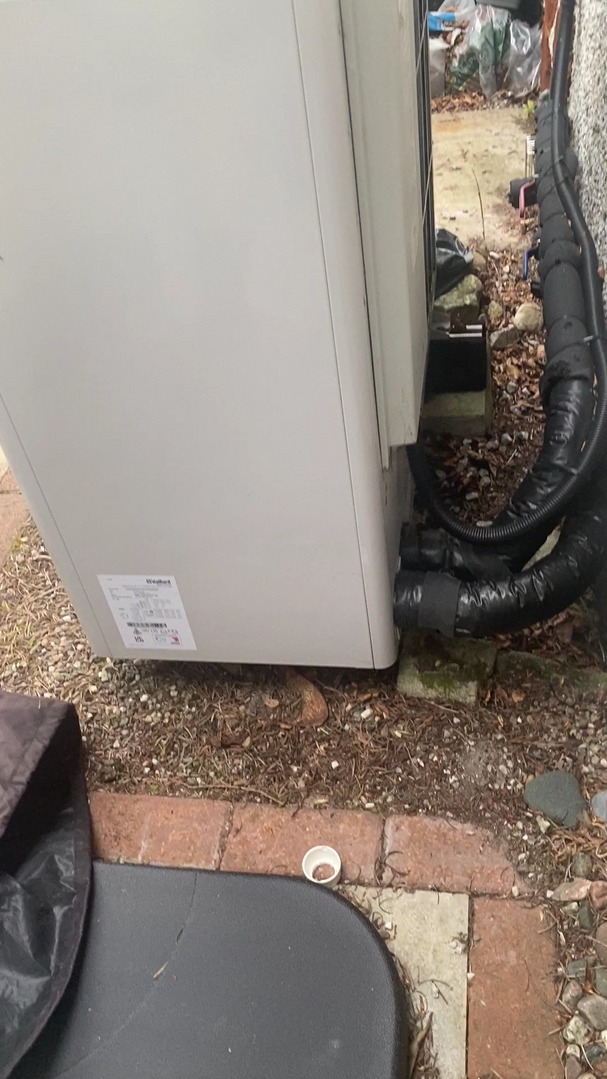
Question:- Does the level of the lowest pipe connected to the Arotherm need to be lower than (or level with) the Arotherm for the frost valves to protect it? I'm concerned that when the lowest frost valve empties the system there will still be water in the heat exchanger? I'm very keen to be rid of this glycol as it seems to be degrading into a brown gunge.
This post was modified 6 months ago by seoras
06/05/2026 7:14 pm
Question:- Does the level of the lowest pipe connected to the Arotherm need to be lower than (or level with) the Arotherm for the frost valves to protect it? I'm concerned that when the lowest frost valve empties the system there will still be water in the heat exchanger? I'm very keen to be rid of this glycol as it seems to be degrading into a brown gunge.
And a good one too.
I will venture an answer but others may disagree.
Anti-freeze valves work because
a) they allow water to move (because some drips away) which reduces the likelihood of freezing
b) they release pressure, which reduces the likelihood of bursting
c) they empty the water which eliminates any of the above
I dont actually know (because I have never seen an a/f valve actually work) which of the above in which order for how long.
(b) is to first order unaffected by height
(a) requires the a/f valve to be below some part of the internal pipework in the ODU
(c) requires it ideally to be below all of the pipework (and certainly below the heat exchanger) in the ODU
I have a faint recollection from last time I took the sides off mine a few months ago, that the HEX is located some distance above the base. That (taking the sides off and having a look) is what you really need to do. So long as they are located below the HERX and preferably below the lowest point of internal water pipes that it should suffice for all three mechanisms, unless of course the internal pipework has loops which trap water (hopefully that is not the case!).
Usual warnings apply if you do take the sides off - isolate electrically first and be careful. Its easy though - top off (2 screws), side opposite fan slides out after undoing a few more screws (2 I think). The screws are some king of Torx or other security bit, pack of various such bits available from Screwfix!
This post was modified 6 months ago 2 times by JamesPa
4kW peak of solar PV since 2011; EV and a 1930s house which has been partially renovated to improve its efficiency. 7kW Vaillant heat pump.
06/05/2026 8:08 pm
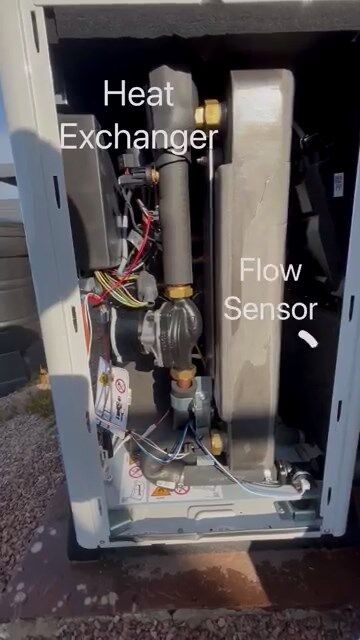
I'm not able yet to remove panels. This is a still taken from a You Tube video. I can't say if this is accurate but, if it is, it seems that anti frost valves will not be low enough to empty the heat exchanger. It also begs the question if there's actually space below the lowest pipe to fit a valve and some kind of container to catch the discharge.
06/05/2026 8:17 pm
I'm not able yet to remove panels. This is a still taken from a You Tube video. I can't say if this is accurate but, if it is, it seems that anti frost valves will not be low enough to empty the heat exchanger. It also begs the question if there's actually space below the lowest pipe to fit a valve and some kind of container to catch the discharge.
The thing labelled flow sensor is the heat exchanger, the pancake shape is the give away.
Discharge from a/f valves should never or rarely happen, so probably not worth worrying about it - mine have no provision for collecting it and Im not too bothered. Discharge from defrost does need to be dealt with otherwise if ice around could be dangerous, but your installer should have done this.
4kW peak of solar PV since 2011; EV and a 1930s house which has been partially renovated to improve its efficiency. 7kW Vaillant heat pump.
06/05/2026 11:02 pm
@jamespa Just watching a video on You Tube of a heating person installing heat pump - antifreeze valves are right at the connection to the heat pump and ensuring heat exchanger empties. Earlier photo of internals maybe misleading as it's a capture from a video just before an arrow points downward.
07/05/2026 9:19 am
@jamespa Just watching a video on You Tube of a heating person installing heat pump - antifreeze valves are right at the connection to the heat pump and ensuring heat exchanger empties. Earlier photo of internals maybe misleading as it's a capture from a video just before an arrow points downward.
Yes, typically as close to the heat pump as possible. If there aren't already isolation valves, now is a good time to fit them! I have a pair which isolate heat pump, mesh filter a metre or so of pipe and the two a/f valves only.
Some people advocate a pair of normally open electric valves on the house side of the feed and return in addition, the idea being that in case of a power cut these will close and thus, when the a/f valves open, only a small amount of water will be drained. It does make some sense, I don't have them but some do. Others advocate not bothering either with glycol or a/f valves on the grounds that we have been fitting oil boilers (which still need an electric pump) outside for years without bothering. It probably depends on how often you expect a power cut long enough to cause freezing!
Hope that helps.
4kW peak of solar PV since 2011; EV and a 1930s house which has been partially renovated to improve its efficiency. 7kW Vaillant heat pump.
Page 2 / 2
Prev

SPONSORS

Degrees of Separation
Latest Posts
-

RE: How will removing the standing charge on gas bills benefit heat pumps?
I'm not sure it makes much of a difference to heat-pump...
By Temperature_Gradient , 7 hours ago
-
@editor Ouch, sorry to re start the tick. I had assume...
By DavidB , 8 hours ago
-
RE: Say hello and introduce yourself
@e-a-west as the good Major said, welcome to the forums...
By Mars , 9 hours ago
-
RE: New Build 3 Phase or 1Phase
We are on three phase power because it's an enormous li...
By EtchedPixels , 10 hours ago
-
RE: How much of your renewable and home setup would still work if the internet went down?
Yes I actually have a copy of a tool that whenever a ce...
By EtchedPixels , 18 hours ago
-
RE: Indevolt Batteries UK Support & Info Thread
@editor Hi, To resolve this, please tap on the A...
By Indevolt Tech , 1 day ago
-
RE: Double or Triple Glazed Windows?
Posted by: @singlespeed With 9 years repairing windo...
By Rob of York , 2 days ago
-
@transparent we’re still running a secure version of PH...
By Mars , 2 days ago
-
RE: How quickly would you want/expect heat recovery to take from setback?
Much longer than that here. The heating isn't even on. ...
By bobflux , 3 days ago
-
RE: Passiv Smart Thermostat - Help & Forum Support
Obviously the weather is changeable but there's a defin...
By Singlespeed , 3 days ago
-
RE: The Changing Jet Stream Could Challenge UK Air Source Heat Pumps
@rob-of-york I must admit that when we had a Daikin hea...
By Toodles , 3 days ago
-
RE: Forum updates, announcements & issues
Get the Renewable Heating Hub heads-up on WhatsApp. I...
By Mars , 3 days ago
-
RE: Safety study for plug in batteries out to tender - looks like Q3 2027 at best before legal
@editor I pointed out to the one of the Fuse execs that...
By dansus , 3 days ago
-
RE: 15kw pump for 225m2 1990's house - over kill?
@seaviews As well as loft insulation, there are othe...
By Rob of York , 3 days ago




SPONSORS