

Notifications
Clear all
Joining the Renewable Heating Hub forums is completely free and only takes a minute. By registering you’ll be able to ask questions, join discussions, follow topics you’re interested in, bookmark useful threads and receive notifications when someone replies. Non-registered members also do not have access to our AI features. When choosing your username, please note that it cannot be changed later, so we recommend avoiding brand or product names. Before registering, please take a moment to read the Forum Rules & Terms of Use so we can keep the community helpful, respectful and informative for everyone. Thanks for joining!
Air Source Heat Pumps (ASHPs)
306
Posts
12
Users
61
Reactions
66 K
Views
03/10/2025 7:02 am
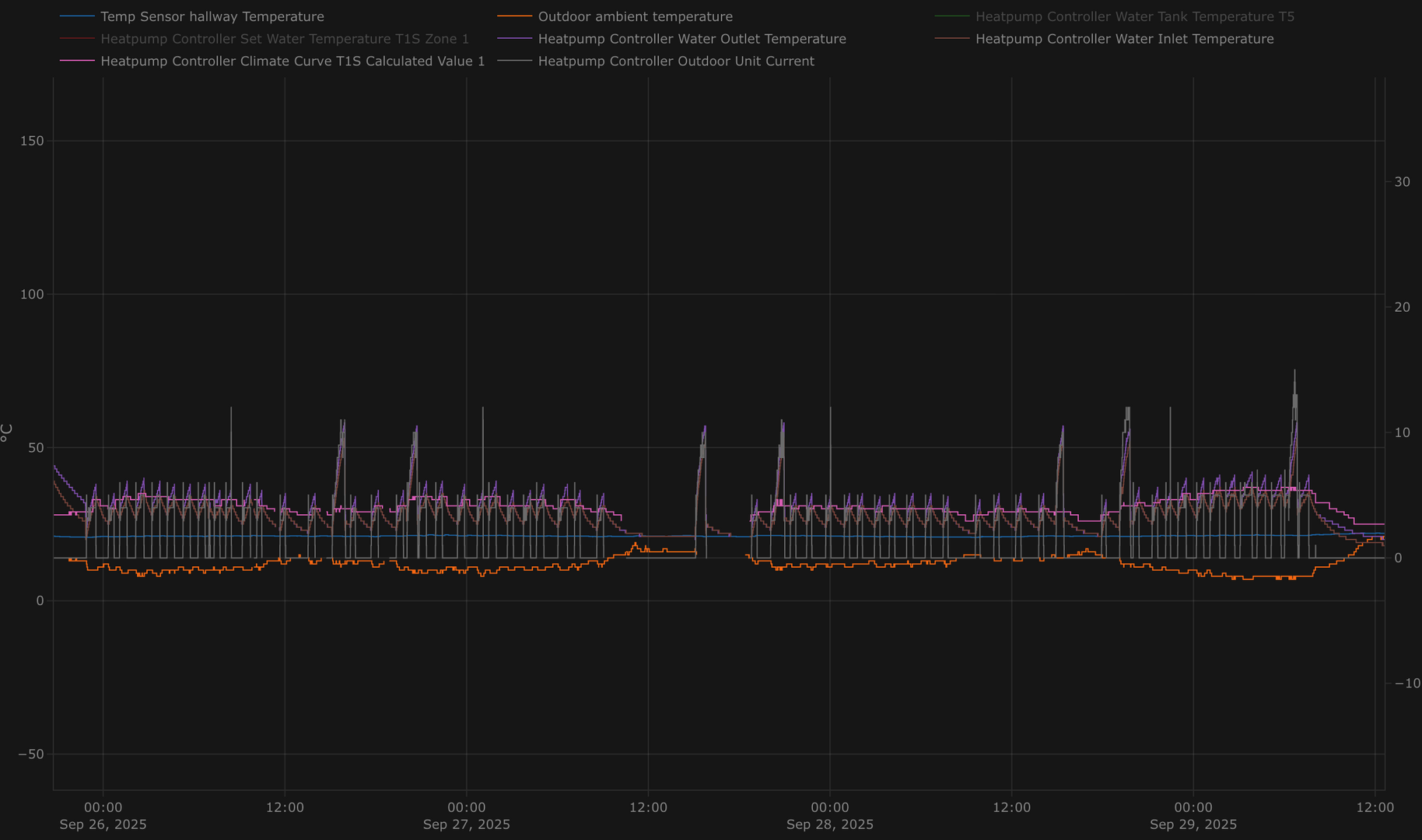
What I didn't quite expect (or understand perhaps) is that the warmer end temp on the weather curve is actually where heating will disable e.g. WCC warm end parameter set at 16 degrees C, and rather than just continuously running at whatever the set LWT is at that point for 16 and above, it will actually just...turn off. Which works rather well as it happens.
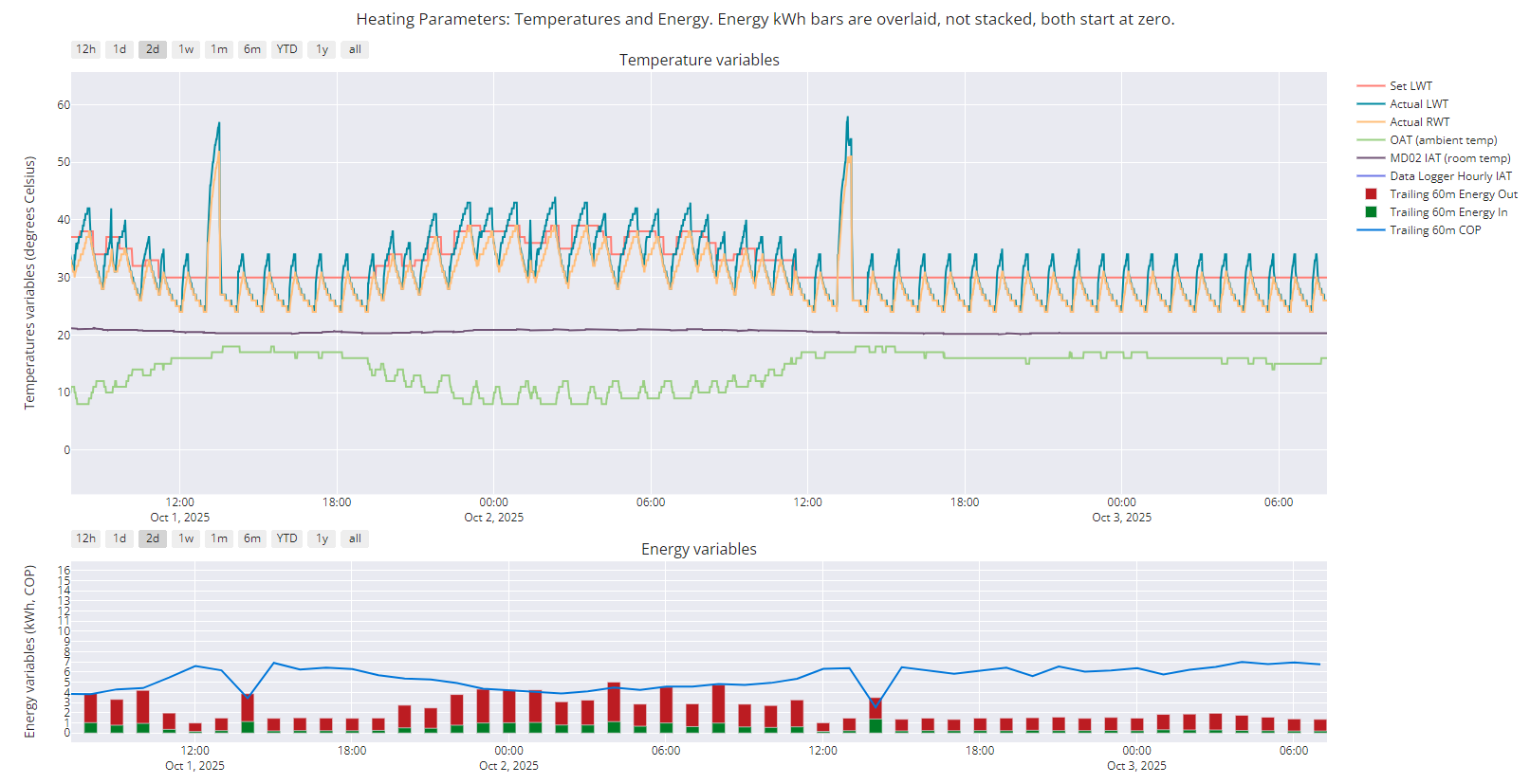
Interesting. I have always assumed, partly because the chart of the WCC in the Midea Engineering Data manual suggests it is so, that at OATs above the right hand set point, the LWT is the same as at the set point ie 30 @ 15 degrees actually 30 @ 15 degrees and above. Ditto at the other end, 50 @ -2 actually means 50 @ -2 or less degrees. True turning off at higher OATs happens not because of the WCC, but because the OAT is higher, and the room stat turns the heating off, as happens in summer. But your chart dies suggest the heat pump stopped producing heat at around 1000 on the 29th. Rather curiously, the LWT actually falls below the IAT, I wonder how it does that? The chart would benefit from also showing the OAT (and the Y axis could range from 0 to 60 rather than -60 to 100, to give a better perspective). Charting the set as well as actual LWT might also provide more information.
Her's my chart for the last two days. I think it bears out the above ie at 15 degrees and above OAT, the set and actual (average) LWT is 30, ie the heat pump doesn't turn off. That will only happen if I dial down the room stat, or otherwise fully turn off the heating:
Wouldn’t interfacing the heat pump with an unapproved control wholly void the warranty?
I agree with @benson - we are using the manufacturer's interface, as documented in the publicly available manuals. The availability of that information is meaningless if we can't make use of it. Or to put it another way, they shouldn't be at all surprised if we use the information if they make it available!
Midea 14kW (for now...) ASHP heating both building and DHW

Topic starter
03/10/2025 8:06 am
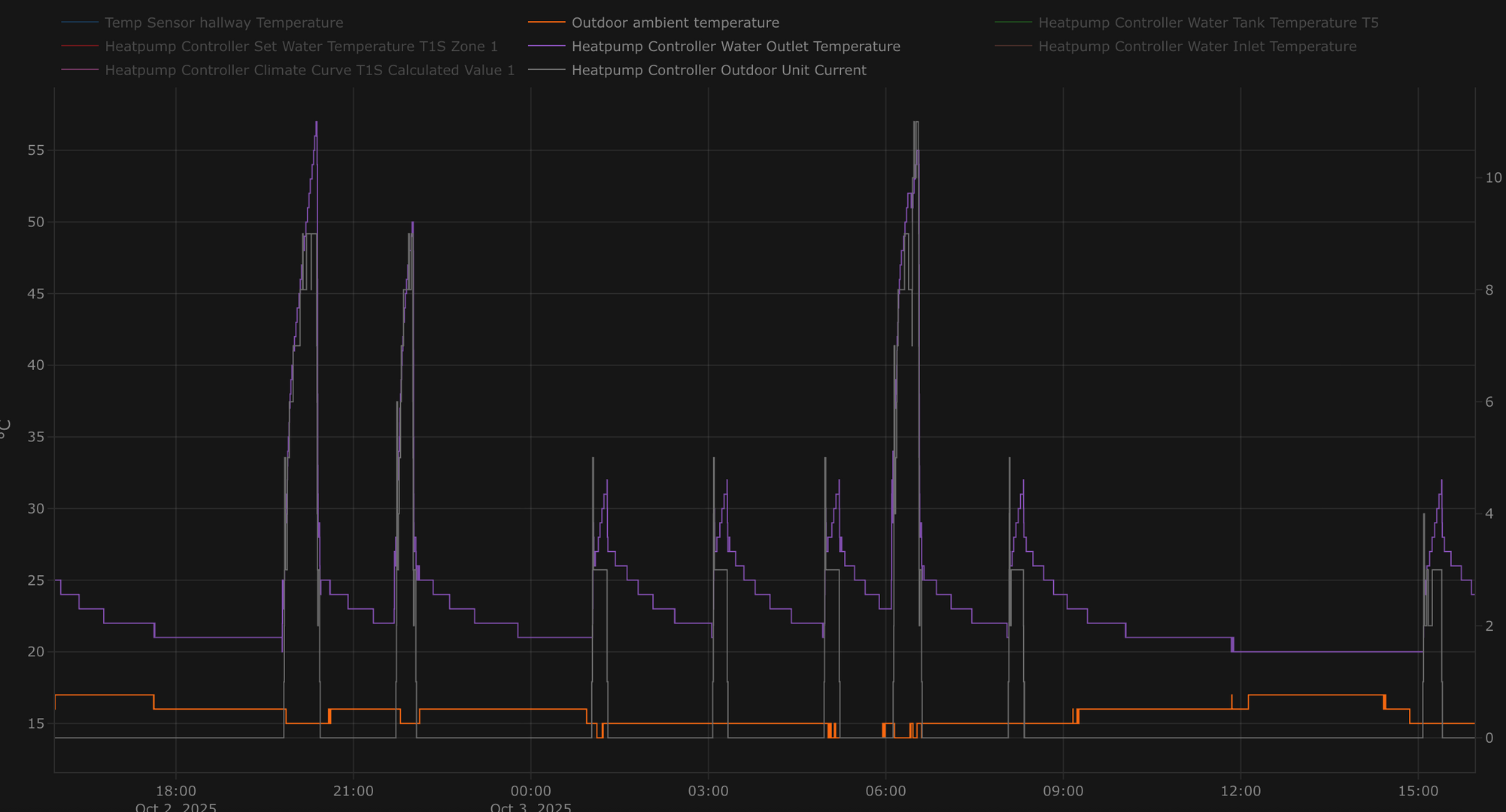
@cathoderay that is so odd. I wonder why mine does this. There's no doubt that mine does this as I've been closely watching it as well over the last couple of days as as soon as we are 16 and above, it will stop heating. There are two time periods on my graph where it does this- around 1000 on 27/09. I just hope that it doesn't do it at the cold end of the curve....
As for the LWT actually being cooler than OAT I hadn't noticed this. Going back to my plotly graph it is only by about 2 degrees C lower so assume this must be where the system water isn't benefiting from solar gain that the climate by the pump would have been, on that day?
03/10/2025 8:33 am
that is so odd. I wonder why mine does this. There's no doubt that mine does this as I've been closely watching it as well over the last couple of days as as soon as we are 16 and above, it will stop heating.
Maybe plot some more variables to see what is really happening. OAT as I said before, and set LWT, plus something that tells you what the heat pump is actually doing, amps in or compressor frequency. To be truly off, both the latter must both be zero.
I just hope that it doesn't do it at the cold end of the curve....
I don't think it will, that really would not make any sense. Unless our Oriental colleagues want us to live interesting times.
Going back to my plotly graph it is only by about 2 degrees C lower so assume this must be where the system water isn't benefiting from solar gain that the climate by the pump would have been, on that day?
I agree, it is not a lot, but something is cooling that water!
Midea 14kW (for now...) ASHP heating both building and DHW
Topic starter
03/10/2025 3:00 pm

03/10/2025 6:02 pm
@benson - getting there - you need to put all the variables on the same chart, ie add those from the second chart to the first chart plus the set LWT, for the time period shown in the first chart so you can see what happens when the LWT goes below the OAT. Also add a note (in the post or on the chart) saying what your current WCC end point settings are.
Midea 14kW (for now...) ASHP heating both building and DHW
Topic starter
03/10/2025 8:24 pm
@cathoderay ...bit cluttered and some missing data for reasons unknown, but here's the graph with everything.
04/10/2025 7:20 am
@benson - thanks.
I've said it before, and I'll say it again, from a performance point of view there is only one line on the chart that matters, and that is the IAT. It is the sum and product of all the other variables and influences, and if it is steady and in the right place, then on one level none of the other temperature lines matter one jot. From an efficiency point of view, the only line that matters is amps in, which is directly proportional to energy in. Just about everything we do with heat pumps is aimed at keeping the IAT steady an in the right place, using the minimum necessary number of amps in (and so kWh and so £££) to achieve that.
From the performance point of view, your heat pump is doing well - the IAT is steady and where you want it. There may be very minor fluctuations, but they have been effectively lost by using a Y axis with too high a maximum value. From the efficiency point of view, you need a bit more data. You already have the energy in (amps x volts x time = kWh), for energy out you need the LWT/RWT delta t (which you already have), flow rate (which I presume you already have) and specific heat capacity of the circulating fluid (a constant). My python script does these calculations once an hour, thus the values recorded at say 0900 with be the energy in and out, and thereby the COP, for the hour 0800 to 0990, and that is what is behind what you see in the lower part ('Energy variables') of my charts. Behind the scenes, I do have a routine that separates out space heating from DHW heating, using the position of the three port two way diverter valve (SV1, which is in one of the bits at modbus register address 129), but the charted values include both. I do all this in my python scripts, I imagine it could also be done in HA if necessary.
Moving on to the turning off question, yes, your heat pump spends several hours in the off state (zero amps in) in your chart, from about 1200 to 1800 on 27th Sep (but with a DHW spike in the middle), and again 0900 to 1200 on the 29th Sep. But these are notably periods when the OAT was highest, and, I suspect, though some of the data is missing, the set LWT is at or very close to the IAT. At such a state, the heat pump doesn't need to do anything. The building is in effect keeping the circulating water at or close to the set LWT, so the heat pump doesn't come on, or rather, stays off, while in that state.
But above analysis all depends on your WCC settings! What are they???
Midea 14kW (for now...) ASHP heating both building and DHW
2
Topic starter
04/10/2025 8:30 am
Here's the current WCC settings I am using:



04/10/2025 8:57 am
@benson OK, i think that is 47 @ -2 for the left hand end, 25 @ 16 degrees for the right hand end.
Lets now look at the right hand end of the previous chart, which I have shifted to the left to get it nearer the left hand Y axis (the right Y axis is for the amps in I think):
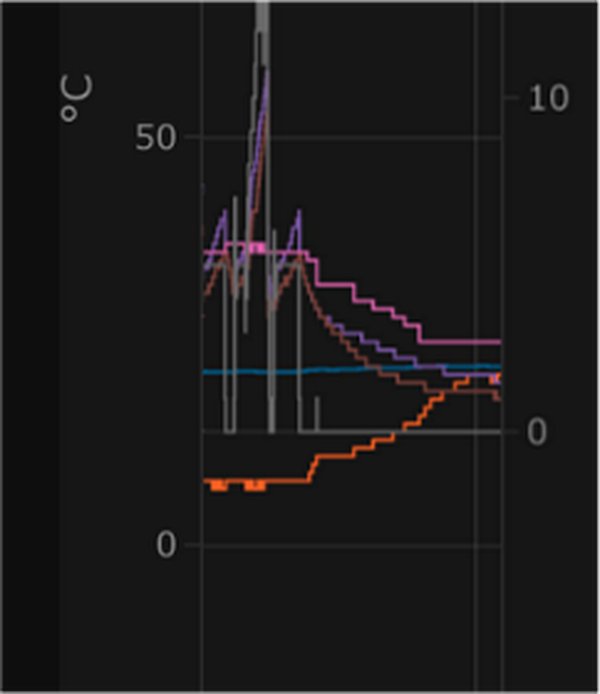
Now, what I think may be happening is this. The OAT (orange) has got to about 19 degrees, that means the set LWT should be 25 degrees, which it looks like it is (upper pink line). But the actual LWT (mauve line) isn't that far away, at around 20 degrees. Depending on the control logic/hysteresis, that may not be far enough away to trigger the heat pump (compressor) to come on. Somewhere I think we talked about how far the actual LWT needs to deviate from the set LWT to trigger heating on, and i seem to recall is was 5 degrees. If so, with an actual LWT of 20 degrees, kept there by the building being at just above that, then the heat pump will very likely stay off, until the actual LWT deviates enough to trigger the compressor to start up.
The charts would be easier to read with sensible scales, usable grid lines and a better colour scheme! There are loads of guides to selecting effective chart colours online. My charts aren't perfect, but I suggest they are easier to read.
Midea 14kW (for now...) ASHP heating both building and DHW
1

04/10/2025 9:25 am
I've said it before, and I'll say it again, from a performance point of view there is only one line on the chart that matters, and that is the IAT. It is the sum and product of all the other variables and influences, and if it is steady and in the right place, then on one level none of the other temperature lines matter one jot. From an efficiency point of view, the only line that matters is amps in, which is directly proportional to energy in. Just about everything we do with heat pumps is aimed at keeping the IAT steady an in the right place, using the minimum necessary number of amps in (and so kWh and so £££) to achieve that."
This is one of the best explanations I have seen on here thanks!
As we are currently being battered by the wind I think today is the day to update my Home Assistant integration one thing that it is struggling to do reliably is to is measure the COP I am not sure why maybe it is because it is using real time data I am not sure.
My python script does these calculations once an hour, thus the values recorded at say 0900 with be the energy in and out, and thereby the COP, for the hour 0800 to 0990, and that is what is behind what you see in the lower part ('Energy variables') of my charts. Behind the scenes, I do have a routine that separates out space heating from DHW heating, using the position of the three port two way diverter valve (SV1, which is in one of the bits at modbus register address 129), but the charted values include both. I do all this in my python scripts, I imagine it could also be done in HA if necessary.
For your COP /Efficiency rating do you do an average for that hour?
Kind Regards
Si
——————————————————————————
Grant Aerona3 13kW
13 x 435w + 13x 480w Solar Panels
Sigenergy 10kW Inverter
25kWh Sigenstor battery

04/10/2025 10:40 am
Depending on the control logic/hysteresis, that may not be far enough away to trigger the heat pump (compressor) to come on. Somewhere I think we talked about how far the actual LWT needs to deviate from the set LWT to trigger heating on, and i seem to recall is was 5 degrees. If so, with an actual LWT of 20 degrees, kept there by the building being at just above that, then the heat pump will very likely stay off, until the actual LWT deviates enough to trigger the compressor to start up.
Are you suggesting the controller is an "on-off" one? Because that would null the inverter capabilities, i.e. smooth, continuous control of the LWT.
Midea MHCV10WD2N7 R290, 5.8kWp energy community solar power.
04/10/2025 2:34 pm
This is one of the best explanations I have seen on here thanks!
Thank you, that is very kind of you to say so!
For your COP /Efficiency rating do you do an average for that hour?
Yes. I select the last 60 rows of minute data, and take the averages, having previously confirmed this (unsurprisingly, but I like to check things) gives the same result as summing the minute data. The key lines in the code are (note how clean they are compared to HA code!):
# get the last hour's data from the minute data file
df = pandas.read_csv("./modbus/mideadata.csv", skiprows=range(1,lines-60))

# calculate energy in for the last hour in kWh
calc_kWh_in = round(((df.amps_in.mean() * df.volts_in.mean() * 1) / 1000) * dcf, 2)

# calculate energy out for the last hour in kWh
calc_kWh_out = round((df.flowrate.mean()/3.6) * spht * (df.LWT.mean() - df.RWT.mean()), 2)

# calculate the COP for the last hour
calc_60m_COP = round(calc_kWh_out / calc_kWh_in, 2)
The energy in dcf (discrepancy correction factor) value is a constant based on the discrepancy between the calculated values, and my independent kWh energy in meter, which supplies only the heat pump. The value of the constant dcf is 1.18, measured over the long term (months/years). I have never been able to explain what causes it, but suspect it may be other things that use energy inside the heat pump, notably but not exclusively the circulating pump. The calculated value is only the energy going into the compressor. For energy out, the divide by 3.6 converts from Midea's cubic metres per hour to litres per second, and spht is the specific heat capacity of the circulating fluid (4.05, as I have some glycol in the system).
Are you suggesting the controller is an "on-off" one? Because that would null the inverter capabilities, i.e. smooth, continuous control of the LWT.
Look at the charts, both @benson's recent one (with amps in), and the one I posted a while back with the compressor frequency. When they are off, they are off, when they are on they jump around rather a lot. But the actual LWT tends to follow a smooth-ish path most of the time, and most of the steps are probably artefacts because the temps are measured in whole numbers at discrete moments in time.
I think you already know that over most of the OAT range, Midea and Midea clone heat pumps slow cycle to modulate output, with the average of the actual LWT being close to the set LWT. No one outside Midea HQ that I know of knows why they do things this way.
Midea 14kW (for now...) ASHP heating both building and DHW
SPONSORS

Degrees of Separation
Latest Posts
-

RE: New Build 3 Phase or 1Phase
Not so. 1: It's now the case that the Service Fuse wi...
By Transparent , 5 hours ago
-
RE: How will removing the standing charge on gas bills benefit heat pumps?
I think it has an enormous impact on air/air users. The...
By EtchedPixels , 12 hours ago
-
@editor Ouch, sorry to re start the tick. I had assume...
By DavidB , 1 day ago
-
RE: Say hello and introduce yourself
@e-a-west as the good Major said, welcome to the forums...
By Mars , 1 day ago
-
RE: How much of your renewable and home setup would still work if the internet went down?
Yes I actually have a copy of a tool that whenever a ce...
By EtchedPixels , 2 days ago
-
RE: Indevolt Batteries UK Support & Info Thread
@editor Hi, To resolve this, please tap on the A...
By Indevolt Tech , 2 days ago
-
RE: Double or Triple Glazed Windows?
Posted by: @singlespeed With 9 years repairing windo...
By Rob of York , 3 days ago
-
@transparent we’re still running a secure version of PH...
By Mars , 3 days ago
-
RE: How quickly would you want/expect heat recovery to take from setback?
Much longer than that here. The heating isn't even on. ...
By bobflux , 3 days ago
-
RE: Passiv Smart Thermostat - Help & Forum Support
Obviously the weather is changeable but there's a defin...
By Singlespeed , 3 days ago
-
RE: The Changing Jet Stream Could Challenge UK Air Source Heat Pumps
@rob-of-york I must admit that when we had a Daikin hea...
By Toodles , 3 days ago
-
RE: Forum updates, announcements & issues
Get the Renewable Heating Hub heads-up on WhatsApp. I...
By Mars , 4 days ago
-
RE: Safety study for plug in batteries out to tender - looks like Q3 2027 at best before legal
@editor I pointed out to the one of the Fuse execs that...
By dansus , 4 days ago
-
RE: 15kw pump for 225m2 1990's house - over kill?
@seaviews As well as loft insulation, there are othe...
By Rob of York , 4 days ago





SPONSORS

