

Notifications
Clear all
Joining the Renewable Heating Hub forums is completely free and only takes a minute. By registering you’ll be able to ask questions, join discussions, follow topics you’re interested in, bookmark useful threads and receive notifications when someone replies. Non-registered members also do not have access to our AI features. When choosing your username, please note that it cannot be changed later, so we recommend avoiding brand or product names. Before registering, please take a moment to read the Forum Rules & Terms of Use so we can keep the community helpful, respectful and informative for everyone. Thanks for joining!

29/01/2024 4:54 pm
Is it documented that this is a 12kW heat pump with a 6kW booster heater, rather than a true 18kW heat pump? If so then I would suspect that is false marketing.

29/01/2024 5:07 pm
@derek-m to be fair, I don’t know, I was referring to what another person said previously. I don’t know. I do know it doesn’t seem able to run at high temps without icing up, which in turn means the Radiators don’t warm up.
here is the marketing info. Daikin approved installer designed and fitted my system
EPRA18DAV37 is my outside unit.
im hoping the original poster will reply back with a happy ending😀
29/01/2024 5:23 pm
I suppose that this is a good reason to avoid HT heat pumps if at all possible.
To produce a higher LWT the compressor has to work harder, therefore moving more refrigerant gas, which of course has to go through the evaporator. A greater flowrate through the evaporator will have a greater cooling effect, which in turn will cause any ice build up to be more frequent. The simple solution is to run at lower LWT's.
1
29/01/2024 6:33 pm
@derek-m I get the principal of how HPs operate. But these HT ones specifically state they run up to 70c.
my house on the OP’s are not set up to operate with low flow temps! Question is, is the HP ever going to operate as it states in the book!


30/01/2024 1:18 pm
@haggistrap I'm sure it does give a 70C flow temp in the right lab test conditions. The issue is that in weather conditions where defrosting is going to happen, which is unfortunately when you need the higher flow temperatures, most, there are two negative factors working against the "high temp heat pump" approach:
the first is that running at a higher flow temperature makes defrosts happen more frequently. Because the HP is working harder (than it would if running a lower flow temperature), the physics means it will ice up faster.
the second is that during the "defrost cycle" of the heat pump, the water temperature of the system goes right down. To get all the way back up to 70 after the defrost, that will take longer than if it had to get up to a lower temperature. So after a defrost your system spends longer with cool radiators.
if you were to plot a graph of your circulating water temperature during a period when defrosts are happening, it might well never reach the target.
My octopus signup link https://share.octopus.energy/ebony-deer-230
210m2 house, Samsung 16kw Gen6 ASHP Self installed: Single circulation loop , PWM modulating pump.
My public ASHP stats: https://heatpumpmonitor.org/system/view?id=45
11.9kWp of PV
41kWh of Battery storage (3x Powerwall 2)
2x BEVs

30/01/2024 1:54 pm
This is an interesting discussion not least on the topic of HT ASHPs. My installer was an old fashioned father son plumber business which had seen the renewable market potential and had transitioned early into that technology some years ago. We had loads of discussions at planning stage of how to move the leaky, timber framed house of LPG and logs and a high temp thermal store to a ASHP. I wanted to cling to a higher temperature source and hybridise with the LPG boiler but he maintained that while that might avoid the pipework and radiator replumbing, but that fundamentally the ASHP was incompatible with HT operation for the reasons @iancalderbank outlined above.
That meant trusting him to get a low temp system to work here. He said NIBE if money was no object, Daiken for commercial but unsophisticated and Ecodan if you want it to work in a cold damp and windy climate. I argued that the Ecodan 14 kW FTC5 pre-packaged cylinder had a LLH which he said that in his opinion it was a actually a hydraulic separator and as the injection plume was above the secondary flow it should not be considered a LLH.
That was 2019 and I am sure the technology has advanced but it would appear the debate is still the same!
06/03/2024 6:43 pm
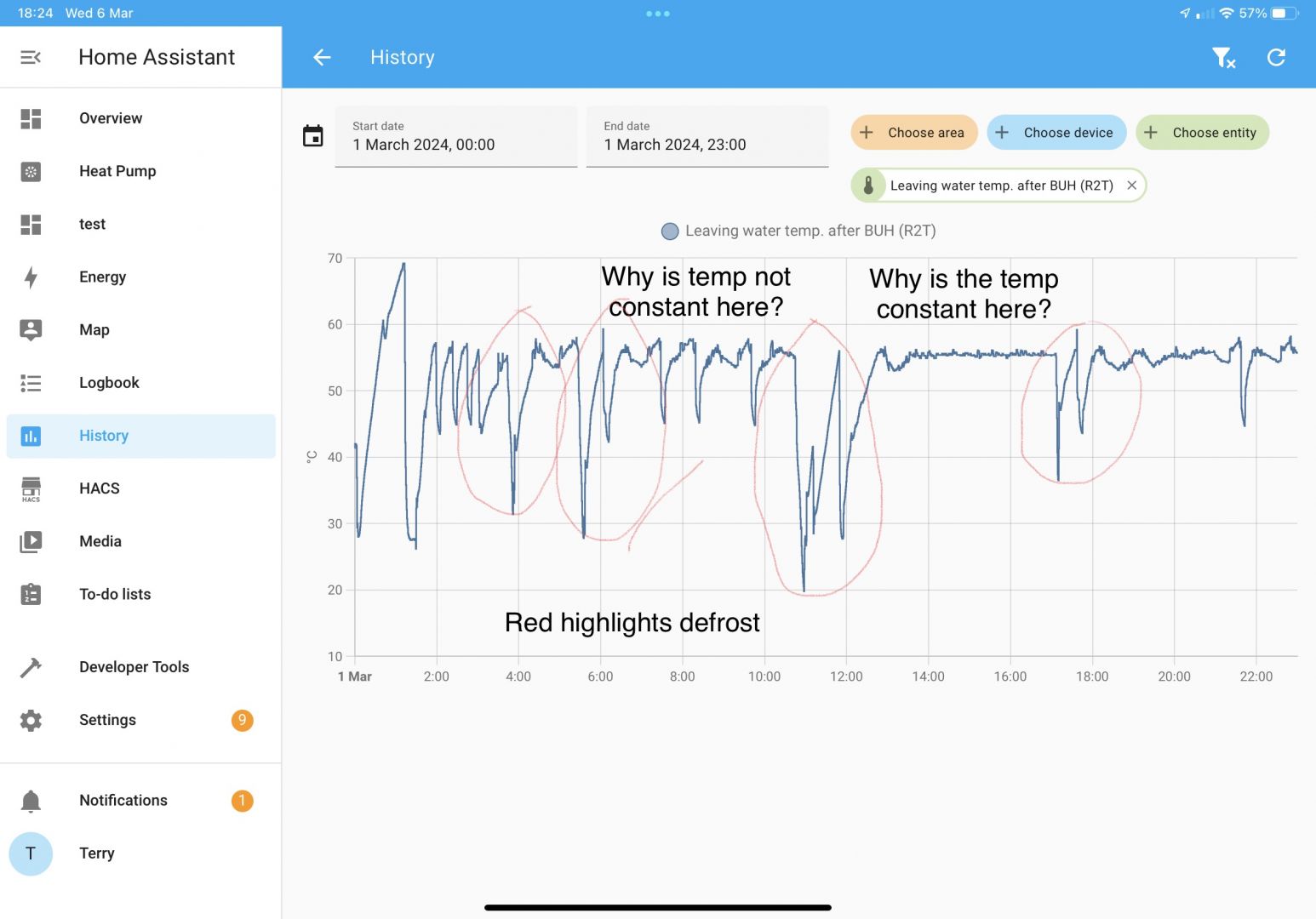
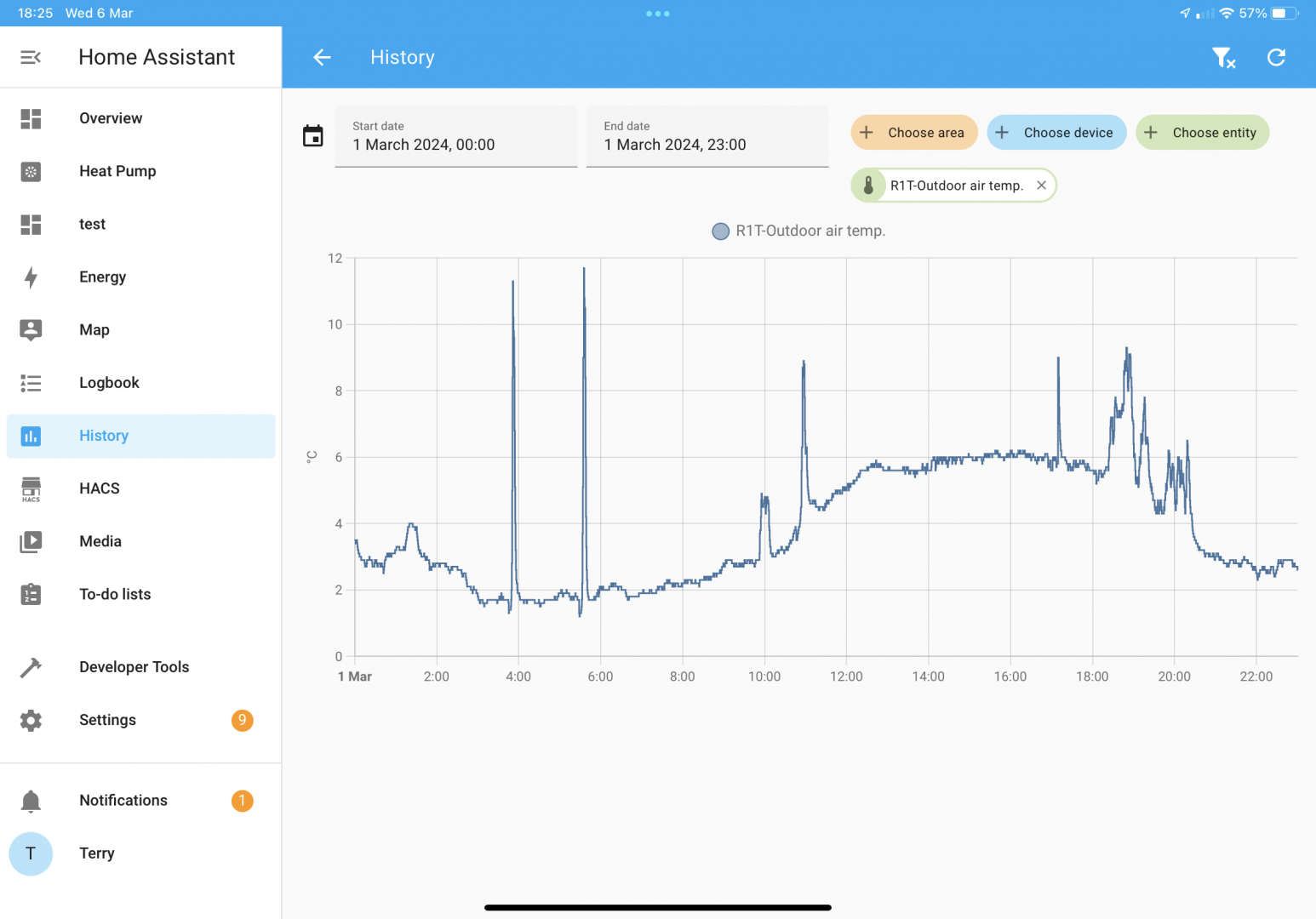
Some graphs if anyone can suggest why my HP seems to not maintain a constant “leaving water” temp more constantly. In the examples below there are three graphs.
It wasn’t really that cold, when it’s colder the problem I have with the HP holding it’s temp is much worse and defrost more frequent and longer.
Does anyone know what is causing the HP to stop heating
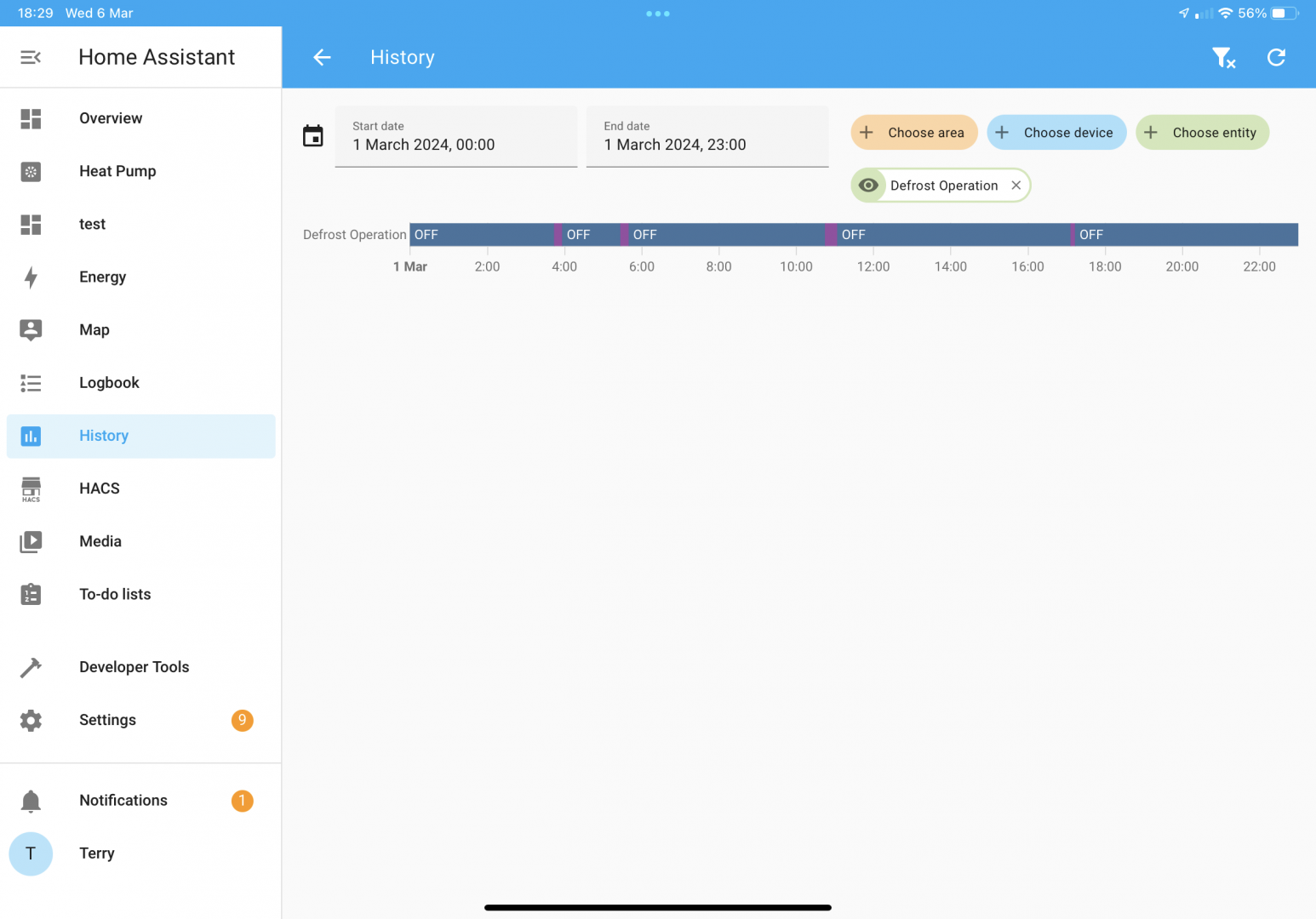
the water even when the thermostat is calling for heat and there is no defrost going on.
My system only seems to record data for a week but when it was colder the HP doesn’t really hold the leaving water temp at it’s set value it just always seems to stop start and obviously there are more frequent and longer defrost cycles?
leaving water temp
outside temp
defrost
06/03/2024 7:58 pm
Are you operating your heat pump in Weather Compensation (WC) mode and if so what are the settings?
Why are you operating your heat pump with such high water temperatures?

06/03/2024 8:25 pm
It’s a high temp heat pump. Marketed and sold as a retro fit for gas boiler, designed to run up to 70c
it’s set to fixed 55c temp.
06/03/2024 9:24 pm
It’s a high temp heat pump. Marketed and sold as a retro fit for gas boiler, designed to run up to 70c
it’s set to fixed 55c temp.
The fact that the heat pump can achieve high temperatures does not mean it has to be operated at high temperatures, which can reduce it efficiency quite dramatically.
I would suggest that you set the controller to operate in WC mode, or better still get your installer to do so, since they should have done this in the first place.
06/03/2024 10:14 pm
@derek-m thanks.
however the house needs a min 55c flow temp to effectively heat it. I’ve done this to lower the temp from higher temperatures, to try and improve efficiency. I’m fully aware lower flow temp will increase efficiency but this HP was specific selected due to its capabilities to operate as a retrofit for a gas boiler!
the lowest flow temp I can run at is 55c, that’s why it’s set high but well within the operating range of this HP.
if anyone knows why it’s not maintaining it’s set flow temp I’d appreciate feedback but please take note this is a High temp unit, capable and designed to operate at this temp.
Though I suspect it’s not really capable of actually replacing a gas boiler, however that’s the claim made by Daikin and the installer. It was their design and recommended.
06/03/2024 10:48 pm
@derek-m thanks.
however the house needs a min 55c flow temp to effectively heat it. I’ve done this to lower the temp from higher temperatures, to try and improve efficiency. I’m fully aware lower flow temp will increase efficiency but this HP was specific selected due to its capabilities to operate as a retrofit for a gas boiler!
the lowest flow temp I can run at is 55c, that’s why it’s set high but well within the operating range of this HP.
if anyone knows why it’s not maintaining it’s set flow temp I’d appreciate feedback but please take note this is a High temp unit, capable and designed to operate at this temp.
Though I suspect it’s not really capable of actually replacing a gas boiler, however that’s the claim made by Daikin and the installer. It was their design and recommended.
While you may need a LWT of 55C at Outside Air Temperatures (OAT) of zero and below, you should not require 55C when the OAT is 5C to 15C.
The idea behind WC is that it varies the LWT to provide sufficient thermal energy to supply the present heat loss, and keep the Indoor Air Temperature (IAT) reasonably constant. It should also help the heat pump to operate in a more stable manner.
Obviously it is your choice as to how you operate your system.
1


SPONSORS

Degrees of Separation
Latest Posts
-

RE: How will removing the standing charge on gas bills benefit heat pumps?
The BUS grant funding for 2026/27 will run out at the c...
By Rob of York , 3 hours ago
-
RE: The Changing Jet Stream Could Challenge UK Air Source Heat Pumps
Thanks @susannasaunders for reviving the topic I find i...
By springswood , 4 hours ago
-
RE: New Build 3 Phase or 1Phase
Not so any more.... 1: It's now the...
By Transparent , 17 hours ago
-
@editor Ouch, sorry to re start the tick. I had assume...
By DavidB , 2 days ago
-
RE: Say hello and introduce yourself
@e-a-west as the good Major said, welcome to the forums...
By Mars , 2 days ago
-
RE: How much of your renewable and home setup would still work if the internet went down?
Yes I actually have a copy of a tool that whenever a ce...
By EtchedPixels , 2 days ago
-
RE: Indevolt Batteries UK Support & Info Thread
@editor Hi, To resolve this, please tap on the A...
By Indevolt Tech , 2 days ago
-
RE: Double or Triple Glazed Windows?
Posted by: @singlespeed With 9 years repairing windo...
By Rob of York , 3 days ago
-
@transparent we’re still running a secure version of PH...
By Mars , 3 days ago
-
RE: How quickly would you want/expect heat recovery to take from setback?
Much longer than that here. The heating isn't even on. ...
By bobflux , 4 days ago
-
RE: Passiv Smart Thermostat - Help & Forum Support
Obviously the weather is changeable but there's a defin...
By Singlespeed , 4 days ago
-
RE: Forum updates, announcements & issues
Get the Renewable Heating Hub heads-up on WhatsApp. I...
By Mars , 4 days ago
-
RE: Safety study for plug in batteries out to tender - looks like Q3 2027 at best before legal
@editor I pointed out to the one of the Fuse execs that...
By dansus , 4 days ago
-
RE: 15kw pump for 225m2 1990's house - over kill?
@seaviews As well as loft insulation, there are othe...
By Rob of York , 4 days ago





SPONSORS
