
Notifications
Clear all
Joining the Renewable Heating Hub forums is completely free and only takes a minute. By registering you’ll be able to ask questions, join discussions, follow topics you’re interested in, bookmark useful threads and receive notifications when someone replies. When choosing your username, please note that it cannot be changed later, so we recommend avoiding brand or product names. Before registering, please take a moment to read the Forum Rules & Terms of Use so we can keep the community helpful, respectful and informative for everyone. Thanks for joining!

09/03/2026 10:31 pm
I found this thread on reddit:
https://www.reddit.com/r/ukheatpumps/comments/1r97882/noisy_home_not_the_heat_pump/Does this seem like something I should ask from Octopus?
https://www.reddit.com/r/ukheatpumps/comments/1r97882/noisy_home_not_the_heat_pump/o6engbb/
Acoustic decoupling with flexible pipe, very possibly. It depends on whether the noise is water borne or pipe-borne. The best bet would probably be the same or similar flexis as are used outside, but the are expensive so Octopus may be reluctant. Before my ASHP I had a shower pump coupled with flexis. It still made one hell of a racket but without the flexis it was much worse, so they can help!
Some water pumps (often called circulators) are quieter than others, maybe worth considering swapping the circulator out, depending obviously on which one you have.
Also worth trying to work out whether the noise is coming from the pump itself, or the passage of water through the pipework. If the latter it could be elbows that are causing problems and replacing key ones with swept bends may help. I had a section of pipework in my old gas system that was very noisy indeed, fortunately it was in a place where it didn't matter. The odd thing is that the noise has completely disappeared now the ASHP is fitted, even though the section of pipe concerned is still in use and the water in it is presumably flowing faster!
This post was modified 3 days ago by JamesPa
4kW peak of solar PV since 2011; EV and a 1930s house which has been partially renovated to improve its efficiency. 7kW Vaillant heat pump.
1

10/03/2026 9:51 am
Possibly not relevant but I can hear noise from some radiators. These are ones where the TRV has been adjusted down; turning them back up again removes the noise. I changed them for decorators cap and turned these down to restrict heat but still allow some flow and the noise hasn’t returned. I suspect some valves are better than others although the problem occurred with valves fitted by Octopus and those not replaced.
10/03/2026 12:18 pm
Possibly not relevant but I can hear noise from some radiators. These are ones where the TRV has been adjusted down; turning them back up again removes the noise.
These will be ones that are at a state of almost closed. The water whistles through. I have occasionally experienced the same with LSVs but a tiny tweak usually fixes it without materially affecting the apparent room temperature. Its an inevitable risk if you try to force a viscous liquid through a small orifice!
4kW peak of solar PV since 2011; EV and a 1930s house which has been partially renovated to improve its efficiency. 7kW Vaillant heat pump.
10/03/2026 5:01 pm
@jamespa I think they were at setting "3" although I don't know how near to fully closed that is. It only stopped when I fully opened them - setting "5". Anyway, it was just a thought for the OP: if his install was "over estimated" with larger radiators that he's had to turn down it may be relevant...
10/03/2026 5:31 pm
@jamespa I think they were at setting "3" although I don't know how near to fully closed that is.
Unless you have unscrewed them from the valves then it depends on the room temperature, TRVs close or open according to room temp. I think 3 may be around 20-21 but I doubt the calibration is accurate!
4kW peak of solar PV since 2011; EV and a 1930s house which has been partially renovated to improve its efficiency. 7kW Vaillant heat pump.

10/03/2026 7:49 pm
We had water hammer with our gas boiler and lived with it.
Since installing the HP our water hammer has gone, so I'd agree that replacing your HP with a gas boiler may not solve this.
11/03/2026 1:48 am
I have no idea. I suspect it was down to the HP engineers and the quality of the installation.
1

Topic starter
12/03/2026 9:06 pm
Another question for those with knowledge on the subject.
So, here's the situation:
1. The HP engineer came by on Friday to balance the radiators.
2. Since the balancing, a room in the house which was previously very cold at night, is now quite warm.
3.The radiator in this room has not been changed, it's still the small raditor from before the HP install.
4. How is this achieved?
I ask because the ringing/resonance I've been complaining about has gotten worse since the balancing was done.
12/03/2026 9:20 pm
2. Since the balancing, a room in the house which was previously very cold at night, is now quite warm.
3.The radiator in this room has not been changed, it's still the small raditor from before the HP install.
4. How is this achieved?
By opening up the lockshield valve on the radiator in question, or closing down a bit lockshield valves on other radiators (the lockshield valve, often abbreviated to LSV, is the valve opposite the TRV). This forces more water to flow through the radiator. Thus for any given output the temperature drop (delatT) across the radiator reduces, its average temperature therefore increases and thus its output increases.
Thats what balancing is. If you want to read up on it there is an article here.
I ask because the ringing/resonance I've been complaining about has gotten worse since the balancing was done.
Thats unfortunate. It would be useful to know flow rate before and after as it might tell us something. Changing the balancing is not the way to fix it however, unless somebody has closed down LSVs too much.
Have you tracked down definitely that its coming from the secondary pump. Are all your TRVs fully open (ie set to max) and if not what happens to the noise if they are?
My strong advice to you is to stop clutching at straws and knuckle down to some detective work. You are much more likely to track it down that any visiting engineer is, because you are there permanently. Once its pinpointed and the characteristics clear in terms of what stimulates it or suppresses it, fixing it will be easier. Im not saying that tracking it down will be easy, but you have a better chance than anyone else.
This post was modified 1 hour ago 3 times by JamesPa
4kW peak of solar PV since 2011; EV and a 1930s house which has been partially renovated to improve its efficiency. 7kW Vaillant heat pump.
Topic starter
12/03/2026 9:43 pm
@jamespa thanks again.
I'll read the article and try to undo the balancing right now.
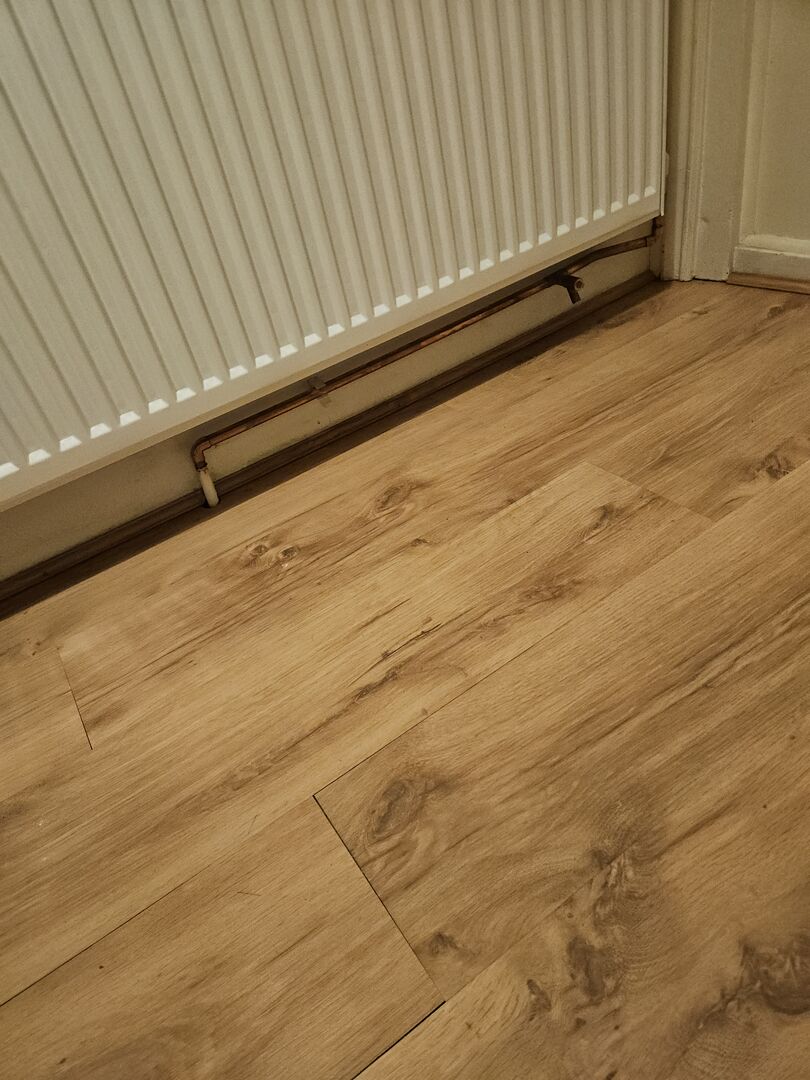
Also, do you think a big, super wide radiator with a bend like this could be causing some of the noise?
This is the hallway radiator next to the living room.
12/03/2026 10:27 pm
I'll read the article and try to undo the balancing right now.
Balancing is a long process and its possible to mess things up if you turn down LSVs too much. If you are happy with the temperature I advise you to leave it unless you have positive reason to suspect its causing a problem. If you wanted to you could, without changing anything, check that at least one radiator has its LSV fully open. It would usually be the one furthest from the heat pump or one nearby.
Elbows in pipework may exacerbate noise, but are unlikely to be the cause unless the radiators are so poorly balanced that a disproportionate flow is going through one or two rads. But if this were the case you would notice it in the heating characteristics. If it is causing it here, the noise will be especially apparent. Is it.
I would focus on the original source of the noise which I thought you said was the pump. Is it?
This post was modified 21 minutes ago by JamesPa
4kW peak of solar PV since 2011; EV and a 1930s house which has been partially renovated to improve its efficiency. 7kW Vaillant heat pump.
Page 15 / 15
Prev

Latest Posts
-
RE: Octopus Cosy 12 Heat Pump Regret: Incredibly Loud, Poor Heating & Constant Hum - Help!
Balancing is a long process and its possible to mess th...
By JamesPa , 23 minutes ago
-
RE: Daikin Altherma 3 LT compressor longevity question
Up to a point yes. However every heat pump (and every ...
By JamesPa , 1 hour ago
-
Thanks everyone for the help, Havenwise now diasbled. q...
By Boycey , 3 hours ago
-
RE: Advice needed after a successful "leftfield" experiment.....
@pauli Depending on whether you can get an EV tariff, I...
By ChandyKris , 4 hours ago
-
-
RE: New Build ASHP Defects - Looking for Advice, Support & Shared Experiences
Is that a single pair only? If so it may be part if th...
By JamesPa , 6 hours ago
-
RE: Solar Power Output – Let’s Compare Generation Figures
@technogeek I think you are correct, but, it didn’t inf...
By Papahuhu , 6 hours ago
-

@batpred, you’re quite right; it does work well. I don’...
By Majordennisbloodnok , 7 hours ago
-

@Mars at the time of writing heating oil is £1.28 / ltr...
By TechnoGeek , 7 hours ago
-
RE: Ecodan Cylinder Possible Weeping Around Thermostat Port
Update: Mitsubishi sent an engineer around. It was li...
By Gruff2001 , 10 hours ago
-
RE: A Smarter Smart Controller from Homely?
@benson Agreed. I believe the COP gains with homely, i...
By Papahuhu , 10 hours ago
-
RE: Samsung Gen 7 16kW Integrated unit Modbus monitoring
The setup for this is a Samsung Modbus card. Connected ...
By antonical , 12 hours ago
-

RE: Forum updates, announcements & issues
@davidalgarve, if the emails are more than roughly a mo...
By Mars , 12 hours ago
-
How to Find All Your Posts and Topics on the Forum – A Quick Guide
If you’ve ever posted something on the forum and then s...
By Mars , 12 hours ago
-
RE: If a heat pump can only heat DHW to 50C then what? Issue with 18KW Heliotherm heat pump
Sorry to hear that but I'm not surprised TBH. Stratifi...
By JamesPa , 13 hours ago
-
RE: Say hello and introduce yourself
@pt151 welcome to the forums, and looking forward to he...
By Mars , 1 day ago
-
RE: Setback savings - fact or fiction?
The answer was in two parts in my reply, the second par...
By RobS , 1 day ago
-
Samsung Gen 7 16kW Integrated unit Modbus monitoring
Looking for some assistance to get modbus monitoring wo...
By antonical , 1 day ago
-
Ecodan control return to Melpump from Havenwise trial. settings check
Hi, Just got control back after being on the hav...
By Boycey , 1 day ago
-
RE: Refrigerant R32, is it now banned in the EU from 1st Jan 2027 for monobloc ASHPs?
I wonder if heat pump manufacturers will tone these sit...
By JamesPa , 1 day ago
-
RE: Who’s Caved and Switched the Heating On Already?
@editor yesterday we used 12kW of electricity for heat,...
By Judith , 1 day ago
-
RE: Rate the quality of your heat pump design and installation
Loss assessments can be a very serious case of GIGO. I...
By JamesPa , 1 day ago
-
RE: Who's your electricity provider and what's your tariff?
@jamespa Just bizarre. This is our data. I really don't...
By antonical , 2 days ago
-
RE: Mitsubishi Ecodan 11.2kW review
I think you said its an 11.2kW model and your house is ...
By JamesPa , 2 days ago