
Notifications
Clear all
Air Source Heat Pumps (ASHPs)
110
Posts
12
Users
44
Reactions
11.4 K
Views

14/12/2025 7:48 am
For most of the period in the analysis, and for the period prior to this, I've been running the entire system under Havenwise control, but since 5th December I've removed the heating operation from this and started using pure weather compensation for heating. Havenwise now only runs the DHW cycle, but it's something that's simple to switch on and off in the app for both heating and DHW independently. I don't have enough data as yet, but ultimately I'm interested in seeing what the real-life difference is between Havenwise control and weather compensation and I had no baseline data by which to compare it to.
Fair play for giving this a go, and please do report back.
I have done exactly the same testing comparisons for Homely versus pure weather comp and funnily enough the same observation- a more comfortable house. Cost wise there seemed very little in it for last month. Possibly slight saving without homely taking into account that it was slightly colder on average this year.
This month so far we have again very similar average OATs in our area according to our local weather station. 824kWh used in Dec 24 with a COP of just over 3.8 (with homely). So far this month, 303kWh used with COP of 4.13- at of time of typing this.
1

Topic starter
14/12/2025 6:27 pm
This is from a system that appears to be relatively inefficient, in pure COP terms, but having studied this further over the last few weeks I'm content that the constraints are related to the specifics of our property, rather than any fundamental issues with the installation, and that may well be a topic for a future post.
I've got a bit of time to draft something today, so the 'future post' might as well come shortly after the previous one!
To provide a bit more context to the quoted comment, I've been puzzling since the start of the heating season as to why I've been getting relatively modest CoP scores from the system. September wasn't too bad, with a heating CoP of 3.5, but as the months have progressed and the heating requirement has increased, this has dropped to 3.15 in October, 2.81 in November and, so far, 2.98 in December. Overall, since commissioning, I have a Heating CoP of 3.01 and a DHW CoP of 2.16 and an overall CoP of 2.89 for the two combined.
I've mentioned in earlier posts that I'm more interested in achieving cost savings than 'SCoP chasing', and I've always been content that the system has been delivering these, and the cost analysis in the previous post is further confirmation of such, but there's been an ongoing 'niggle' that I wanted to understand the system performance further to see if there was anything tangible I could do to positively impact the efficiency.
The ability to dig into the detail had been limited to the MELCloud app and the standard Havenwise user app, both of which provide a high level oversight of the system, but little more than that (which will be fine for a typical user, I'm sure). It's only in the last few weeks where this has progressively changed, initially via requesting access to the installer level detail within Havenwise, then by connecting the MELCloud data to the Mel Pump app, and finally by purchasing the inexpensive dongle that opens up a further level of data interrogation from the system, and the ability to interface this into Home Assistant. Short of adding one of the level 3 energy monitoring kits from Open Energy Monitor, which is a step too far even for me, I now have access to all the system data I can reasonably expect to see as an end user.
When I initially started interrogating this in more detail, I queried whether the way Havenwise was running the heating system was a factor in this, as the observed data showed that it runs the heating in short 'blasts' and then lets it sit idle for long periods, so rather than 'low and slow' it provides more of a 'short and sharp' profile for heating, whether being run in their 'Option 1' profile, which tries to match energy usage to your electricity tariff, or their 'Option 2' setting which ignores this (and is therefore a feasible alternative for running Havenwise with PV and battery systems). The basis of the query was whether this method of running was delivering efficiency, but at the expense of CoP. It also aligned with a comment by an Octopus representative on one of the recent forum YouTube videos that implied that they were running their Cosy heat pumps in a similar way.
I've accumulated a couple of months of data from Havenwise operation, but had no baseline figures to compare this against, which is what has triggered the switch to standard weather compensation from 5th December. There's no way to reach any kind of conclusion at this stage, so that's an ongoing 'experiment' to continue over the next few months.
However, within all this, it occurred to me that I had no real concept of 'what good looks like' for my own system, other than comparing to a general expectation that heat pumps should be hitting SCoP scores of 4, or if you take the lower level of SCoP guarantee offered by Heat Geek for their Zero Disrupt offering, they're still guaranteeing a performance of 3.4 on their less disruptive installations.
Thanks to this forum, I'm also aware from my initial research into selecting a heat pump system that the power 'badge' on a heat pump has the potential to be hugely misleading, and that the data tables for each individual heat pump are the only way to get any proper insight into this, so I've spent recent days searching out some more information on my particular model.
At this point, I think it's appropriate to quote from "Hitchhikers Guide to the Galaxy", as the ability to seek out this information felt similar to Arthur Dent's experiences of seeking out the plans for the forthcoming destruction of his house that begins the story:
“But the plans were on display…”
“On display? I eventually had to go down to the cellar to find them.”
“That’s the display department.”
“With a flashlight.”
“Ah, well, the lights had probably gone.”
“So had the stairs.”
“But look, you found the notice, didn’t you?”
“Yes,” said Arthur, “yes I did. It was on display in the bottom of a locked filing cabinet stuck in a disused lavatory with a sign on the door saying ‘Beware of the Leopard.”
The initial search led fairly easily to the following graph of power output at various flow rates and outside air temperatures.
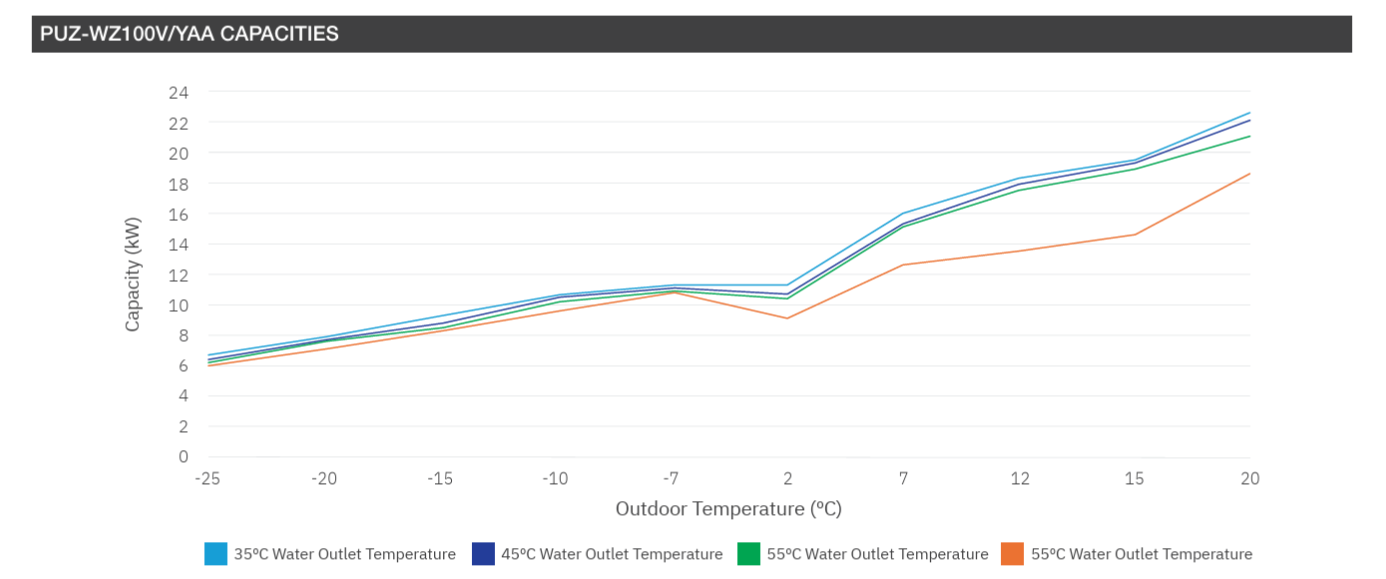
I didn't spot it immediately, to my shame, but when I finally spotted that they'd applied varying scaling to the x-axis it created a determination to find something better than this, which took a bit more time, as simple google searching doesn't bring it up. Eventually, I did a click by click navigation into the Mitsubishi Ecodan website, read each of the end user documents and discovered nothing new, before finally navigating into the 'for installers' section and finding the relevant databook for my model. This finally did provide some useful information, and a really enlightening insight as to what the system can and can't be expected to do.
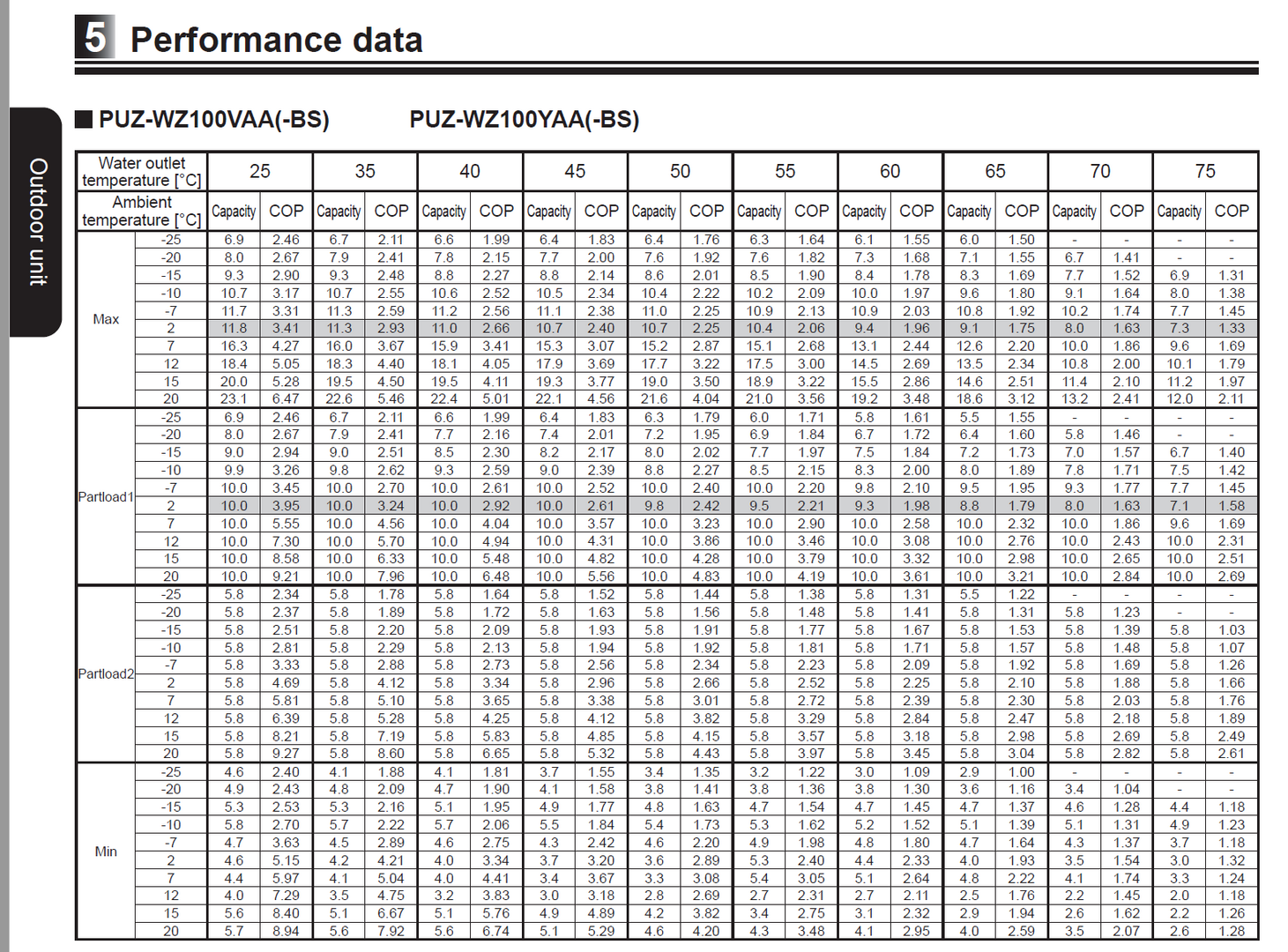
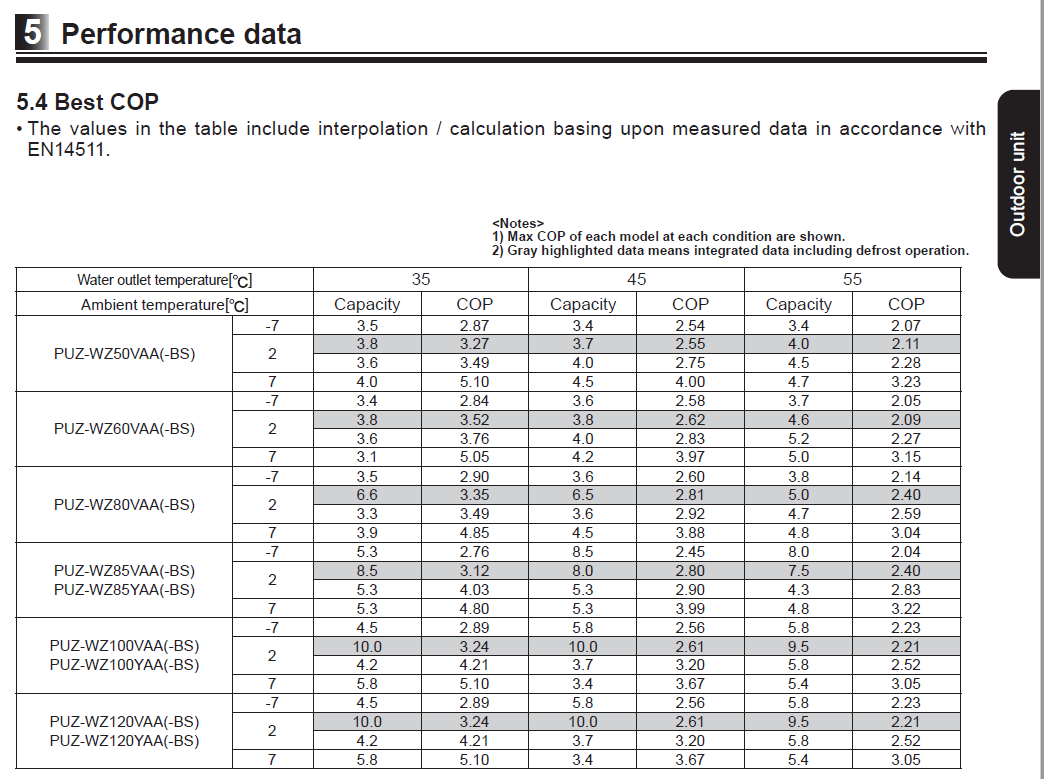
The first data table in particular is one that I keep looking at and discovering new things. Depending on the outside air temperature, the 10kW heat pump is actually a 6.9-23.1kW heat pump (which is actually reassuring to learn that it can still kick out 6.9kW of heat output at -25°C) and that operating range, from memory, is one of the better profiles I've seen, which is what I would have hoped for from an R290 pump.
However, the bit that really fascinated me was the CoP information that is provided alongside it, which essentially shows what CoP's are achievable by the heat pump in lab tested conditions under various testing scenarios, which then required searching out EN14511 information to figure out what Partload1 and Partload2 actually referred to.
What is immediately striking to me is quite how many datapoints in the table, even at low flow temperatures, show a laboratory tested CoP beginning with a 2, rather than a 3 or 4, and seeing it has provided me with an actual frame of reference by which I can realistically judge my own real-life system scores, taking into account that I'm running a system that feeds from ground level, through pipework in the loft, to a plant room in the centre of the house at 1st floor level which was the site of the original water cylinder, and the logical location of the new one. This then supplies heating on a single zone which includes a, much improved conservatory area, efficiency-wise, but one that still has 17m^2 of glazing in it.
It's also interesting to see the measured impacts when anti-freeze protection starts to kick in at 5°C and below, given that much of the data I've been observing in recent weeks has been at around these temperature levels, as well as the milder temperatures seen in the last couple of weeks or so.
Ultimately, going to all this effort has given me a proper frame of reference by which I can judge my installation and, as noted in the previous post, I'm now increasingly content that the specifics of the property and system design are the key factors behind the data I'm seeing been reported, rather than anything more fundamental. It has also enabled me to set more realistic goals in terms of the scope of any improved efficiencies I can generate directly.
I'm posting this as something of a cautionary tale for other inexperienced heat pump users, like myself, to ensure that you have a proper reference point by which to judge whether your systems are performing well or not.
And here endeth the lecture for today. I think I'll treat myself to Pan Galactic Gargleblaster to celebrate!
130m2 4 bed detached house in West Yorkshire
10kW Mitsubishi Ecodan R290 Heat Pump - Installed June 2025
6.3kWp PV, 5kW Sunsynk Inverter, 3 x 5.3kWh Sunsynk Batteries
MyEnergi Zappi Charger for 1 EV (Ioniq5) and 1 PHEV (Outlander)
User of Havenwise (Full control Jun-Dec 2025, DHW only from early Dec)
Subscriber to MelPump App data via CN105 Dongle Kit
Page 10 / 10
Prev

Latest Posts
-
Struggling to get CoP above 3 with 6 kw Ecodan ASHP
I've been using this heatpump for two winters now and a...
By GoodbyeGas , 8 minutes ago
-

RE: Humidity, or lack thereof... is my heat pump making rooms drier?
That would make sense. I've found the effects are prett...
By Majordennisbloodnok , 18 minutes ago
-

RE: Testing new controls/monitoring for Midea Clone ASHP
@benson — as @tasos suggests, plotting multiple variabl...
By cathodeRay , 1 hour ago
-
@painter26 — as @jamespa says, it's for filling and re-...
By cathodeRay , 2 hours ago
-

RE: Oversized 10.5kW Grant Aerona Heat Pump on Microbore Pipes and Undersized Rads
@uknick TBH if I were taking the floor up ...
By JamesPa , 13 hours ago
-
RE: What determines the SOC of a battery?
@batpred Your BMS parameters will be the same as m...
By Bash , 14 hours ago
-

RE: Getting ready for export with a BESS
I would have not got it if it was that tight
By Batpred , 15 hours ago
-
RE: Setback savings - fact or fiction?
I also need to correct something I said by mistake earl...
By cathodeRay , 15 hours ago
-
RE: Electricity price predictions
@judith Thanks for sharing, and nice to see how the ...
By Batpred , 16 hours ago
-
RE: Need help maximising COP of 3.5kW Valiant Aerotherm heat pump
@judith thanks Judith. Confirmation appreciated. The ...
By DavidB , 18 hours ago
-
RE: Recommended home battery inverters + regulatory matters - help requested
That makes sense. I thought better to comment in this t...
By Batpred , 19 hours ago
-
Bosch CS5800i 7kW replacing Greenstar Junior 28i
My heat pump journey began a couple of years ago when I...
By Slartibartfast , 19 hours ago
-
RE: How to control DHW with Honeywell EvoHome on Trianco ActiveAir 5 kW ASHP
The last photo is defrost for sure (or cooling, but pre...
By JamesPa , 20 hours ago
-
RE: Plug and play solar. Thoughts?
Essentially, this just needed legislation. In Germany t...
By Batpred , 21 hours ago
-
RE: A Smarter Smart Controller from Homely?
@toodles Intentional opening of any warranty “can of wo...
By Papahuhu , 22 hours ago
-
RE: Safety update; RCBOs supplying inverters or storage batteries
Thanks @transparent Thankyou for your advic...
By Bash , 23 hours ago
-
RE: Air source heat pump roll call – what heat pump brand and model do you have?
Forum Handle: Odd_LionManufacturer: SamsungModel: Samsu...
By Odd_Lion , 23 hours ago
-
RE: Configuring third party dongle for Ecodan local control
Well, it was mentioned before in the early pos...
By F1p , 2 days ago
-
RE: DIY solar upgrade - Considering adding more panels
I know this is a bit old, but it made me wonder what co...
By Batpred , 2 days ago
-

RE: New Vaillant aroTherm Plus in black - When will it come to the UK?
@majordennisbloodnok Daikin, take note! (In fact, I hav...
By Toodles , 2 days ago
-
RE: Midea ASHP – how to set weather compensation
@mk4 — good work! First, I agree, no evidence of cycl...
By cathodeRay , 2 days ago
-

RE: Solis inverters S6-EH1P: pros and cons and battery options
I don't know about Solis inverters. It isn't a featur...
By Transparent , 2 days ago
-
Daikin Altherma 3 H HT - Freeze Prevention Threshold
Hi. We have an Altherma 3 HT (18kW I think) which, now ...
By RICHARDF5033 , 2 days ago