
Notifications
Clear all
03/03/2026 9:09 am
And I agree, the site below seems less credible than the manual, but it makes much more sense! Here is also a screenshot of the relevant extract.
I think it is just another Grundfos manual on one of those manuals.lib sites, the wording in the description is all but the same. It is a slightly different pump, the UPM3 Hybrid rather than the UPM3 Auto. I think one difference is the former has a PWM capabilities, the latter (mine) does not.
Frankly I find it impossible to take seriously the literature of a company that starts its UPM3 Auto 'Quick Guide' with an 'advisory' that 8 year olds, the blind, the deaf, the neuropathic, and not to mention the physically and mentally infirm, can all use the pump so long as they are 'given supervision or instruction':

As I said a while back, these manuals are written by AI bots running on chips a few capacitors short of a full circuit. Finding a 'performance curve' for a particular Grundfos pump makes finding a needle in a haystack look easy but at long last I think I have found one:
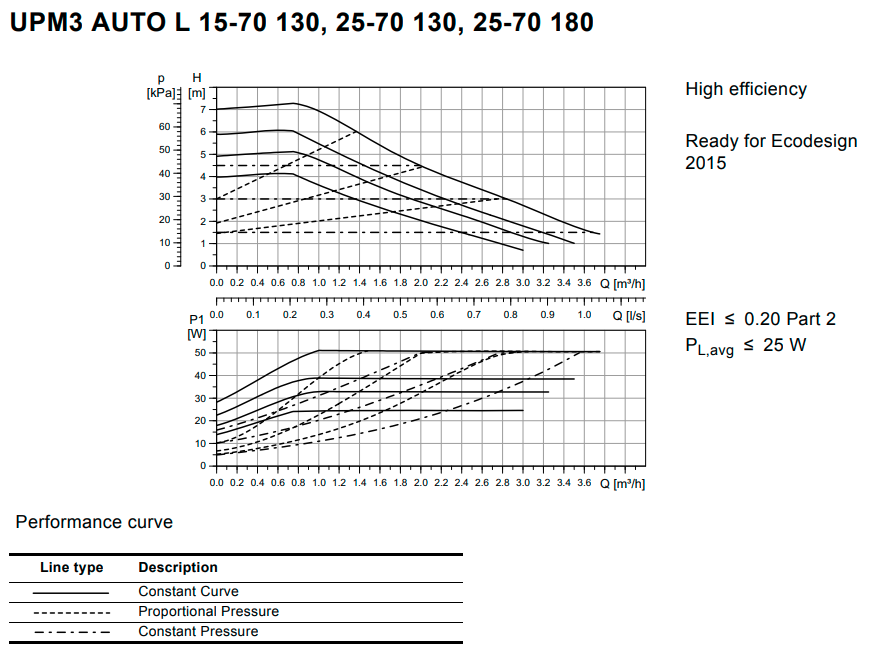
This too is as clear as mud. I am sure it is good to know that apropos of nothing, EEI ≤ 0.20 Part 2, and furthermore, that PL,avg ≤ 25 W. These are the kind of nuggets of information that help me get through my day. Elsewhere it says there are three 'CC' ('constant curve') settings, the chart has four CC lines, all showing varying speeds for a pump that runs at a constant speed. Without better labelling and explanation, that chart is nothing more than a waste of space.
However, all is not lost! I went back to a previous thread, the one that led to 'big bang' ie opening up all my lock shield valves, as a way to improve secondary flow, and was reminded of a post by the excellent @bobtskutter that it is in fact possible to calculate the secondary flow, given primary and secondary delta t and primary flow rate:
How did I calculate the secondary flow rate?
If you ignore energy accumulation within the metal work of the PEX and assume the same fluid on both sides with no phase change:
Energy reduction on hot side = Energy increase on cold side
Energy = M x Cp x DT
Energy_hot = Energy_cold
M_hot x Cp x DT_Hot = M_cold x Cp x DT_cold
Therefore:
M_cold = M_hot x DT_Hot / DT_cold
If I assume the fluid is water then density = 1, so:
flow_cold = flow_hot x DT_Hot / DT_ColdYour most recent data doesn't have a primary side flowrate, so I'll assume it's 1.5m3/hr, which seems a typical number in the data you've posted so far. The temperatures you've measured are repeatable - you've recorded roughly the same temperature 5 times. So I'll use the average value of the temperatures.
1.5 x 5 / 4 = 1.875m3/hr
The secondary flow is equal to the primary flow multiplied by the primary delta t divided by the secondary delta t. I already know the primary flow and delta t, all I need to do is manually measure the secondary delta t, and I can calculate the secondary flow.
The only problem is my heat pump's primary delta t is rarely constant. Nonetheless, the next time I get steady state running (OAT ~6-8°C), I can measure the secondary delta t and calculate the secondary flow rate. If the secondary delta t stays constant, then that must also means the secondary flow rate is constant.
What might happen to the secondary flow rate and secondary delta t when the unit is running in normal Midea cycling mode is at the moment beyond me, beyond a vague thought that if the secondary flow rate is constant, then the secondary delta t must do a merry dance to keep up with the changes in the primary delta t.
Since constant speed has basically no brains, if some TRVs close, the pump doesn't slow down, so the other still open TRVs get more flow.
Thanks. I am clear the pump has no brains, constant speed means constant speed. In a two rad system as shown, if one rad is shut down, the other gets twice the flow. But my system is totally open, all valves (TRVs and lock shields) all fully open all the time. Presumably this implies constant steady flow at the pump all the time, albeit with different flows in different branches of the circuit depending on the branches relative resistance? And this in turn means the secondary delta t must do a merry dance, as described above?
Midea 14kW (for now...) ASHP heating both building and DHW

03/03/2026 9:18 am
And this in turn means the secondary delta t must do a merry dance, as described above?
Yest exactly that. Many heat pumps (including, so far as I can, tell mine) run on constant pump speed (even if they have a water pump that is capable of modulating) and this means that the deltaT will vary depending on the load. As yet I haven't seen here a coherent argument that this is a problem.
As it happens this means that, for radiators at any rate, a straight-line WC curve is closer to the theoretical ideal having regard to the non linear relationship between radiator output and deltaT rad-room. So there is an argument that fixed flow is actually a good thing. Another argument is that fixed flow results in the need for slightly lower flow temperatures at low load. The counter argument is higher consumption by the water pump. For very low loss properties this could be significant, for properties with a more typical loss (say 6kW up) rather less so.
This post was modified 21 hours ago by JamesPa
4kW peak of solar PV since 2011; EV and a 1930s house which has been partially renovated to improve its efficiency. 7kW Vaillant heat pump.
03/03/2026 9:35 am
And this in turn means the secondary delta t must do a merry dance, as described above?
Yest exactly that. Many heat pumps (including, so far as I can, tell mine) run on constant pump speed
Don't forget that here I am talking about the secondary pump. But I think the argument still applies, the secondary delta t has to do a merry dance to keep up with the primary delta t merry dance.
Midea 14kW (for now...) ASHP heating both building and DHW
03/03/2026 9:56 am
And this in turn means the secondary delta t must do a merry dance, as described above?
Yest exactly that. Many heat pumps (including, so far as I can, tell mine) run on constant pump speed
Don't forget that here I am talking about the secondary pump. But I think the argument still applies, the secondary delta t has to do a merry dance to keep up with the primary delta t merry dance.
I know and yes.
The secondary deltaT wont necessarily keep up with the primary deltaT because that will depend on what the pumps are doing, but it is determined by the exact same physics as the deltaT on a system without a buffer ie deltaT=heat lost from rad/(flow rate*specific heat capacity).
4kW peak of solar PV since 2011; EV and a 1930s house which has been partially renovated to improve its efficiency. 7kW Vaillant heat pump.
Page 5 / 5
Prev

Latest Posts
-
RE: Connecting Growatt SPH5000 over wired ethernet rather than wireless
The simplest wired option is usually the Growatt Ethern...
By Jonatan , 3 hours ago
-

RE: Peak Energy Products V therm 16kW unit heat pump not reaching flow temperature
ASHPs do have a minimum compressor speed. The minimum h...
By bobflux , 10 hours ago
-

RE: Electricity price predictions
@jamespa And it seems some of the nasty public cloud...
By Batpred , 10 hours ago
-
@bobflux My apologies, they somehow were removed in ...
By Ubert767 , 10 hours ago
-
RE: Tell us about your Solar (PV) setup
Location: near Lyon, France 12kWp on the roof, 2x Sol...
By bobflux , 11 hours ago
-

RE: Jokes and fun posts about heat pumps and renewables
Technology is rapidly advancing. BBC News reported th...
By Transparent , 14 hours ago
-
What matters for flow and pressure drop is internal dia...
By bobflux , 14 hours ago
-

RE: Do Fridges and Freezers have COP ratings?
@editor Thank you all for your replies and submitted in...
By Toodles , 17 hours ago
-
I know and yes. The secondary deltaT wont necessaril...
By JamesPa , 20 hours ago
-
RE: Designing heating system with air to water heat pump in France, near Lyon
Just love the way you put it! 🤣
By Batpred , 1 day ago
-
RE: Safety update; RCBOs supplying inverters or storage batteries
Thank you for sharing. So it seems that your Schneid...
By Batpred , 1 day ago
-

RE: Forum updates, announcements & issues
@upnorthandpersonal thanks for the thoughtful, consider...
By Mars , 2 days ago
-
RE: Solar Power Output – Let’s Compare Generation Figures
@mk4 All 21 panels have their own Enphase IQ7a microinv...
By Toodles , 2 days ago
-
RE: Setback savings - fact or fiction?
Great, so you have proven that MELCloud is consistently...
By RobS , 3 days ago
-
RE: Mitsu PUHZ120Y 'Outdoor Temp 'error?
Thanks David & James It almos...
By DavidAlgarve , 3 days ago
-
RE: Surge protection devices SPDs
@trebor12345 - your original Topic about the right type...
By Transparent , 3 days ago
-
RE: Help needed with Samsung AE120RXYDEG
@tomf I’ve been sent this from a service engineer at Sa...
By Mars , 3 days ago
-
RE: Buying large amp bidirectional RCD and RCBO
Yes... I went through this particular headache and ende...
By bobflux , 4 days ago
-
O-oh! Let's take this as an opportunity to 'pass the ...
By Transparent , 4 days ago
-
RE: Homely setup on daikin heat pump
@craigh I refer to our somewhat elevated temperature of...
By Toodles , 4 days ago
-
RE: Air source heat pump roll call – what heat pump brand and model do you have?
My turn, this describes the future installation, only t...
By bobflux , 4 days ago
-
RE: Say hello and introduce yourself
@liam-dr, I’d like to echo James’ welcome, and we look ...
By Mars , 4 days ago