Joining the Renewable Heating Hub forums is completely free and only takes a minute. By registering you’ll be able to ask questions, join discussions, follow topics you’re interested in, bookmark useful threads and receive notifications when someone replies. When choosing your username, please note that it cannot be changed later, so we recommend avoiding brand or product names. Before registering, please take a moment to read the Forum Rules & Terms of Use so we can keep the community helpful, respectful and informative for everyone. Thanks for joining!
Help me keep the faith with my air source heat pump installation
if im running effectively a higher curve it should lower the scop not keep it nearly the same.
You would expect so but don't forget cop varies with oat also. Also depends on how long you are averaging over. My 24 HR cop is now down to 3.4, but the 7 day cop is still 3.8. What's your 24hr cop as shown in the app? Your ft is a bit higher than mine so it may be a bit less.
This post was modified 4 months ago 3 times by JamesPa
4kW peak of solar PV since 2011; EV and a 1930s house which has been partially renovated to improve its efficiency. 7kW Vaillant heat pump.
OK. I have 2.8 for DHW and 3.4 for space heating running at an actual FT of about 36. Yours does seem a bit low depending on what FT you were running at. I do run in NR mode for 7 hrs which has the effect of capping compressor modulation (and output - the house suffers a slight temperature drop ) but Im not sure that would account for it. Is there anything in your setup that might be restricting things (eg restricted airflow, restricted water flow)? Measured at the heat pump itself there is not a lot than can distort the figures.
4kW peak of solar PV since 2011; EV and a 1930s house which has been partially renovated to improve its efficiency. 7kW Vaillant heat pump.
@jamespa no airflow problems definitely. primaries 28mm, got a few bends. flow and return to about half the rad back bone 28mm. other half fed from two T's on the end of the 28mm F+R which runs in 22mm. then 15mm to rads. quite a long run to last rad, from heat pump to rad maybe 25m, but still gets heat.
when the strainers are clean and i run the pump test at 100% get 1500+ l/h. i generally know when things are getting blocked as the pressure on the app swings between 1.5bar and as low as 0.7 bar depending on if the pump is running.
i do wonder if maybe they short filled the compressor maybe?
@jamespa no airflow problems definitely. primaries 28mm, got a few bends. flow and return to about half the rad back bone 28mm. other half fed from two T's on the end of the 28mm F+R which runs in 22mm. then 15mm to rads. quite a long run to last rad, from heat pump to rad maybe 25m, but still gets heat.
when the strainers are clean and i run the pump test at 100% get 1500+ l/h. i generally know when things are getting blocked as the pressure on the app swings between 1.5bar and as low as 0.7 bar depending on if the pump is running.
i do wonder if maybe they short filled the compressor maybe?
It does feel like you may have a genuine fault, unfortunately perhaps not bad enough to convince the manufacturer easily.
Id be tempted to collect some data at specific temperatures etc that can be directly compared (as best as possible) with the manufacturer specs and then (a) see if anyone on the Vaillant owners thread on Openenergymonitor can comment (they have gone a long way into how the machine works on there) or (b) Vaillant will come out.
4kW peak of solar PV since 2011; EV and a 1930s house which has been partially renovated to improve its efficiency. 7kW Vaillant heat pump.
Hi I see you posted on openenergymonitor, this in particular
house is 1967 3 bed extended over the garage in 2005 to 4 bed then garage changed to room this year, 125m2 aprox. cavity wall with mix of 1980’s poly beads/rockwall. aprox 300mm loft. double glazing. 4kwp solar PV. given B epc before heat pump was installed.
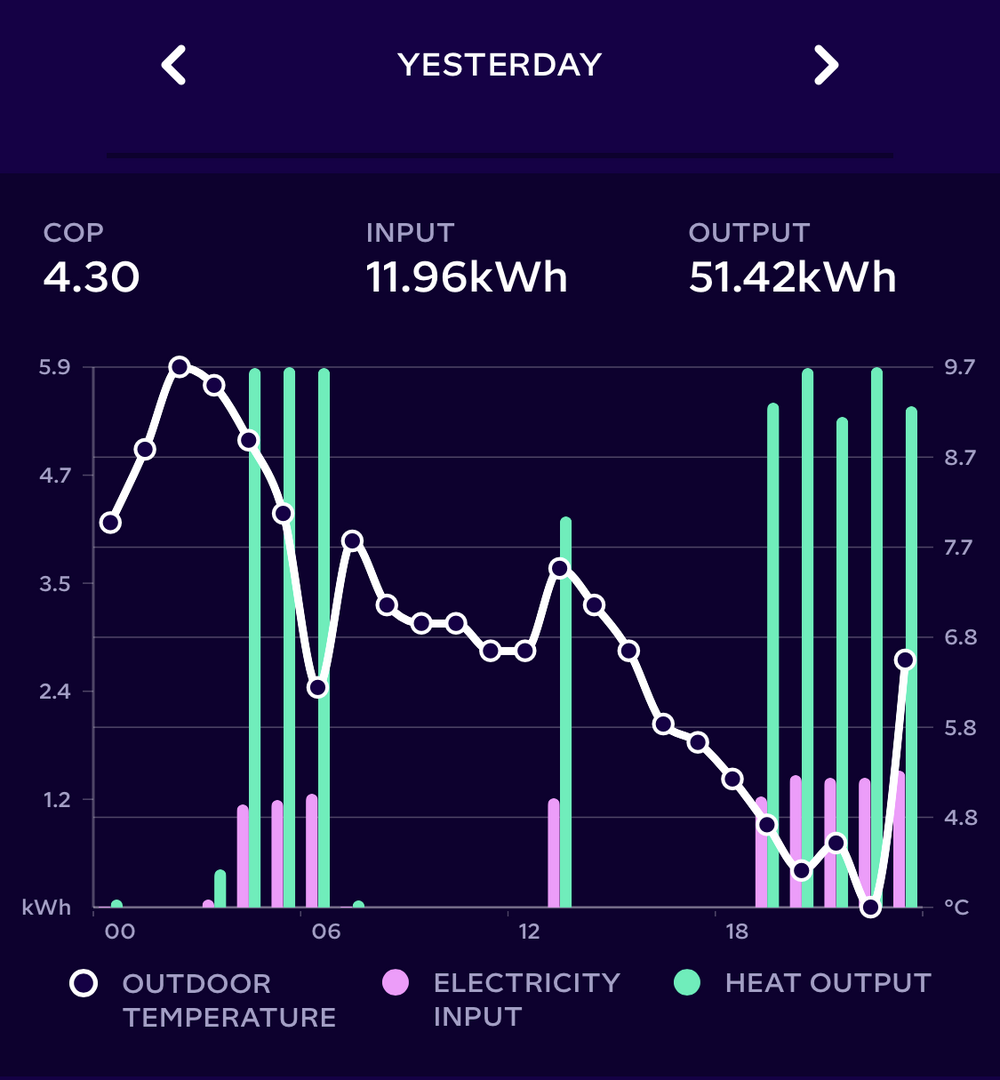
i dont have energy monitor but Vaillant app on detailed view says 20th November 0.8c outside, 20.4c inside, and 27.1kwh electric for the heating only.
FWIW the consumption for my 7kW house was 32kWh, so if yours is genuinely about 7kW then very similar. My concern is that 7kW seems a bit high for 125sq m given the construction, so wondering if house is actually 7kW. I agree with your thought that flow and return sensor errors would affect both DHW and space heating, so something not quite stacking up yet!
4kW peak of solar PV since 2011; EV and a 1930s house which has been partially renovated to improve its efficiency. 7kW Vaillant heat pump.
The engineer came yesterday and as the rooms were ok temp wise said didn’t need balancing. So nearly all rads still wide open.
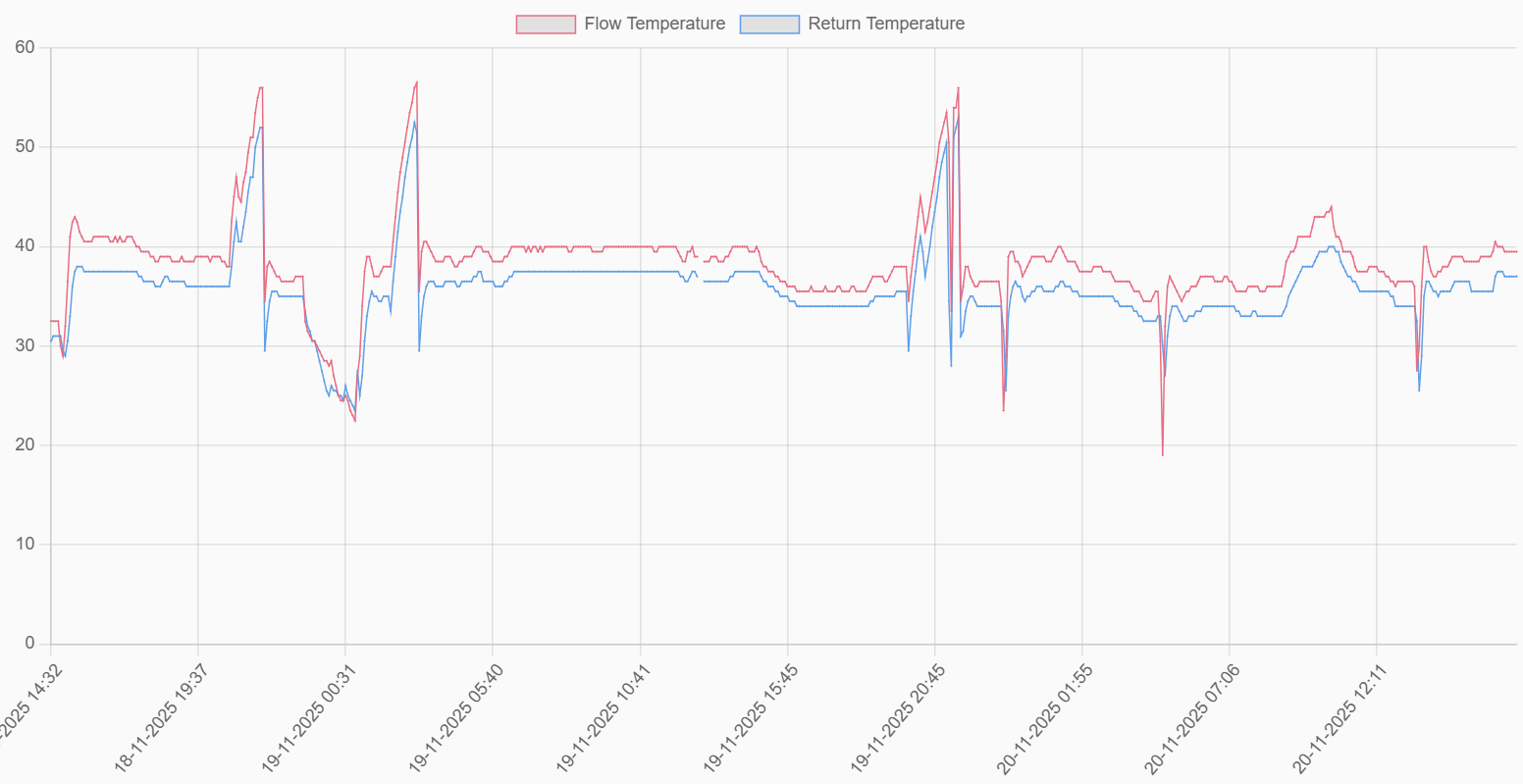
has tried a fixed circulation pump speed rather than auto as Havenwise were concerned my dt on the hp is only 2c.
looked this morning and doesn’t seem to have helped. Think even with my bad back I’m going to have to have a go at this myself. I wonder if the water is returning to the hp too quickly.
looked this morning and doesn’t seem to have helped. Think even with my bad back I’m going to have to have a go at this myself. I wonder if the water is returning to the hp too quickly.
If the house is heating up I wouldn't worry about low deltaT. Lower is more efficient, at least up to the point where the power consumption of the water pump starts to become significant, which is likely only with low loss houses.
Low DT would also stack up with house loss being less than the design value, but it would also stack up with faulty sensor (assuming DT is as measured by the heat pump)!
Lets just make sure we dont lose sight of the actual 'problem' which, as I recall, is low SCOP for space heating. As discussed on openenergymonitor this could be a sensor problem. Are you able either (a) independently able to measure flow and return temp or (b) willing to dive inside the odu and swap the sensors and their connections. Only doing these is going to eliminate or confirm if the problem actually exists
This post was modified 3 months ago 2 times by JamesPa
4kW peak of solar PV since 2011; EV and a 1930s house which has been partially renovated to improve its efficiency. 7kW Vaillant heat pump.
@jamespa so the potential for the water to short circuit through a rad wouldnt affect the scop? one guy on FB said if most of the lockshields and trv are wide open the water will just whizz round and back to the HP.
@jamespa so the potential for the water to short circuit through a rad wouldnt affect the scop? one guy on FB said if most of the lockshields and trv are wide open the water will just whizz round and back to the HP
In short, like much on FB, this is nonsense.
The amount of heat lost by the radiators to the room (which is what you care about) depends on the average surface temperature (essentially the flow temperature) not flow rate.
There is a small influence from flow rate, a higher flow rate means a lower DT which means that, at any given ft from the heat pump, the average rad surface temp will be higher. Thus in principle it's most efficient to operate at the highest flow rate/lowest DT possible. Of course there is a trade off with water pump consumption and pipe noise etc, which is why we typically design for a dt of around 5 at which point the benefit of operating at a lower dt/higher flow rate becomes relatively small. However this isn't critical and if dt is lower or even a bit higher it's nothing to worry about.
If one rad is taking all the flow then others will be deprived of water and won't get warm. That's why we balance.
Throttling flow overall by turning down all lsvs is just madness, it's introducing resistance for no reason. In the unlikely event that flow is too high (and, for example, causing excessive noise in the pipework) the solution is to reduce the water pump speed so long as that doesn't push dt up too much.
Hope that helps, people all to often get confused about this because they concentrate first on the mass flow equation (energy transfer proportional to flow rate x DT) rather than the rad output which depends on flow temp. The easiest way to avoid getting confused is to think of dt as a result of rad output and flow rate, not a determinant of same.
4kW peak of solar PV since 2011; EV and a 1930s house which has been partially renovated to improve its efficiency. 7kW Vaillant heat pump.