

Notifications
Clear all
Joining the Renewable Heating Hub forums is completely free and only takes a minute. By registering you’ll be able to ask questions, join discussions, follow topics you’re interested in, bookmark useful threads and receive notifications when someone replies. Non-registered members also do not have access to our AI features. When choosing your username, please note that it cannot be changed later, so we recommend avoiding brand or product names. Before registering, please take a moment to read the Forum Rules & Terms of Use so we can keep the community helpful, respectful and informative for everyone. Thanks for joining!

Topic starter
03/11/2023 9:36 am
@derek-m Good work! I will try to take a look over the next few days. Im presuming its a linear WC curve defined by the figures in K5/6. If that's not the case perhaps you could explain.
What I cant quite get my mind around is that your previous version had variable flow temperatures as well, which were related to the load amongst other things. Although you explained that this had the effect of modelling the emitter actual demand, I was never quite sure how it worked. Perhaps you could just clarify the logic of how you work this out ie the steps taken to get from the various variables to the flow temperature and energy delivered in any one period. I can follow some of it but the length of the formulae, on which I congratulate you, makes it quite challenge to reverse engineer!
4kW peak of solar PV since 2011; EV and a 1930s house which has been partially renovated to improve its efficiency. 7kW Vaillant heat pump.
Topic starter
03/11/2023 9:50 am
@josephiah For what its worth modelling done completely independently by @derek-m and me, and using completely different approaches, tends to suggest that setback may be more likely to save money (if at all) when the OAT is moderate, than when its really cold. Its also (obviously) more likely to yield a comfortable result when the OAT is moderate than when its cold.
This assumes that the house cool down time is fairly long (half a day or more); a house with a very low thermal mass would defeat this (very tentative) conclusion.
So your tentative real world data tends to support the modelling output and, for once, comfort and cost-saving probably tend towards adopting the same behaviour.
Our house is occupied during the day and, for the past couple of years, in prep for fitting a HP, I've been running my gas boiler, on which I have limited the the max o/p at 8.5kW (as opposed to 28kW which it is capable of) and the FT to 50/55 as follows:
a) 24x7 when its really cold
b) 6am-10pm in the shoulder season
c) 6am-8am and 4pm-10pm at the ends of the season
Altogether leading to a really comfortable result, much more comfortable than my previous regime with high temperature radiators and timed operation even during the very cold periods. So far as I can tell consumption has dropped not increased, although I suspect this is due to reducing FT so that it actually condenses as its supposed to!
I have a growing feeling a-b (or similar) may well be the way to operate a HP in my house also, once my District Council finally stops getting in the way of me fitting one!
4kW peak of solar PV since 2011; EV and a 1930s house which has been partially renovated to improve its efficiency. 7kW Vaillant heat pump.
1
03/11/2023 10:03 am
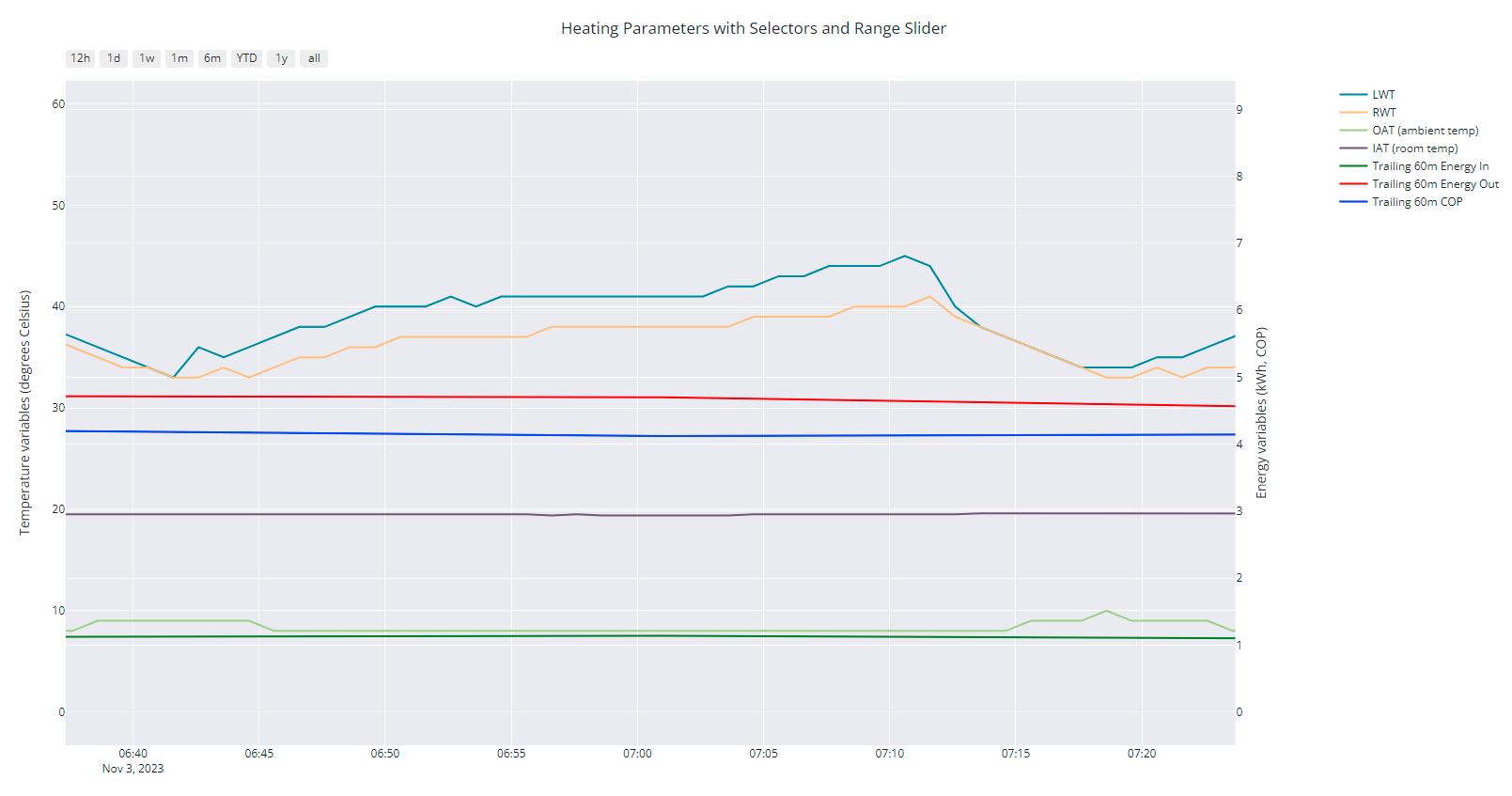
Anatomy of a cycle: here is a single cycle from my heat pump, from around 0640 to 0720 this morning. This has been the pattern for the last few days, just under two cycles per hour. In addition, the LWT/RWT delta t is less than 5 degrees. I presume both, the cycling and the lower than expected delta t, are the heat pump's way of reducing output to match low demand. Each 40 minute cycle has four roughly 10 minute phases, (1) initial ramp up, (2) steady state, (3) another unexplained ramp up and (4) cool down. I am still baffled by the second ramp up - why not stay at steady state once it has got there?
Once again, the effect of the compressor running/not running on the OAT can be seen, as the OAT rises a degree or two when the compressor is off during phase 4, the cooling down phase.
The energy in and out are remarkably steady during the whole cycle (ie no hills and valleys) but I think this is most likely an artefact of the way I record the data. The temp readings are recorded every minute, but the energy readings are only determined every hour, that is, once an hour, the amount of energy in and out is calculated for the preceding 60 minutes. This means the minute by minute energy in and out could vary substantially, but we never see that, instead, we just see the average over the hour. I did it like that because the idea of a minute by minute COP seemed at the time rather absurd, but in fact it may not be. I will see if I can tease out minute by minute energy in and out (and COP) and then chart that.
The thing is, a cycle is a hill and valley pair - ie a setback and recovery boost. We may already have the experiment running under our very noses. More later...
Midea 14kW (for now...) ASHP heating both building and DHW
1

03/11/2023 10:14 am
It would be useful to see the real-time energy going into the pump from a Watt meter, it might show something. I attach one of mine below, mine also cycles about twice an hour until the OAT gets below about 6C, this charg shows a couple of cycles and a longer run, but the minute-by-minute energy of the pump is interesting.

I should add that it's in full weather comp mode against full house flow with no thermostats atm, the flow temp settings calculated by s/sheet are below, I have no idea why the pump chooses in some cases to cycle and others to run on, there's clearly something going on in its internal algorithms but I have seen other comments from other Ecodan users that this kind of cycling with very short off-times as the pump gets towards fully-on runtimes/OATs is not unusual. Our pump (PUZ 11.2) is slightly oversized for the house, but we intend some building work so live with that for now.


03/11/2023 10:25 am
@rod - I do have a separate third party kWh meter that supplies only the heat pump but maddeningly it is not modbus enabled, meaning I can only get readings manually, and I draw the line at standing on steps reading the damn thing every minute for an hour! However, I have established that my modbus derived and then calculated kWh/energy in values are pretty close to the separate meter values, at least over longer time frames (one hour or more). The minute data does have everything needed to calculate energy in and out every minute, and I am doing that at the moment, and will post the results once I have them.
Midea 14kW (for now...) ASHP heating both building and DHW
03/11/2023 10:30 am
I use one of these with the device in a fused-spur surface-mounted box next to the consumer unit, and the sensor clamp around the live to the pump in the consumer unit - my pump has a dedicated circuit. Could be put around the live anywhere, it's wifi enabled and gets picked up by Home Assistant to do the monitoring.
https://shellystore.co.uk/product/shelly-em-2x50a/
03/11/2023 11:19 am
Here are the minute by minute energy values alongside the minute by minute temp values I posted earlier. Note they are Wh, not kWh, and, as a sanity check, I summed the values over the entire 44 minute period and got 762 Wh in and 3055 Wh which equates to 1.04 kWh in and 4.17 kWh (and a COP of 4.01) over the hour which are consistent with the hourly values shown in the earlier chart. MD02_tmp is the room temp:

Interestingly, the first ramp up isn't associated with a disproportionate increase in energy use (energy in). In fact, it (energy in) is pretty stable throughout the on phase, while the energy out rises a bit during the on phase, suggesting a slight increase in efficiency over the on phase (which I suppose could also be worded as it starts off a bit less efficient). But, overall, as I see it, nothing world shattering to see here, no obvious cycling penalty.
Midea 14kW (for now...) ASHP heating both building and DHW
1

03/11/2023 11:46 am
I suspect that the second increase in LWT occurs after your heating system and heat emitters are fully up to temperature, hence the RWT starts to increase which in turn pushes up the LWT.

03/11/2023 12:11 pm
I suspect that the second increase in LWT occurs after your heating system and heat emitters are fully up to temperature, hence the RWT starts to increase which in turn pushes up the LWT.
That sounds very plausible, except for the fact the LWT rise appears to start just before the RWT rise, see at around 0703h. The four phase pattern is ubiquitous at the moment, here is another random selection from late October, and again the LWT starts just before the rise in RWT in two of the three cycles (in the other, the left hand one, they change at the same time). That said, we are relying on the Midea sensors being spot on...

Midea 14kW (for now...) ASHP heating both building and DHW
03/11/2023 1:58 pm
We have some towel rail radiators which are connected directly to the HP flow/return and mixing valves ar the underfloor manifolds - I would expect that the returning water temp would climb pretty fast as some hot water will not have far to go before coming back to the pump. This would then be followed by water passing through different parts of the UFH system and contribute to phased rises as each one pushes out the colder water and returns the new warmer flows.
Possibly contributing?
03/11/2023 2:01 pm
Hi James,
You are indeed correct, the WC 'curve' is a straight line calculation based upon the values in cells I5 and I6 and K5 and K6.
Energy Demand : This is calculated from the standard heat loss as set in Initial Data and the temperature difference between IAT and OAT.
Energy Supply : This is an awkward one to calculate since it needs to limit the value when the heat pump reaches maximum output and cannot go any higher. Whilst the heat pump is operating within its normal range, energy supply is a measure of how much thermal energy the heat emitters can accommodate at the given LWT. It also takes account of changes in Delta T and variations in IAT, such that as IAT increases, the heat emitters can dissipate less thermal energy for a given LWT. The problem was trying to limit the maximum value of energy supply, since this varies with LWT and OAT, so in the end I took the simple solution of only calculating the limit for the energy supply, when energy demand exceeded 14000W. This approach works okay unless the OAT is above -4C, and a large positive WC offset is applied when energy demand is below 14000W. If you can think of a solution I will be 'all ears'.
Duty Cycle : This is a measure of when the energy supply falls below the minimum continuous output of the heat pump, so will likely start to cycle.
PI (Power Input) : This is derived by dividing the energy supply value by the COP value.
LWT : This is calculated from the WC curve values and the WC offset.
COP : This is obtained from the Detailed Data tables via the Lookup Table and the Intermediate Table and should be the value at the given LWT and heat pump loading.
Building Thermal Capacity : This was added to investigate how different thermal masses could affect how a system responds. The effect is seen in the Actual IAT (finish) calculation, where the change in energy balance affects the IAT.
Obviously the green highlighted cells are the ones that can be varied.
One thing that became apparent is that although the WC curve may be linear, the actual response in thermal energy output is not. I believe this due to the fact that the thermal energy output of the heat emitters is not linear, so although LWT may change linearly with OAT, the quantity of thermal energy being supplied is not linear. I adjusted the WC curve settings to be balanced at 0C and 15C, but this balance is not maintained at other OAT values. I would welcome your thoughts if my assumptions are correct.
Topic starter
03/11/2023 2:13 pm
I believe this due to the fact that the thermal energy output of the heat emitters is not linear, so although LWT may change linearly with OAT, the quantity of thermal energy being supplied is not linear. I adjusted the WC curve settings to be balanced at 0C and 15C, but this balance is not maintained at other OAT values. I would welcome your thoughts if my assumptions are correct.
I can respond to this straightaway as I played around it when I did my WC simulation model (a very focussed model designed to test that one thing only - attached).
As you say the 'ideal' WC (with rads) is not linear and a linear WC will lead to slight mismatches in output vs demand. In my model I looked at several variants on possible linear and non linear wc curves, to see if they made much difference (answer - a percent or two in energy use). You can see the variants in the tables. A 'best fit' linear approximation is one of the options, as is that jacked up by a degree or two to ensure that the house is always warm enough.
Oddly enough this is where HPs that do not modulate the flow rate for constant delta T may be slightly better. Linear WC with constant flow rate' is a bit closer to the 'ideal' weather compensation curve than is 'Linear with fixed delta T'.
Thanks for the explanation, very helpful, I will give it a look over and try some breaking tactics.
4kW peak of solar PV since 2011; EV and a 1930s house which has been partially renovated to improve its efficiency. 7kW Vaillant heat pump.

SPONSORS

Degrees of Separation

Latest Posts
-

RE: How much of your renewable and home setup would still work if the internet went down?
Another angle to this is how vulnerable it leaves you t...
By scrchngwsl , 16 minutes ago
-
Neso website not critical enough to be brought back up ...
By Batpred , 1 hour ago
-
RE: Indevolt Batteries UK Support & Info Thread
yes, the irrelevance is also that nobody would run anyt...
By Batpred , 2 hours ago
-
RE: How quickly would you want/expect heat recovery to take from setback?
Much longer than that here. The heating isn't even on. ...
By bobflux , 6 hours ago
-
RE: Passiv Smart Thermostat - Help & Forum Support
Obviously the weather is changeable but there's a defin...
By Singlespeed , 6 hours ago
-
RE: Double or Triple Glazed Windows?
It is very comforting to see the condensation on the ou...
By Toodles , 6 hours ago
-
RE: The Changing Jet Stream Could Challenge UK Air Source Heat Pumps
@rob-of-york I must admit that when we had a Daikin hea...
By Toodles , 7 hours ago
-
RE: Forum updates, announcements & issues
Get the Renewable Heating Hub heads-up on WhatsApp. I...
By Mars , 8 hours ago
-
RE: Safety study for plug in batteries out to tender - looks like Q3 2027 at best before legal
@editor I pointed out to the one of the Fuse execs that...
By dansus , 8 hours ago
-
RE: 15kw pump for 225m2 1990's house - over kill?
@seaviews As well as loft insulation, there are othe...
By Rob of York , 10 hours ago
-
RE: BT cuts you off, Plusnet blames Openreach... welcome to “seamless” broadband switching
Both of which (in most cases) use Openreach for the las...
By JamesPa , 11 hours ago
-
RE: Renewables & Heat Pumps in the News
Yes, this is a swiss and german standard I believe, Vai...
By Batpred , 1 day ago
-
RE: Octopus Cosy 12 Heat Pump Regret: Incredibly Loud, Poor Heating & Constant Hum - Help!
@editor FWIW my problem was resolved, eventually, after...
By BigFish , 1 day ago
-
My heating has been off and DHW on throughout the summe...
By DavidAlgarve , 1 day ago
-
RE: Anyone concerned about GivEnergy?
The GivE forum seemed to have survived the collapse of ...
By downfield , 2 days ago





SPONSORS