Joining the Renewable Heating Hub forums is completely free and only takes a minute. By registering you’ll be able to ask questions, join discussions, follow topics you’re interested in, bookmark useful threads and receive notifications when someone replies. Non-registered members also do not have access to our AI features. When choosing your username, please note that it cannot be changed later, so we recommend avoiding brand or product names. Before registering, please take a moment to read the Forum Rules & Terms of Use so we can keep the community helpful, respectful and informative for everyone. Thanks for joining!
I suggested to have a Contactum RCBO and the installer´s anxiety was very clear! Obviously the Hager CU is worth it, to avoid the emergency electricians that he had in the past. And not knowing for sure if the DC leakage is solved, I definitely want to make sure it is in place - we are resigned to add yet another CU to our collection. We kept some old CUs, but clearly this large RCCB comes with a matching Hager CU.
The other topic that we became aware of is that the Arotherm Pro heatpump is still not in the ENA list. I have no idea if the special RCBO that is needed for the current Plus is listed nor whether the Pro will also have it. It reminded me that the DNO step is an application, not a notification. 🤨
8kW Solis S6-EH1P8K-L-PLUS hybrid inverter; G99: 8kW export; 16kWh Seplos Fogstar battery; Ohme Home Pro EV charger; Vaillant Arotherm Pro 7kW; 100Amp head, HA lab on mini PC
And not knowing for sure if the DC leakage is solved,
The issue isn't DC leakage.
Type-B RCDs and RCBOs will trip correctly despite the waveform having a DC component present.
You need the contacts to open when there is a genuine difference of 30mA or more between the AC current being supplied via the Live and returning in the Neutral. A Type-B will do so; ie the DC element is ignored.
The presence of a DC component is usually regarded as an undesirable effect imposed by EV Chargers.
The presence of harmonics is generally associated with heat-pumps.
It seems odd to me that Vaillant have introduced an AC to DC power supply into their ASHPs which is imposing both errors onto the mains incomer to sufficient extent that the company has teamed up with Hager to recommend a particular protection trip. The message it gives to me is "our power supply design isn't good, and we haven't fitted HF filters either!"
Consumers shouldn't be asked to spend £600 having an expensive RCD fitted just because the heat-pump power supply has design deficiencies.
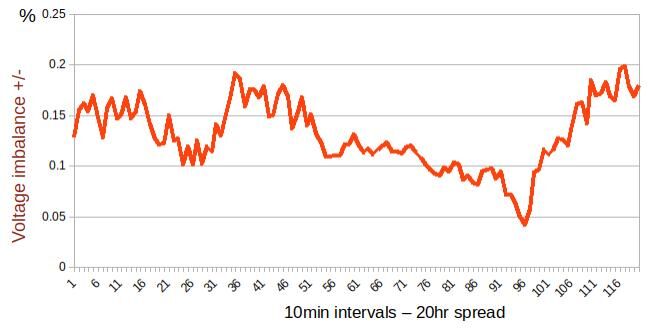
I've created the above timeline from spreadsheet date sent to me by a DNO.
It shows the absolute deviation of voltage imbalances which are being passed through local substations and on to the higher voltages of the Distribution Grid (11kV and above).
Whilst losses due to phase imbalances are substantially occurring only at the local substation level, harmonics pass right through every transformer on the grid. This is what causes the audible hum when you're in the vicinity of larger transformers. That's energy being lost.
It seems odd to me that Vaillant have introduced an AC to DC power supply into their ASHPs which is imposing both errors onto the mains incomer to sufficient extent that the company has teamed up with Hager to recommend a particular protection trip.
...
Consumers shouldn't be asked to spend £600 having an expensive RCD fitted just because the heat-pump power supply has design deficiencies
I agree with your final sentence but where exactly in the Vaillant documentation does it say this. Neither my Vaillant documentation, nor the document @trebor12345 produced, requires an RCD at all. What am I missing?
This post was modified 4 months ago 2 times by JamesPa
4kW peak of solar PV since 2011; EV and a 1930s house which has been partially renovated to improve its efficiency. 7kW Vaillant heat pump.
It seems odd to me that Vaillant have introduced an AC to DC power supply into their ASHPs which is imposing both errors onto the mains incomer to sufficient extent that the company has teamed up with Hager to recommend a particular protection trip.
...
Consumers shouldn't be asked to spend £600 having an expensive RCD fitted just because the heat-pump power supply has design deficiencies.
I reiterate that, whilst I agree with your final sentence, neither my Vaillant documentation, nor the document @trebor12345 produced, appears to require an RCD at all. So where exactly in the Vaillant documentation do you believe it say this? Just because some potentially self motivated (as you rightly point out) installer says something is the case does not mean that it is the case!
This post was modified 4 months ago 7 times by JamesPa
4kW peak of solar PV since 2011; EV and a 1930s house which has been partially renovated to improve its efficiency. 7kW Vaillant heat pump.
I reiterate that, whilst I agree with your final sentence, neither my Vaillant documentation, nor the document @trebor12345 produced, appears to require an RCD at all. So where exactly in the Vaillant documentation do you believe it say this? Just because some potentially self motivated (as you rightly point out) installer says something is the case does not mean that it is the case!
Vito Energy has information on their website about this Hager/Vaillant collaboration. Hager still shows some info in their website.
Could it be that Vito's arguably excessive focus on these perceived risks is making all installations more expensive than Vaillant anticipated?
8kW Solis S6-EH1P8K-L-PLUS hybrid inverter; G99: 8kW export; 16kWh Seplos Fogstar battery; Ohme Home Pro EV charger; Vaillant Arotherm Pro 7kW; 100Amp head, HA lab on mini PC
And not knowing for sure if the DC leakage is solved,
The issue isn't DC leakage.
Type-B RCDs and RCBOs will trip correctly despite the waveform having a DC component present.
So would the presence of DC components require RCDs to be fit? Vaillant does not seem to be different from other heat pump manufacturers: they state that local regulations would determine such need.
I've created the above timeline from spreadsheet date sent to me by a DNO.
It shows the absolute deviation of voltage imbalances which are being passed through local substations and on to the higher voltages of the Distribution Grid (11kV and above).
Whilst losses due to phase imbalances are substantially occurring only at the local substation level, harmonics pass right through every transformer on the grid. This is what causes the audible hum when you're in the vicinity of larger transformers. That's energy being lost.
Are heat pumps inherently a major contributor to these losses? If that is the case, Germany and the Nordics would be having a big problem?
8kW Solis S6-EH1P8K-L-PLUS hybrid inverter; G99: 8kW export; 16kWh Seplos Fogstar battery; Ohme Home Pro EV charger; Vaillant Arotherm Pro 7kW; 100Amp head, HA lab on mini PC
Could it be that Vito's arguably excessive focus on these perceived risks is making all installations more expensive than Vaillant anticipated?
Yes, and doubtless, as @transparent observed, more profitable.
My installer somewhat cannily circumvented the whole issue by asking me if I was willing to get the circuit put in before he arrived. So he was presented with a signed off 16A circuit (actually capable of 32A in case needed in future, but deliberately down-fused) certified by a qualified electrician to be compliant with regs, with a breaker on the end to which the installer could make a connection. It meant I had to pay VAT on the installation of the circuit, but at sub £200 (I did first fix myself) that really didn't matter a whole lot. My 'second choice' installer was proposing to take the exact same approach.
I do realise that this is an unusual route which few would take, helped by the fact that I have worked with the electrician in question for a decade and he is one of those relatively rare tradesmen that you can just trust to do the right, but not excessive, thing.
This post was modified 4 months ago 3 times by JamesPa
4kW peak of solar PV since 2011; EV and a 1930s house which has been partially renovated to improve its efficiency. 7kW Vaillant heat pump.
So would the presence of DC components require RCDs to be fit?
Erm... I can interpret that question in more than one way, so I'm unsure of the angle you're taking.
All Type-B RCDs and RCBOs will correctly trip if there is an element of Direct Current superimposed onto the mains 50Hz waveform. I've deliberately changed the wording to clarify the concept.
The reasons that earth-leakage devices are fitted to circuits is usually to
protect the cable in the event of fire / over-heating
prevent death in the unlikely event of a person touching a live wire or connector
prevent the metal casing on an appliance becoming live due to a short-circuit fault
That decision is the same irrespective of whatever aberrations are present on the sine wave.
Are heat pumps inherently a major contributor to these losses? If that is the case, Germany and the Nordics would be having a big problem?
I haven't communicated with grid engineers in countries outside Britain.
Nor have I investigated whether their certification requires lower levels of harmonics to be emitted by heat-pumps than we allow in GB.
We already have an excessive amount of regulation for our electrical installations and appliances. I don't think we've benefited as a result.
As an example, companies who install heat-pumps must be signed up to the RECC (Retail Energy Code). That's a digital library which pulls together all governance issues which were previously published by other organisations.
But would you know if actions taken by a heat-pump installer complied with RECC requirements?
If your heat-pump, storage battery or solar inverter were intermittently ceasing to work, do you know where you'd look in the RECC documentation to find who's responsible?
How could you discover if those faults were being instigated by harmonics?
We've spent £millions creating The RECC, but it lacks the cross-indexing which would make it functionally useful.
Perhaps I'm the only one here who has attempted to consult the RECC on a real-world issue.
This post was modified 4 months ago 2 times by Transparent